

From historical sagas and legal thrillers to a pilgrim’s journey across France and Spain, there’s something exciting here for everyone. Scroll down to discover this month’s titles from your favourite Sapere authors.
May’s Fiction Releases
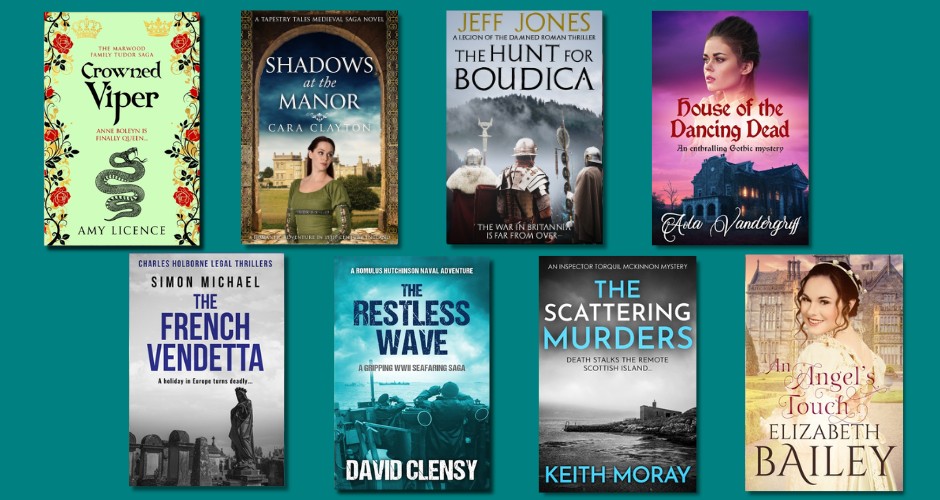
The Crowned Viper by Amy Licence is the sixth book in the Marwood Family Tudor Saga Series, set at Henry VIII’s court. When her uncle dies, newly-married Thomasin travels to London to settle his estate, and once more finds herself at the centre of court intrigue.
Shadows at the Manor by Cara Clayton is the third book in the Tapestry Tales Medieval Sagas. After a spate of robberies occur on the roads around the manor, seventeen-year-old Grace Amundeville d’Albert is determined to work out who is behind them. But could the culprit be close to home?
The Hunt for Boudica by Jeff Jones is the fourth instalment in the Legion of The Damned Roman Thrillers. Centurion Marcus Corvo and his Legion of The Damned are given a choice: face execution or accept another suicide mission — hunt down and capture Queen Boudica.
House of the Dancing Dead by Aola Vandergriff is an atmospheric Gothic mystery set in New Mexico. Abandoned by her partner and grieving the death of her mother, Christie Lynne agrees when her boss offers a year’s paid vacation in the mountains. But regrets are swift to follow when she arrives at the remote Harper abode, whose strange inhabitants sleep all day and dance all night. And when a horrifying discovery is made, everything around her is thrown into question.
The French Vendetta by Simon Michael is the eleventh novel in the Charles Holborne Legal Thrillers. When a rare gap opens in barrister Charles Holborne’s court diary, he and Sally seize the chance for their long-postponed honeymoon. But deep in the heart of rural Gascony Charles discovers a community still fighting the Second World War, where old crimes refuse to stay buried.
The Restless Wave by David Clancy is the fourth book in the Romulus Hutchinson Naval Adventures, set during the Second World War. While Romulus sees action in the Mediterranean for the Allied landings at Sicily and Salerno, as well as helping to lift the siege of Malta as part of Operation Pedestal, his twin brother Remus is once again unlucky enough to experience the wrong end of a torpedo strike.
The Scattering Murders by Keith Moray is the eighth crime thriller in the Inspector Torquil McKinnon Mystery Series, set on a remote Scottish island. When a well-liked farmer is found dead, Detective Inspector McKinnon soon finds himself with more than one mystery to solve.
An Angel’s Touch by Elizabeth Bailey is a touching Georgian romance featuring a spirited and passionate heroine. Can a young woman’s love bring a grieving recluse back into the world?
May’s Audio Releases

Lose yourself in a great audiobook this month!
Professor, friend, Soviet spy; who was the real Hugh Hambleton? Find out in Hugh Hambleton, Spy by Leo Heaps.
Two brothers are keen to start their naval careers. But could it all be over before they’ve barely begun? Find out in For Those in Peril by David Clensy.
Don’t miss this unique account of the Battle of the Atlantic from the perspective of a British destroyer captain in U-Boat Killer by Donald Macintyre.
Discover the unforgettable history of French intelligence agents and courageous British pilots who risked everything in the fight against Hitler in A House for Spies: SIS Operations into Occupied France from a Sussex Farmhouse by Edward Wake-Walker.
May’s Non-Fiction Releases

Hurricanes over Murmansk by John Golley tells the remarkable story of the RAF’s daring defence of the Soviet Union against the brutal Nazi onslaught of 1941. Drawing on first-hand accounts from RAF pilots as well as senior Soviet officials, Golley has crafted a thoroughly researched, vividly told account of bravery, sacrifice, and wartime ingenuity.
The Battle for European Skies by Chaz Bowyer is a comprehensive account of the savage aerial war fought over Europe during the Second World War. This book stands as a poignant tribute to the bravery and dedication of the men on both sides who took to the skies time and again, uncertain of their fate, in the service of their country.
To Drive the Enemy from Southern Soil by Michael W. Taylor draws upon the personal correspondence of Confederate Colonel Francis Marion Parker to recount the history of the brave men of the 30th Regiment North Carolina Troops, from its inception in September 1861 to its final surrender at Appomattox in 1865. The result is a deeply personal record of the daily life and cares of a Civil War soldier.
The Field of the Star is a searingly honest account of author Nicholas Luard’s pilgrimage along the Camino de Compostela, undertaken after the devastating illness and death of his eldest daughter.
Happy Reading! Team Sapere
Vibrant Voices. Sensational Stories. Beautiful Books.

We are thrilled to announce that we have signed three new instalments in the Tom Walsingham Mystery Series by C. P. Giuliani.
The series follows the espionage adventures of Tom Walsingham during the Elizabethan era in Tudor England.
In C. P. Giuliani’s words:
“I’m thrilled to be working with Sapere Books on three more instalments in my Tom Walsingham mystery series. As I researched the previous books, I kept coming across material and inspiration for more stories, so I proposed them to Amy Durant, and she accepted at once. This is one of the reasons why working with Sapere is so rewarding: the enthusiasm of a very skilled and friendly team.
“Following the death of Tom Walsingham’s influential kinsman and mentor, spymaster Sir Francis Walsingham, Tom thinks his career in intelligence is finished — but he will soon discover that one is never quite done with a life in espionage! As he becomes reluctantly entangled in the troubles of wayward poet Kit Marley and Queen Elizabeth’s physician Dr Roderigo Lopes, Tom will encounter new foes, new allies, visit new places, and grapple with new cases of murder and intrigue — and he will have to do it all without Sir Francis’s powerful network at his back.
“I can’t wait to plunge into Tom’s new adventures — actually, I’m already at work on Book Ten — and all because the lovely team at Sapere still make the journey as enjoyable and stimulating as they did with Book One.”
Death at Home is available from Amazon now.
Visit C. P. Giuliani’s website for all her latest news or follow her on X.
From action-packed naval thrillers and gripping stories of military heroism to captivating travel memoirs, there’s something exciting here for everyone. Scroll down to discover this month’s titles from your favourite Sapere authors.
April’s Fiction Releases
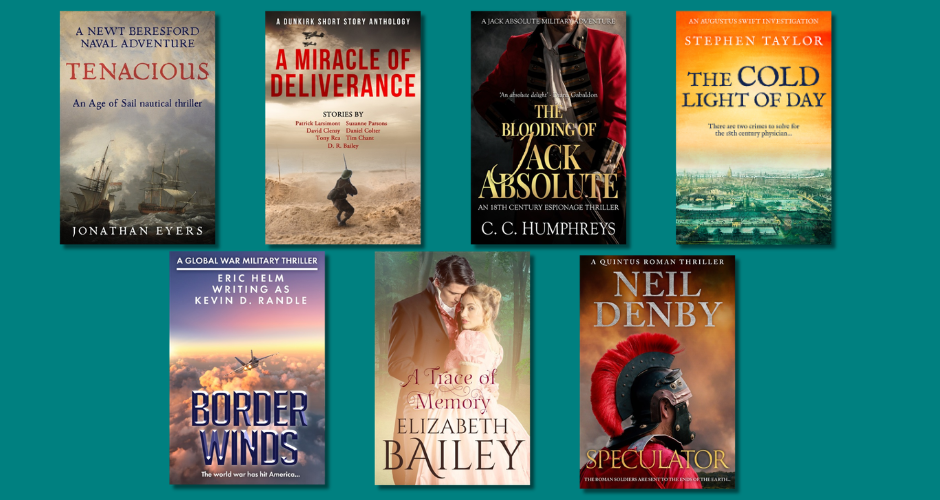
Tenacious by Jonathan Eyers is the first book in the Newt Beresford Naval Adventures series: Age of Sail historical adventures set in the 18th century. When Newt Beresford joins the frigate HMS Tenacious, he soon finds himself increasingly isolated on a ship full of whispered secrets, coded names, mysterious symbols and threatening messages.
A Miracle of Deliverance: A Dunkirk Short Story Anthology is a collection of linked short stories that commemorate the evacuation of Dunkirk in 1940. From a British soldier reflecting on the chaos of war, to a naval lieutenant doing his best to save the army from complete disaster, each of these stories reveals the heroic actions and deeply moving stories of the men and women who took part in this remarkable evacuation.
The Blooding of Jack Absolute by C. C. Humphreys is the first book in the Jack Absolute Military Adventure series: page-turning historical thrillers set in the 18th century. Can young Jack endure bloody battles in a wild landscape?
The Cold Light of Day by Stephen Taylor is the second book in the Augustus Swift Investigations series: chilling historical mysteries set in 18th-century London. Can Augustus Swift track down the ‘Beast of London’ before there are any more deaths?
Border Winds by Eric Helm is the second book in the Global War Military Thriller series. The world war has reached America’s backyard in this alternative-history military adventure set in the 20th century.
A Trace of Memory by Elizabeth Bailey is a quirky historical romance set in Georgian England with an intriguing twist. How can Elaine trust her heart if she can’t remember who she is?
Speculator by Neil Denby is the sixth book in the Quintus Roman Thrillers series. Centurion Julius Quintus Quirinius and his comrades are pushed to their limits in this action-packed military adventure set in Ancient Rome.
April’s Fiction Backlist Releases
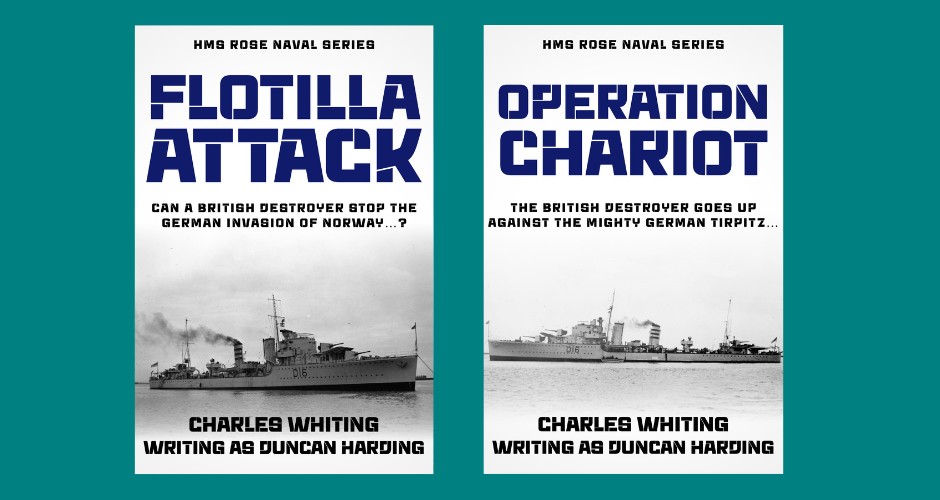
We are pleased to announce that Flotilla Attack and Operation Chariot by Charles Whiting writing as Duncan Harding are now available from Amazon. Don’t miss these page-turning historical naval adventures set during the Second World War.
April’s Audio Releases

Lose yourself in a great audiobook this month!
Can an enterprising thief unmask a murderer? Find out in Murder at Greenwich Palace by Adele Jordan.
Discover a thrilling police procedural with an unexpected twist in Lying and Dying by Graham Brack.
The war is intensifying for the Secret Sirens in The Night Angels by D. R. Bailey.
A young centurion is sent on a suicide mission in Fortress of Steel by Jeff Jones.
April’s Non-Fiction Releases
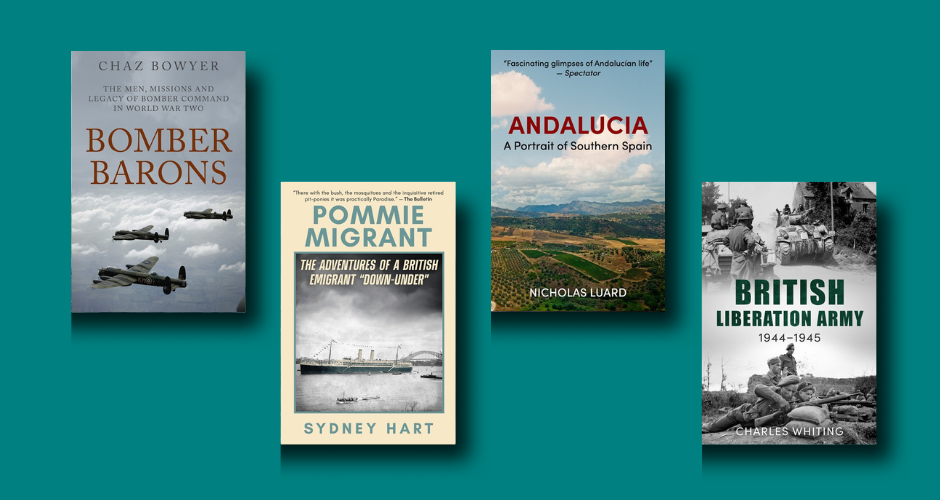
Bomber Barons by Chaz Bowyer is a powerful and compelling history of Bomber Command and the extraordinary men who risked everything in the skies over Nazi Germany.
Pommie Migrant by Sydney Hart is a vivid and entertaining memoir of a “Ten Pound Pom” who left post-war Britain to begin a new life in Australia, capturing both the highs and lows of the migrant experience.
Andalucia by Nicholas Luard offers a vivid portrait of the region’s landscapes, traditions, and tumultuous past — a must-read for everyone who loves travel, history, and Spain.
British Liberation Army: 1944–1945 by Charles Whiting is a gripping account of the British Infantry’s final push to liberate Europe from Nazi control in the last year of the Second World War, 1944–1945.
Happy Reading! Team Sapere
Vibrant Voices. Sensational Stories. Beautiful Books.

To mark the publication of the first book in the WWII Aviatrix Adventures, author Suzanne Parsons takes a closer look at the inspirations behind the series.
Entering Sapere Books’ first writing competition back in 2021, I was thrilled to be awarded a contract for a three-book series. Strong female characters, wartime espionage and aviation — what a brief! The WWII Aviatrix Adventure series is the result. Before long I was immersed in everything to do with the Second World War, especially those members of the Special Operations Executive (SOE) who in Churchill’s words ‘set Europe ablaze’. There were so many inspirational stories, like that of the beautiful Violette Szabo, who worked as a courier for the SOE and was posthumously awarded the George Cross for bravery, and wireless operator — or ‘pianist’ — Noor Inayat Khan, an Indian princess. There were other stories deemed unnewsworthy, so I was determined my female protagonist would be part of that group: unremarkable, unobtrusive, someone who might even make the odd mistake.
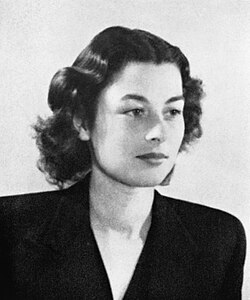
Enter Miriam Nugent, who enjoys hill-walking, dancing and reading. Her journey to France is convoluted, beginning at that place of codes and Enigma machines, Bletchley Park, before the draw of the SOE proves irresistible. Miriam is young, naïve, and away from home for the first time. But she is a fast learner. The training is tough, the assault course at Arisaig House in the West Highlands worthy of the SAS. The gadgets are also extraordinary, making those in any Bond film appear dull, but the message is clear: war turns the ordinary into the extraordinary. Years ago, I met a work colleague’s mother. There was always something behind her warm smile and friendly manner. What was it? Then I was told she had been an SOE spy.
The spectre of World War One loomed large for those in this war, and having read The General by C. S. Forester, the image of a man who sips tea and discusses fine wine in a French château as his men go ‘over the top’, was strong. What would any man think of that, twenty years on?
Enter Archie Bowater, who is ashamed of his father. He is also desperate to join the RAF and goes to extraordinary lengths to do so. He drifts from plane to plane, flying Spitfires, Hurricanes, Bristol Beaufighters and the wooden De Havilland Mosquito in his quest to be the hero his father never was.

The Moon Squadrons that supported the SOE were another inspiration, the iconic painting They Landed by Moonlight by Robert Taylor — capturing a night landing in an isolated field — hard to forget. Flying deep into France under a full moon, transporting agents and rescuing downed airmen, was dangerous. But what if a woman flew those missions? In wartime, women attracted less suspicion than men, their role to nurture uppermost in most minds. Surely an experienced aviatrix could pull off flying a bulky Lysander Mark II? In Britain, women only ever flew as part of the Air Transport Auxiliary (ATA), but then, isn’t fiction all about the what ifs?
In book two, Red Sky at Night, the ATA takes a prominent role, we see a new aviatrix in action, and a spy is sent to Russia, where she encounters the ‘Night Witches’.
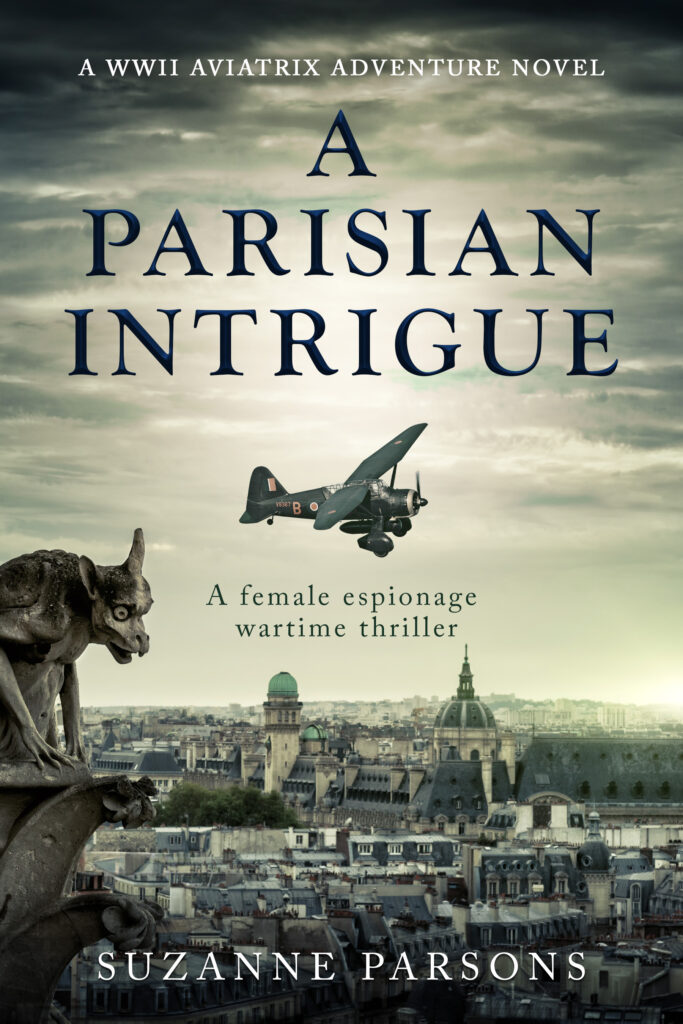
A Parisian Intrigue is available from Amazon now.
You can follow Suzanne on Facebook and X.
All images are from Wikimedia Commons (public domain).
We are thrilled to announce that we have signed the next three books in the Anne Boleyn Chronicles by Rozsa Gaston.
Set during Anne Boleyn’s formative years, the series follows Anne through the Habsburg Netherlands to France, then back to England before rising to become one of England’s most legendary queens.
In Rozsa’s words:
“The adventure of chronicling Anne Boleyn’s teenage years in Europe has catapulted me far beyond my original plan for a three-book series. Anne’s story deepened as I researched the historically significant figures who shaped her, both psychologically and politically, including Margaret of Austria, the future Charles V, Erasmus, Francis I of France, Mary Tudor, Louise of Savoy, Diane de Poitiers, Clément Marot, and Leonardo da Vinci.
“The next three books in the Anne Boleyn Chronicles see Anne at the 1520 Field of the Cloth of Gold, where her unique advantage as an Englishwoman with French sensibilities allow her to stand out. Her final year in France, however, is fraught with rumblings of religious reformation spurred by Martin Luther, and the coming war with England.
“In 1521 Anne is summoned home to England, where she shines after eight years spent at two of the most powerful courts in Europe. Her father is determined to see Anne marry well. But Anne’s sights are set even higher than her father’s. In book six we shall see how high she soars following her extraordinary years abroad.”
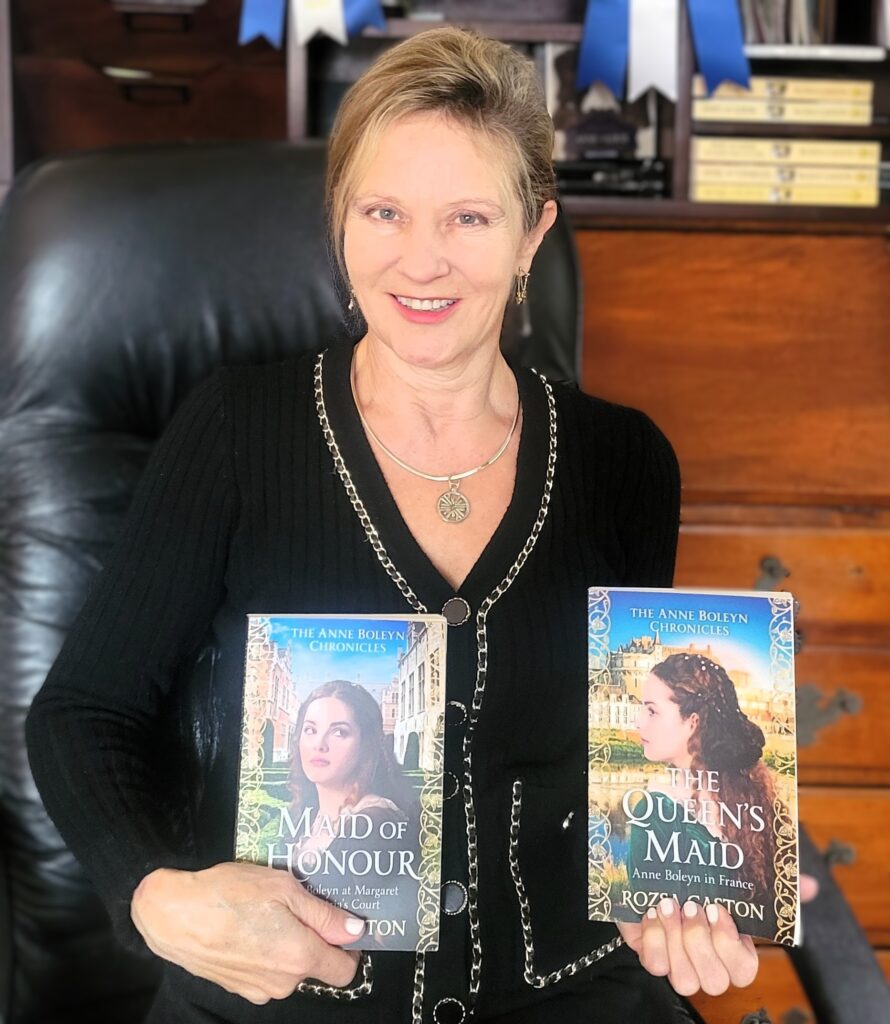
Queen of Diamonds is available to pre-order now.
Following the success of his Romulus Hutchinson Naval Adventure Series, we are delighted to have signed a new naval military series by David Clensy.
In David’s words:
“U-Boat Aces will be a sweeping, seafaring saga that charts the rise and fall of Germany’s submarine elite across two world wars.
“Spanning three decades, from 1914 to 1945, the five-book series will follow a handful of officers from idealistic cadets to disillusioned veterans, set against the relentless evolution of undersea warfare. Readers will travel the world alongside some of history’s most ruthless U-boat commanders, in a series that will be charged with the claustrophobic conditions of life aboard the German U-boat fleet.
“I am delighted to be working with Sapere Books once again on a second series of action-packed, authentic historical adventures. The team at Sapere brilliantly understand the passions of their audience, making them an absolute delight to work with.”
The Romulus Hutchinson Naval Adventures follow twin brothers fighting with the Royal Navy and the Merchant Navy during the Second World War. The third instalment in the series, The Mighty Ocean, is available to pre-order now.
Sign up to David’s newsletter and stay up to date with his news and latest releases here.
Featured image credit: German U-boat UB 14 with its crew from Wikimedia Commons (public domain).
From medieval adventures and Gothic mysteries to gripping accounts of military heroism — there’s something exciting here for everyone. Scroll down to discover this month’s titles from your favourite Sapere authors.
December’s Fiction Releases
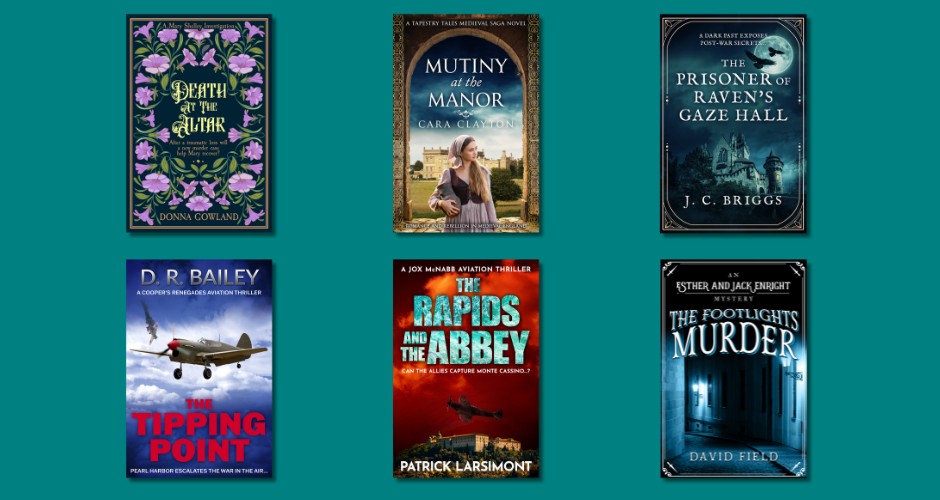
Death at the Altar by Donna Gowland is the third book in the Mary Shelley Investigations. In this instalment, Mary puts her grief aside as she and Percy investigate the murder of a curate at a friend’s wedding.
The Tipping Point by D. R. Bailey is the first book in the Cooper’s Renegades Aviation Thrillers, action-packed aviation adventures set during the Second World War and featuring a team of fighter pilots. When war is declared on Japan by the U.S., American pilot Cooper Donahue soon finds himself in the thick of the action.
Mutiny at the Manor by Cara Clayton is a thrilling tale of romance and rebellion in medieval England. Will this troubled period in history bring ruin to all Elizabeth Amundeville holds dear?
The Rapids and the Abbey by Patrick Larsimont is the sixth book in the Jox McNabb Aviation Thrillers. In this instalment, fighter pilot Jox McNabb takes to the war-torn skies of Italy and the capture of Monte Cassino.
The Prisoner of Raven’s Gaze Hall by J. C. Briggs is a gripping Gothic novel set in Yorkshire. When Catherine Sisley arrives at Raven’s Gaze Hall to nurse an elderly lady, she soon realises that the house — and its occupants — are not all they seem.
The Footlights Murder by David Field is the twelfth crime thriller in the Esther and Jack Enright Mysteries. In this instalment, Jack and Esther take up amateur dramatics in an attempt to track down a murderer and clear Jack’s sister’s name.
December’s Fiction Backlist Releases
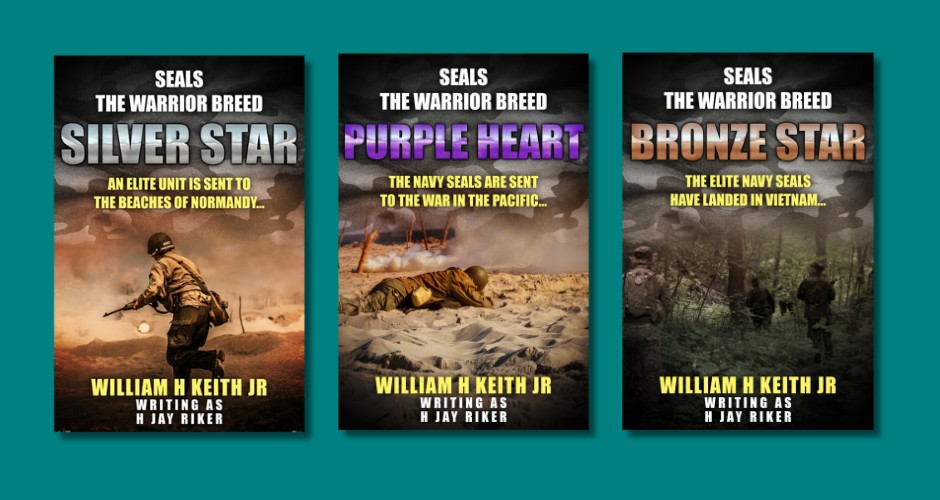
We are delighted to announce that the first three instalments in William H. Keith Jr’s adrenalin-fuelled SEALS: The Warrior Breed series are out now! Don’t miss these action-packed military adventures following the U.S. Navy’s elite commando demolition unit.
December’s Non-Fiction Releases

A Captain’s War by Herbert M. Schiller is the remarkable first-hand account of life as a young Confederate officer during the brutal years of the American Civil War.
Disaster at Kasserine by Charles Whiting is a dramatic account of the Allied disaster at Kasserine Pass, where inexperienced American troops clashed with Rommel’s battle-hardened Afrika Korps in North Africa.
Admiral Rodney by Donald Macintyre is a fascinating biography chronicling the life of one of England’s greatest sea commanders, famed for his decisive victory over the French at the Battle of the Saintes during the American War of Independence.
Men of Bomber Command by Chaz Bowyer tells the epic, untold story of the Allied bomber crews who helped turn the tide of World War Two.
Fighting for Defeat by Michael C. C. Adams provides a new perspective on the American Civil War and the reasons behind the Union Army’s early defeats, despite its superiority in manpower, wealth, and industry.
Happy New Year and Happy Reading! Team Sapere
We are delighted to announce that we have signed two new books in Angela Ranson’s Catrin Surovell Tudor Mystery series: exciting historical thrillers set at the court of Elizabeth I.
Here, Angela tells us more about the series and what to expect from the latest instalments:
“I started working with Sapere Books in March 2022, when I was named as a runner-up in their first writing competition. From the very first, the people at Sapere have brought light and positivity to my writing life. They have offered real help and support, and their editing process has improved my writing enormously. Sapere has helped me understand and appreciate the many stages of writing a book.
“Or, as it has turned out, a series of books. We started out with three Catrin Surovell Tudor mysteries, and then it grew to five, and just last month it grew to seven. I was so excited to receive the latest contracts and know that I could continue to explore the character of Lady Catrin, Countess of Ashbourne and favoured lady of the bedchamber for Queen Elizabeth I. Lady Catrin is a clever and courageous woman in a dangerous world — much as Elizabeth’s real ladies of the bedchamber would have been. It was not all music, gossip, fine clothes and embroidery for these women, despite the way they are portrayed in modern movies. In real life, they had difficult battles to fight.
“Thus far, Lady Catrin has remained close to her queen at court. She has battled many villains who have tried to remove Elizabeth from her throne, or destroy the reforms the queen has put in place. She has fought against religious zealots, royal traitors and court conspirators, all with the help of her close friend Lady Lucy and a collection of people as dedicated to the queen’s service as she is. In the fourth book, Grave Merriment (which will be released in March 2026), Lady Catrin will battle two villains, each with a specific goal but one area of common ground: the desire to destroy all the queen holds dear, at the most festive time of the year.
“It is important to me that Lady Catrin’s adventures could have happened and that Lady Catrin herself could have investigated and unmasked the villains. I try very hard not to change history or give Lady Catrin more power than she would have had. I do, however, often answer historical questions that have never been answered, or create fictional scenarios that take place in parallel with a known event. That is why the fifth book in the series will focus on an event that never took place: a meeting between Elizabeth I and Mary, Queen of Scots. This meeting has been included in many fictional accounts of these two queens. Usually, the wise queen of England grows frustrated with how the reckless and impulsive Queen of Scots always ‘feeds her with fair words’ that mean nothing.
“Instead of following this trend, the fifth Catrin Surovell mystery will follow history more closely, and focus instead on why that meeting didn’t happen. Lady Catrin will be the one who learns the secret that keeps these ‘fair cousins’ apart … just in time to save their lives.”
Grave Merriment is available to pre-order now.
Visit Angela’s website to stay up to date with her news and latest releases.
From Tudor adventures and World War Two thrillers to fascinating accounts of historical battles — there’s something exciting here for everyone. Scroll down to discover this month’s titles from your favourite Sapere authors.
November’s Fiction Releases
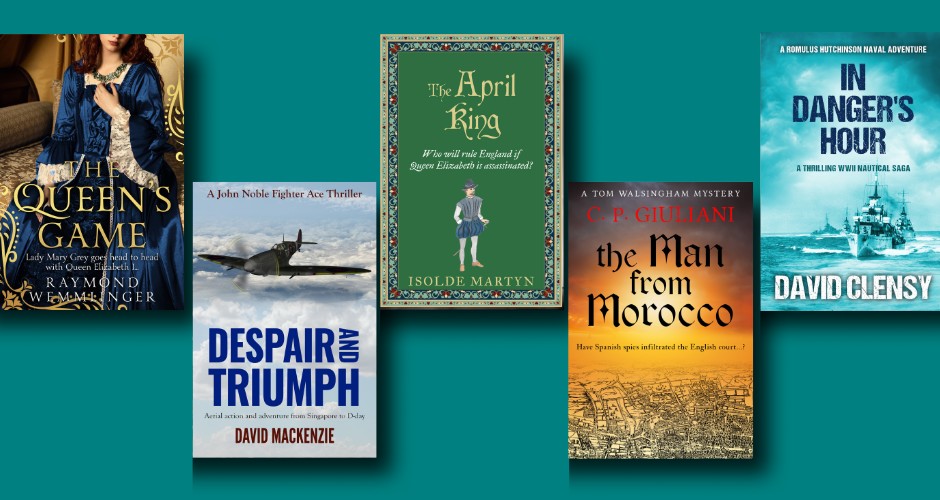
The Queen’s Game by Raymond Wemmlinger is a thrilling novel of succession set at the Tudor Court. Will Lady Mary Grey see her family name rise to victory, or tumble into obscurity…?
Despair and Triumph by David Mackenzie is the third book in the John Noble Fighter Ace Thrillers series. In this instalment, John finds himself sent on a mission halfway around the world.
The April King by Isolde Martyn is a compelling and romantic biographical historical mystery novel set in Tudor Elizabethan England.
The Man from Morocco by C. P. Giuliani is the seventh book in The Tom Walsingham Mysteries series: page-turning espionage adventures set during the Elizabethan era.
In Danger’s Hour by David Clensy is the second book in the Romulus Hutchinson Naval Adventure series: authentic historical adventures following twin brothers fighting with the Royal Navy and the Merchant Navy during the Second World War. With Operation Dynamo around the corner, will the Hutchinson brothers both make it out alive…?
November’s Fiction Backlist Releases
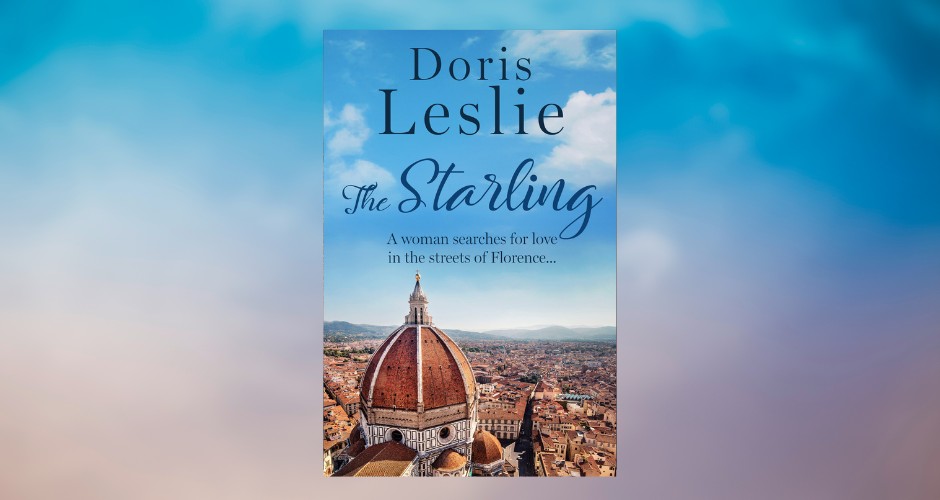
The Starling by Doris Leslie is a compelling historical novel of passion, new beginnings and the nature of true love, set in London and Florence, Italy.
November’s Non-Fiction Releases

Patton’s Last Battle by Charles Whiting tells the dramatic story of American General George Patton’s final months of command in World War Two.
Jutland by Donald Macintyre uncovers the dramatic, in-depth story of the Battle of Jutland, the most significant naval clash of World War One.
Soldiers of Fortune John Bagot Glubb explores the captivating history of the Mamluk Empire, one of the Middle East’s most powerful forces from 1250 to 1517.
Men of the Desert Air Force by Chaz Bowyer is a gripping, real-life account of the brave pilots who flew over the deserts of North Africa and the Mediterranean during World War Two.
Happy reading! Team Sapere
With the forthcoming publication of In Danger’s Hour, the second book in his Romulus Hutchinson Naval Adventure Series, author David Clensy takes a closer look at the events surrounding Operation Excess during the Second World War.
In January 1941, the Mediterranean was a tense theatre of war. The British Royal Navy, stretched thin and under constant threat from Axis forces, launched a bold and complex operation known as Operation Excess. It was a high-stakes convoy mission designed to deliver vital supplies to Malta, Greece and Alexandria, while simultaneously striking a blow against enemy naval and air power in the region.
The convoy itself was a patchwork of merchant vessels and warships, departing from Gibraltar and heading eastward through waters teeming with danger. Malta, then under siege and of immense strategic importance, was a key destination. Supplies were desperately needed to sustain its defences and civilian population. The convoy was escorted by a formidable force of Royal Navy ships, including aircraft carriers, cruisers and destroyers, all tasked with protecting the vulnerable merchantmen from attack.
Operation Excess was a particularly challenging task for the Allied forces. Italian and German aircraft launched repeated assaults, particularly as the ships neared Sicily. The Royal Navy’s carrier-based aircraft, including Fairey Fulmars and Swordfish, fought valiantly to repel the attacks, often flying in difficult conditions and against superior numbers.
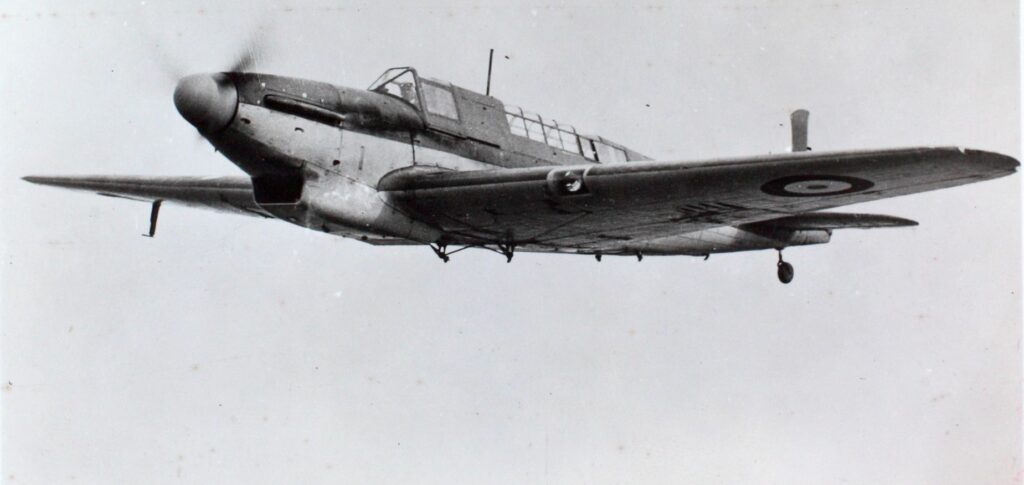
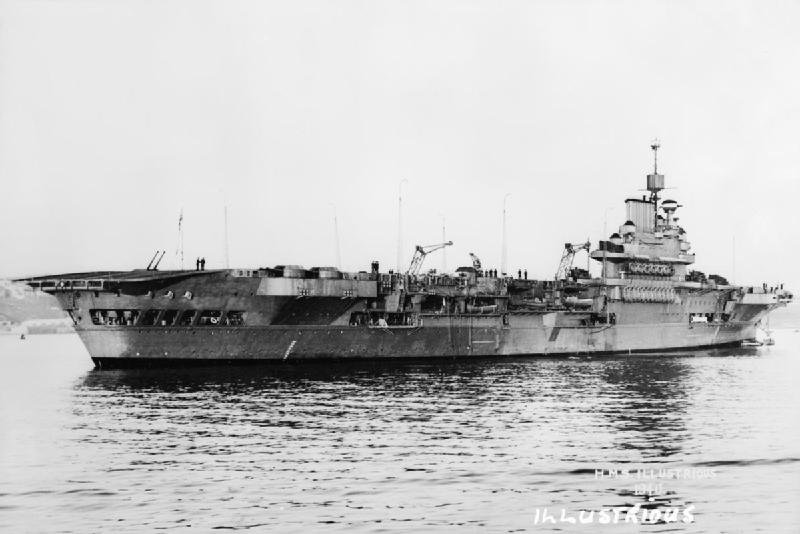
One of the most dramatic episodes of the operation occurred on the 10th of January, when HMS Illustrious, a key British aircraft carrier, came under ferocious air attack near Malta. The damage was severe, and casualties were high. Yet the carrier remained afloat and was eventually able to limp into Grand Harbour, where she became a symbol of resilience for the Maltese people.
Meanwhile, other elements of the operation were unfolding. British forces used the opportunity to launch diversionary attacks against Italian positions in the Dodecanese and to reinforce troops in Greece.
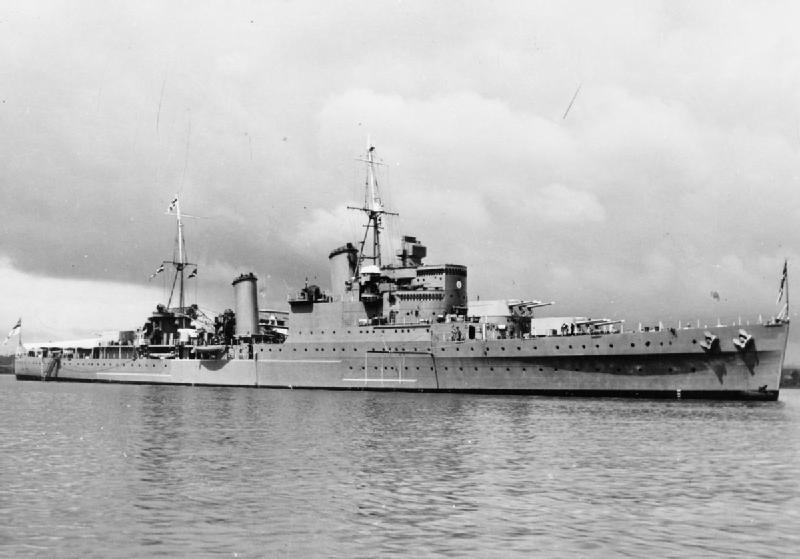
As part of Force B, HMS Southampton’s role was to transport troops from the Aegean to Malta before joining the main convoy. On the 11th of January, while operating south of Sicily, HMS Southampton came under sustained attack from German dive bombers of the Luftwaffe’s X Fliegerkorps. The Stukas struck with deadly precision, scoring multiple hits that ignited fires and caused catastrophic damage. With the cruiser listing and engulfed in flames, the order was given to abandon ship. HMS Southampton was eventually scuttled by torpedoes from HMS Gloucester to prevent her from falling into enemy hands.
Though the operation came at a cost, it was ultimately deemed a success. Supplies reached their destinations, and the Royal Navy showed it could still operate effectively in contested waters. Operation Excess was more than a supply run. It was a statement of intent, a show of defiance against Axis control of the Mediterranean.
November 2025 sees the release of In Danger’s Hour, the second book in the Romulus Hutchinson Naval Adventure Series. Following their earlier adventures in For Those In Peril, we follow twin brothers Romulus and Remus throughout 1941, from the Mediterranean to the coast of West Africa. It covers a series of key strategic operations, including Operation Demon — the British-led evacuation of Allied forces from mainland Greece in April 1941. At the opening, readers will join our central character, Rom, as he faces an enemy attack while serving on HMS Southampton at the height of Operation Excess.
In Danger’s Hour will be published on the 28th November 2025.
Stay up to date with David’s news and latest releases here.
From Medieval Europe and Georgian England to naval warfare and military autobiographies — there’s something exciting here for everyone. Scroll down to discover this month’s titles from your favourite Sapere authors.
October’s Fiction Releases
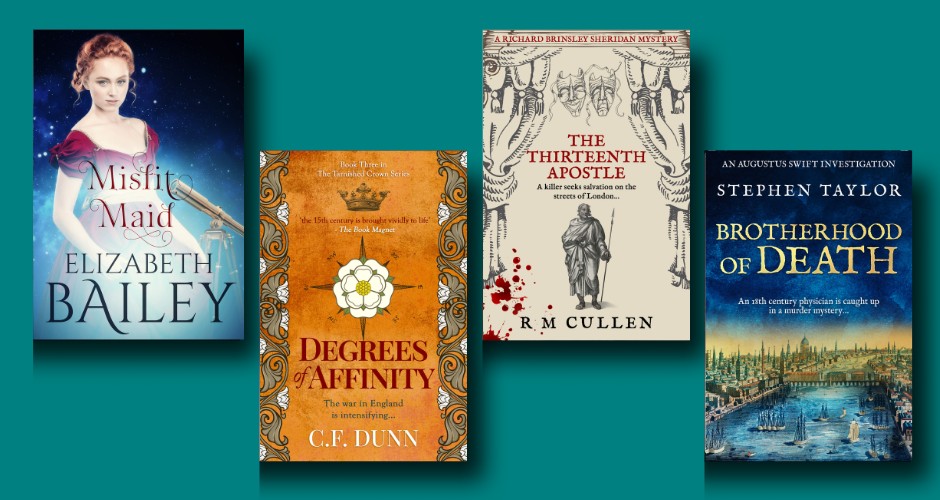
The Misfit Maid by Elizabeth Bailey is a lively, humorous historical romance set in Georgian England with an engaging and unconventional heroine.
Degrees of Affinity by C. F. Dunn is the third book in The Tarnished Crown series: historical fiction set during the Wars of the Roses. Isobel Fenton has overcome her enemies and regained her manor of Beaumancote. Now she looks forward to a future with the man she loves. But when she is unwittingly drawn into the political intrigue at Court, Isobel’s life is once more thrown into turmoil.
The Thirteenth Apostle by R. M. Cullen is the third historical murder investigation in the Richard Brinsley Sheridan Mystery Series: eighteenth-century crime thrillers set in London at a time of Revolution. Can Sheridan unmask a ruthless killer stalking the streets of London?
Brotherhood of Death by Stephen Taylor is the first historical murder investigation in the Augustus Swift Investigations Series, a new detective series set in Georgian England. When a series of cabinet members are poisoned, physician Augustus Swift must employ science and logic to prevent more deaths.
October’s Fiction Backlist Release

We are delighted to announce that the first book in the Robert Porter Alternative History Thrillers is out now! Ultimatum by Richard Rohmer is a heart-pounding political thriller that hits close to home. The fate of millions hangs in the balance when a crisis right out of today’s headlines sets the President of the USA on a course from which there can be no retreat.
October’s Non-Fiction Releases
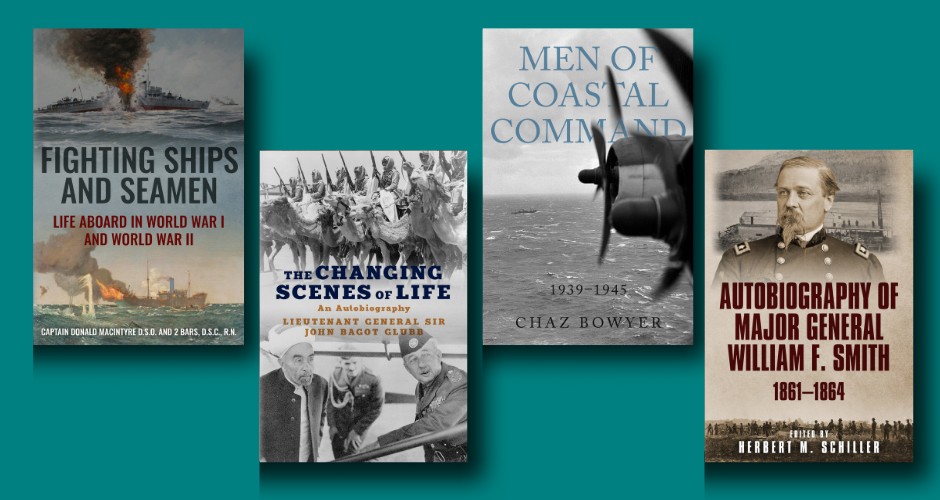
Fighting Ships and Seamen: Life Aboard in World War I and World War II by Donald Macintyre charts the experiences of sailors and their ships during naval engagements and is an essential account of naval warfare across the two world wars.
The Changing Scenes of Life: An Autobiography is a gripping account of the life and legacy of Sir John Bagot Glubb — soldier, scholar, and legendary commander of the Arab Legion.
Men of Coastal Command: 1939-1945 by Chaz Bowyer is an eye-opening account of a much-overlooked branch of the Royal Air Force, who protected Britain’s seas from the air during the Second World War.
Autobiography of Major General William F. Smith: 1861-1864 by Herbert M. Schiller is a candid autobiography of one of the Union’s most controversial generals — praised as a saviour, condemned as a scapegoat.
Happy reading! Team Sapere
Following the success of his standalone historical novels, Stephen Taylor is now writing the Augustus Swift Investigations: a new detective series set in Georgian England.
The first instalment — Brotherhood of Death — will be released at the end of October, and we are thrilled to have signed the third book in the series.
In Stephen’s words:
“My new series is set in the 1790s, thirty years before the first Metropolitan Police force and fifty years before the first Criminal Investigation Department was founded. The detective I have created is Augustus Swift: a physician and apothecary who has studied modern medicine and logic at Edinburgh University. But he has also travelled to Egypt to study Islamic philosophy and doctoring. He is a humanist who looks to science to explain the world rather than religious beliefs.
“It is the age of the Enlightenment, yet political control is still firmly in the hands of the aristocratic landowners, as it has been for centuries. Dr Swift, however, is a man of the Enlightenment.
“Yet fate raises a capricious eyebrow in his direction when he is recruited by the Home Department to advise on poisons. His life is dedicated to upholding the physician’s ethical principles, but now, by working for the government, his actions perpetuate the injustices of those in power.”
Keep up with Stephen’s latest news via his website.
Following the success of his Quintus Roman Thrillers series, we are thrilled to announce that we have signed a new trilogy by Neil Denby.
In Neil’s words:
“The Leinster Chronicles are set in twelfth-century Ireland, a time and place little covered by contemporary historical novels, but one rich in story.
“Geographically, there are three major groups involved in the timeline — the native Irish, the invading Vikings and the Normans across the water.
“The Irish were bound by ancient law. Brehon law was a detailed system with compensation for criminal acts called éraic at its heart. It was not Roman law, but a system better suited to its times. Included was the rule that kings did not inherit their titles. The chieftain was elected — from an eligible pool of royal blood — by his family or clan.
“They were also Christian. St Patrick is credited with bringing Christianity to Ireland in the fifth century, but there was tension between Christian law and Brehon law. The Church in Rome saw the Irish Church as rebellious and depraved, in dire need of reform. The Roman Church was happy to grant overlordship of Ireland to the ‘good’ Christian Norman lords of England and France.
“The Vikings had been raiding and trading for hundreds of years. There were many holy houses for them to plunder, carrying precious relics, silver and slaves back to their homelands. Eventually they settled. There were established Viking trading ports, the chief amongst them being Dublin, probably the biggest slave-trading port in the northern hemisphere. Further south sat Wexford, Waterford and Cork. Other centres were at Wicklow and Arklow (which yielded silver). On the Shannon river, navigable to longships, sat Limerick.
“At this time Ireland had over a hundred kings, many little more than local chieftains. The senior kings ruled the seven kingdoms of Leinster, Munster, Connaught, Meath, Ailech, Airghilia and Ulaid. (The last three later became known as Ulster.)
“From these was drawn the ‘Ard Rí’, the High King of Ireland, traditionally — for at least five hundred years — one of the northern branch of the Uí Neill, whose high seat was in Tara. Though the title sounds impressive, in actuality it bestowed little unless the holder could keep it, usually by invading enemy territory and demanding hostages.
“Many battles were fought between greater kings and lesser kings. The tradition was to let a battle decide an argument; the losing side would then give up hostages against their good behaviour. The warriors would head home.
“These books will tell the tale of one of these kings — one who was castigated and damned in terrible terms by the Victorians for inviting the Normans into Ireland. But the story is more complex than that, the reasons more nuanced; perhaps the central character is not as evil as is made out.
“It is a tale I have wanted to tell for some time and I am grateful to Sapere Books for giving me the opportunity to share it.”
IN THE QUINTUS ROMAN THRILLERS SERIES:
BOOK ONE: Legionary
BOOK TWO: Decanus
BOOK THREE: Optio
BOOK FOUR: Centurion
BOOK FIVE: Scutarius
Welcome to Sapere Books’ September round-up of new releases!
From Ancient Rome and Victorian London to an American Civil War siege and air gunners of World War Two — there’s something exciting here for everyone. Scroll down to discover this month’s titles from your favourite Sapere authors.
September’s Fiction Releases

The Ladies’ Lounge by Graham Brack is the eighth international crime thriller in the Josef Slonský Investigations series: atmospheric police procedurals full of dark humour. In the latest instalment, Captain Slonský investigates the suspicious death of a cabaret club manager.
Targets of Opportunity by D. R. Bailey is the seventh book in the Spitfire Mavericks Thrillers: action-packed aviation adventures set during the Second World War and featuring a team of vigilante pilots. Flight Lieutenant Angus Mackennelly and his squadron have been given a new mission, but with a thief in their midst will mistrust interfere with operations in the skies…?
Forests of Death by Jeff Jones is the second book in the Legion of the Damned Roman Thrillers series: action-packed, authentic historical military adventures set in Ancient Rome. Can Centurion Marcus Corvo and his Legion of the Damned survive the harsh forests of Germania?
The Belvedere Scandal by David Field is the eleventh crime thriller in an exciting historical series, the Esther and Jack Enright Mysteries, a traditional British detective series set in Victorian London and packed full of suspense. When the heir apparent is suspected of murder, the Enrights must prevent a scandal and secure the throne.
September’s Fiction Backlist Releases
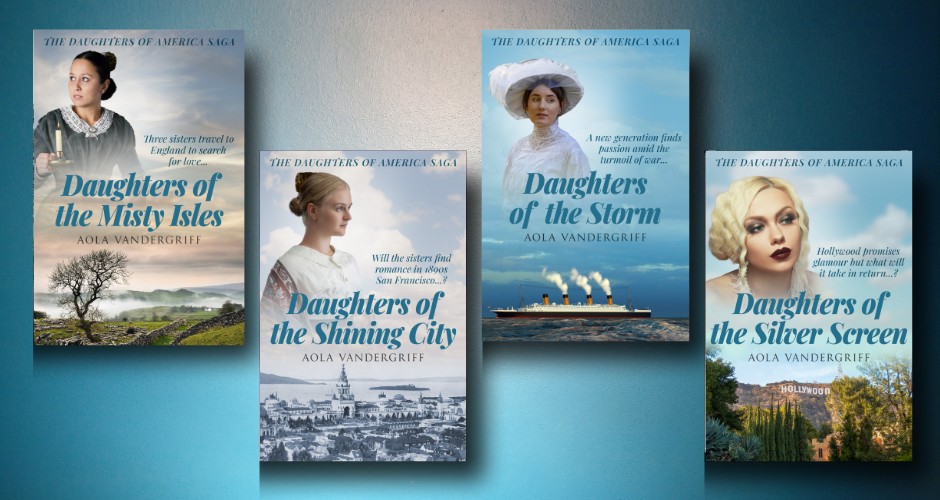
We are delighted to announce that four new instalments of Aola Vandergriff’s gripping Daughters of America saga are out now! The series follows the tumultuous story of three sisters in 1800s America.
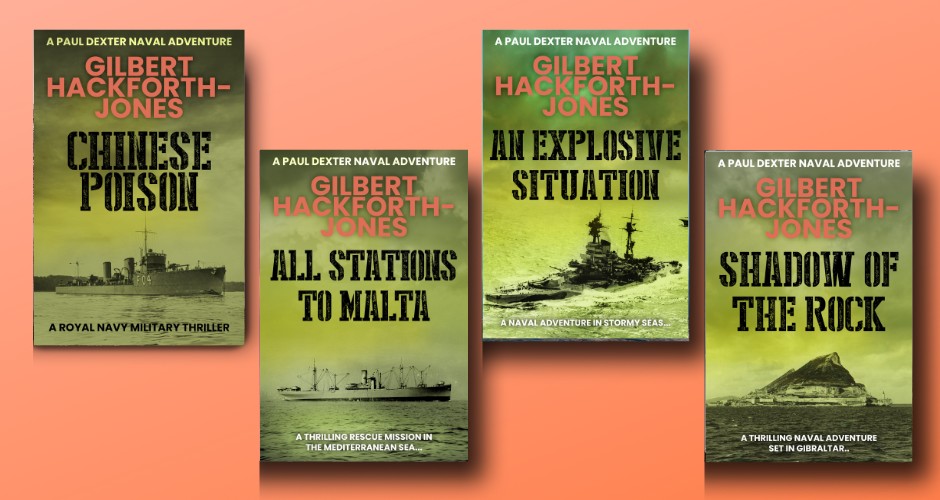
We are also thrilled to bring you the first four books in the Paul Dexter Naval Adventures by Gilbert Hackforth-Jones: action-packed historical naval adventures featuring young naval officer Paul Dexter.
September’s Non-Fiction Releases
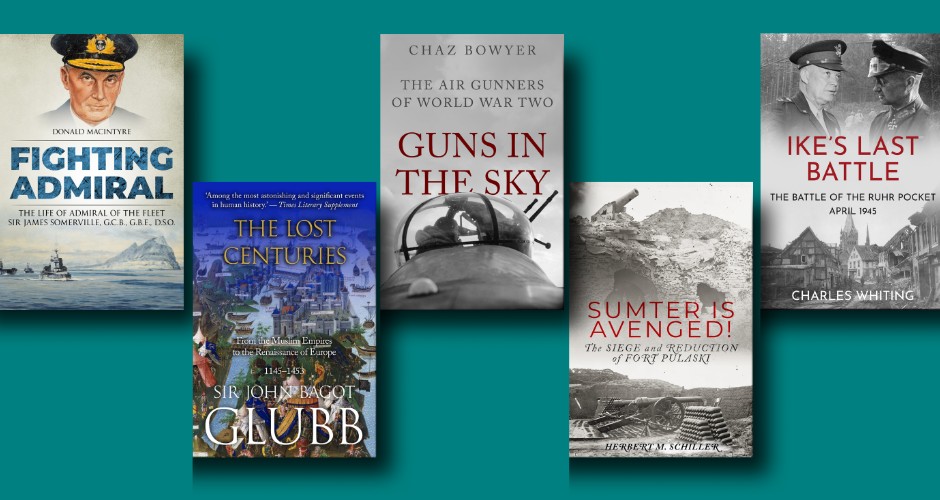
Fighting Admiral: The Life of Admiral of the Fleet Sir James Somerville by Donald Macintyre is a remarkable biography of an extraordinary man. It is essential reading for anyone interested in the naval history of the Second World War.
The Lost Centuries by John Bagot Glubb is an engaging and detailed history of the Islamic world from the twelfth to the fifteenth century, tracing events from the Crusades to the fall of Constantinople.
Guns In The Sky by Chaz Bowyer pays tribute to the air gunners of Word War Two, vividly recreating their harrowing experiences while offering an in-depth exploration of the origins, evolution, and tactics of air gunnery.
Sumter Is Avenged by Herbert M. Schiller tells the dramatic story of the siege of Fort Pulaski during the American Civil War and how it changed the shape of warfare forever.
Ike’s Last Battle by Charles Whiting is a fascinating history of the Battle of the Ruhr Pocket — a crucial engagement that destroyed the last major German force in Western Europe.
Happy reading! Team Sapere
Following the success of his many historical series, including the Bailiff Mountsorrel Tudor Mysteries and Esther and Jack Enright Mystery Series, we are delighted to announce that we have signed a new Wars of the Roses series by David Field.
In David’s words:
“For much of the late Medieval period, England was a permanent battlefield, as the rival descendants of the fertile Edward III claimed the right to the crown. Brother fought with brother, cousin sought to depose cousin, heirs to the throne were murdered, and the leading barons of the realm threw in their lot with one side or the other — frequently changing sides in the process.
“It’s a complex network of fast-moving events even for a historian, but for a novelist it’s a daunting challenge. However, it’s one I couldn’t resist, having already taken the story of England’s history forward from the Norman Conquest to the death of Simon de Montfort in my Conquest series for Sapere Books. I’d also picked up the story again in the Tudor series, beginning with the Battle of Bosworth and the accession of Henry VII. This new Wars of the Roses series will fill the gap between these two series.
“Join me as Edward I seeks to put down challenges from the Welsh and the Scots, Edward II squanders his birthright on favourites, and Edward III enjoys a lengthy reign that produces five sons and lights the fuse on the domestic strife to follow with his ill-advised ‘letters patent’ as to who was to succeed him, and in what order. When Richard II was deposed by Henry Bolingbroke in order to become Henry IV, his son, Henry V, brought the nation military triumph across the Channel, only to die tragically young, leaving an inadequate successor to rule as Henry VI. The spurned House of York saw its opportunity, and the ‘Kingmaker’ Earl of Warwick raised Edward IV to the ultimate position of power. But his wily and jealous younger brother Richard of Gloucester wove a treacherous web that left him as the spider in the centre, until the nation threw off his yoke and welcomed back Henry Tudor, the last Lancaster, as Henry VII.
“Behind the scenes, the ultimate fictitious descendants of the man who first rallied the Saxons against the invading Duke William of Normandy seek to survive with honour amid all the mayhem.
“The new series begins in early 2026, and I look forward to sharing it with you.”
Visit David’s website to stay up to date with his news and latest releases.
We are delighted to announce that we have signed the thirty-first book in the Vietnam: Ground Zero series: action-packed, authentic historical thrillers set during the Vietnam War.
When an enemy force attacks Camp A-398, Sergeant Major Anthony B. Fetterman joins a striker force to chase the enemy back into Cambodia. When the strikers run into the enemy rear guard, they are forced to give up their pursuit.
A reporter at Camp A-398 believes that the strikers, as well as Fetterman, had illegally crossed the border into Cambodia, creating an international incident. When the allegation reaches the highest levels of the United States Army, Fetterman is arrested and court-martialed for crossing the border. It makes no difference that Fetterman was not in command of the strikers, and that they said they were never in Cambodia.
The case has to be settled, not by getting at the truth but by reaching the approved solution. If an old soldier like Fetterman needs to be sacrificed, then that is a small price to pay.
In the Vietnam: Ground Zero series:
BOOK 1: Vietnam: Ground Zero
BOOK 2: P.O.W.
BOOK 3: Unconfirmed Kill
BOOK 4: The Fall of Camp A-555
BOOK 5: Soldier’s Medal
BOOK 6: The Kit Carson Scout
BOOK 7: The Hobo Woods
BOOK 8: Guidelines
BOOK 9: The Ville
BOOK 10: Incident at Plei Soi
BOOK 11: Tet
BOOK 12: The Iron Triangle
BOOK 13: Red Dust
BOOK 14: Hamlet
BOOK 15: Moon Cusser
BOOK 16: Dragon’s Jaw
BOOK 17: Cambodian Sanctuary
BOOK 18: Payback
BOOK 19: MACV
BOOK 20: Tan Son Nhut
BOOK 21: Puppet Soldiers
BOOK 22: Gunfighter
BOOK 23: Warrior
BOOK 24: Target
BOOK 25: Warlord
BOOK 26: Spike
BOOK 27: Recon
BOOK 28: Pioneer Post
BOOK 29: Proxy War
BOOK 30: Bromhead’s War
Congratulations to Natalie Kleinman, whose second-chance love story, After All These Years, is out out now!

When Guy Ffoulkes walks into Honeysuckle ‘Honey’ Bunting’s tea shop in the little town of Rills Ford, she’s transported back in a flash to her teenage years – and to the pain of first love.
As a young girl she worshipped Guy from afar – but to him, she knows, she was simply his best friend’s scruffy younger sister.
Over the years Honey has poured her energy into her business and caring for her elderly mother, telling herself it’s enough for her. But no man has ever replaced Guy in her heart…
Now, fourteen years on, Guy has returned from Australia, a rich and successful architect, but a lonely man. And when he and Honey reconnect, neither can deny the spark between them.
But Honey’s loyalties are tested to the extreme when Guy reveals the reason for his return…
Does Honey know her old flame as well as she thinks? Will Guy let pride and ambition drive away the only woman he has ever loved?
And as the pair find themselves at the heart of a local scandal, can they find the strength to take a chance on love?
Following the success of her many historical and mystery romances, including the Lady Fan Mystery Series and The Governess Trilogy, we are delighted to announce that we will be republishing eight backlist titles by Elizabeth Bailey.
In Elizabeth’s words:
“As a child, I found and read with relish Georgette Heyer’s historical romances. For several years, my parents gave me the latest Heyer as one of my presents at Christmas, thereby ensuring I would bury myself in the book until I finished it. It was inevitable, perhaps, that when I came to write myself, I chose to try my luck with historical romance. It took time, but I was successful at last.
“Of the eight books that Sapere is taking on, almost all feature a hero or heroine disadvantaged in some way. It is an ever-fascinating thing to me how the human spirit manages to overcome all manner of life’s apparent cruelties. Yet these are not necessarily dark tales, although they have their moments. It is the pleasure of writing romance that one’s task is to lead the protagonists through the scary woods and out into the light of happiness.
“I could not have hoped for a better home for these stories than Sapere Books. I’ve worked with them since the publishing house was formed and the editors are both meticulous and sympathetic to the author’s intentions. They are friendly, helpful and supportive. Moreover, Sapere covers are superb! I’m delighted to entrust my books to Sapere’s hands.”
The forthcoming titles are:
A Trace of Memory
A Lady In Name
Friday Dreaming
The Count’s Charade
An Angel’s Touch
The Veiled Bride
The Conqueror’s Dilemma
A Fragile Mask
Find out more about Elizabeth here.
Congratulations to R. M. Cullen, whose twisty murder mystery, Death’s Long Shadow, is out now!
Death’s Long Shadow is the second instalment in the Richard Brinsley Sheridan Mystery Series: eighteenth-century crime thrillers set in London at a time of Revolution.
1792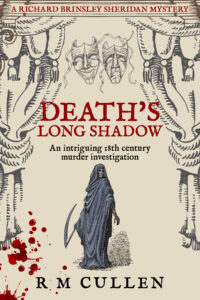
Playwright Richard Brinsley Sheridan’s retreat to the country is interrupted when he stumbles upon a body during a woodland stroll.
The man is identified as Edward Stretton, cousin to Earl Cannock who Sheridan is residing with.
Stretton had a reputation as a scoundrel and seducer and was heavily in debt at the time of his death.
He had been poisoned, and when the Earl’s servants are questioned, unusual evidence puts one man in custody.
But Sheridan is not convinced of his guilt. And one another man is murdered, he suspects there may be a connection.
Can Sheridan uncover the link? Could he save an innocent man from death?
Or will this case prove too complex for this amateur sleuth…?
We are delighted to announce that we have signed a new naval fiction novel set during the Second World War by Anthony Palmiotti.

Anthony Palmiotti
In Anthony’s words:
“When searching for subjects to write about, I look for little-known stories or actions within bigger events that emphasize the strength of character and the contributions made by ordinary people — the individuals that make a difference to the outcome. Invariably, it is the strength of character of the common man or woman that determines the outcome — that makes the difference between winning and losing. It could be a single heroic action or simply a steadfast stubbornness. It might be the will to go on when common sense says this is not a good idea. They are the unknown people who make the seemingly impossible, possible.
“Operation Pedestal was just one convoy in a war that saw hundreds of convoys. Malta was just one island in a sea of islands. What makes these two different is that they faced extreme odds and yet, through a steadfast perseverance, they beat the odds. The citizens of Malta and the common men on the convoys showed an uncommon resolve. They simply did not give up, even when giving up was the smart thing to do.
“My take on Malta during the summer of 1942 and Operation Pedestal is not a history but a novel. A novel allows the writer to get personal. It not only offers the facts, but, hopefully, a feel for what it’s like when ordinary people are asked to do extraordinary things.”
Discover more about Anthony here.
Congratulations to David Field, whose Victorian thriller, The Long Delayed Revenge, is out now!
The Long Delayed Revenge is the tenth instalment in the Esther and Jack Enright Mystery Series – a traditional British detective series set in Victorian London and packed full of suspense.
London, 1899
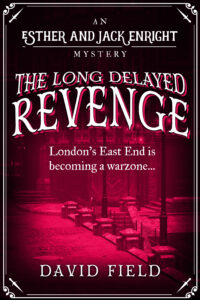
Jack and Esther Enright, with their four children in tow, have recently moved to a comfortable new home. Esther has settled into her dream job as headmistress of the local private school, owned by her mentor Emily Allsop.
But things are not going so well for Jack. Though he does not mind the commute to his high-ranking desk job at New Scotland Yard, he is disturbed by the level of recent resignations in by uniformed constables in the East End.
Though the police force has always been used to tackling crime in the more impoverished parts of London, a recent influx of Russian immigrants has led to gang warfare and vigilante justice which is proving impossible to control.
And when Esther’s school is vandalised with a disturbing message, he finds his detective skills are needed closer to home as well.
Things escalate when one of the young pupils is abducted and Jack needs all the help he can get in finding the perpetrator before it is too late.
Can Jack and Esther solve another case together? Will they rescue the child in time?
Or will the unrest in London prove too much for even Jack to handle…?
Following the success of The Marwood Family Tudor Saga, we are delighted to announce that we have signed a new Sherlock Holmes-inspired cosy crime series by Amy Licence.
In Amy’s words:
“Tucked away in a sleepy Sussex village, Sherlock Holmes’ great-great niece Charlotte Holmes wants nothing more than to run her antiquarian bookshop in peace and quiet. Divorced, and with her grown-up children having flown the nest, she’s looking forward to reading her way through the shelves, attending quiz nights with best friend Nell, and going out for dinner with handsome lecturer Toby. But then a young woman unexpectedly turns up in answer to an advert she placed for a housemate, whose name just happens to be Scarlet Watson. It seems too much of a coincidence, but when the landlady of the local pub is murdered, the pair team up to solve the crime, and Scarlet’s infectious enthusiasm wins Charlotte over. But is the new arrival all she seems? What secrets is Scarlet hiding?
“A Study in Scarlet is the first book in my new cosy crime series, inspired by the Sherlock Holmes stories. I’ve always loved reading detective fiction and, as an English teacher, I have been reading the Holmes stories with my classes for twenty years. I felt it was a perfect addition to the genre, imagining a modern setting for some familiar devices, swapping the gender of the detective, and keeping a literary twist — my heroine loves reading! Each book is based on one of the original stories and Holmes fans will love spotting the overlap and solving the crime.
“I’m delighted to be branching out with Sapere Books into another genre that I’ve always loved. Books two and three in the series are already planned and ready to be written, with more sleepy village intrigue, plus some local festival glamour, but always remaining true to the Holmes genre.”
Discover more about Amy here.
Congratulations to D. R. Bailey, whose heart-pounding military adventure, The Fire Maidens, is out now!
The Fire Maidens is the third book in the Secret Sirens Aviation Thrillers, set during the Second World War.
Autumn, 1943
Sisters Anna and Jennifer Nightingale have been flying in top missions with the Secret Sirens all-female RAF unit for nearly a year.
Their squadron of twelve Mosquitos stages a raid on Rouen to divert the enemy’s attention from the Lancasters which are coming in to bomb the marshalling yards and port.
But while Jennifer makes it through the mission safely, Anna and her navigator, Maria, are forced to ditch into the Channel.
Luckily they are picked up by a British Destroyer. And on board is none other than Winston Churchill himself.
Impressed by the skill-level and bravery of the female pilots, Churchill is keen to learn more about their training.
He escorts them back to base where they are given a new mission: to attack the Nazi-occupied Mimoyecques Fortress.
The Allies know that the Fortress is being armed with high calibre guns capable of reaching London in a massive, unending bombardment. The Sirens need to drop bombs into the railway tunnel entrance of the Fortress as soon as possible before the unthinkable happens.
But with very little time to train, will the Sirens be able to pull off the task? Can they reach the Fortress unscathed?
Or will these Fire Maidens join the many thousands who have already lost their lives in this brutal war…?
As we celebrate 250 years since the birth of one of England’s most beloved authors, we asked Laura Martin, author of the Jane Austen Investigations series, to tell us what Jane Austen’s work means to her and how it has influenced her own writing.
2025 marks the 250th anniversary of Jane Austen’s birth and is the perfect opportunity to reflect on her literary legacy and the influences that shaped her writing.

The Royal Crescent, Bath
Jane Austen is one of Britain’s most well-known and influential authors. Over two hundred years after her death her books are still immensely popular and there are numerous film and television adaptations, as well as books inspired by her life and her characters. Much has been theorised about the sort of woman she was, a picture built from the letters she wrote to her sister Cassandra as well as other friends and relatives; she has become immortalised by her work and the people who celebrate it.
One reason Jane Austen’s books are so popular is her ability to build complex and layered characters, a reflection of the people we meet in real life. No two characters are the same, and even the minor players are well defined. It allows the characters and their flaws to linger in the reader’s mind — how often have I met someone and thought how similar they are to anxious Mr Woodhouse or foolish Lydia Bennet.
Undoubtedly there were many influences on Jane Austen and her books. Her main themes revolved around marriage, love, class divisions and morality. Her stories often centred on intelligent and spirited heroines — Elizabeth Bennet, Elinor Dashwood, Anne Elliot — who are forced to navigate societal expectations in the pursuit of happiness. Through these characters Jane Austen explored the roles of women in society, economic dependence and social mobility with a clarity and subtlety that remains impressive to this day.

Pulteney Bridge at twilight
Although Jane Austen did not live past the age of forty-one, she led a rich and varied life for a woman of her time. Her early life was spent in rural Hampshire, but in 1801 she moved to the city of Bath — a move that her letters suggest she was not overly happy with. However, there is no doubt that her time spent in the city — a place of genteel society and social ambition — offered her the perfect opportunity to observe human behaviour, which she then used to help form the flawed but interesting characters that we have all come to love.
For an author writing about Jane Austen, Bath is the perfect place to immerse yourself in the Georgian era. The streets are lined with beautiful examples of Georgian architecture and when you stroll around the curve of the Royal Crescent, you can almost imagine you might catch a glimpse of Jane Austen herself.
In my Jane Austen Investigations series I have attempted to capture the essence of Jane as an author and a person, especially her unparalleled insight into human nature. It is always daunting, writing a story where the main character once existed, especially when it is someone universally beloved, but I hoped to celebrate her genius and explore the life of the woman behind the books.
I have no doubt that in another two hundred and fifty years Jane Austen’s books will still be as popular as they are today — her wit and wisdom will still be as compelling as they are now.
Discover more about Laura here.
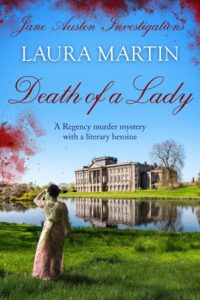
IN THE JANE AUSTEN INVESTIGATIONS SERIES:
Featured image credit: Photo by Dominika Walczak on Unsplash.
Congratulations to Tim Chant, whose thrilling naval adventure Vengeance at the Falklands, is out now!
Vengeance at the Falklands is the fifth book in the Marcus Baxter Naval Thriller Series: action-packed historical adventures following former Royal Navy officer Marcus Baxter during the early 1900s and through the First World War.
Winter, 1914
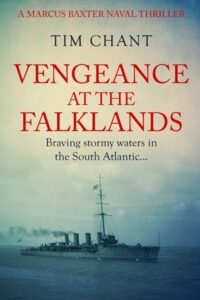
Lieutenant Marcus Baxter is working in the supply department at HM Dockyard Devonport, when word arrives that the German East Asia Squadron has destroyed a British squadron at the battle of Coronel.
Baxter seizes an opportunity to impress the First Sea Lord, Jackie Fisher, during a snap inspection of the dockyard and secures an appointment to HMS Astute, a scout cruiser, which is being sent to join the squadron in the South Atlantic.
Surviving a storm in the mid-Atlantic, Astute has a run-in with a mysterious passenger liner sailing under the Stars and Stripes, and duels with a German light cruiser stalking the rich hunting grounds off the South American coast.
After an intense engagement, which sees the Astute fleeing along the coast to Montevideo for emergency repairs, Baxter once again encounters the suspicious liner. And this time he is determined not to let it get away.
Baxter risks everything to sneak aboard, and makes a shocking discovery. He needs to reach the safety of the Falklands before any intelligence falls into the wrong hands.
But with the enemy on his tail, the race along the South Atlantic won’t be an easy one…
Jeremy Howard-Williams DFC (1922–1995), author of Night Intruder, had a distinguished career in the RAF as a night-fighter pilot during the Second World War and was awarded the Distinguished Flying Cross for gallantry. To commemorate the eightieth anniversary of the end of the Second World War, Jeremy’s son, Anthony Inglis Howard-Williams, reflects on the arrival of peace in 1945 and how it influenced his father’s life.

Jeremy Howard-Williams warming up the engines of a clipped wing Spitfire
When peace came to Europe in May 1945, Flight Lieutenant Jeremy Howard-Williams DFC was stationed at HQ, 11 Group Uxbridge. Three days before Germany’s unconditional surrender, a party was held to celebrate peace. Jeremy and his brother Peter did so by marching a guest — Flight Lieutenant Andrew from RAF Intelligence — between them up and down an anteroom. The junior flight lieutenant just happened to have been their pre-war boarding school housemaster, and the brothers had found it too good an opportunity to miss. When, years later, he was asked how the lieutenant had taken the ribbing, Jeremy replied, “with remarkable good humour!”
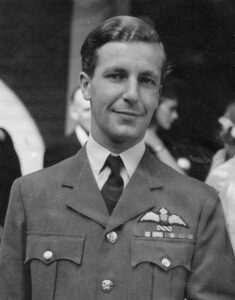
Jeremy at his wedding in 1951
Like so many in 1945, Jeremy was headed for an uncertain future. With peace came the pressing question: what happens now? For most, life outside of the forces beckoned. With millions demobilising, the assimilation of those who had been at war back into civilian society became one of the new post-war government’s biggest challenges. For those who did not want to leave the forces came a different challenge. With Jeremy’s father a retired RAF pilot, Peter a Battle of Britain day-fighter pilot and Jeremy a night-fighter pilot with the Fighter Interception Unit — an elite force at the forefront of the RAF’s early experiments with radar equipment — both brothers understandably wished to remain serving.
With the Royal Air Force downsizing, deployment meant less flying — not a very exciting prospect for a twenty-three-year-old war veteran. Jeremy had specifically joined the RAF in order to fly when the Nazis had tried to seize control of Western Europe. However, in the new modern era of the jet engine, aircraft were flying ever faster and higher. Now that was exciting!
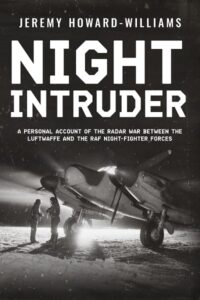 In the end, both brothers remained in the RAF. Jeremy was first posted in an admin job to Singapore during the Malayan Emergency, where he met his wife, uniting two distinguished RAF families. He later worked as an assistant air attaché in the Paris and Berlin embassies. He did fly during these postings, but mainly a desk. He resigned in 1957.
Ultimately, Jeremy’s parents divorced and his father remarried into the Ratsey family, where Jeremy became sales manager for the famous sail-making firm Ratsey & Lapthorn in Cowes on the Isle of Wight. After leaving the company, he wrote many authoritative books on sailing, as well as Night Intruder, republished by Sapere Books, a personal account of his wartime service as a pilot and the radar war between the RAF and Luftwaffe night-fighter forces.
Congratulations to David Mackenzie, whose wartime aviation thriller, Spitfires Rising, is published today.
Spitfires Rising is the first book in the John Noble Fighter Ace Thrillers: action-packed military adventures following an RAF pilot during the Second World War.
1938
Having been raised on a farm, young New Zealander John Noble longs for an adventure away from his family’s homestead.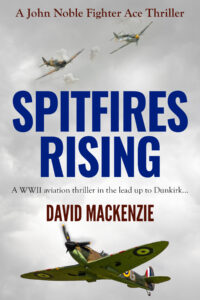
Enthralled by the sight of a Tiger Moth flying overhead, he decides to pursue a career as an RAF pilot and travels to the United Kingdom to complete his training.
After receiving his Wings, John is sent to RAF Catterick, where he finds himself flying the formidable Spitfire.
When tensions in Europe reach breaking point and Britain declares war on Germany, John’s training and courage are put to the ultimate test.
As the squadron prepares to face the Luftwaffe, John starts to question the effectiveness of their tactics, leading to clashes with senior officers.
And as his missions grow ever more dangerous, John begins to wonder just how far he will go to survive the war…
Is John ready for battle? Will he be able to follow orders while preserving his life?
Or is he destined to become a casualty of war…?
Congratulations to David Field, whose twisty Victorian thriller, The Retirement Murder, is out now!
The Retirement Murder is the ninth instalment in the Esther and Jack Enright Mystery Series – a traditional British detective series set in Victorian London and packed full of suspense.
London, 1898
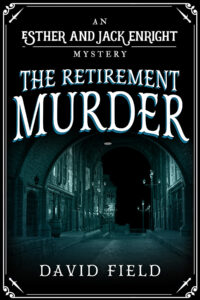
The time has finally come for Percy Enright to retire from Scotland Yard. His nephew, Jack, is sad to lose a partner in the force, but Jack’s wife Esther is glad Percy won’t be getting her husband into any further scrapes.
It seems Esther’s relief might be short lived, though, when a senior officer collapses at Percy’s farewell ceremony.
It soon becomes clear that the officer was poisoned, and Percy delays retirement to help Jack track down the culprit.
It’s a daunting task that involves trawling through all the murdered officer’s recent cases in the search for someone who may still bear him a grudge.
But when it becomes clear the dead man may not have been the intended target, the investigation suddenly turns in a new direction.
Why are the police being targeted? Can Percy make one final arrest before he retires?
Or will the murderer outwit the Enrights in their latest case…?
Following the success of his many historical series, including the Sandal Castle Medieval Thrillers and Inspector Torquil McKinnon Mystery Series, we are delighted to announce that we have signed a new supernatural series set in Victorian London by Keith Moray.
In Keith’s words:
“The first book in the series is set in London in 1854. Jack Moon is a foundling, brought up in an orphanage and then a workhouse, where he and his best friend Danny are subject to regular beatings. Together they escape, but when Danny dies in tragic circumstances, Jack secretly buries his friend in a cemetery at night.
“Alone and living in a deserted and rat-infested warehouse, Jack starts seeing Danny’s ghost, who warns him that someone is out to kill him and worse, the girl he loves, too. This is Victorian London, with its criminal underworld, body-snatchers, phrenologists, séances, ghosts and ghouls.
“I am delighted to be writing another historical series with Sapere Books, who have permitted me to set my stories in a variety of times and places, from ancient Egypt and medieval England to a contemporary Scottish island. My new mystery series delves into the occult and the psyche of the Victorian mind. It is murky, sinister and just a little bit scary.
“And one of the main characters is a ghost.”
Following the success of his many military thrillers, including the Vietnam Ground Zero Series and Wings Over Nam aviation thrillers, we are delighted to announce that we have signed a new historical military series by Eric Helm.
In Eric’s words:
“At the end of the 1980s and at the beginning of the 1990s, the world moved close to a world war that could easily escalate into a thermonuclear exchange that would end modern civilization. There were those who wished for nothing more because they believed it would thrust them to the top and in control of the world. And there were those who wanted to prevent that. Their purpose wasn’t always altruistic, but that goal matched their own climb to power. It is into this world that the characters in this series move, serving on every continent and sailing all the oceans, dealing with those problems.
“The characters are military and civilian, members of the media, and those with an academic frame of mind. Each brings an interesting take to the problems of trying to prevent a world war, except for one nation whose leaders believe such a conflict would benefit them. These are unique situations that require unique solutions. This is a tale told on the world stage with players at nearly every level of society.
“Sapere Books have been very good to me. The packaging of my Vietnam Ground Zero series has been perfect. The enthusiasm with which the books have been received has been wonderful. Sapere is a great publisher who have looked out for my best interests. Everyone seems to be excited by the various projects that I have suggested and there is no pressure to crank out a book quickly. They let it evolve naturally, which I believe makes the books that much better.”
Congratulations to D. R. Bailey, whose thrilling aviation novel, The Night Angels, is published today!
The Night Angels is the second novel in the Secret Sirens Aviation Thrillers Series, heart-pounding Second World War escapades with strong female leads.
1943

Sisters Anna and Jennifer Nightingale are recruits in the top-secret Siren Squadron: a group of women trained in the RAF to fight against the enemy.
The Sirens are tasked with flying a series of night stealth missions as part of Operation Scorpion. The first mission is successful, and on returning to base they are told that new members will be joining their ranks.
Hopeful that this means the all-female squadron has been deemed a success, the sisters welcome the new recruits and start training them on the Mosquitos.
They head out on another night mission. But this time not everyone returns.
With a downed plane found empty off the English coast, fears grow that one of the Sirens hasn’t survived.
But the show must go on. And Anna Nightingale has to destroy the crashed plane so the Sirens can remain classified.
As their night missions continue, increased skirmishes with enemy pilots suggest someone may be leaking information to the Germans.
Have the Sirens been compromised? Can they find the mole?
Or will these daring female agents be forced out of the war…?
Congratulations to Angela Ranson, whose gripping Tudor mystery, A Glittering Peril, is out now!
A Glittering Peril is the third book in the Catrin Surovell Tudor Mysteries Series: exciting historical thrillers set at the court of Elizabeth I.
1561
Every summer, Queen Elizabeth takes a journey around her kingdom. It is a time of revels and celebration, full of pleasure and extravagance.
But in July 1561, the trip begins badly when the corpse of an unknown man is left in her path.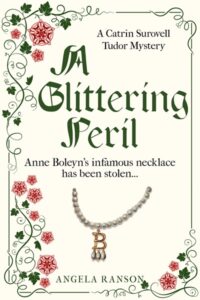
The nervous queen asks Catrin Surovell, her trusted favourite lady-in-waiting, to find out who is trying to sabotage her journey.
But Catrin soon discovers that the queen’s nervousness stems from something greater than the mysterious death.
Someone has been leaving reminders of the queen’s mother, Anne Boleyn, in strange places. A woman appears in the distance who looks like her; the scent of Anne’s perfume is left in the queen’s chamber, and Anne’s favourite French ballads are sung by a disembodied voice as the queen is travelling.
Worst of all, Anne Boleyn’s famous gold-and-pearl necklace with teardrop pearls hanging from a letter ‘B’ is taken from the queen’s bedchamber. The queen is devastated by the loss, for the necklace was one of very few mementos she had of her mother.
The queen begins to suspect one of her courtiers, so Catrin visits his home to conduct a secret investigation into his actions. And that’s when she discovers this is the most difficult mystery she has ever had to solve.
Is Queen Elizabeth being haunted by her ill-fated mother? Or is someone trying to drive her insane?
And can Catrin find the connection between the missing jewels and the unknown corpse…?
We are thrilled to announce that we have signed the first three books in Kristi Ross’ new Scottish Queens series.

Kristi Ross with Bolt
In Kristi’s words:
“My new series brings to life the untold stories of Scotland’s Stuart queens. While the histories of queens in England, France, and much of Europe are well documented, these Scottish queens have been mainly forgotten — until now.
“In this series, readers will explore the compelling journey of Queen Joan Beaufort, niece of King Henry IV and cousin to King Henry V, who enters Scotland as the wife of King James Stuart I after he was held prisoner by her English family for eighteen years. Her tale is one of true love, resilience, and determination as she navigates her husband’s assassination, becoming the first dowager queen of Scotland in over a hundred years.
“We also delve into the story of Queen Euphemia Ross, whose life begins as King Robert Bruce I’s ends. Her rise from noblewoman to queen consort is a testament to the position of pawn that high-ranking women played. As the second wife of King Robert Stuart II, Euphemia constantly defends her children’s succession rights against rivals and navigates the complex dynamics of her husband’s family. Readers will also meet her daughter-in-law, Queen Annabella, born into the powerful Drummond clan and niece to King David Bruce II’s second wife, Queen Margaret Drummond. Annabella takes the reins of the kingdom when her husband, King Robert Stuart III, is incapacitated, showcasing her leadership and strength in crisis.
“Working with Sapere Books is a perfect match, as their commitment to historical fiction and their passion for bringing forgotten stories to light resonates deeply with me. These women had little control over their destinies, yet their strength and adaptability are fascinating. It drives me to tell the world their stories so that their legacies are remembered.”
We are thrilled to announce that we have signed three new instalments in the Tom Walsingham Mysteries Series by C.P. Giuliani.
The series follows the espionage adventures of Tom Walsingham during the Elizabethan era in Tudor England.
In C.P. Giuliani’s words:
“Tom Walsingham sleuths on! I’m thrilled to have signed up three more adventures featuring my Elizabethan detective and spy with Sapere Books. I have great plans for Tom. He will be tasked with recovering a misplaced foreign ambassador — whose mission could change the course of Anglo-Spanish relations; he’ll become involved in a personal investigation when death strikes at his family home, Scadbury Manor; and poor Tom will find himself in prison when his money troubles and Sir Francis Walsingham’s plans collide. Plenty of mysteries and dangers lie ahead for Tom!
“I’m really happy to be working with Sapere, whose welcoming and stimulating atmosphere and competent, friendly and helpful team have made (and are making) my publishing journey a truly lovely adventure.”
Following the success of his DS Hunter Kerr Investigations and Dr Hamlet Mottrell Investigations, we are delighted to announce that we have signed a new historical police procedural series by Michael Fowler.
In Michael’s words:
“My new series features Detective Winter Cooper of Scotland Yard and is set in the 1950s.
“Detective Cooper’s first case is based upon a real event, the Eastcastle Street robbery — Britain’s biggest cash-in-transit hold-up at the time. In May 1952, robbers used two cars to sandwich a Post Office van in London and escaped with mailbags containing £287,000 (estimated to be worth approximately £8,500,000 today). It was a case that shocked the nation and embarrassed the Government, with Prime Minister Winston Churchill demanding daily updates from the Police Commissioner. Despite the involvement of over a thousand police officers, and the offer of a £25,000 reward, no one was ever caught.
“This is my take on that case, and while it is a deviation from my contemporary novels, I hope readers will embrace Winter Cooper with the same enthusiasm that I have put into creating him and this new series.
“Working with Sapere Books again was an easy decision to make. Over the past five years, they have given me so much support as a writer and I cannot thank them enough. When I ran the idea of this new series past them, their backing was unflinching.”
In this behind-the-scenes blog series, Sapere Books authors offer an intriguing insight into how, where and why they write.
Today, we are delighted to spotlight Daniel Colter, author of the Knights Templar Thriller Series.
Writers are a strange breed.

The view from Daniel’s window
We invent friends in our heads, decide how they speak, what they wear, where they go, then spend countless hours conversing with them. No two writers share the same head-friends, oddly, despite running in the same social circles. Neither do any two writers develop a story the same way.
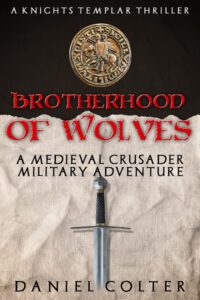
Specific routines keep us on track, or don’t (looking at you, internet), and each work proceeds at its own pace. Most writers are one of two species: a plotter or a pantser. A plotter maps out each scene, chapter, and verse before putting fingers to keyboard. Pantsers fly by the seat of their pants, beginning with an idea, then writing towards a vaguely defined ending. I mapped out my first novel, Brotherhood of Wolves, but tossed the map aside by chapter 3. I found pantsing more rewarding, and still do, because much of the fun (and frustration) is writing myself into a corner and finding a path out.
My novels are historical fiction, where history provides setting, culture, and place. History can also frame the plot. Story is given precedent over history, however, because the goal is to entertain, not to educate. One or more characters are historical persons and the fictional protagonist lives within their orbit. Historical fiction should stay true to history and the fiction takes flight where history grows murky — which it usually does, especially the further back in time one travels. The murk is where the fun begins, in my opinion, and its where the what if fleshes out the story, where the pantser finds out what happens to his head-friends.
Writers are also strange creatures.
Some writers have habits, like a dog that circles exactly three and a half times before lying down, and these rituals are intended to fuel creativity. Isabel Allende started her first novel on January 8, 1981, and that day became a ceremonial start date for all her subsequent works. The poet Friedrich Schiller kept rotten apples in his desk and, when his mind needed a jolt, he would give one a sniff.
 My writing rituals are more mundane and less … smelly. I start with two (not one, not three) cups of coffee. I keep a stuffie of Curious George on my desk, in honour of Curious George Rides a Bike, the first book I read cover-to-cover. I say hello to George each morning.
Ritual also comes from my father. He was a painter and writer and used a second-hand desk as his art space. I acquired that desk, set to rehabbing it, but foolishly sanded the top to expose wood veneer over composite. I left his dried paint splashes along the edges, though, and I touch them when I write. They make me think of him, and thinking of him puts me in a creative mood. I told him I had begun writing historical fiction, his favourite genre, but he passed away before reading Brotherhood of Wolves. I often wonder what he would think of my series, and suspect he would be pleased (except for the part where I ruined his desk).
In this behind-the-scenes blog series, Sapere Books authors offer an intriguing insight into how, where and why they write.
Today, we are delighted to spotlight contemporary romance author Patricia Caliskan.
I wrote my third novel, When We Were Us, at my bureau, which has become my writing enclave. Something about opening the bureau desktop gives me a sense of immediacy which speeds the writing along. I write upstairs, free from distractions, except for my dogs who stop by to visit, but basically closed off from everything except the world I’m creating.

Patricia’s bureau
I never thought I had any writing rituals until people began asking the question. I realised that I have rituals in general. All three of my novels were largely written at night. Once the demands of the day are over, night-time is not only the perfect fit in a practical sense but allows me the space I need to daydream on behalf of my characters, and fully immerse my thoughts in the world of the book.
I’m a huge advocate of those tiny details which promote wellbeing, even when I’m not writing. So, before I get back to my latest manuscript, I mix essential oils for my diffuser, which works like magic for changing up the mood, and I set a timer to monitor my working hours.
I find having scheduled time slots super helpful. I can show up and do the work and know exactly how much time I’ve spent on the novel, which is reassuring when I’m trying to find enough time to work on a project.
I switch on my moon light, as I call it, a perfect orb of white light, and always freshen up my perfume before I write. I think of perfume as a superpower. A favourite scent signals that we’ve got work to do and someplace else to be.
I usually start by reading over where I left off to reacclimatise. I try not to spend too much time agonising over a word choice or a sentence formation until I’m at the editing stage. I have a natural tendency to edit as I go, wanting the work to be as close to the final manuscript as possible, which can hinder the drafting process.
When it comes to first drafts, I remind myself of my own advice: to just get it all down. I need solitude to do that, and sitting at my bureau, I feel enclosed in the world of the book. When it comes to editing, I usually end up inadvertently making a playlist to score parts of the novel or characters, which I find helpful with tone and pace. Once I have a completed manuscript, I print the work out and read it aloud, because if the writing doesn’t sound right, it isn’t right, and needs reworking.
Writing fiction requires both discipline and detachment, and my little bureau space provides just that!
Congratulations to Eric Helm, whose thrilling Vietnam War adventure, Proxy War, is published today!
Proxy War is the twenty-ninth book in the Vietnam: Ground Zero series: action-packed, authentic historical thrillers set during the Vietnam War.
Republic of Vietnam, 1969
The American government has known for a long time that there were Soviet advisors in North Vietnam, but now it seems they are ready to strike.
Intelligence has been gathered suggesting that Soviet fighter pilots have engaged in aerial combat with American Air Force and Navy pilots.
As of yet the Americans have not retaliated, as the UN is terrified of the Vietnam War escalating into a global nuclear disaster.
But the Soviets have been spotted engaging local Vietnamese troops and it seems they are readying for an attack.
U.S. Army Special Forces Major Mack Gerber and Sergeant Major Anthony Fetterman have been on light duties in Vietnam, during a relatively peaceful period in the war.
But after a visit to a Special Forces Camp, they are told that the enemy have been increasing their assaults on the base.
What are the Soviets planning? How large is their army?
Can the US Special Forces stop their deadly attack…?
In this behind-the-scenes blog series, Sapere Books authors offer an intriguing insight into how, where and why they write.
Today, we are delighted to spotlight C.P. Giuliani, author of the Tom Walsingham Mysteries Series.

C.P Giuliani’s garden house
Every year, as soon as summer comes, I move my writing to the garden house. It’s not really cooler, as temperature goes, but it feels summery and pleasant. I love the tall ceiling, the terracotta floor, the desk that used to belong to my great-grandfather, and the view onto the garden. There’s a little pond outside the French windows, and the birds bathing or drinking are, I confess, something of a distraction — but they also provide a cheerful break whenever I find myself stuck. A paragraph refusing to take the right shape? A character mutinying? A dull passage? I step away from the desk and watch while the blackbirds play in the water — and, more often than not, a solution will suggest itself.
For all its rustic pleasantness, the garden house has decent Wi-Fi — which is rather essential when my pile of reference books is not enough to confirm some detail — and is equipped with an electric kettle to make cup after cup of tea, which is a fundamental of my writing method.
In truth, beyond the insane amounts of tea, I have little in the way of a writing routine. Working in theatre means that my hours are flexible. Sometimes I write in the morning, sometimes very late at night, sometimes both; sometimes I must snatch the odd hour here and there, between a rehearsal session and a meeting with the techs. One thing I do is to always keep a notebook with me. Through the years, I’ve learnt to keep a dedicated notebook for each project, beside a general one for everything and anything: notes, stray ideas, snatches of dialogue overheard or imagined, lists, questions… It’s the general notebook that I carry around, so I can jot down anything that occurs to me — to be transferred to the relevant one later. This means that I do some of my writing at the theatre, at the vet’s, as I stand in a queue at the Post Office…
My family, friends and colleagues have developed a high degree of amused tolerance for my ‘Notebook Moments’, when I drop whatever I’m doing to take a note; strangers are occasionally a little put out until I explain that, for one thing, I’m prone to forgetting what I don’t write down and, for another, sometimes an idea will present itself in a very iridescent shape, little more than a flicker of colour under the surface of the water — and will need to be recorded quickly and thought through in writing, at least a little, if it’s to be of any use.
So to recap, I’m absent-minded, easily distracted, forgetful, and can’t keep a routine… I suppose it’s no wonder that a quiet, pleasant place like the garden house is important to my writing process.
In this behind-the-scenes blog series, Sapere Books authors offer an intriguing insight into how, where and why they write.
Today, we are delighted to spotlight David Field, author of numerous historical series including the Bailiff Mountsorrel Tudor Mystery Series and the New World Nautical Saga Series.
I’ve always written stories, even as a child, then I progressed from childhood scribbles to more serious attempts at literary glory on an old upright Olivetti typewriter (one of those with a red and black ribbon, if you’re old enough to remember) when my handwriting graduated from ‘untidy’ to ‘execrable’.
Reluctantly I then honoured my mother’s wish, and my father’s insistence, and got a ‘real job’ as a criminal trial lawyer, which was about as relaxing as standing on one leg on the top outer ledge of The Shard in London, without the reassurance of a safety harness. To relieve the stress I decided to start working on a novel — but what should I choose for a genre?
A good friend of mine who already earned a precarious living as a novelist was insistent that one should always write about things that one knows, and by this stage I knew two things outside my professional straightjacket — some history from my schooldays, and the streets of my home town, Nottingham. During the final years of my working life I spent stolen moments imagining the lives of those living in Nottingham during the Luddite Riots, and In Ludd’s Name was eventually published by a boutique publishing house owned by an old school friend.
Bitten by the bug, and buoyed up by having finally been published, I grew ambitious, and searched the history books for possible storylines, most notably from that most colourful of periods of English history, the Tudor era. The literary world seemed to be awash with Henry VIII, Anne Boleyn, Elizabeth I and even ‘Bloody Mary’, but two seminal characters from that era seemed never to have received much attention from novelists.
First was the progenitor of the Tudors, the boy from Wales, Henry VII, and I climbed inside his head to bring to the pages that followed his boyhood imprisonment in a bleak castle in South Wales, his youthful exile in Brittany, his triumphant return at the head of a ramshackle army that deposed Richard III at Bosworth, and his love match with Elizabeth of York that brought the Wars of the Roses to an end in the nursery rather than on the battlefield. To my delight, and secret surprise, I found a publisher — Sapere Books — and Tudor Dawn was launched.
Then — unbounded joy and amazement! — Sapere wanted another one, so this time I focused on a butcher’s son from Ipswich who rose from obscurity to become Archbishop of York, Papal Legate for life, Lord Chancellor and the diplomacy coach of choice of Henry VIII. Cardinal Thomas Wolsey’s spectacular downfall was just as dramatic, and The King’s Commoner was published, as testament to the fact that I had a second novel in me.
Dozens of titles have since been published, all by Sapere Books, and all ‘historical’ in genre. As one of the characters in Alan Bennett’s delightful creation, The History Boys, says of history — ‘It’s just one ******* thing after another’, and so it has been for me.
In this behind-the-scenes blog series, Sapere Books authors offer an intriguing insight into how, where and why they write.
Today, we are delighted to spotlight Neil Denby, author of the Quintus Roman Thriller series.
Inspiration can come at any time of the day or night, but I find that the small hours are awash with ideas — plot lines, character development, a resolution to a particularly tricky scenario — so it is important that I keep a notepad and pencil by the bed. It may be old-fashioned but it is also reliable and has the advantage of not involving bright screens.
Frustratingly, come morning, I cannot always decipher what I have written down, but sometimes there are gems. These may be character or plot evolution, or perhaps just phrases, but I know I would have forgotten them completely if I had not made a note.
While out walking — an excellent way to clear the brain of fog — I defer to modern technology and record voice notes on my mobile phone. The same principle applies — if there is no immediate record, the thoughts can be lost.
These brief lines are later transferred to a laptop. This is strategically placed in a corner of my study so that I am not distracted by the view outside the window. A row of reference books and one of my favourite possessions, an original Steve Bell cartoon, are all that I have for company. It also helps if I can visualise a character or a place, so I keep a sketchpad on my desk where I can create basic images — maps, plans, sometimes the progress of marches or battles. These drawings help to maintain consistency and authenticity.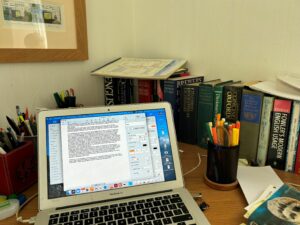
This is my primary space, where the words are typed up. I add to them, enhance them, contextualise them, read them back. I often discover that I have used a particular word or phrase twice or more. Or if there is something I’m not sure about, I look it up. The reference books help to straighten out facts and also to find alternative words. Roget’s and Brewer’s and Fowler’s and Chambers provide a wealth of information unmatched by an American-leaning internet. I admit to slipping down rabbit holes of etymology and semantics, but find it strangely satisfying.
I always have to read what has been written, in context with the book so far. Traditionally that would have meant printing the manuscript out and sitting down with a pencil. Happily, that is no longer the case. Instead (thanks to everything going up into the Cloud) I can now read and review on my iPad. This means I can lounge in a chair, or sit outside, or read whilst travelling. So it is more a case of recreating the experience of the reader to see how and if things work.
Of course, there are edits, and actual printouts sometimes, but that is basically it: pencils and pads and technology.
Oh technology, where were you when I had all those essays to write at school?
We are delighted to announce that we have signed a new series of Tudor mysteries by Kate Robertson.
In Kate’s words:
“The series follows Anne Winston, a lady at the court of Queen Elizabeth I. Quiet and unassuming, she is a keen observer and has a skill for puzzling out problems.
“When we first meet Anne, she has just returned to court from burying her husband. She soon learns that her nephew has been arrested for sedition and must race against the clock to prove his innocence while also being drawn into the emerging spy network under Sir William Cecil, the Secretary of State.
“As the series progresses, we will see Anne uncover intrigues and conspiracies, using her powers of observation and ability to go unnoticed in most situations. I wanted to write a story about an older female protagonist who discovers the power of her voice and finds her agency in a complicated world, all while trying to right wrongs and find justice for the forgotten.
“I met Amy Durant at the Historical Novel Society Conference in San Antonio in 2023. I initially pitched her a different story but when she asked what else I had, I knew I needed to share Anne, my most personal protagonist, entrenched in the Tudor era, which is my first historical period love.
“I’m excited to work with Sapere — it’s inspiring to work with a publisher that knows and loves historical fiction so well.”
We are delighted to announce that we have signed a series of Roman military adventures by Jeff Jones.
In Jeff’s words:
“Legion of the Damned is set in the middle of the first century when Rome was arguably at the pinnacle of its power and follows the career of Marcus Corvo, a man seemingly destined to forever live in his ancestors’ shadows. After a reckless act of bravery turns the tide of a battle, Corvo expects to be severely punished but is instead promoted and recruited for a clandestine rescue mission deep in enemy territory. But this is no ordinary mission and Corvo is obliged to recruit men from the gladiatorial arenas, prisons and mines. His small force is to comprise of expendables — a legion of the damned.
“In the coming series, Corvo’s adventures will take him and his men from the desert sands of Parthia, to the forests of Germania and then to Britannia where he will arrive in time to be caught up in Boudicca’s rebellion.
“The idea for Legion of the Damned has been bouncing around in my head for some time now and my original intention was for it to be made into an historical fantasy novel. When Sapere Books asked whether I’d be interested in writing Roman historical fiction I jumped at the chance. I knew that I could make the idea work.”
Gaynor Torrance is the author of the DI JEMIMA HUXLEY THRILLERS series.
Like many other people, I’m a crime thriller junkie. I can honestly say that books in this genre are my guilty pleasure — as well as chocolate, of course. As far as I’m concerned, it has to be well-written and absolutely has to have a complex plot. I need an abundance of twists and turns, along with a large helping of red herrings. If it keeps me guessing, it will offer me everything I expect from a good book.
I want the story to grab me and not let go. Whenever this happens, my own identity quickly fades into the background, and I become the protagonist. Gender is unimportant to me. I don’t care whether the protagonist is male or female. The only thing that matters is that I inhabit a world I would shun in real life. Fictional characters are instantly relying on me, and I’m desperately trying to save lives whilst I figure out what’s going on. 
From the safety of a comfy armchair, these books have transported me to places I’ll never visit. They’ve presented me with opportunities to solve mysteries. Allowed me to get up close and personal with some of the most evil and twisted minds you could ever imagine. Over the years, I’ve brought justice to victims, been caught up in life-threatening situations and sometimes even had a hand in saving the world from imminent disaster.
Immersing oneself in these fictional scenarios is my ultimate form of escapism. It’s a white-knuckle ride minus the personal risk.
Having so many ideas of my own, I decided to take things a step further. And so I began writing about Detective Inspector Jemima Huxley, whose stories are set in Cardiff, a city I know well.
I love Jemima, but that’s because I know what makes her tick. I appreciate that on first appearance, she’s perhaps not the most likeable of characters. In Revenge, which is when readers are introduced to her, she comes across a bit like Marmite. She’s not a typical lead detective, and this will polarise opinion, as you’ll either love her or hate her.
When I created Jemima, I wanted her to have an interesting backstory. Over the years, I’ve read so many crime novels that have a hard-nosed lead detective heavily dependent on alcohol. Or whose personal relationships are in tatters because of the pressures of the job.
DI Jemima Huxley is different. She’s a modern woman who gets stuck in and excels at her job. Jemima is determined to have it all. At work, she’s a capable, dedicated detective: loyal, brave and intelligent. If only she had more control over other aspects of her life…
If you’ve read Revenge, you’ll already know that Jemima has some serious personal issues. She’s hiding things from everybody. Her mental health is suffering, and she’s in danger of falling down a rather large rabbit hole.
Most importantly, Jemima hasn’t yet figured out what’s at the root of her problems. I have a feeling that that epiphany is a long way off, and until it happens, there’s little chance she’ll begin to turn things around.
Jemima’s personal torment manifests itself in a way that is guaranteed to upset some readers. And I’ll let you in on a secret — I’ve shed tears as I’m writing those scenes. What Jemima does to her body is shocking, brutal and heartbreaking. But her method of keeping a lid on things is a reality for some people.
It’s a sad fact that mental health issues are still stigmatised. And, like many others, Jemima feels compelled to hide her suffering for fear of being judged.
But Jemima isn’t the sort of person to give up easily. She has her low moments but always seems to manage to pull herself together and face whatever life throws at her. Any serial killers stalking the streets of Cardiff had better watch out, because Jemima’s returning soon to investigate her next big case, Sole Survivor!
Click here to order REVENGE now!
On Tuesday we attended the annual autumn Independent Publishers’ Guild conference, which is a great chance for us to find out more about the latest developments in the industry, get some ideas and inspiration for our own practices, and catch up with old friends. Here are our highlights from the day!
The conference opened with a keynote speech from serial entrepreneur Sam Conniff Allende, the author of self-help book Be More Pirate. He shared his thoughts on the importance of rule-breaking: challenging systems and taking risks to effect positive change and drive success. Sam also compared Golden Age pirates with modern entrepreneurs – in terms of their powerful branding and shrewd tactics!

Booksellers Peter Saxton, Phil Henderson and Tamara Macfarlane
A talk on the importance of fresh branding and operations was led by Stephen Page of Faber and Faber, Nicola Usborne of Usborne Publishing, and Chris Bennett of Cambridge University Press. Each showed how developing modern-looking visual marketing campaigns, analysing previous successes and failures, and maximising the potential of their backlists keep their businesses moving forward.
A trio of trade and children’s retailers – Peter Saxton of Waterstones, Phil Henderson of Blackwell’s and Tamara Macfarlane of Tales on Moon Lane – brought us up to date on the latest trends in bookselling. A particularly welcome development is a surge in the popularity of books celebrating women in non-gender-stereotypical roles and inspirational stories for young girls.
Jeremy Yates-Round of Haynes Publishing showed how he keeps his business agile in a tough climate. Techniques included humorous and imaginative marketing campaigns, both licensing and being licensed by external brands, and offering customers different platforms to access content (e.g. via online apps).
Josie Dobrin of Creative Access
Josie Dobrin of Creative Access and Rik Ubhi of Zed Books led an important discussion on how publishers can attract, welcome and maintain a diverse workforce. Practical tips for recruiters included undertaking unconscious bias training, checking recruitment data to see at what point in the selection process BAME candidates are excluded (and working to fix the filtering systems so that this happens less frequently), avoiding the ‘quick hire’, removing unnecessarily high barriers for entry-level jobs, and making existing BAME hires feel safe, listened to and valued.

Claire Farrell, Extinction Rebellion co-founder
Clare Farrell, the co-founder of Extinction Rebellion (XR) – a climate change mitigation movement – gave a rousing speech on the realities of the climate emergency and the ways in which XR is putting pressure on governments to instigate action on a wider scale. She also explained how the publishing sector can take its own stand via actions as simple as using recycled paper for all books.
The conference wrapped up with a surprise singing lesson from author and musician James Sills – good fun for all!
When did you first start writing? Did a specific event encourage you to start?
When I was six years old, I saw a TV programme about the Blitz, which as you can imagine was pretty alarming. I wrote a poem about it.
How much research do you do?
I am fascinated with the Victorian era and do a lot of research to try and get the details right. I read contemporary newspapers and journal articles, biographies and medical works. I study maps, census returns, directories, legislation, photographs, and art. I have about a hundred books just on the history of spiritualism.
Tell us about where you write / your writing habits.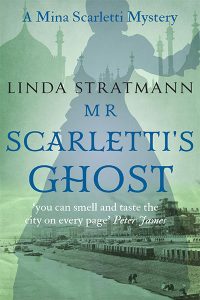
I work from home and have a room which is my office. I don’t work set hours; even when I am doing the household chores, my mind is still working on my latest project or planning a new one.
What part of the writing process do you find most difficult? Starting, knowing when you’ve done enough research, the ending?
When I begin a project, I know where I am starting from and where I will end up, but I have to link the two in a way that makes sense. Every time I pause in order to find that natural link, I have to remind myself that I found it last time. It’s worked so far.
How real do your characters become and do they ever seem to control their own storyline?
They feel very real to me, and because I let themes develop naturally in my mind often the characters do things that I hadn’t necessarily planned but emerge from their personalities and situations, so sometimes they do take me by surprise.
Do you ever feel guilty about killing off characters or do you relish it?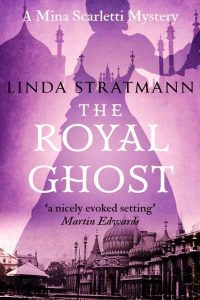
Neither, but it is sometimes sad. It’s very hard writing about a character who I know is about to become a murder victim.
Do you find it hard to know when to end a story?
No, I know when it feels right to me.
What are you working on?
I am editing a new volume in the Notable British Trials series about the trial of the Mannings in 1849. I am also developing the plot for the fifth Mina Scarletti book, to be entitled His Father’s Ghost.
What are you reading right now?
Munich by Robert Harris.
What is your favourite book? Who is your favourite character?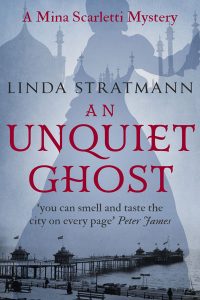
I have read thousands of books and it is impossible to pick one!
What book do you wish you had written?
See above.
Do you love any genres/books that are very different from what you write?
Most of my reading is non-fiction: history, biography, true crime, psychology. In crime fiction, I tend to read books with modern settings or if historical, a very different time period from the one I write about.
Tell us something surprising about you!
I prefer pickles to sweets!
When did you first start writing? Did a specific event encourage you to start?
There has never been a time when I didn’t write. As a child, my idea of a perfect game was to tell a story to my teddies, then write it down. It was never a conscious decision, it was part of me then and it still is now.
How much research do you do?
It entirely depends on the story. For a while I wrote film scripts, mostly comedies, and they didn’t need any research. Likewise my first few attempts at novels (still languishing unpublished!). One story, The Music Makers took all its chapter heading from the wheel of the Major Arcana cards in the Tarot pack. Although I was a fairly proficient Tarot reader back then, I did research other, wider meanings, for the cards to add extra depth to the main character’s adventures.
The Marquess House Trilogy, which has a split timeline comprising of a present day strand and a historical section has taken years of research. Book one: The Catherine Howard Conspiracy was actually not my intended starting place. The big reveal that appears in book two: The Two Elizabeths was the kernel of the idea for this story and, over the years, I have written many different versions of it trying to make it work. However, none of them were quite right and after several years of juggling work, life and researching Elizabethan England I realised the only way I’d be able to capture this monster of a story on paper was to split it into three separate tales, rather than trying to cram it into one book. Three books, one for each piece of jewellery: two ruby rings and a silver locket.
It was actually devastating because it meant starting again from the beginning. In true frustrated writer style, rather than face this unhappy truth, I wrote a comedy instead, entitled The Patron Saint of Married Women, which was set in the present day and needed very little research. In. Your. Face. History.
In the end, I caved in and began researching Henry VIII’s fourth and fifth brides. I also made the alarming decision to dump my two main characters: Isabella and Oliver. I never liked them much anyway. The name Perdita had been running around my head for a while. From reading Dodie Smith’s One Hundred and One Dalmatians when I was younger, I knew it meant Little Lost One and somehow this seemed appropriate for my main character. Then one morning, I woke up with the question: “Who is Piper?” running around my head. Immediately, I knew she was Perdita’s twin sister and something clicked into place.
The very very first version of this story featured Isabella (now gone) mourning her twin sister who had died under mysterious circumstances on an archaeological dig after she had unearthed a silver locket. The idea was that she had been murdered by MI One Elite. Strangely, the nasty old Watchers were there from the beginning, as was Mary Fitzroy, James Rivers and Alistair Mackensie. Jerusalem was always around too, although it took me a while to settle on its true nature. Warren Dexter was another one who survived the character cull. However, it wasn’t until Perdita and Piper popped up that the story suddenly opened up before me. Then, Kit arrived. He had been through a number of names and he finally found an identity because I quite fancied Kit Harington who plays Jon Snow in Game of Thrones. Yes, it’s an embarrassing admission but he was the inspiration for Kit and once he had his name, the last piece of the puzzle was in place and the story flooded out.
I’ve long since moved past my toe-curling crush, though. Ahem.
Anyway, in answer to your question, at present, several months of research and writing of detailed timelines. By gathering all the information into one huge chart, it’s easier to write fluently and present a more rounded and believable version of my historical periods.
Tell us about where you write / your writing habits.
I have a purpose built writing hut in the garden with insulation and a heater. I write every day and, at the moment, am lucky enough to be able to treat it like my day-job.

What part of the writing process do you find most difficult? Starting, knowing when you’ve done enough research, the ending?
It varies. I love the lure of the blank page. Every piece of paper is an adventure waiting to unfold. Knowing when you’ve done enough research is a tricky one but there comes a point where you have to plunge in and see what happens. I don’t like writing endings, not because I don’t like them but because it means you’re saying goodbye to your characters.
How real do your characters become and do they ever seem to control their own storyline?
Very real. They all seem to end up taking over their own storylines. Sometimes, I even argue with them. Although perhaps I shouldn’t have admitted that…
Do you ever feel guilty about killing off characters or do you relish it?
Never! I worry about killing them off for different reasons. What about if I suddenly realise I need them again but they died in Chapter Four?!! EEEKKK!
Do you find it hard to know when to end a story?
Usually I know the end before I begin. The Marquess House trilogy has proved more troublesome though because in my head, it’s one long story, so realising I had to make three endings, instead of just the one at the very very end of book three, has taken a while to adjust to.
What are you working on?
Part three of The Marquess House trilogy. It’s working title was always Prince Oliver but I don’t think this works any more. The title will arrive when its ready.
What are you reading right now?
The Moon Sister by Lucinda Riley. It’s part five of her Seven Sisters series. I only recently discovered these books but I’m really enjoying them.
What is your favourite book? Who is your favourite character?
This is a tough one. How do you choose between so many friends? And also, do I go for something literary and make it look as though I’m very high brow or do I tell the truth?!
For a long time now, my favourite book has been Harry Potter and the Prisoner of Azkaban. I was going through quite a tough time when I began reading these books and, not only was Hogwarts a wonderful place to hide, I was awed by J K Rowling’s brilliance. Goblet of Fire had just been released, the films had been cast and the storm of Harry Potter was building. I never like making judgements on phenomena unless I’ve read/seen/visited them, so I bought the books. Philosopher’s Stone hooked me from page one. Chamber of Secrets worried me – who was Dobby? Was he good or bad? – but when I read the third book with its fabulous twist with Scabbers and the appearance of Sirius Black who had first been mentioned in chapter one of book one, I realised this was more than a series of children’s books. This was truly magical. I’ve asked for help at Hogwarts many times and it’s always been given.
My favourite character is Hermione Granger. Although Harry is pretty amazing too.
I also love Ballet Shoes by Noel Streatfeild and Moll Flanders by Daniel Defoe.
What book do you wish you had written?
Apart for the Harry Potter series? The God of Small Things by Arundhati Roy or The Passion by Jeanette Winterson.
Do you love any genres/books that are very different from what you write?
I try to read a broad cross-section of genres. If a story is well-written, it’ll grip you no matter what the genre. I try never to suffer from literary snobbery. Every book is worth trying, you may not make friends there but you don’t need to be rude!
Tell us something surprising about you!
I play musicals in the background while I write.
Are you working on a new series set in the Age of Sail? Have you written a naval thriller set during the World Wars? Are you passionate about seafaring stories? Sapere Books wants to hear from you!
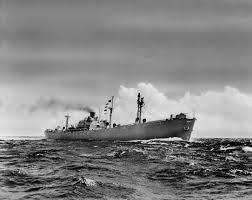
We are actively looking to acquire nautical fiction from both debut and established authors. We are particularly interested in historical naval fiction, nautical thrillers, and books in a series.
If you are an author who owns the rights to a previously published naval series, or a writer working on a new nautical novel, please get in touch and tell us about it!
Email our Editorial Director, Amy Durant, directly with some information about your nautical writing and a synopsis of your naval novel and we will get back to you as soon as possible.
We hope to hear from you soon!
When did you first start writing? Did a specific event encourage you to start?
In the 1990s. I can’t be more specific as I went to several creative writing classes, usually with the same tutors. The class would start out well attended, then people gradually would drop out – usually in winter. Then the following year the funding would change and we’d start up again at a different venue. But I always persevered and about three or four of us went to the same classes, which I enjoyed very much. Finally one tutor suggested I sent off some of my stories to a magazine. The first one was rejected but the editor must have seen something in my writing and made some useful suggestions. So luckily my next one was accepted by Ireland’s Own. I still have the cover framed on my wall. It’s dated August 1999 and has the picture of a Connemara pony on the front.
How much research do you do?
For Song of the Shuttle I went to Quarry Bank Mill, a working cotton mill near Manchester owned by the National Trust. The volunteer guide on duty was so helpful, explaining how the machines worked, then demonstrating them. He was really patient answering all my questions. From a large second hand book store in South Manchester I was lucky enough to find a book from the television series about the American Civil War shown back in the 1990s. It was packed with information and original photographs which was invaluable to my research. Other books like ‘The Hungry Mills’ and ‘Reveille in Washington’ helped enormously and also a map showing the major battles of the war.
For subsequent books I’ve turned to Victorian history which has always interested me. The internet is invaluable too. Where else could you discover the uniform that an American military hospital orderly wears?
Tell us about where you write / your writing habits.
I’ve set up office in a small bedroom since my son and daughter have left home. It overlooks the back garden and I can see the small birds bobbing about in the trees. I’m afraid I’m not an organised writer or set time each day for writing. I have a habit of waking up at an unearthly hour with an idea in my head and can’t get back to sleep until I’ve typed it out. I did try to write those ideas down on a pad by the bed but couldn’t read my writing in the morning. So I drag on a hairy old dressing gown – and tracky bottoms in winter – and sneak off into my office for an hour or so. Then I slip back into bed and sleep soundly.
What part of the writing process do you find most difficult? Starting, knowing when you’ve done enough research, the ending?
Most of my stories are written in my head long before they reach the page. Then when I have time I want to get down the information as quickly as possible. Of course I have to go through it all again and edit it. Sometimes I seem to write in Polish! I’m not keen on editing and don’t like rewriting at all.
How real do your characters become and do they ever seem to control their own storyline?
My characters do seem to take on a life of their own and I instinctively know how they will act. This is a very perceptive question as many times my ideas and plots will change when faced with what a character would do.
Do you ever feel guilty about killing off characters or do you relish it?
I have sat and wept when one of my characters died. Normally it’s only the baddies that ‘get it’. I feel they get what they deserve.
What are you reading right now?
At the moment I’m reading a spy novel by John Le Carre and persevering with it. I get annoyed by the macho attitude of the men though! I have Lamentation by C. J. Sansom waiting in the wings. I love his Shardlake novels.
What is your favourite book?
My favourite book is Jane Eyre. I’ve always loved it from being young when I had the Dean and Son version for young readers.

What book do you wish you had written?
Something brilliant like The Book Thief. I’ve recommended it to so many people and they’ve all enjoyed it.
Do you love any genres/books that are very different from what you write?
I have very eclectic taste. I really enjoy Terry Pratchett books. Patrick O’Brian’s seafaring novels are a favourite and also Lyndsay Davies’ Roman detective Falco. Although they are historical novels, they are very different from the romances that I’m writing.
Tell us something surprising about you!
I’ve had a painting exhibited in Manchester Art gallery. I won a competition where all the art classes round the city sent a painting that was inspired by one of the Gallery’s paintings. It was called ‘Things to Do’ and in one corner featured a cosy armchair, a book and a cup of tea. The rest of the canvas had an ironing board, a dirty frying pan, an un-ironed shirt and lots and lots of socks – black with a different coloured heel. None of the socks matched! The blurb was that I’d rather sit reading than doing all the chores. Along with a certificate I received a bag of art goodies. Unfortunately I don’t have time to go to any art classes nowadays.
Chapter One
Sunday, March 28th, 2010
Danny Sanchez arrived at 10:27.
It was already bedlam; hundreds of people covered the dusty patch of waste ground beyond the white walls of the property, shouting, pushing, arguing among the cacti and scruffy palms. The excavator’s arm loomed menacingly above the roof of the two-storey villa.
The demolition had been scheduled for nine a.m., but frantic negotiation had earned the elderly expat owners a three-hour stay of execution while the house was cleared. The whole neighbourhood turned out to help, Briton and Spaniard alike. A stream of people walked back and forth along the edge of the unpaved road, carrying everything and anything they could salvage – doors, windows, even the kitchen work surface. The problem now was where to put it all. An incongruous pile of household items was collecting around the trunk of a fan palm. Danny watched as a negligee blew free from a box and wrapped itself around a cactus.
Christ, what a mess.
In eighteen years of journalism, Danny had witnessed dozens of horrors – people cut from the wreckage of car accidents, a woman leap from a burning building, a suicide on a railway track – but this was something new. They were going to demolish Peggy and Arthur Cookes’ house and nothing could be done to avert it. He’d seen the paperwork. Nearly every penny the poor old duffers had was invested in the villa; a lifetime’s equity would be smashed to rubble. It was like waiting for an execution.
The Junta de Andalucía, southern Spain’s regional government, had sent a woman in her mid-thirties to oversee the demolition. Crafty, Danny thought; people found it harder to get angry with a woman, especially an attractive one. Her hard hat and fluorescent bib bobbed at the centre of a tightly-knit group of people. Guardia Civil officers in green boiler suits formed a protective ring around the Junta woman. Then came the leaders of the protestors, waving documents and trying to argue over the shoulders of the Guardia officers.
Behind them was the press pack, two dozen strong, cameras and microphones waving above the crowd as it surged and rocked. Gawkers and curious children milled at the edges, wondering what all the fuss was about.
For her part, the woman from the Junta looked genuinely distraught at what she had to do. Danny had no idea whether she could follow the English words being bellowed at her, but it was obvious she understood the gist. She kept pointing to the paperwork on her clipboard, raising hands and shoulders in shrugs of helplessness. Someone, somewhere had decreed the demolition must go ahead; it was her job to get it done.
The Cookes were inconsolable. Peggy sat on an armchair that had been dumped among spiky clumps of esparto grass. Tears carved streaks through the dust that had settled on her face. Danny recognized the armchair; he’d sat in it when he’d interviewed them a year before, when the demolition orders were first served. Arthur Cooke had looked dapper and defiant as he posed for the cameras back then; now, every one of his seventy-three years weighed upon him. He stood with his hand on his wife’s shoulder and turned moist eyes as Danny approached.
“Not now, mate,” he said, shaking his head. “The bastards are about to ruin us.”
Danny nodded, glad he’d been spared having to ask the obligatory “How do you feel?” It was amazing how dumb those four words could make you feel sometimes.
Peggy Cooke wanted to speak, though. “Why us?” she said, her voice shrill. “Out of all the hundreds of people, why does it have to be us? I want you to print that. It’s not fair.”
Why us? That had been everyone’s first reaction in March 2009 when the judicial demolition orders were delivered to eleven different families dotted around the municipality of Los Membrillos. It seemed so monstrously unfair, given the scale of the problem in Almeria, the province that occupies Spain’s south-eastern tip. A Junta survey had uncovered more than 12,500 irregular constructions in just ten of the worst affected municipalities. But the Spanish legal system was a Heath-Robinson contraption manned by characters from Kafka; immense and baffling in its complexity, arbitrary in the decisions it dispensed and spitefully prescriptive when it did so. It was one of the dangers of emigrating to Spain, the flipside to all the sunshine, fiestas and good living.
Not that it had worried the tens of thousands of Britons who had flooded the Almanzora Valley at the turn of the century, buying up villas and plots of land for self-builds, breathing life into the moribund rural communities that nestled below the Sierra de los Filabres mountain range. But the rush to expand had left thousands caught in the legal quicksand between the local and regional government of Andalusia. Local councils could grant licences to build, but the regional government had the right to challenge those licences. The catch-22 was that no one would stop you from planning to build a house; the house actually had to be built – and the money spent – for it to come to the Junta’s attention and challenge its legality.
Why us? Danny knew the answer to Peggy Cooke’s question; he’d interviewed the mayor of Los Membrillos. “We had so many applications for building licences, we were swamped,” the mayor had said, unlocking a cabinet and indicating three large cardboard boxes leaking paperwork. We only got round to processing eleven.” That was the bitter irony of it; by trying to follow the rules, these unlucky eleven home owners had created a paper trail that Junta officials could follow back to specific properties.
Time was ticking on. The crowd was getting angrier, the shouting louder. More Guardia officers arrived. Danny phoned everyone and anyone he could think of who was involved with the case.
It was the usual pass-the-parcel.
The council blamed the Junta, the Junta blamed the courts, the courts blamed the council; all down the line, each link of the chain shrugged its shoulders and pointed to someone else. Arthur Cooke watched Danny in action, hoping that this man who spoke such perfect Spanish could somehow work a miracle. Danny finished the phone call, shook his head. The flicker of light in the old man’s eyes dulled.
Paco Pino arrived at 11 a.m., yawning and scratching at his chest. “My one day off,” the photographer said, screwing a lens onto one of three cameras dangling from his neck, “And this has to go and happen. Just my luck.”
Danny was glad the Cookes couldn’t speak Spanish; crass comments like that were the last thing they needed to hear. Not that Paco was a bad person; experience had simply made him blasé, like everyone who made a living reporting other people’s misfortunes. Truth be told, Paco was a saint in comparison with some; Danny had spoken to one of the journalists sent by a UK red top to cover the announcement of the demolition orders the previous year.
“We won’t be interested again now until they knock the things down,” she said as she left, nodding toward the cloudy March sky. “Let’s hope they do it in summer, eh? I might get a bit of a tan.”
The pile around the palm tree grew: beds, sofas, lampshades, mirrors, cardboard boxes stuffed with clothes and crockery. Danny looked at his watch. Not long now.
At ten to twelve, uniformed officers of the Policia Local cleared the last of the protestors from the garden and checked no one was left inside the house. There were more scuffles on the white gravel outside the villa, more insults in English and Spanish. The property’s black gates had been lifted from their hinges earlier to allow the excavator through. Having shoved a final protestor outside, Guardia Civil officers formed a human barrier in the space between the gateposts. Protestors waved paperwork at the Junta woman as she looked at her watch and waved toward the workers.
The sudden roar of the excavator’s engine caused everyone to freeze and fall silent. The crowd turned as the engine revved and the excavator’s mantis arm uncoiled and rose above the house. For a moment, time seemed stilled…
…and then the air thundered as the excavator’s claw drove down through the roof. An angry moan emerged from the crowd as the arm rose and hundreds of dislodged tiles showered and smashed on the ground. The excavator arm dipped once, twice, three times more, prising the roof apart before ripping backwards and pulling free a ragged-edged section of brickwork. Looking through the jagged rent it created was surreal; the neatly-tiled interior walls had been exposed, giving a view inside a giant dolls’ house.
The Cookes stood holding each other: Peggy sobbing; Arthur straining to keep her on her feet, his face stoic. They were tearing his house down, but he wouldn’t show a flicker of weakness. Another huge section of wall tumbled away; it fell to the ground with a thud. Dust rose, people coughed, choked, began walking back along the road. Danny pulled his jacket up to cover his mouth.
The Spanish woman atop the ridge didn’t really care about the foreigners; their house was illegal; it had to come down.
She was only there for the spectacle, to have something to tell her friends tomorrow at the market.
She was the first to see it.
Her mouth gaped; then she began to scream and point toward the corner of the house. People looked to see what the noise was but the sounds were rendered unintelligible by the rumble of falling brickwork and the excavator’s diesel chug.
But the dust was settling now; people were following the woman’s outstretched hand, squinting as they too noticed the thing wedged in the narrow gap between exterior and interior wall.
A Guardia Civil officer rushed to the excavator, banged on the window. The machine fell silent. Other people had noticed the shouting woman now and were pressing closer, shading their eyes, unsure of what they were seeing. For the second time that morning, a sudden silence halted the crowd.
Danny thought it was a mannequin at first. And then the corpse fell forward, bending from the waist, its blackened head rocking back and forth. Some people screamed; others stood open-mouthed; some turned to run.
Arthur Cooke’s face remained expressionless as he stared at the semi-skeletal corpse lolling from the broken wall of his house. Then, without moving a single muscle of his face, he toppled forward and fell heavily to the earth.
Need to know what happens next? Get Scarecrow now from Amazon.