

Writing advice can help you change your process, develop your characters, improve your prose, and give you the confidence to submit your work. You never know which piece of advice might change everything.

We have gathered ten pieces of writing advice from our Sapere Books authors, ordered alphabetically, straight from them to you, to help you take your writing further.

10 Pieces of Writing Advice From Our Authors

D.R. Bailey

“The most useful thing I’ve done with my writing is to adopt a particular discipline. It’s inspired by the Pomodoro technique. I have a tomato timer app on my desktop, which I use to time 25-minute writing stints. So I sit down to write, and I hit the start button. For twenty-five minutes, I have to write and do nothing else but get words down. I may also edit the scene as I go, but focusing for 25 minutes at a time is what works. I can do two or three tomatoes (as I call them) a day, or sometimes more, but by this method, I get my books written. I also keep writing stats, word counts, number of tomatoes, how many words to go, things like that. I’ve been doing this for years now, and that’s how I have maintained my production record. PS – during a tomato nobody is supposed to bother me, but apparently my cat doesn’t understand the rules!”

Discover more from D.R. Bailey here.

David Clensy

“You need to read a lot of other peoples’ work. Writing novels isn’t something you can do in cultural isolation. Storytelling is a cumulative process that builds over generations. When it’s finally your turn to sit down and start writing your novel, you’re standing on the shoulders of lots of other writers who came before you.

Once you do start writing, my simple piece of advice is to keep writing. Creating a novel can seem intimidating at first. But it’s a bit like climbing a mountain. Don’t stand there looking at the mountain – work out how you get up the next few steps. If you can find the discipline to get a certain amount written each day and stick to it, you will get there eventually. I am fairly strict with myself when I’m working on a novel. I have to write 5,000 words a week. But when you break that down to a daily figure, it’s perfectly manageable. Within just a few months, as if by magic, you have a full first draft manuscript. It’s important to battle on, even if you don’t feel like writing that day. If you wait for some magical muse to work her magic, your book will forever remain a pipe dream.”

David’s other piece of advice focuses specifically on writing historical fiction.

“My novels always contain a combination of real historical characters alongside entirely fictional characters. I am creating fiction, but I’m always conscious of the responsibility that comes with a literary resurrection of real people. I always approach this process with a sense of respect for the dignity of their memory. They do, of course, become “fictionalised” characters, but it’s vital to always keep front of mind that they lived and breathed – they were people with real lives and emotions. The fact that they’re no longer alive does not negate the importance of remembering this at all times when you’re briefly writing them back into existence.

As a writer, you have to make constant judgements as you fictionalise them – assessing what their reactions would have been. So you build up a real sense of understanding of their nature and it’s not too much of an exaggeration to say that by the end, you do feel as if you know them, as you might know a real person. There’s a kind of writer-character relationship that builds up in your mind.”

Consequently, David feels it’s important to go through a process of “getting to know” his characters. Wherever possible, this involves researching – not just plain “facts” about their lives – but visiting places they would have experienced and walking in their footsteps. He has recently travelled around northern Germany to build a picture of the locations his characters will inhabit in his forthcoming U-boat Aces series. You can watch a short film about his experience on his website at www.davidclensy.com

“It adds so much, if you can get out and invest a bit of time in doing that. You’re creating something that is as authentic as possible and when you get that right and come to read it back, as a writer you can feel that. It’s very rewarding to have that sense of having crafted something from nothing.”

David Clensy writes the Romulus Hutchinson Naval Adventure Series, which follows the story of twin brothers serving in the Royal Navy and Merchant Navy during the Second World War and is currently working on a new historical fiction series based on the German U-boat aces of the two world wars.

You can keep track of what David is currently working on by signing up for his newsletter or following him on Instagram, Facebook, Bluesky, X, Threads, and Substack.

Daniel Colter

“Readers often ask how much time I spend in research. The answer is both confusing and confounding — more than I should but never enough.

By that I mean research rabbit holes are fun to explore but can waste hours (days?) better spent writing. An author can’t know too much about the period in which they work, though, and that requires time. Knowledge allows one to write authentically and to show a period as it likely was — I say ‘likely’ because uncertainties increase the further back in history we travel.

I don’t create detailed outlines and rarely know how a book will end when I begin writing (the few times I knew, I later proved myself wrong). So how do I use arguable history to craft a half-formed story?

The ‘large history’ is fleshed out at the start, of course. This can take weeks. I recently crafted The Eagle and the Serpent, a story set within the Great Illyrian Revolt of A.D. 7 to 9, one of Rome’s lesser-known wars. I began by researching the historical players, the setting (geography, cultures, etc.), and the major events. In the process I purposely sought the holes and contradictions.

History provided many of both, fortunately, because these grey areas are where historical novelists run and play. They’re where we plant fictional stories; invent characters, wants, conflicts; where we weave events that might have happened with what history says happened.

As the story grew, my research became fine-grained, done in small batches, multiple times a day. What would a Roman legionary eat, for example? Learn that, then the issue becomes one of application — meaning, how to weave diet into story, to provide ‘flavour,’ while not making the reader drowsy?

Carve away the minutiae that distract from the story, for one. Another tool is to tuck details into the character’s interactions with their world, make the history bits relevant to the story, so the two flow together. Describing what a legionary carried is a bit flat. Better to show how heavy the character’s kit is, that it slows him, that it blisters his palms, that he arrives to the battle late, tired, and sore.

At the end of the journey, readers want to be entertained without being bored by overexplaining, or offended by egregious anachronisms. Details matter, knowing which to include is a fine balance, but crafting a believable, well-flavoured story is what matters.”

You can find Daniel’s book, The Eagle and the Serpent, or find Daniel on Facebook.

Claire Dunn

“If I have one thing that I come back to time and again it is a personal mantra that goes something like this:

Always try to remain true:

– to the subject of your novels and the characters within,

– to your readers who invest time, money and themselves in your books,

– to your publisher who believes in you, and

– to yourself, the author, who sees the world through a different lens and must never lose sight of the vision that drove you to pick up the pen in the first place.”

Claire can be found on her website, Facebook, and on Linktree.

Rozsa Gaston

“Do not let anyone get in your way during your writing hours. Mine are 8:30 am – 3 pm, Mon. – Fri.

If a family member needs something from you, answer in monosyllables, then shut the door of your writing room once they leave, so they understand that you are WORKING.

If someone texts or emails, DO NOT look at the message until you have finished the scene you are working on.

If someone calls, answer with a terse “Hi, I’m on deadline.” If there’s follow up, tell them to text or email you, rather than call so you’re not interrupted.

Compliment your family member every time one of them solves a problem for themselves instead of asking you for something. Say you are proud of them for taking care of it themselves during your WORK HOURS, so you can get your manuscript done by its due date. Your children will understand because they have school assignment deadlines. Your husband will be a harder nut to crack, but he will enjoy being complimented, so keep buttering him up when he figures out how to do something on his own.”

Rosza Gaston’s work can be found on Amazon.

Jeff Jones

1.“One piece of advice you will often hear from people within the publishing industry is to conduct research on what is selling well and write a book that fits in with that current trend. I tried it once and by the time I had spent the best part of a year writing and polishing the manuscript, tastes had moved on and the book subject was no longer in vogue. So my tip for any aspiring writer would be to write the book you want to write and that you’d enjoy reading and worry about its place in the market later. Who knows, you might start your own sub-genre.

2. When I am not writing I am usually working as a proofreader or copy editor and the best piece of advice I was ever given and that I try to impart to my clients, is to keep it simple. Don’t use a word that is so obtuse that it has people reaching for a dictionary – nobody likes that – use simple everyday words. Impress your readers with a great plot and characters, not your vocabulary.

3. One piece of good writing advice I was given over the years was just to get the novel written. Don’t worry about crafting the perfect page or chapter – that’s what the editing process is for – write your book as it comes to you, you can worry about smoothing those edges off later.”

Discover more from Jeff Jones here.

Richard Kurti

“Be Kind … then be Cruel!

“How do I know if what I’m writing is any good?”

It’s the question which plagues everyone who puts pen to paper. You may think it’s a work of genius, only to have your best friend read it and go, “Meh. It’s alright. A bit slow.”

Which is why you always try to be your own critic, questioning every sentence and every plot twist, constantly asking if something could be improved.

But then you end up so full of self-doubt, it becomes impossible to put any words on paper at all. “If it’s not perfect, it must not be typed!” is the quickest route to writer’s block.

Over the years, I’ve developed a method to square this circle by leaning into Multiple Personality Syndrome. So, when I’m actually typing words, laying down the first draft, I am full of encouragement. “Great line!” I enthuse to myself. “Nice twist! Lovely rich thematics!”

I live in this cloud of self-congratulatory enthusiasm until I have completed the first draft. Then I put it aside for a few days, and when my mind has cleared, I switch into Grumpy Reader Mode. Then I pick up the Kindle and imagine that I’ve paid hard-earned cash for this book. I picture myself on a train after a gruelling day in the office, wanting to be entertained/thrilled/intrigued/hooked by the time the train rolls into Sevenoaks.

And reading with the eyes of a stern consumer, I pick holes in my draft. “Too wordy. Too long to get going. Cliché. Confusing. Why should I care about any of this?” get scribbled across the draft in an outpouring of discontent.

When I get to the end, I switch mindset again and become Conciliatory Writer: “Okay, the reader wasn’t happy, and I don’t want to get any one-star reviews, so let’s see if I can sort this out…”

And so it goes on, back and forth, alternating between being my greatest fan and my cruellest critic, until I’m at my wits’ end. Only then do I submit to the publisher!”

Find Richard Kurti at www.richardkurti.com.

Patrick Larsimont

“When writing historical fiction, I think you need to do at least some plotting. If nothing else, to ensure your character’s story fits with the sequence of historical events. Typically, I write about three sentences per chapter, to clarify to myself what I need to cover in the 2K-3K of my chapter. I don’t have to have the whole novel laid out, just the start and endpoint, then about the first two thirds of the story before I start writing.

I’ve heard the analogy that writing a novel is a bit  like knowing your destination is say Edinburgh and you are driving from London. You know where you are and where you need to get to. It’s a dark, stormy night, you have no map, just know you must head north and that you can only see as far ahead as far as your headlights. You set off, full of fear, trepidation, hope and anticipation. You’re excited, a little scared, but you’ll get there.

One other technique I use, I call the ‘sling shot.’ It involves knowing where a scene needs to get to, but ending my writing for the day, leaving it uncompleted. The next day, I review what I wrote yesterday, tweak it once and then get catapulted forward into finishing the scene / chapter. This helps avoid the ‘tyranny of the blank page’, staring at the screen, thinking, now what do I write? The ‘slingshot’ helps me hit the ground running.”

Explore Patrick’s website and Patrick’s Linktree.

Ros Rendle

“When I was a new writer, one of the best pieces of advice I was given was ‘go deeper, not wider’.

To illustrate this – it’s not the kiss, but the build up to it. The scent, the sensations of touch, the pauses which involve deep emotions. There may be anticipation or nervousness; perhaps willingness; a complex mix of emotions.

The lead in to a battle will ensure the reader is engaged. It will be the subtle sounds in the distance, the smells of fabric or armour. Clothing may itch or feel too hot and scratchy. There will be other sensations of touch that may result from apprehension, fear or excitement, that build before the moment of fighting and gore. Sight will play its part in the anticipation of what is to follow.

Exploration and use of the five senses, and ensuring powerful verbs are in play, will create strong writing and a vivid, emotional experience for the reader.”

Find Ros Rendle on her website.

Linda Stratmann

“Writing methods are individual and deeply personal. Approach your writing in the way that feels natural to you. Don’t try and fit in with another person’s approach, it might not suit you. Find your own style and method.

This is one rule I always follow:  the characters in a book should drive the development of the plot, so events flow naturally and believably. The story will be convincing and the characters relatable.”

For more from Linda, explore her website and Facebook.

Sapere Books

Be sure to follow Sapere Books on FacebookInstagram, and Bluesky to stay up to date with our upcoming novels and new releases.

If the advice of some of our Sapere authors makes you want to give back, read our blog ‘9 Easy Ways A Reader Can Support Their Favourite Author’ for examples of quick, simple, and free ways that you can make a difference.

From leaving book reviews on Amazon and Goodreads to pre-ordering new releases and recommending books, there are so many simple ways readers can support authors and improve book discoverability. If you’re a reader who wants to support authors, independent publishers, and improve book discoverability, these simple actions can make a real difference.

Why Supporting Authors Matters

Reader recommendations, social media engagement, and reviews can significantly impact a book’s success by increasing visibility and helping new readers find it. While a single review may have little effect on a bestselling title, it can make a meaningful difference for an independent author.

Many successful indie books gain traction through reader enthusiasm and word-of-mouth marketing. If you’d like to support independent authors and smaller publishers, here are some of the most effective ways to do so.

How to Support Your Favourite Authors

Graphic showing list of 9 ways for readers to support authors

1. Buy Their Books

The most direct way to support an author is to purchase their work. Every sale contributes to the author’s success. Sales figures can influence retailer recommendations, future publishing opportunities, advertising budgets, and overall visibility.

2. Follow Authors on Social Media

Following an author on social media is a simple but powerful way to show support.

Social media platforms use engagement signals to determine which content gets shown to larger audiences. When readers like, comment on, save, or share an author’s posts, it increases the likelihood of those posts reaching potential new readers.

3. Subscribe to Author Newsletters

Email newsletters remain one of the most effective marketing tools available to authors.

Unlike social media platforms, where visibility depends on constantly changing algorithms, newsletters allow authors to communicate directly with readers who are genuinely interested in their work. For authors, every subscriber represents a reader who wants to stay connected and support their journey. Plus, it can be a fantastic way to stay up to date and see more behind the scenes.

4. Recommend Books to Friends and Book Clubs

Word-of-mouth marketing remains one of the most powerful forms of book promotion. When readers recommend books to friends, family members, book clubs, online communities, or fellow readers, those recommendations often carry more weight than traditional advertising. A genuine recommendation from a passionate reader can introduce an author to an entirely new audience.

5. Share Book Posts and Announcements

Sharing a cover reveal, release announcement, review, or author update can help introduce a book to new readers. Even a single share may reach someone who becomes a lifelong fan!

6. Attend Author Events and Signings

Book launches, signings, conventions, and literary festivals provide valuable opportunities for authors to connect with readers. Attendance and engagement help make these events successful and encourage organisers to host similar events in the future.

7. Request Books at Your Local Library

Library requests can have a surprisingly large impact on an author’s success. Many libraries purchase books based on reader demand, meaning a single request can result in a book being added to a collection. This not only supports the author financially, but also introduces their work to new readers who may later purchase other books in the series.

8. Pre-Order

Buying a book before release day can make a big difference. Penguin Random House in their article ‘All About Pre-Orders’ says:

‘For an author, pre-orders can alert retailers and consumers that they should pay attention to your book. From the bookseller perspective, the pre-order quantity is a good early indicator of a book’s success, and can lead to retailers increasing their initial orders.’

Book launches are often driven by momentum. Early support can encourage retailers, reviewers, influencers, bloggers, and other readers to pay attention. The more momentum a book builds before launch day, the greater its chances of reaching a wider audience after publication.

Many retailers count pre-orders toward a book’s launch-week sales performance. As these sales are concentrated around release day, they can help improve chart rankings and visibility during a crucial period. A strong launch can create additional opportunities for discovery, recommendations, and media coverage.

9. Leave A Review

Corrin Foster, Sr. Director of Book Marketing & Promotions at Forbes Books, says on her guest post, The Benefit of Reader Reviews on NetGalley, that:

“Reader reviews are the social proof that helps to convert browsers into buyers.”

Reviews don’t just help authors; they help future readers make informed purchasing decisions. Seeing positive reviews can reassure potential buyers that a book is worth their time and money. In many cases, readers discover new books specifically because they were intrigued by another reader’s review.

Reviews also play an important role in how books are displayed on major retail and discovery platforms. While no platform publicly reveals its exact algorithm, books with higher levels of reader engagement are generally more likely to appear in recommendation feeds, search results, and “customers also bought” sections. More reviews can therefore increase a book’s visibility, helping it reach readers who may never have found it otherwise.

There are several places where readers can leave book reviews, including:

You can also share reviews through:

  • Personal blogs
  • Instagram posts
  • Facebook recommendations
  • Threads and Bluesky posts

If you post reviews on social media, tag the author. Not only does this allow them to see your review, but it can help introduce their work to your followers!

How Can You Support Sapere Books Authors?

Whether you enjoy historical fiction, crime fiction, thrillers, mysteries, romance, or non-fiction, every action you take can make a meaningful difference to an author’s success.

You can help Sapere Books authors by:

What may seem like a small gesture can have a lasting impact on an author’s career and help ensure more great books are published in the future. Browse our latest releases, discover new authors, and join our growing community of readers who help support independent publishing every day.

We are delighted to announce that we have signed the eleventh book in the Charles Holborne Legal Thrillers series: gritty, hard-boiled mysteries featuring maverick barrister Charles Holborne.

In Simon’s words:

“As regular readers of the Charles Holborne Legal Thrillers will be aware, every book has been set in a different year, tracking the corrupt Metropolitan Police force and the gangs like the Krays’ ‘Firm’ through the 1960s. I’m afraid I’ve never had much patience with writers whose formulaic books never allow their characters to grow up (or old). There’s one particular tough guy (you may remember him being portrayed on film by a certain very famous diminutive actor) who, thirty books in, should now be approaching the ripe old age of sixty-six. Yet, chained to a steel table with a broken wrist, he is still capable of choking a big guard into unconsciousness.

“I prefer realism. If the Charles Holborne books are based on real cases, real political events and real people, my hero barrister should also be real: he must get older and, one hopes, wiser. In The Brief, set in 1960, he was thirty-five years of age. By the time we get to book 11, he’s a decade older. And what did most good looking, easy-going, solvent professional men do in 1970? They got married, maybe started a family and … went on holiday.

“The playful title I had in my head as I wrote the book was ‘Charlie Holborne Goes to France’. Sapere Books have been wonderful publishers (evidence: this will be my eleventh book with them) but even I knew their patience might be stretched by such a title. Wrong vibe altogether. In any case, this holiday turns nasty. Charles and Sally find themselves embroiled in a vendetta in the heart of stunning rural Gascony, a vendetta with its roots in the war between those who resisted and those who collaborated with Vichy. Their Gascon idyll turns dark, putting their lives and that of their daughter at risk. And, because no Charles Holborne novel can omit a courtroom drama, Charles finds himself on a busman’s holiday, fighting the good fight as always.

“I have enjoyed writing this book because it is set in a beautiful part of the world that I know and love well. In addition to action, mystery and courtroom drama, there’s magnificent countryside and wonderful food to go with the true historical facts. I can’t wait for you to read it.”

Visit Simon’s website to stay up to date with his news, events and latest releases.

In this behind-the-scenes blog series, Sapere Books authors offer an intriguing insight into how, where and why they write.

Today, we are delighted to spotlight Angela Ranson, author of the Catrin Surovell Tudor Mysteries.

Angela’s study

I write in my study, which doubles as a playroom for my two cats. I love having their energy and curiosity as the backdrop for my writing. This is especially true because I write about a world long dead — Tudor England — and try with every scene to bring it back to life.
My books centre around the early years in the reign of Elizabeth I (the 1560s), which I studied when I earned my doctorate in sixteenth-century English history. I live in York, within a stone’s throw of King’s Manor. This was the building where Henry VIII stayed in 1536, and his suite of rooms is now one of the University of York’s libraries. If you stand at the back of the building, you can see a tiny window that leads to nowhere: it originally let some light into Henry’s specially-made toilet, or garderobe.

I love that York has these little historical treasures; I go looking for them whenever I have the opportunity. That isn’t as often as I would like, because I write between the hours dedicated to two jobs at the university. Writing is what I do to relax, to escape from the trials of daily life. Thus, you’ll often see me writing while I eat my supper, or early on a Saturday morning when I’m still in my pyjamas. Turns out, those are the hours when dreams come true.

The third Sapere Books’ Writers’ Retreat took place at The Priest House Hotel, Castle Donington between the 28th and 31st of October this year.

Adele Jordan, author of the Kit Scarlett Tudor Mysteries and the Shadow Cutpurses Tudor Thriller Series, helped to organise a full programme over the four days.

In Adele’s words:

“For a lot of writers, it’s a solitary world. Whether you are struggling to complete your manuscript or are in love with your story and find it hard to step away, it can’t be denied that for many writers a lot of time is spent in a staring contest with your computer screen, and sometimes we need to step away from that screen.

“For the last three years, a group of authors from Sapere Books have come together to create their own writing retreat, and this year saw our biggest yet. Fourteen authors, who write across various historical genres, came together to talk about all things writing.

Photo of The Priest House Hotel by Andy Stephenson, used under the Creative Commons Licence

“From romance to crime, we plundered the depths — from the importance of accuracy in military fiction, to how we plan and approach clue-filled detective stories. What transpired was not only a shared enthusiasm for our craft, but the reassurance we sometimes need that we are not alone — that there are others out there with the same passion who are keen to inspire and be inspired themselves.

“This year, we had some special sessions led by writers in the group. Highlights included an insightful look into the editing process by Neil Denby, author of the Quintus Roman Thrillers Series, and a debate on the accurate use of poisons in fiction and the importance of research by Linda Stratmann, author of The Early Casebook of Sherlock Holmes Series.

Adele Jordan

“Amy Durant, Sapere Books’ Publishing Director, led a popular Q&A session with authors attending the retreat. We also covered what makes a good title, how to grab your reader’s attention from the very first line, the complications around weaving a narrative with more than one viewpoint, and a friendly critique session where people were invited to bring their own work for discussion.

“Following inspiring chats, some political debates, good food and a very comfortable bar, I was delighted to see so many of the writers come away with big smiles on their faces. Thank you to everyone who came this year and to Amy Durant too for sparing the time to talk to us. Here’s hoping next year’s Writers’ Retreat is not only just as good, but the biggest and best yet!”

Some comments from the attendees:

Ros Rendle, author of The Strong Family Historical Saga and the Moondreams House Romances: ‘Thanks to all attendees at the authors’ retreat week for making it so useful and fun. Particular thanks to Adele Jordan for all the organising, the excellent programme and for keeping us on track with such diplomacy.’

Michael Fowler, author of the DS Hunter Kerr Investigations and Dr Hamlet Mottrell Investigations: ‘[The retreat] has turned the plot of my next book completely around. And it was nice to catch up with colleagues from previous retreats, as well as meet up with new ones.’

Linda Stratmann, author of The Early Casebook of Sherlock Holmes Series: ‘The sessions really stimulated the little grey cells of the brain, and I got some insights which had me rushing off to do some writing!’

C V Chauhan, author of the Inspector Sharma Thrillers Series: ‘It was a fantastic four days! Thanks everyone and a big thank you to Adele for leading and managing the four days so well.’

In this behind-the-scenes blog series, Sapere Books authors offer an intriguing insight into how, where and why they write.

Today, we are delighted to spotlight contemporary romance author Patricia Caliskan.

I wrote my third novel, When We Were Us, at my bureau, which has become my writing enclave. Something about opening the bureau desktop gives me a sense of immediacy which speeds the writing along. I write upstairs, free from distractions, except for my dogs who stop by to visit, but basically closed off from everything except the world I’m creating.
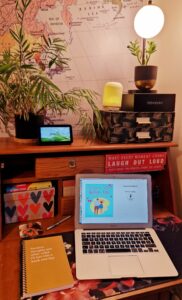
Patricia’s bureau

I never thought I had any writing rituals until people began asking the question. I realised that I have rituals in general. All three of my novels were largely written at night. Once the demands of the day are over, night-time is not only the perfect fit in a practical sense but allows me the space I need to daydream on behalf of my characters, and fully immerse my thoughts in the world of the book.

I’m a huge advocate of those tiny details which promote wellbeing, even when I’m not writing. So, before I get back to my latest manuscript, I mix essential oils for my diffuser, which works like magic for changing up the mood, and I set a timer to monitor my working hours.

I find having scheduled time slots super helpful. I can show up and do the work and know exactly how much time I’ve spent on the novel, which is reassuring when I’m trying to find enough time to work on a project.

I switch on my moon light, as I call it, a perfect orb of white light, and always freshen up my perfume before I write. I think of perfume as a superpower. A favourite scent signals that we’ve got work to do and someplace else to be.

I usually start by reading over where I left off to reacclimatise. I try not to spend too much time agonising over a word choice or a sentence formation until I’m at the editing stage. I have a natural tendency to edit as I go, wanting the work to be as close to the final manuscript as possible, which can hinder the drafting process.

When it comes to first drafts, I remind myself of my own advice: to just get it all down. I need solitude to do that, and sitting at my bureau, I feel enclosed in the world of the book. When it comes to editing, I usually end up inadvertently making a playlist to score parts of the novel or characters, which I find helpful with tone and pace. Once I have a completed manuscript, I print the work out and read it aloud, because if the writing doesn’t sound right, it isn’t right, and needs reworking.

Writing fiction requires both discipline and detachment, and my little bureau space provides just that!

In this behind-the-scenes blog series, Sapere Books authors offer an intriguing insight into how, where and why they write.

Today, we are delighted to spotlight C.P. Giuliani, author of the Tom Walsingham Mysteries Series.
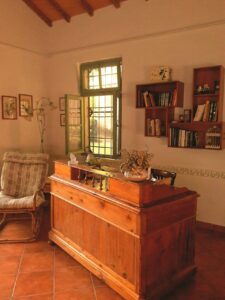
C.P Giuliani’s garden house

Every year, as soon as summer comes, I move my writing to the garden house. It’s not really cooler, as temperature goes, but it feels summery and pleasant. I love the tall ceiling, the terracotta floor, the desk that used to belong to my great-grandfather, and the view onto the garden. There’s a little pond outside the French windows, and the birds bathing or drinking are, I confess, something of a distraction — but they also provide a cheerful break whenever I find myself stuck. A paragraph refusing to take the right shape? A character mutinying? A dull passage? I step away from the desk and watch while the blackbirds play in the water — and, more often than not, a solution will suggest itself.

For all its rustic pleasantness, the garden house has decent Wi-Fi — which is rather essential when my pile of reference books is not enough to confirm some detail — and is equipped with an electric kettle to make cup after cup of tea, which is a fundamental of my writing method.

In truth, beyond the insane amounts of tea, I have little in the way of a writing routine. Working in theatre means that my hours are flexible. Sometimes I write in the morning, sometimes very late at night, sometimes both; sometimes I must snatch the odd hour here and there, between a rehearsal session and a meeting with the techs. One thing I do is to always keep a notebook with me. Through the years, I’ve learnt to keep a dedicated notebook for each project, beside a general one for everything and anything: notes, stray ideas, snatches of dialogue overheard or imagined, lists, questions… It’s the general notebook that I carry around, so I can jot down anything that occurs to me — to be transferred to the relevant one later. This means that I do some of my writing at the theatre, at the vet’s, as I stand in a queue at the Post Office…

My family, friends and colleagues have developed a high degree of amused tolerance for my ‘Notebook Moments’, when I drop whatever I’m doing to take a note; strangers are occasionally a little put out until I explain that, for one thing, I’m prone to forgetting what I don’t write down and, for another, sometimes an idea will present itself in a very iridescent shape, little more than a flicker of colour under the surface of the water — and will need to be recorded quickly and thought through in writing, at least a little, if it’s to be of any use.

So to recap, I’m absent-minded, easily distracted, forgetful, and can’t keep a routine… I suppose it’s no wonder that a quiet, pleasant place like the garden house is important to my writing process.

In this behind-the-scenes blog series, Sapere Books authors offer an intriguing insight into how, where and why they write.

Today, we are delighted to spotlight Neil Denby, author of the Quintus Roman Thriller series.

Inspiration can come at any time of the day or night, but I find that the small hours are awash with ideas — plot lines, character development, a resolution to a particularly tricky scenario — so it is important that I keep a notepad and pencil by the bed. It may be old-fashioned but it is also reliable and has the advantage of not involving bright screens.

Frustratingly, come morning, I cannot always decipher what I have written down, but sometimes there are gems. These may be character or plot evolution, or perhaps just phrases, but I know I would have forgotten them completely if I had not made a note.

While out walking — an excellent way to clear the brain of fog — I defer to modern technology and record voice notes on my mobile phone. The same principle applies — if there is no immediate record, the thoughts can be lost.

These brief lines are later transferred to a laptop. This is strategically placed in a corner of my study so that I am not distracted by the view outside the window. A row of reference books and one of my favourite possessions, an original Steve Bell cartoon, are all that I have for company. It also helps if I can visualise a character or a place, so I keep a sketchpad on my desk where I can create basic images — maps, plans, sometimes the progress of marches or battles. These drawings help to maintain consistency and authenticity.
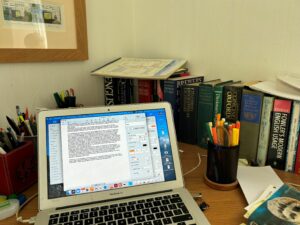
This is my primary space, where the words are typed up. I add to them, enhance them, contextualise them, read them back. I often discover that I have used a particular word or phrase twice or more. Or if there is something I’m not sure about, I look it up. The reference books help to straighten out facts and also to find alternative words. Roget’s and Brewer’s and Fowler’s and Chambers provide a wealth of information unmatched by an American-leaning internet. I admit to slipping down rabbit holes of etymology and semantics, but find it strangely satisfying.

I always have to read what has been written, in context with the book so far. Traditionally that would have meant printing the manuscript out and sitting down with a pencil. Happily, that is no longer the case. Instead (thanks to everything going up into the Cloud) I can now read and review on my iPad. This means I can lounge in a chair, or sit outside, or read whilst travelling. So it is more a case of recreating the experience of the reader to see how and if things work.

Of course, there are edits, and actual printouts sometimes, but that is basically it: pencils and pads and technology.

Oh technology, where were you when I had all those essays to write at school?

We are thrilled to be celebrating five years in business this month and we are incredibly grateful to all the writers, agents and literary estate holders who have helped us bring to market such a vibrant and diverse list of books.

Since launching Sapere Books in March 2018, our list has grown to include over six-hundred books by over one hundred authors. We have sold over 3 million books to date with 500 million pages read through Amazon’s Kindle Unlimited program.

In 2019, we employed our first full-time staff member, Natalie Linh Bolderston, who now holds the title of Assistant Editor, and in 2020, Matilda Richards and Helen Jennings both also joined our editorial team. They have all been essential to our ongoing success and we are over the moon that they are continuing the journey with us as we celebrate our first big milestone.

In 2020, we launched our non-fiction list, which includes classic works by authors such as E R Chamberlin, Sir Peter Gretton and John Bowle. And we are now pleased to announce that we are also hiring another staff member to help look after our burgeoning military history and military fiction list.

Since launching, we have focussed primarily on fiction, particularly historical fiction and crime fiction, and in 2021 we created our first historical writing contest, asking for entrants to submit a series outline loosely based on briefs we set. The response was so strong that as well as signing up five prize-winners we also signed ten more authors from the shortlisted entries.

We have always been keen to foster a community among our authors. In 2020, to combat some of the isolation due to the pandemic, we started running weekly Zooms for our authors to join and chat about their writing. These have become a valuable part of our ethos and we want to continue to make our authors feel welcomed, valued and part of the Sapere Books family.

We are also proud to announce that we have been certified Carbon Neutral since 2021 and we have created our own Sapere Books forest, planting a tree for every author that we work with.

We look forward to continuing to build strong relationships within the writing community and to publishing more brilliant genre fiction to capture the imagination of readers. Thank you again to everyone who has supported us and we hope you continue to love our books!

Amy, Richard and Caoimhe


Testimonials from four of the authors who launched with us in 2018:


David Field, author of the Medieval Saga series, the Tudor Saga series and many more 

By one of life’s happy coincidences, I came across Amy Durant just when the publisher that had commissioned my first historical novel series decided to close down. Five years later I’ve published over twenty historical novels with Sapere, with ten more waiting to go.

When you become a member of the Sapere family, you’re all set for a rewarding writing career. If the quality’s right, you know that your latest ‘baby’ will be assured of a good home. They provide great editing, superb covers, expert marketing, regular royalty payments and guaranteed replies to your emails. Sapere authors have indeed been smiled upon by the patron saint of aspiring writers.


Keith Moray, author of the Inspector Torquil McKinnon series

Being published by Sapere Books has been a revelation for me as a writer. From the very first moment that Isabel Atherton, my agent at Creative Authors, arranged a chat with Amy Durant it has been a fabulous experience. Over the past five years, I have seen my backlist of fiction published along with five new novels, and I have three more under contract. Every aspect of book production from editing, cover design, publicity and marketing has been handled with flair and efficiency. On top of that, communication could not be easier or quicker, and Sapere Books have created a friendly atmosphere among all of the authors that makes me feel pleased to be part of the Sapere Books family. I could not be happier than I have been with Sapere Books, who are in my opinion without parallel in the publishing industry.


Linda Stratmann, author of The Early Casebook of Sherlock Holmes and the Mina Scarletti Mysteries 

Becoming a Sapere Books author is like joining a warm and welcoming family, dedicated to providing the best for authors and readers. An experienced and hardworking team offers a soundly professional service, always on hand for support and advice. The last five years has seen Sapere grow and flourish, but never losing that personal touch.


Elizabeth Bailey, author of the Lady Fan Mystery series

Working with Sapere has been the most enjoyable and rewarding publishing experience in all my thirty-odd years as an author. That my career is flourishing is testament to the care and attention given to every book. Authors are encouraged to interact and support each other, which makes me feel part of a family, parented by the nurturing and talented Sapere team. Long may they reign! Oh, and we all love our covers!



Wordpress Social Share Plugin powered by Ultimatelysocial