

We are pleased to announce that we have signed an exciting new series of Tudor mysteries by Paul Walker.
In Paul’s words:
“History, in pictures, books or old buildings, has always prompted my imagining of what it must have been like all those years ago. The sixteenth century was filled with intrigue, politicking and socio-religious turmoil, and that is where I’ve put my protagonist, Doctor William Constable.
“Constable is a physician and mathematician of the stars, with a house in West Cheap, central London. He becomes involved (unwillingly, at first) in foiling plots against Queen Elizabeth, under the watchful eye of Sir Francis Walsingham.
“I am delighted to have the first four books in the series scheduled for publication by one of the most prized names in historical fiction, Sapere Books. These books cover the years 1578 to 1585 and include some well-known events and names. Work is underway on books five and six.”
Visit Paul’s website to stay up to date with his news and latest releases.
We are delighted to announce that we have signed two new books in Angela Ranson’s Catrin Surovell Tudor Mystery series: exciting historical thrillers set at the court of Elizabeth I.
Here, Angela tells us more about the series and what to expect from the latest instalments:
“I started working with Sapere Books in March 2022, when I was named as a runner-up in their first writing competition. From the very first, the people at Sapere have brought light and positivity to my writing life. They have offered real help and support, and their editing process has improved my writing enormously. Sapere has helped me understand and appreciate the many stages of writing a book.
“Or, as it has turned out, a series of books. We started out with three Catrin Surovell Tudor mysteries, and then it grew to five, and just last month it grew to seven. I was so excited to receive the latest contracts and know that I could continue to explore the character of Lady Catrin, Countess of Ashbourne and favoured lady of the bedchamber for Queen Elizabeth I. Lady Catrin is a clever and courageous woman in a dangerous world — much as Elizabeth’s real ladies of the bedchamber would have been. It was not all music, gossip, fine clothes and embroidery for these women, despite the way they are portrayed in modern movies. In real life, they had difficult battles to fight.
“Thus far, Lady Catrin has remained close to her queen at court. She has battled many villains who have tried to remove Elizabeth from her throne, or destroy the reforms the queen has put in place. She has fought against religious zealots, royal traitors and court conspirators, all with the help of her close friend Lady Lucy and a collection of people as dedicated to the queen’s service as she is. In the fourth book, Grave Merriment (which will be released in March 2026), Lady Catrin will battle two villains, each with a specific goal but one area of common ground: the desire to destroy all the queen holds dear, at the most festive time of the year.
“It is important to me that Lady Catrin’s adventures could have happened and that Lady Catrin herself could have investigated and unmasked the villains. I try very hard not to change history or give Lady Catrin more power than she would have had. I do, however, often answer historical questions that have never been answered, or create fictional scenarios that take place in parallel with a known event. That is why the fifth book in the series will focus on an event that never took place: a meeting between Elizabeth I and Mary, Queen of Scots. This meeting has been included in many fictional accounts of these two queens. Usually, the wise queen of England grows frustrated with how the reckless and impulsive Queen of Scots always ‘feeds her with fair words’ that mean nothing.
“Instead of following this trend, the fifth Catrin Surovell mystery will follow history more closely, and focus instead on why that meeting didn’t happen. Lady Catrin will be the one who learns the secret that keeps these ‘fair cousins’ apart … just in time to save their lives.”
Grave Merriment is available to pre-order now.
Visit Angela’s website to stay up to date with her news and latest releases.
As a historical novelist, I’d say that what resides in the details is a sense of place and time. Whether found by accurate research, by educated guesswork or by extrapolation, details endow fiction with a near-tangible quality that lets both the writer and the reader experience a measure of truth behind it. We ‘hear’ a long dead spy’s voice in the clipped sentences and spelling quirks of his reports, or we find a mindset in a statesman’s liking for trees and Italy.
Details are also highly addictive.
I usually begin by wanting to know something innocent — say, what fine Moroccan jewellery would have looked like five and a half centuries ago. And at four in the morning, I’m still browsing the web, and writing to friends whose spouses work in museums, or to complete strangers who happen to be historians. In the end, the (broken) Moroccan necklace will make one brief appearance — but it will look like an actual sixteenth-century one.
Once, a few books ago, I spent a happy hour in an antiquary’s shop in Venice, peppering the owner with questions about just what kind of blade a certain kind of Venetian citizen would have bought and worn, so that, in The Road to Murder, Paolo Citolini’s Venetian dagger was not just an element of the plot, but also something that his grandfather could have bought, and his father brought with him in his English exile as a piece of home.
And then there was the session of theatre rehearsals I hijacked into a demonstration of the different styles in Renaissance fencing, to see just what my protagonist, Tom Walsingham, would learn from an Italian swordsmaster. Or the museum curator who asked his mayor for leave in orderpermission to scan old cadastral maps for me. Or the kind librarian at the diocese of Paris’ archives whom I sent on a quest for the name of the bishop’s coadjutor in 1587. Most diocesan records were lost during the Revolution, and the name I wanted couldn’t be found — and yet I became fascinated with the idea of this nameless coadjutor: can he truly be only clinging to the cliff of history by a brief mention in an English diplomatic report? Someday this will be a story, too.
And what would the inn have been called in this village? And where would the great stairs have been in that long-destroyed manor house? Details — often quite small — to be happily hunted down rabbit-holes. They don’t even all necessarily end up on the page: what goes there thickens the atmosphere; what doesn’t still serves to add depth and texture and colour to the story.
Visit C. P. Giuliani’s website to stay up to date with her news and latest releases.
Following the success of her Medieval Ladies Series, we are delighted to have signed a new Thomas Middleton series by Coirle Mooney.
In Coirle’s words:
“While studying for my PhD, I became intrigued by Thomas Middleton. Who was this lesser known, younger, more dashing contemporary of Shakespeare who preferred to be called ‘Plain Tom’?
“In the first book of my new series, schoolboy Tom dreams of becoming a great poet like Kit Marlowe or William Shakespeare and draws inspiration from the daily crime pamphlets sold around St Paul’s Cathedral, as well as the preachers’ passionate sermons on vice and evil-doers. His essay wins the grand prize of a season ticket to the Lord Chamberlain’s Men, but his plan (and childhood) is derailed when his charismatic stepfather attempts to poison his beloved mother, forcing him to give up the precious prize to help pay for the lawsuit that ensues. Alongside his poetic aspiration, Tom develops a lifelong distrust of appearances and an obsession with rooting out poisoners.
“The series follows Tom down the dark alleyways of Southwarke’s lawless baiting dens, taverns, brothels, the Rose and the (newly built) rival Globe theatre, where he meets like-minded playwrights and actors who move easily between all social ranks in late Elizabethan and early Jacobean London. Tom and his fellow artisan dissidents are well placed to root out corruption in the shape of poisoners, like his stepfather, who destroy innocent lives in the pursuit of wealth, status and power.
“All three books reimagine poisonings of the time, with Tom’s character central to discovering the murderers. Book three culminates in the Overbury murder scandal, where members of the Jacobean court and their citizen accomplices were famously put on trial for the poisoning of Sir Thomas Overbury.
“I am thrilled to be working with the marvellous team at Sapere once more and grateful to have a platform worthy of plain Tom!”
We are thrilled to announce that we have signed three new instalments in the Tom Walsingham Mysteries Series by C.P. Giuliani.
The series follows the espionage adventures of Tom Walsingham during the Elizabethan era in Tudor England.
In C.P. Giuliani’s words:
“Tom Walsingham sleuths on! I’m thrilled to have signed up three more adventures featuring my Elizabethan detective and spy with Sapere Books. I have great plans for Tom. He will be tasked with recovering a misplaced foreign ambassador — whose mission could change the course of Anglo-Spanish relations; he’ll become involved in a personal investigation when death strikes at his family home, Scadbury Manor; and poor Tom will find himself in prison when his money troubles and Sir Francis Walsingham’s plans collide. Plenty of mysteries and dangers lie ahead for Tom!
“I’m really happy to be working with Sapere, whose welcoming and stimulating atmosphere and competent, friendly and helpful team have made (and are making) my publishing journey a truly lovely adventure.”
In this behind-the-scenes blog series, Sapere Books authors offer an intriguing insight into how, where and why they write.
Today, we are delighted to spotlight C.P. Giuliani, author of the Tom Walsingham Mysteries Series.
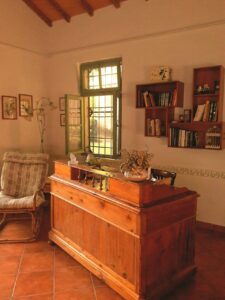
C.P Giuliani’s garden house
Every year, as soon as summer comes, I move my writing to the garden house. It’s not really cooler, as temperature goes, but it feels summery and pleasant. I love the tall ceiling, the terracotta floor, the desk that used to belong to my great-grandfather, and the view onto the garden. There’s a little pond outside the French windows, and the birds bathing or drinking are, I confess, something of a distraction — but they also provide a cheerful break whenever I find myself stuck. A paragraph refusing to take the right shape? A character mutinying? A dull passage? I step away from the desk and watch while the blackbirds play in the water — and, more often than not, a solution will suggest itself.
For all its rustic pleasantness, the garden house has decent Wi-Fi — which is rather essential when my pile of reference books is not enough to confirm some detail — and is equipped with an electric kettle to make cup after cup of tea, which is a fundamental of my writing method.
In truth, beyond the insane amounts of tea, I have little in the way of a writing routine. Working in theatre means that my hours are flexible. Sometimes I write in the morning, sometimes very late at night, sometimes both; sometimes I must snatch the odd hour here and there, between a rehearsal session and a meeting with the techs. One thing I do is to always keep a notebook with me. Through the years, I’ve learnt to keep a dedicated notebook for each project, beside a general one for everything and anything: notes, stray ideas, snatches of dialogue overheard or imagined, lists, questions… It’s the general notebook that I carry around, so I can jot down anything that occurs to me — to be transferred to the relevant one later. This means that I do some of my writing at the theatre, at the vet’s, as I stand in a queue at the Post Office…
My family, friends and colleagues have developed a high degree of amused tolerance for my ‘Notebook Moments’, when I drop whatever I’m doing to take a note; strangers are occasionally a little put out until I explain that, for one thing, I’m prone to forgetting what I don’t write down and, for another, sometimes an idea will present itself in a very iridescent shape, little more than a flicker of colour under the surface of the water — and will need to be recorded quickly and thought through in writing, at least a little, if it’s to be of any use.
So to recap, I’m absent-minded, easily distracted, forgetful, and can’t keep a routine… I suppose it’s no wonder that a quiet, pleasant place like the garden house is important to my writing process.
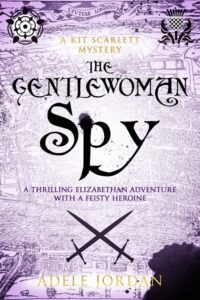
The first book in the Kit Scarlett Mystery series
Following the success of Adele Jordan’s absorbing Kit Scarlett Tudor Mysteries, we are delighted to announce that we have signed her new series of Tudor thrillers.
In Adele’s words:
“I’m thrilled to be working with Sapere Books once more on my new series, The Shadow Cutpurses. This first instalment is the culmination of a lot of research into the Tudor era and a fascination with women’s lives outside of the royal court. This tale about cutpurses or thieves is a thriller, looking at what can happen when a woman at the bottom of the hierarchy is pitted against a man of ultimate power.
“My hope is that every page is a thrilling step in Gwynnie’s adventure. I hope that fans of my first series will find the same pace and spirit of adventure in this series, while plunging into the darkness of life during a slightly different period of Tudor history. It’s been a great joy to work with the Sapere family, and my huge thanks goes to Amy, Caoimhe, Richard and Natalie, for their support. My thanks also have to go to the other authors with Sapere, who through our chats have helped me to improve my writing.”