

We are thrilled to announce that we have signed three new instalments in the Tom Walsingham Mystery Series by C. P. Giuliani.
The series follows the espionage adventures of Tom Walsingham during the Elizabethan era in Tudor England.
In C. P. Giuliani’s words:
“I’m thrilled to be working with Sapere Books on three more instalments in my Tom Walsingham mystery series. As I researched the previous books, I kept coming across material and inspiration for more stories, so I proposed them to Amy Durant, and she accepted at once. This is one of the reasons why working with Sapere is so rewarding: the enthusiasm of a very skilled and friendly team.
“Following the death of Tom Walsingham’s influential kinsman and mentor, spymaster Sir Francis Walsingham, Tom thinks his career in intelligence is finished — but he will soon discover that one is never quite done with a life in espionage! As he becomes reluctantly entangled in the troubles of wayward poet Kit Marley and Queen Elizabeth’s physician Dr Roderigo Lopes, Tom will encounter new foes, new allies, visit new places, and grapple with new cases of murder and intrigue — and he will have to do it all without Sir Francis’s powerful network at his back.
“I can’t wait to plunge into Tom’s new adventures — actually, I’m already at work on Book Ten — and all because the lovely team at Sapere still make the journey as enjoyable and stimulating as they did with Book One.”
Death at Home is available from Amazon now.
Visit C. P. Giuliani’s website for all her latest news or follow her on X.
As a historical novelist, I’d say that what resides in the details is a sense of place and time. Whether found by accurate research, by educated guesswork or by extrapolation, details endow fiction with a near-tangible quality that lets both the writer and the reader experience a measure of truth behind it. We ‘hear’ a long dead spy’s voice in the clipped sentences and spelling quirks of his reports, or we find a mindset in a statesman’s liking for trees and Italy.
Details are also highly addictive.
I usually begin by wanting to know something innocent — say, what fine Moroccan jewellery would have looked like five and a half centuries ago. And at four in the morning, I’m still browsing the web, and writing to friends whose spouses work in museums, or to complete strangers who happen to be historians. In the end, the (broken) Moroccan necklace will make one brief appearance — but it will look like an actual sixteenth-century one.
Once, a few books ago, I spent a happy hour in an antiquary’s shop in Venice, peppering the owner with questions about just what kind of blade a certain kind of Venetian citizen would have bought and worn, so that, in The Road to Murder, Paolo Citolini’s Venetian dagger was not just an element of the plot, but also something that his grandfather could have bought, and his father brought with him in his English exile as a piece of home.
And then there was the session of theatre rehearsals I hijacked into a demonstration of the different styles in Renaissance fencing, to see just what my protagonist, Tom Walsingham, would learn from an Italian swordsmaster. Or the museum curator who asked his mayor for leave in orderpermission to scan old cadastral maps for me. Or the kind librarian at the diocese of Paris’ archives whom I sent on a quest for the name of the bishop’s coadjutor in 1587. Most diocesan records were lost during the Revolution, and the name I wanted couldn’t be found — and yet I became fascinated with the idea of this nameless coadjutor: can he truly be only clinging to the cliff of history by a brief mention in an English diplomatic report? Someday this will be a story, too.
And what would the inn have been called in this village? And where would the great stairs have been in that long-destroyed manor house? Details — often quite small — to be happily hunted down rabbit-holes. They don’t even all necessarily end up on the page: what goes there thickens the atmosphere; what doesn’t still serves to add depth and texture and colour to the story.
Visit C. P. Giuliani’s website to stay up to date with her news and latest releases.
Congratulations to C. P. Giuliani, whose absorbing historical thriller, A Matter of Blood, is out now!
A Matter of Blood is a page-turning espionage adventure set in Tudor England. It is the sixth book in the Tom Walsingham Mysteries series.
London, 1588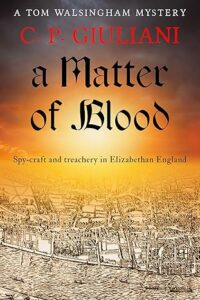
Mary Stuart, the deposed Queen of Scots, polestar of all Catholic intriguers, and a life-long danger to England has met the executioner’s axe.
But many of her supporters still hold influential positions in Paris and her death has not endeared England to the French.
Unbeknownst to the Queen of England, her spymaster, Sir Francis Walsingham, had more than a little to do with manipulating her into finally condemning her cousin.
And now a letter has been leaked exposing Walsingham’s secret to the Queen’s ambassador in Paris, Sir Edward Stafford.
There is no love lost between Stafford and Walsingham and the ambassador will happily expose his nemesis, no matter the consequences for England.
Walsingham instructs his cousin Tom to travel to Paris to quell the rumours and discover Stafford’s intentions. But then a troublesome Catholic leader, a kinsman of Stafford’s, is suspected to have been poisoned, and Tom finds himself embroiled in another mystery.
Can Tom win the trust of Stafford? Will he save his cousin’s reputation?
Or will the Parisians seek revenge on this hapless Englishman…?
We are thrilled to announce that we have signed three new instalments in the Tom Walsingham Mysteries Series by C.P. Giuliani.
The series follows the espionage adventures of Tom Walsingham during the Elizabethan era in Tudor England.
In C.P. Giuliani’s words:
“Tom Walsingham sleuths on! I’m thrilled to have signed up three more adventures featuring my Elizabethan detective and spy with Sapere Books. I have great plans for Tom. He will be tasked with recovering a misplaced foreign ambassador — whose mission could change the course of Anglo-Spanish relations; he’ll become involved in a personal investigation when death strikes at his family home, Scadbury Manor; and poor Tom will find himself in prison when his money troubles and Sir Francis Walsingham’s plans collide. Plenty of mysteries and dangers lie ahead for Tom!
“I’m really happy to be working with Sapere, whose welcoming and stimulating atmosphere and competent, friendly and helpful team have made (and are making) my publishing journey a truly lovely adventure.”
In this behind-the-scenes blog series, Sapere Books authors offer an intriguing insight into how, where and why they write.
Today, we are delighted to spotlight C.P. Giuliani, author of the Tom Walsingham Mysteries Series.

C.P Giuliani’s garden house
Every year, as soon as summer comes, I move my writing to the garden house. It’s not really cooler, as temperature goes, but it feels summery and pleasant. I love the tall ceiling, the terracotta floor, the desk that used to belong to my great-grandfather, and the view onto the garden. There’s a little pond outside the French windows, and the birds bathing or drinking are, I confess, something of a distraction — but they also provide a cheerful break whenever I find myself stuck. A paragraph refusing to take the right shape? A character mutinying? A dull passage? I step away from the desk and watch while the blackbirds play in the water — and, more often than not, a solution will suggest itself.
For all its rustic pleasantness, the garden house has decent Wi-Fi — which is rather essential when my pile of reference books is not enough to confirm some detail — and is equipped with an electric kettle to make cup after cup of tea, which is a fundamental of my writing method.
In truth, beyond the insane amounts of tea, I have little in the way of a writing routine. Working in theatre means that my hours are flexible. Sometimes I write in the morning, sometimes very late at night, sometimes both; sometimes I must snatch the odd hour here and there, between a rehearsal session and a meeting with the techs. One thing I do is to always keep a notebook with me. Through the years, I’ve learnt to keep a dedicated notebook for each project, beside a general one for everything and anything: notes, stray ideas, snatches of dialogue overheard or imagined, lists, questions… It’s the general notebook that I carry around, so I can jot down anything that occurs to me — to be transferred to the relevant one later. This means that I do some of my writing at the theatre, at the vet’s, as I stand in a queue at the Post Office…
My family, friends and colleagues have developed a high degree of amused tolerance for my ‘Notebook Moments’, when I drop whatever I’m doing to take a note; strangers are occasionally a little put out until I explain that, for one thing, I’m prone to forgetting what I don’t write down and, for another, sometimes an idea will present itself in a very iridescent shape, little more than a flicker of colour under the surface of the water — and will need to be recorded quickly and thought through in writing, at least a little, if it’s to be of any use.
So to recap, I’m absent-minded, easily distracted, forgetful, and can’t keep a routine… I suppose it’s no wonder that a quiet, pleasant place like the garden house is important to my writing process.
Congratulations to C. P. Giuliani, whose gripping espionage thriller, A Snare of Deceit, is out now!
A Snare of Deceit is a page-turning adventure set during the Elizabethan era in Tudor England. It is the fifth book in The Tom Walsingham Mysteries series.
London, 1587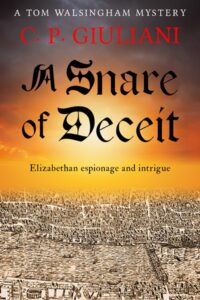
A new year is being celebrated at Greenwich Palace, but not everyone is in the mood for rejoicing.
Mary Stuart, the imprisoned Queen of Scots has been officially declared a traitor. But Queen Elizabeth is reluctant to sign the death warrant and her mood has been downcast, even in the middle of the festivities.
And the night is soured further when one of the performers is found dead in the tiltyard.
The show must go on, but Tom Walsingham, spying for his cousin Sir Francis, stays behind to investigate. The dead man was no ordinary player, but a man called Jack Perkin, who Tom knew was meant to be passing information to the queen’s confidants about a plot against her life.
With Perkin’s death unlikely to be an accident, Tom feels the danger of the murderous plot escalating out of control. And the player was killed before he could pass on his warning.
But that would place the murderer at court. And dangerously close to the queen…
Can Tom find the killer? Will he uncover the deadly plot?
Or will the web of deceit close in on him…?
Congratulations to
A Deadly Complot is the fourth book in The Tom Walsingham Mysteries series.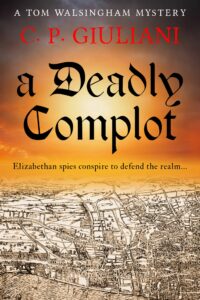
England, 1586
Tom Walsingham has been tasked with keeping watch over the network of spies recruited by his spymaster cousin, Sir Francis Walsingham.
After intercepting a series of letters sent to and from Chartley Castle, where Mary Queen of Scots has been imprisoned, the spies have infiltrated a ring of Catholic plotters. Led by the zealous Anthony Babington, the conspirators plan to murder Queen Elizabeth and replace her with Mary, thus restoring Catholicism to the realm.
With most of the plotters under careful observation, the spies have only to wait for the right moment to have them arrested. However, when one of the spies’ couriers — Isaac Finch — is murdered, it seems that Babington’s conspirators may suspect that they have informers in their midst.
Fearing that Finch may have been forced to reveal the spies’ plans, Tom vows to find out who killed him.
As he follows the sinister trail, Tom discovers that there is no shortage of people who may have wished Finch harm. And with the queen and the realm under threat, the pressure is on to solve the mystery before any more of Sir Francis’s recruits are lost…
Have Sir Francis’s spies been discovered? Is there a traitor in their midst?
And can Tom unravel the courier’s fate before Babington’s plotters act on their treasonous scheme…?