

From twisty mysteries and Roman adventures to exciting tales of historical privateers — there’s something exciting here for everyone. Scroll down to discover this month’s titles from your favourite Sapere authors.
January’s Fiction Releases
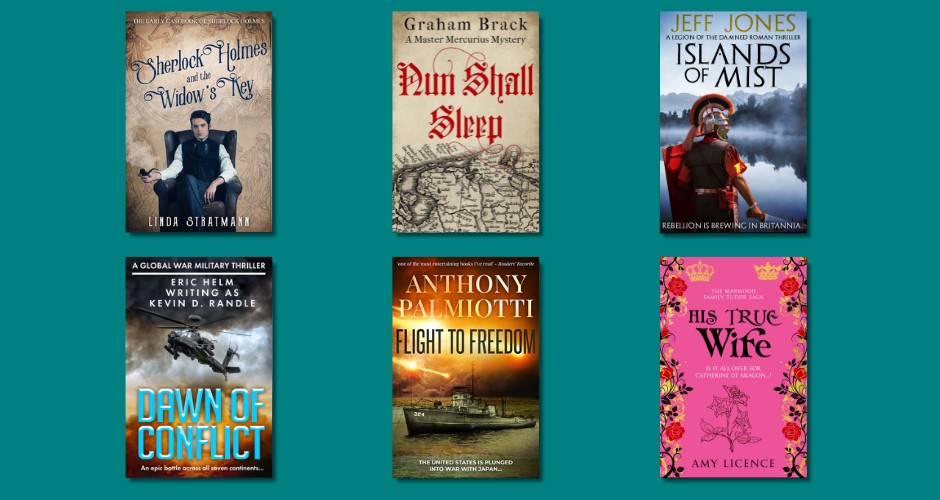
Sherlock Holmes and the Widow’s Key by Linda Stratmann is the tenth book in The Early Casebook of Sherlock Holmes series. In this instalment, Holmes and Stamford investigate the death of a mysterious widow — and make a gruesome discovery in the process.
Nun Shall Sleep by Graham Brack is the ninth book in the Master Mercurius Mystery series: atmospheric crime thrillers set in seventeenth-century Europe. In his latest adventure, Mercurius is drawn into strange — and possibly sinister — happenings at a convent.
Islands of Mist by Jeff Jones is the third book in the Legion of the Damned Roman Thrillers series: action-packed military adventures set in Ancient Rome. For their latest mission, Centurion Marcus Corvo and his men must prevent or crush a suspected rebellion in Britannia.
Dawn of Conflict by Eric Helm is the first book in the Global War Military Thriller Series. In this alternative-history thriller set in the late twentieth century, a series of stunning geopolitical changes destabilizes a dozen major governments around the globe, pitching the armies of each nation into world warfare.
Flight to Freedom by Anthony Palmiotti is a tense World War Two naval adventure. When the Japanese bomb Pearl Harbor, the United States is plunged into war. As one of the few remaining ships in the region, the Tanager is called to evacuate Army nurses and those fleeing from the enemy.
His True Wife by Amy Licence is the fifth book in The Marwood Family Tudor Saga series. In the latest instalment, Catherine of Aragon prepares for the Legatine Court, while lady-in-waiting Thomasin Marwood awaits a marriage proposal from the man she loves.
January’s Fiction Backlist Releases
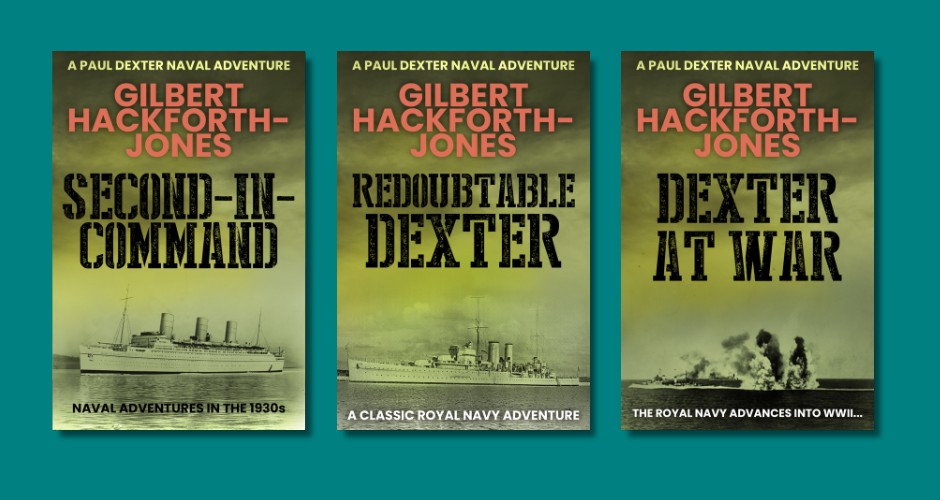
We are pleased to announce that the fifth, sixth and seventh instalments of Gilbert Hackforth-Jones’ gripping Paul Dexter Naval Adventures series are out now! Don’t miss these entertaining and action-packed tales of life at sea.
January’s Non-Fiction Releases
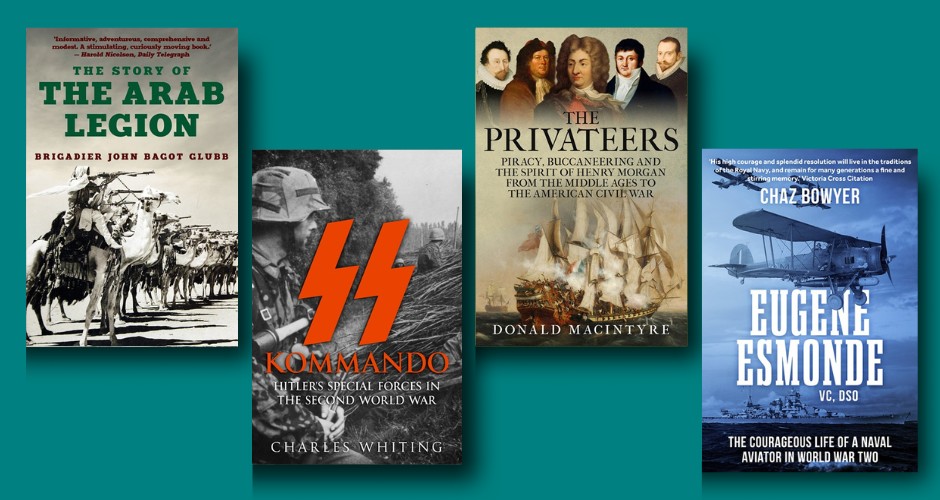
The Story of the Arab Legion by John Bagot Glubb is a fascinating personal account of the development of the Arab Legion as a formidable fighting force from the 1930s to the Second World War.
SS Kommando by Charles Whiting is a compelling read for anyone interested in Kommando operations throughout World War Two — the men involved, their leaders and rivals under the Führer, and the desperate tactics employed in the face of defeat.
The Privateers by Donald Macintyre charts the golden age of privateering — from its Elizabethan origins, through the daring exploits of British and French buccaneers against Spanish treasure ships, to its eventual outlawing and brief revival during the American Civil War.
Eugene Esmonde, V.C., D.S.O. by Chaz Bowyer is a moving biography of a remarkable pilot who received a posthumous Victoria Cross for courageous but fatal actions during World War Two.
Happy Reading! Team Sapere
Congratulations to Jeff Jones, whose exciting Roman adventure, Fortress of Steel, is out now!
Fortress of Steel is the first book in the Legion of the Damned Roman Thrillers series.
Rome, 59 AD
When the son of his commanding officer is taken prisoner, young centurion Marcus Corvo is tasked with recruiting men from the underbelly of the Empire to rescue him.
Corvo sets about scouring the gladiatorial arenas, prisons and slave markets, for men desperate and tough enough to join him on what is likely to be a suicide mission.
The quest will take them to the eastern fringes of the Empire where the prisoner is being held in Armenia.
Corvo attempts to mould his recruits into a cohesive fighting force, but long before they are ready they are ordered to leave.
In a land where brother fights brother, and where Corvo and his men could easily be mistaken for the enemy or deserters, Corvo must keep his wits about him as they cross hostile land.
Can Corvo keep his wilful legion of men in line? Will they work together to complete the task?
Or will the journey prove too perilous for even the most hardened men of Rome…?
Congratulations to Neil Denby, whose action-packed Roman adventure, Scutarius, is out now!
Scutarius is the fifth book in the Quintus Roman Thrillers series.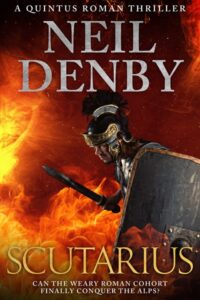
In the high Alpen lands, Tiberius, General, Praetor, son of Caesar Augustus, is incensed by the insolence of the native tribesmen who dare to oppose him.
First Spear Centurion Julius Quintus Quirinius and his depleted cohort are posted behind enemy lines to eliminate them. They are to be irregulars, to act as shield-bearer or ‘scutarius’ to Tiberius’ armies, keeping the way before them clear.
If they succeed, Quintus and his men could win back their rightful ranks and stations in the legions. And might even finally be allowed to return to Rome.
But unfamiliar with the rapid turning of the seasons in the mountains, Quintus finds himself trapped by snow and lost in the vast lands of the enemy.
He needs to find a way forward, to do service to Caesar’s sons, but the task seems increasingly impossible.
Can Quintus find his way back to the battle? Could victory in the Alps be in his grasp?
Or will the fickle gods once more betray him…?
We are delighted to announce that we have signed a new trilogy of Roman mysteries by Jacquie Rogers.
In Jacquie’s words:
“My new series is set in a wealthy but remote part of third-century Roman Britain.
“Otto Cornelius is a garlanded senior officer in Chester’s XXth legion. Forced to take early retirement, he returns to his hometown of Viroconium Cornoviorum (now Wroxeter Roman City in Shropshire).
“He soon discovers that the quiet life of a pensioned-off officer is no sinecure, and Viroconium is no longer the idyll of his childhood. The murder of an itinerant Greek merchant, coupled with the theft of the iconic Wroxeter silver mirror, are just the beginning. Otto is quickly embroiled in a dangerous conspiracy, one in which old friends and new enemies have much to hide. No-one is who they seem, including Otto himself.
“I am so delighted to be working with Sapere Books. Their passion for historical fiction matches my own, and I’ve had the warmest of welcomes into their supportive organisation. I know my pacy Roman thrillers have found a wonderful home.”
Alistair Forrest is the author of the action-packed Roman adventures Sea of Flames, Libertas and Vipers of Rome. He is currently working on a new series, The Britannia Conspiracy, set in the period during Caesar’s invasion of Gaul.
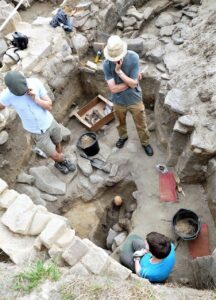
A 3,000-year-old skeleton. Photo: David Nash
Every year I climb into old jeans, don an Indiana Jones-style hat, and dash a hundred yards down the road to assist in an archaeological dig.
I live on the island of Alderney, which just happens to have an ancient Iron Age settlement, on top of which is a Roman village. Next to this is one of Europe’s best-preserved Roman forts, which was built to protect trade routes between Europe and Britain.
I’ve got to know both of the lead archaeologists — Dr Phil de Jersey and Dr Jason Monaghan — and confess that I’d like to know what they know, as long as it fits my ideas for a new historical fiction series.
So far I’ve struck lucky.
We know for sure that Iron Age folk lived and loved on this tiny island a few miles off the Normandy coast. We’ve found the skeletons, complete with bronze torcs and jewellery.
Our team, Dig Alderney, is bent (both literally and figuratively) on scraping away aeons of history to find the story behind these settlements. And at every layer we have been able to confirm that the Romans first came to this Channel Island in around 56 or 55BC when Julius Caesar was conquering Gaul and had set his sights on Britain, just across the English Channel.
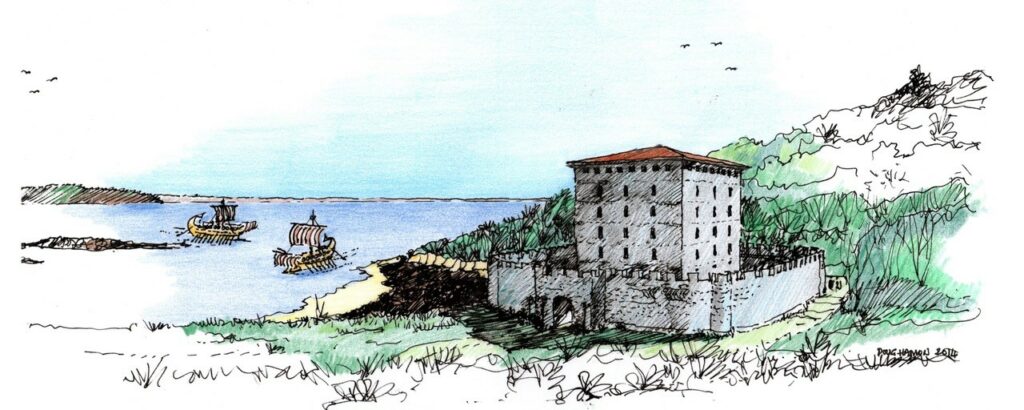
Artist Doug Hamon’s impression of the Roman fort.
Later, the Romans built a fort which has stood intact since the 4th century. Sadly, the huge central tower has long gone, its stonework no doubt used to build medieval houses in the vicinity, and part of the south wall tumbled onto my local beach who knows when, where its parts can still be seen to this day.
The area is crowded with archaeological features. Some relate to German activity (Alderney was occupied during the Second World War) or Victorian fortifications inside and around the fort. Modern roads partly conceal what we know is an Iron Age cemetery discovered in 2019.
Two skeletons were discovered back then. That’s when I got involved after arriving on the island to write, and I was given backroom jobs like pot-washing, shovelling and making sandwiches. Just to be there was a privilege!
This is now a long-term project to learn more about the Roman and Iron Age settlement on Longis Common, a few yards from my home. How extensive is the Iron Age cemetery, and where was the village in which these people lived?
We hope to discover how far the Roman buildings extend, and if this was the site of an earlier Roman fort that predated the 4th century one, or the vicus municipal administration settlement that grew up close to a fort, or a purely civilian village?
Of course, I already know the answers because they’re in my head, as you would expect from an adventurous historical fiction author.
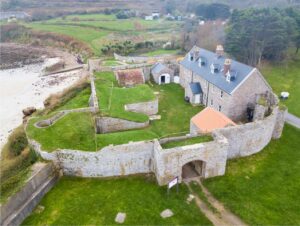
Alderney’s Roman fort today. Photo: Alan Perks
I know I’m on to a winner. Take this exuberant comment by Dr Monaghan: “Finds include pottery, metalwork, glass, building materials, human bones and food remains including animal bones. The finds need to uncover more about the people who lived and were buried there. We want to learn about their lifestyle and how ancient Alderney was connected to the wider world.”
I’d call it making the facts fit a good story, and I’m already well into book two of The Britannia Conspiracy series. This series begins with coded messages from Julius Caesar to attend a secret conference on this island to plan his expeditions to Britain.
Should it be a full-on invasion, or a trade expedition? Either way, he’s in for some surprises, especially as far as the local Celts are concerned!
In this behind-the-scenes blog series, Sapere Books authors offer an intriguing insight into how, where and why they write.
Today, we are delighted to spotlight Alistair Forrest, author of Sea of Flames, Libertas and Vipers of Rome.
For some authors, inspiration is a flash of instant eureka. For me, it’s been more like evolution.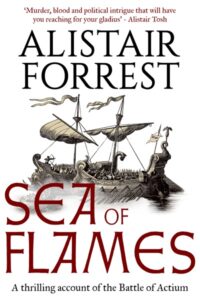
I had never intended to write historical novels centred on the late Roman Republic, but it became inevitable when I moved to Spain with my wife, two-fifths of our children and assorted pets.
Our new home had been built slap bang in the middle of an ancient battlefield. More about that later.
For me, inspiration began in an English lesson at boarding school. One day, evening prep was to write an essay on Macbeth and I hadn’t got a clue how to answer the question. So I flipped to the cover of my textbook, which featured an image of Dunsinane Castle and the encroaching Birnam Wood.
I used my embryonic creative writing skills to describe the scene and thus avoid answering the question, hoping my talent would impress the English teacher, Patrick Cormack.
He wasn’t impressed. He called out my feeble effort in front of Class 4R, announcing that my work was too descriptive, and I wanted the ground to open up and swallow me. But the truth is, I really enjoyed writing that essay.
 If I had ever summoned the courage to discuss career options with him, he would have said ‘Go and be an accountant’ or something like that. But while he became a politician with a knighthood and later Lord Cormack, I became a humble journalist. Yes, I could write.
Years later, on the publication of my first novel, Libertas, Lord Cormack was kind enough to give me an endorsement. “Forrest has the gift of a true storyteller,” he said, with a hint of a chuckle in his email.
My journalism career provided further inspiration. As a pimply cub reporter on the South Wales Echo, the terrifying news editor would peer down the vast newsroom to see who was slacking. The ‘punishment’ was to be handed the latest novel supplied by a hopeful publisher and told to review it by the next day. This happened to me frequently, and I never objected.
Among the many was Gateway to the Gods by Mary Teresa Ronalds, a magical excursion into the ancient world of Babylonia. It clicked for me, because as a child and teenager, I had lived in three Middle Eastern countries. From that moment, I wanted nothing more than to be a writer of ancient stories.
Leap forward decades, and that move to Spain. My wife and I chose a house amid well-tended olive groves in an upland valley opposite Monda (ancient Munda), a charming village in the Sierra de las Nieves Natural Park, not far inland from Marbella.
And it didn’t take long to discover that Julius Caesar had marched his crack legions through our garden.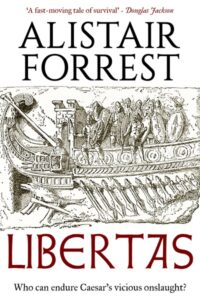
I started writing Libertas, revelling in the scenery and culture, and imagining what the community might have been like when Caesar came.
I developed the theme of an indigenous people who were creative and inventive in their own right. They understood herbcraft and lacked nothing for a full, healthy life.
The hero in Libertas is not a warrior but a thinker. He is appalled at the horror that Rome brings to his hometown.
Living in the same community as my protagonist, separated by centuries in which nothing much happened between Caesar and Franco, enabled me to add colour and feeling to my imagined community of bakers, brewers and cheesemakers.
Happily I can refer to a comment by the Historical Novel Society’s reviewer: “Forrest makes us care about Munda. He captures the tragedy of a people dragged into the horror of a vicious war brought about by circumstances over which they had no control and could hardly understand.”
Such a contrast to my teacher’s comment on my Macbeth essay. But let’s face it, his comment was where inspiration began for me.
Congratulations to
42BC
Two years on from Julius Caesar’s assassination, his successors still crave vengeance. The massed legions of the new Caesar, Octavian, and Mark Antony face off against Cassius and Brutus at Phillipi.
Leading the charge for New Rome are primus pilus Titus Villius Macer and his optio, Crispus.
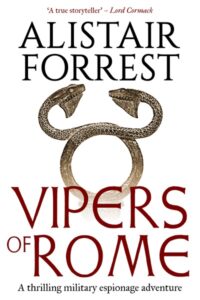
Their heroics come to the attention of Octavian’s spymaster, Marcus Vipsanius Agrippa, who recruits them for his Viper network of spies.
Their mission: Return to Titus’s native Sicilia to gather intelligence on its current ruler, Sextus Pompey.
But when Titus and Crispus arrive in Sicilia, they find much has changed while they’ve been fighting with the Fifth Legion.
The woman Titus came home to marry has grown cold and he must face up to domestic troubles while trying to help Agrippa restore Sicilia to Roman rule.
Suspecting a plot to assassinate Rome’s new rulers, Titus will face savage sea warfare against the local pirate fleet.
Can he uncover the deadly plot? Will he save another Caesar from assassination?
And can he save his family from the ravages of war…?
In this behind-the-scenes blog series, Sapere Books authors offer an intriguing insight into how, where and why they write.
Today, we are delighted to spotlight Neil Denby, author of the Quintus Roman Thriller series.
Inspiration can come at any time of the day or night, but I find that the small hours are awash with ideas — plot lines, character development, a resolution to a particularly tricky scenario — so it is important that I keep a notepad and pencil by the bed. It may be old-fashioned but it is also reliable and has the advantage of not involving bright screens.
Frustratingly, come morning, I cannot always decipher what I have written down, but sometimes there are gems. These may be character or plot evolution, or perhaps just phrases, but I know I would have forgotten them completely if I had not made a note.
While out walking — an excellent way to clear the brain of fog — I defer to modern technology and record voice notes on my mobile phone. The same principle applies — if there is no immediate record, the thoughts can be lost.
These brief lines are later transferred to a laptop. This is strategically placed in a corner of my study so that I am not distracted by the view outside the window. A row of reference books and one of my favourite possessions, an original Steve Bell cartoon, are all that I have for company. It also helps if I can visualise a character or a place, so I keep a sketchpad on my desk where I can create basic images — maps, plans, sometimes the progress of marches or battles. These drawings help to maintain consistency and authenticity.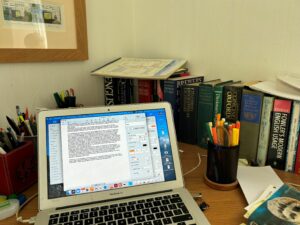
This is my primary space, where the words are typed up. I add to them, enhance them, contextualise them, read them back. I often discover that I have used a particular word or phrase twice or more. Or if there is something I’m not sure about, I look it up. The reference books help to straighten out facts and also to find alternative words. Roget’s and Brewer’s and Fowler’s and Chambers provide a wealth of information unmatched by an American-leaning internet. I admit to slipping down rabbit holes of etymology and semantics, but find it strangely satisfying.
I always have to read what has been written, in context with the book so far. Traditionally that would have meant printing the manuscript out and sitting down with a pencil. Happily, that is no longer the case. Instead (thanks to everything going up into the Cloud) I can now read and review on my iPad. This means I can lounge in a chair, or sit outside, or read whilst travelling. So it is more a case of recreating the experience of the reader to see how and if things work.
Of course, there are edits, and actual printouts sometimes, but that is basically it: pencils and pads and technology.
Oh technology, where were you when I had all those essays to write at school?
Congratulations to Alistair Forrest, whose action-packed Roman adventure, Libertas, is out now!
Hispania Ulterior, 51 BC
The son of a baker, young Melqart has lived all his life in Munda — an idyllic mountain town untouched by the troubles of Rome.
But when General Pompey sends his sons, Gnaeus and Sextus, to create strongholds and raise new legions, the citizens of Munda find themselves pulled into Rome’s conflicts. Recognising Melqart’s talents as an engineer and strategist, Sextus soon recruits him to his cause.
As tensions between Pompey and his political rival, Julius Caesar, reach breaking point, it seems that Munda is set to become a battleground.
And as darkness begins to fall over his beloved homeland, Melqart must summon all of his courage and ingenuity to save his community from destruction…
Congratulations to Alistair Forrest, whose gripping Roman adventure, Sea of Flames, is out now!
33BC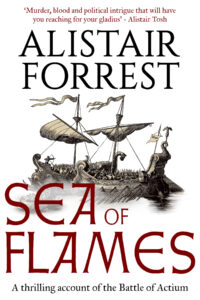
On landing in Ephesus to trade, Lachares, a Greek sea merchant, is seized and unfairly executed by Mark Antony, the triumvir of Rome’s eastern provinces.
Lachares’ crew are left to deliver the news to his son, Eurycles, the governor of a Greek trading post. Horrified, Eurycles vows to take revenge on Mark Antony.
With conflict brewing between Antony and his greatest political rival, Octavian Caesar, Eurycles is invited to work against Antony’s cause by smuggling two defectors out of his camp. Eager for an opportunity to get close to his enemy, Eurycles pledges his ship and men to Caesar.
Now embroiled in the deadly machinations of spies and defectors, Eurycles must decide who he can trust.
And when Mark Antony’s legions land in Actium and begin to prepare for an all-out war, Eurycles starts to wonder whether he will survive long enough to exact his revenge…
Congratulations to Neil Denby, whose absorbing Roman adventure, Optio, is out now!
Optio is the third book in the Quintus Roman Thrillers series: action-packed, authentic historical military adventures set in Ancient Rome.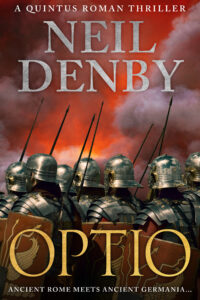
Julius Quintus Quirinius, Decanus of his contubernium, has failed in his mission to secure a bridgehead in Britannia for the emperor Augustus.
Despite their failure, they have collected valuable intelligence from the British tribes that they are keen to share with Augustus, hoping that will restore their reputation.
Together with his rescued comrades, Quintus flees the misted isle of the enemy and begins the long and treacherous journey home.
Once they locate the remnants of their cohort, Quintus is promoted to Optio and tasked with leading his men against rebel Germanic tribes.
Success could mean a fast route back to Rome and the favour of the emperor. But failure means an almost certain death.
When disaster strikes, can Quintus rescue the honour of Rome and lead the cohort to safety?
Or will the odds once more refuse to fall in their favour…?
Neil Denby is the author of the Quintus Roman Thrillers series: action-packed, authentic historical military adventures set in Ancient Rome.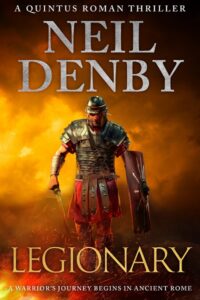
No doubt you are familiar with the major Roman gods: mighty Jupiter/Jove of the thunderbolts, king of the gods; Juno, his wife and the protector of the community; and their sons, Mars, god of war and lame Vulcan, god of the forge. Perhaps you also know that these were pretty much taken wholesale from the Greeks: Zeus does thunderbolts and lightning, and Hephaestus the blacksmith limps. However, unlike the Greek gods, who had their home on top of Mount Olympus, their Roman equivalents lived in forests, rivers and seas, at crossroads (compitalia) and boundaries and, if important enough, in temples.
The legionary soldier was as superstitious as the next Roman, perhaps even more so. Each had family gods, and needed not only to appease the gods, but to avoid offending them. The protagonist in my book series, Quintus, reveres Ceres, as goddess of agriculture. His comrade, Crassus, reveres Vulcan of the forge, while another comrade, Sextus, reveres Mercury, god of thieves and tricksters.
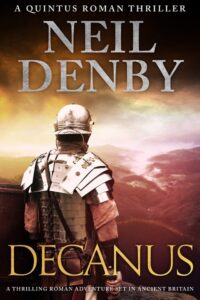 It was a central part of legionaries’ duties to carry out the correct sacrifices, with the right animals, on the designated days. If this was not possible, a legionary or officer would become a priest himself — a simple matter of covering one’s head — and make the necessary requests and offerings. One of my characters, Tullius, will sacrifice anything to appease the gods (a seal, a mouse, a cockroach), whilst Sextus is adept at reading omens, auguries and stars, as seen in Legionary.
The gods were invoked for good fortune, honoured with sacrifices and remembered on particular occasions. The oddest thing about Roman gods was the number of them that started their life as humans. When it came to turning actual people into divine beings, the Romans did not hold back. Romulus, founder of Rome, had a temple, and the shepherd’s hut in which he and his brother had lived still stood in Rome 700 years after his death. Julius Caesar claimed descent, via Aeneas, from Venus.
With Caesar’s death came what is referred to as the ‘imperial cult’. After his assassination and on the orders of the victors of Actium, he became a god — Divus Julius — gaining temples, priests and sacrifices. The newly minted Augustus (previously Octavian) became divi filius — son of a god — one of the titles he most loved. Other emperors followed, including both Augustus and his wife.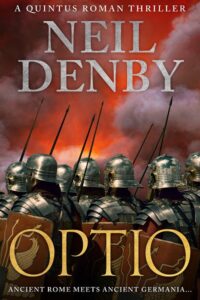
The legionaries in my stories refer to Julius Caesar as the general, the dictator or Divine Julius, depending on how well they knew him. He was assassinated in 44BC, less than thirty years before the beginning of the first book, Legionary. This is within living memory for many of my characters; indeed, the veteran Marcus served under Caesar as a young man.
There were countless gods that fell in and out of fashion, including all the souls of the departed. Larés and manés were the minor gods that represented the benevolent souls of the dead, whilst the lemurés were reckoned to be malevolent.
Religion thus permeated every aspect of a soldier’s life. They were all gods-fearing, if not gods-bothering — though they may have actually met some of those who were deified!