

From action-packed naval thrillers and gripping stories of military heroism to captivating travel memoirs, there’s something exciting here for everyone. Scroll down to discover this month’s titles from your favourite Sapere authors.
April’s Fiction Releases

Tenacious by Jonathan Eyers is the first book in the Newt Beresford Naval Adventures series: Age of Sail historical adventures set in the 18th century. When Newt Beresford joins the frigate HMS Tenacious, he soon finds himself increasingly isolated on a ship full of whispered secrets, coded names, mysterious symbols and threatening messages.
A Miracle of Deliverance: A Dunkirk Short Story Anthology is a collection of linked short stories that commemorate the evacuation of Dunkirk in 1940. From a British soldier reflecting on the chaos of war, to a naval lieutenant doing his best to save the army from complete disaster, each of these stories reveals the heroic actions and deeply moving stories of the men and women who took part in this remarkable evacuation.
The Blooding of Jack Absolute by C. C. Humphreys is the first book in the Jack Absolute Military Adventure series: page-turning historical thrillers set in the 18th century. Can young Jack endure bloody battles in a wild landscape?
The Cold Light of Day by Stephen Taylor is the second book in the Augustus Swift Investigations series: chilling historical mysteries set in 18th-century London. Can Augustus Swift track down the ‘Beast of London’ before there are any more deaths?
Border Winds by Eric Helm is the second book in the Global War Military Thriller series. The world war has reached America’s backyard in this alternative-history military adventure set in the 20th century.
A Trace of Memory by Elizabeth Bailey is a quirky historical romance set in Georgian England with an intriguing twist. How can Elaine trust her heart if she can’t remember who she is?
Speculator by Neil Denby is the sixth book in the Quintus Roman Thrillers series. Centurion Julius Quintus Quirinius and his comrades are pushed to their limits in this action-packed military adventure set in Ancient Rome.
April’s Fiction Backlist Releases

We are pleased to announce that Flotilla Attack and Operation Chariot by Charles Whiting writing as Duncan Harding are now available from Amazon. Don’t miss these page-turning historical naval adventures set during the Second World War.
April’s Audio Releases

Lose yourself in a great audiobook this month!
Can an enterprising thief unmask a murderer? Find out in Murder at Greenwich Palace by Adele Jordan.
Discover a thrilling police procedural with an unexpected twist in Lying and Dying by Graham Brack.
The war is intensifying for the Secret Sirens in The Night Angels by D. R. Bailey.
A young centurion is sent on a suicide mission in Fortress of Steel by Jeff Jones.
April’s Non-Fiction Releases
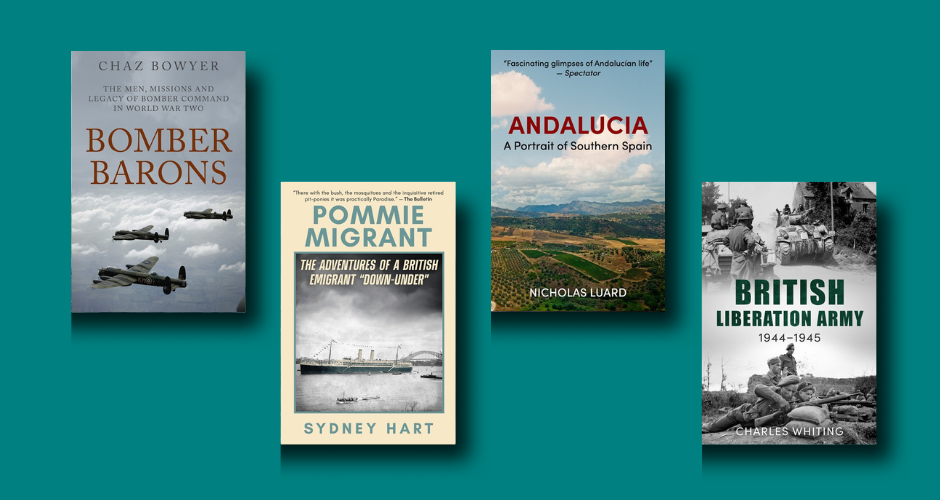
Bomber Barons by Chaz Bowyer is a powerful and compelling history of Bomber Command and the extraordinary men who risked everything in the skies over Nazi Germany.
Pommie Migrant by Sydney Hart is a vivid and entertaining memoir of a “Ten Pound Pom” who left post-war Britain to begin a new life in Australia, capturing both the highs and lows of the migrant experience.
Andalucia by Nicholas Luard offers a vivid portrait of the region’s landscapes, traditions, and tumultuous past — a must-read for everyone who loves travel, history, and Spain.
British Liberation Army: 1944–1945 by Charles Whiting is a gripping account of the British Infantry’s final push to liberate Europe from Nazi control in the last year of the Second World War, 1944–1945.
Happy Reading! Team Sapere
Vibrant Voices. Sensational Stories. Beautiful Books.

Following the success of his Quintus Roman Thrillers series, we are thrilled to announce that we have signed a new trilogy by Neil Denby.
In Neil’s words:
“The Leinster Chronicles are set in twelfth-century Ireland, a time and place little covered by contemporary historical novels, but one rich in story.
“Geographically, there are three major groups involved in the timeline — the native Irish, the invading Vikings and the Normans across the water.
“The Irish were bound by ancient law. Brehon law was a detailed system with compensation for criminal acts called éraic at its heart. It was not Roman law, but a system better suited to its times. Included was the rule that kings did not inherit their titles. The chieftain was elected — from an eligible pool of royal blood — by his family or clan.
“They were also Christian. St Patrick is credited with bringing Christianity to Ireland in the fifth century, but there was tension between Christian law and Brehon law. The Church in Rome saw the Irish Church as rebellious and depraved, in dire need of reform. The Roman Church was happy to grant overlordship of Ireland to the ‘good’ Christian Norman lords of England and France.
“The Vikings had been raiding and trading for hundreds of years. There were many holy houses for them to plunder, carrying precious relics, silver and slaves back to their homelands. Eventually they settled. There were established Viking trading ports, the chief amongst them being Dublin, probably the biggest slave-trading port in the northern hemisphere. Further south sat Wexford, Waterford and Cork. Other centres were at Wicklow and Arklow (which yielded silver). On the Shannon river, navigable to longships, sat Limerick.
“At this time Ireland had over a hundred kings, many little more than local chieftains. The senior kings ruled the seven kingdoms of Leinster, Munster, Connaught, Meath, Ailech, Airghilia and Ulaid. (The last three later became known as Ulster.)
“From these was drawn the ‘Ard Rí’, the High King of Ireland, traditionally — for at least five hundred years — one of the northern branch of the Uí Neill, whose high seat was in Tara. Though the title sounds impressive, in actuality it bestowed little unless the holder could keep it, usually by invading enemy territory and demanding hostages.
“Many battles were fought between greater kings and lesser kings. The tradition was to let a battle decide an argument; the losing side would then give up hostages against their good behaviour. The warriors would head home.
“These books will tell the tale of one of these kings — one who was castigated and damned in terrible terms by the Victorians for inviting the Normans into Ireland. But the story is more complex than that, the reasons more nuanced; perhaps the central character is not as evil as is made out.
“It is a tale I have wanted to tell for some time and I am grateful to Sapere Books for giving me the opportunity to share it.”
IN THE QUINTUS ROMAN THRILLERS SERIES:
BOOK ONE: Legionary
BOOK TWO: Decanus
BOOK THREE: Optio
BOOK FOUR: Centurion
BOOK FIVE: Scutarius
Congratulations to Neil Denby, whose action-packed Roman adventure, Scutarius, is out now!
Scutarius is the fifth book in the Quintus Roman Thrillers series.
In the high Alpen lands, Tiberius, General, Praetor, son of Caesar Augustus, is incensed by the insolence of the native tribesmen who dare to oppose him.
First Spear Centurion Julius Quintus Quirinius and his depleted cohort are posted behind enemy lines to eliminate them. They are to be irregulars, to act as shield-bearer or ‘scutarius’ to Tiberius’ armies, keeping the way before them clear.
If they succeed, Quintus and his men could win back their rightful ranks and stations in the legions. And might even finally be allowed to return to Rome.
But unfamiliar with the rapid turning of the seasons in the mountains, Quintus finds himself trapped by snow and lost in the vast lands of the enemy.
He needs to find a way forward, to do service to Caesar’s sons, but the task seems increasingly impossible.
Can Quintus find his way back to the battle? Could victory in the Alps be in his grasp?
Or will the fickle gods once more betray him…?
The third Sapere Books’ Writers’ Retreat took place at The Priest House Hotel, Castle Donington between the 28th and 31st of October this year.
Adele Jordan, author of the Kit Scarlett Tudor Mysteries and the Shadow Cutpurses Tudor Thriller Series, helped to organise a full programme over the four days.
In Adele’s words:
“For a lot of writers, it’s a solitary world. Whether you are struggling to complete your manuscript or are in love with your story and find it hard to step away, it can’t be denied that for many writers a lot of time is spent in a staring contest with your computer screen, and sometimes we need to step away from that screen.
“For the last three years, a group of authors from Sapere Books have come together to create their own writing retreat, and this year saw our biggest yet. Fourteen authors, who write across various historical genres, came together to talk about all things writing.

Photo of The Priest House Hotel by Andy Stephenson, used under the Creative Commons Licence
“From romance to crime, we plundered the depths — from the importance of accuracy in military fiction, to how we plan and approach clue-filled detective stories. What transpired was not only a shared enthusiasm for our craft, but the reassurance we sometimes need that we are not alone — that there are others out there with the same passion who are keen to inspire and be inspired themselves.
“This year, we had some special sessions led by writers in the group. Highlights included an insightful look into the editing process by Neil Denby, author of the Quintus Roman Thrillers Series, and a debate on the accurate use of poisons in fiction and the importance of research by Linda Stratmann, author of The Early Casebook of Sherlock Holmes Series.

Adele Jordan
“Amy Durant, Sapere Books’ Publishing Director, led a popular Q&A session with authors attending the retreat. We also covered what makes a good title, how to grab your reader’s attention from the very first line, the complications around weaving a narrative with more than one viewpoint, and a friendly critique session where people were invited to bring their own work for discussion.
“Following inspiring chats, some political debates, good food and a very comfortable bar, I was delighted to see so many of the writers come away with big smiles on their faces. Thank you to everyone who came this year and to Amy Durant too for sparing the time to talk to us. Here’s hoping next year’s Writers’ Retreat is not only just as good, but the biggest and best yet!”
Some comments from the attendees:
Ros Rendle, author of The Strong Family Historical Saga and the Moondreams House Romances: ‘Thanks to all attendees at the authors’ retreat week for making it so useful and fun. Particular thanks to Adele Jordan for all the organising, the excellent programme and for keeping us on track with such diplomacy.’
Michael Fowler, author of the DS Hunter Kerr Investigations and Dr Hamlet Mottrell Investigations: ‘[The retreat] has turned the plot of my next book completely around. And it was nice to catch up with colleagues from previous retreats, as well as meet up with new ones.’
Linda Stratmann, author of The Early Casebook of Sherlock Holmes Series: ‘The sessions really stimulated the little grey cells of the brain, and I got some insights which had me rushing off to do some writing!’
C V Chauhan, author of the Inspector Sharma Thrillers Series: ‘It was a fantastic four days! Thanks everyone and a big thank you to Adele for leading and managing the four days so well.’
Congratulations to Neil Denby, whose action-packed Roman adventure, Centurion, is published today!
Centurion is the fourth book in the Quintus Roman Thrillers series.
After wintering in Germania, Julius Quintus Quirinius is commanded to gather up the remains of his cohort and meet with General Drusus, who is marching with many legions west down the Rhine from the Alps.
But treacherous enemies and the fickle gods of the weather combine to slow them down. And a new force, led by a mysterious freedom fighter, is organising the local tribes against them.
Desertion plagues them and when the cohort commander is captured, Quintus and the other centurions have decisions to make.
They need to rescue their commander and destroy the fortress where he is being held, but they also need to lead the men to the Alpen passes that point to Rome and home.
Quintus has faith in his companions and knows they respect him in return. But he doesn’t want to test their loyalty by making an unpopular decision.
Can Quintus lead his cohort to victory – and their homeland?
Or will Rome once more remain beyond their reach…?
In this behind-the-scenes blog series, Sapere Books authors offer an intriguing insight into how, where and why they write.
Today, we are delighted to spotlight Neil Denby, author of the Quintus Roman Thriller series.
Inspiration can come at any time of the day or night, but I find that the small hours are awash with ideas — plot lines, character development, a resolution to a particularly tricky scenario — so it is important that I keep a notepad and pencil by the bed. It may be old-fashioned but it is also reliable and has the advantage of not involving bright screens.
Frustratingly, come morning, I cannot always decipher what I have written down, but sometimes there are gems. These may be character or plot evolution, or perhaps just phrases, but I know I would have forgotten them completely if I had not made a note.
While out walking — an excellent way to clear the brain of fog — I defer to modern technology and record voice notes on my mobile phone. The same principle applies — if there is no immediate record, the thoughts can be lost.
These brief lines are later transferred to a laptop. This is strategically placed in a corner of my study so that I am not distracted by the view outside the window. A row of reference books and one of my favourite possessions, an original Steve Bell cartoon, are all that I have for company. It also helps if I can visualise a character or a place, so I keep a sketchpad on my desk where I can create basic images — maps, plans, sometimes the progress of marches or battles. These drawings help to maintain consistency and authenticity.
This is my primary space, where the words are typed up. I add to them, enhance them, contextualise them, read them back. I often discover that I have used a particular word or phrase twice or more. Or if there is something I’m not sure about, I look it up. The reference books help to straighten out facts and also to find alternative words. Roget’s and Brewer’s and Fowler’s and Chambers provide a wealth of information unmatched by an American-leaning internet. I admit to slipping down rabbit holes of etymology and semantics, but find it strangely satisfying.
I always have to read what has been written, in context with the book so far. Traditionally that would have meant printing the manuscript out and sitting down with a pencil. Happily, that is no longer the case. Instead (thanks to everything going up into the Cloud) I can now read and review on my iPad. This means I can lounge in a chair, or sit outside, or read whilst travelling. So it is more a case of recreating the experience of the reader to see how and if things work.
Of course, there are edits, and actual printouts sometimes, but that is basically it: pencils and pads and technology.
Oh technology, where were you when I had all those essays to write at school?
Congratulations to Neil Denby, whose absorbing Roman adventure, Optio, is out now!
Optio is the third book in the Quintus Roman Thrillers series: action-packed, authentic historical military adventures set in Ancient Rome.
Julius Quintus Quirinius, Decanus of his contubernium, has failed in his mission to secure a bridgehead in Britannia for the emperor Augustus.
Despite their failure, they have collected valuable intelligence from the British tribes that they are keen to share with Augustus, hoping that will restore their reputation.
Together with his rescued comrades, Quintus flees the misted isle of the enemy and begins the long and treacherous journey home.
Once they locate the remnants of their cohort, Quintus is promoted to Optio and tasked with leading his men against rebel Germanic tribes.
Success could mean a fast route back to Rome and the favour of the emperor. But failure means an almost certain death.
When disaster strikes, can Quintus rescue the honour of Rome and lead the cohort to safety?
Or will the odds once more refuse to fall in their favour…?
Neil Denby is the author of the Quintus Roman Thrillers series: action-packed, authentic historical military adventures set in Ancient Rome.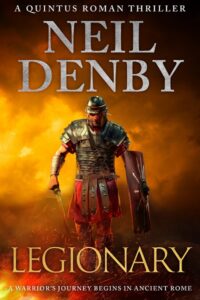
No doubt you are familiar with the major Roman gods: mighty Jupiter/Jove of the thunderbolts, king of the gods; Juno, his wife and the protector of the community; and their sons, Mars, god of war and lame Vulcan, god of the forge. Perhaps you also know that these were pretty much taken wholesale from the Greeks: Zeus does thunderbolts and lightning, and Hephaestus the blacksmith limps. However, unlike the Greek gods, who had their home on top of Mount Olympus, their Roman equivalents lived in forests, rivers and seas, at crossroads (compitalia) and boundaries and, if important enough, in temples.
The legionary soldier was as superstitious as the next Roman, perhaps even more so. Each had family gods, and needed not only to appease the gods, but to avoid offending them. The protagonist in my book series, Quintus, reveres Ceres, as goddess of agriculture. His comrade, Crassus, reveres Vulcan of the forge, while another comrade, Sextus, reveres Mercury, god of thieves and tricksters.
 It was a central part of legionaries’ duties to carry out the correct sacrifices, with the right animals, on the designated days. If this was not possible, a legionary or officer would become a priest himself — a simple matter of covering one’s head — and make the necessary requests and offerings. One of my characters, Tullius, will sacrifice anything to appease the gods (a seal, a mouse, a cockroach), whilst Sextus is adept at reading omens, auguries and stars, as seen in Legionary.
The gods were invoked for good fortune, honoured with sacrifices and remembered on particular occasions. The oddest thing about Roman gods was the number of them that started their life as humans. When it came to turning actual people into divine beings, the Romans did not hold back. Romulus, founder of Rome, had a temple, and the shepherd’s hut in which he and his brother had lived still stood in Rome 700 years after his death. Julius Caesar claimed descent, via Aeneas, from Venus.
With Caesar’s death came what is referred to as the ‘imperial cult’. After his assassination and on the orders of the victors of Actium, he became a god — Divus Julius — gaining temples, priests and sacrifices. The newly minted Augustus (previously Octavian) became divi filius — son of a god — one of the titles he most loved. Other emperors followed, including both Augustus and his wife.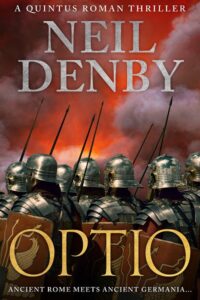
The legionaries in my stories refer to Julius Caesar as the general, the dictator or Divine Julius, depending on how well they knew him. He was assassinated in 44BC, less than thirty years before the beginning of the first book, Legionary. This is within living memory for many of my characters; indeed, the veteran Marcus served under Caesar as a young man.
There were countless gods that fell in and out of fashion, including all the souls of the departed. Larés and manés were the minor gods that represented the benevolent souls of the dead, whilst the lemurés were reckoned to be malevolent.
Religion thus permeated every aspect of a soldier’s life. They were all gods-fearing, if not gods-bothering — though they may have actually met some of those who were deified!
We are delighted to announce that the first two books in Neil Denby’s action-packed military adventure series, the Quintus Roman Thrillers, will be released as audiobooks by Tantor Media.
The books follow a solider, Julius Quintus Quirinius, as he fights for survival in the brutal Roman army.
In Neil’s words:
“It has been a delight to work with the supportive publishing team at Sapere, who have helped to hone my writing to the level where Tantor Media bought the audiobook rights. I was excited to choose Matthew Lloyd Davies as an authentic voice for the first two books. Matthew is an actor and director with a long and distinguished career, including regular appearances with the Royal Shakespeare Company.
“The first book, Legionary, is the story of a common soldier and his close comrades stationed in Hispania during the first years of the Principate. Together they suffer punishments, fight battles and discover secrets that could prove useful to the Empire. Against the odds, they strive to maintain dignity and, above all, honour. The second book, Decanus, relates their further adventures with the tribes of the mysterious island of Britannia, after they are shipwrecked on its shores.
“The new deal puts Legionary and Decanus in distinguished company indeed. Matthew has narrated greats like Aldous Huxley, Robert Louis Stevenson and HG Wells, along with dozens of modern authors. The audiobooks will be released in early 2024.”
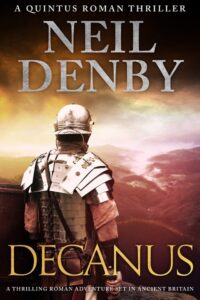
Congratulations to Neil Denby, whose Roman military adventure, Decanus, is out now!
Decanus is the second book in the Quintus Roman Thrillers series.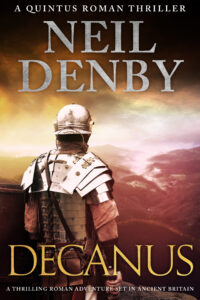
Julius Quintus Quirinius and his cohort sail to the mysterious land of Britannia. They have been sent on a mission to scout out the savage country and battle the local tribesman to pave the way for their emperor.
But before they can land, a violent storm scatters their ships, separating Quintus, newly promoted to Decanus, from some of his comrades. In seeking them, he encounters Britons who may be friend or foe.
Betrayal is in the air when he discovers the missing legionaries have been captured by a local tribe. And the tribesmen are not willing to release the Romans alive.
Quintus is prepared to rescue his men or die in the attempt. His oath demands it. But can the legionary training of the Roman soldiers defeat the fierce foreign tribesmen?
Or will Quintus’ first foreign mission be his last?
Congratulations to Neil Denby, whose action-packed military adventure, Legionary, is out now! Legionary is the first book in the Quintus Roman Thrillers series.
17 BC
Julius Quintus Quirinius, like many citizens in the years after Rome’s civil wars, must volunteer with the Roman army or be sold into slavery.
Keen to prove his worth, he becomes a member of the IXth Legion, but after only six months his cohort suffer a brutal defeat, the result of stupidity and cowardice.
Cowardice in a legionary carries a heavy punishment: the sentence of decimation – to live or die at the whim of the gods with the unlucky ones clubbed to death by their fellow soldiers.
Ursus, the man killed in Quintus’ group, lays a heavy charge on the youth, asking him to look after the remaining men and to take care of his family back in Rome.
Keen to fulfil Ursus’ last wishes, Quintus helps lead his cohort south to defeat the tribesmen skulking in the mountains in the hope that the IXth legion’s reputation will be restored.
But if they win the fight, their reward may not be the prize they had hoped for… And it soon seems as if returning to Rome is further out of reach than ever…