

Linda Stratmann is the author of the Mina Scarletti Mysteries and the Early Casebook of Sherlock Holmes series.

Sherlock Holmes and the Aeronauts is set in 1879, at which time there had never been a successful crossing of the Channel from France to England by balloon due to unfavourable wind currents. One of the key themes in my book is a proposed competition to be first to make such a flight, with a large prize for the winner.
Some histories of ballooning include only brief accounts of the first east-to-west Channel flight which was made in 1883 by a Monsieur L’Hoste. Some histories do not even mention him. I determined to find out more about this neglected pioneer of aviation.
François L’Hoste was born in Paris on 2 August 1859, the second son of a well-to-do manufacturer of wrought iron goods. Aged twenty, he entered the aeronautical academy as a voluntary student, where he impressed his instructors with his skill, composure and courage. He was particularly inspired by a stirring lecture on the use of balloons during the siege of Paris, and the heroism of aerial experiments. His instructors had only one criticism: he was too eager — his enthusiasm and passion for adventure could barely be tempered even by the wisest advice.
The year 1883 was an important milestone in aviation history, the centenary of the first public demonstration of the Montgolfier hot air balloon. That May, during an ascent from St Omer in his gas balloon, L’Hirondelle, L’Hoste formed a new and all-consuming ambition. On arriving at Calais, he had encountered a southeast wind, which carried him over the Channel to within eight or nine miles of the English coast. A change in the wind reversed his direction, and he eventually landed in Holland. He was convinced that if he could locate and make use of favourable currents, it should be possible to cross from France to England. He shared this information with his friend and fellow enthusiast Monsieur Eloy, and they agreed to make the attempt on 5 June.
Their new balloon was named Pilâtre de Rozier in honour of the aeronaut who had first attempted the east-to-west crossing in 1785 in a hybrid hot air and hydrogen balloon. On that occasion, the balloon made little progress from Boulogne, before it was blown back over land. Soon afterwards it caught fire and plunged to earth. De Rozier and his associate, Romain, were both killed.
L’Hoste’s first attempt at a crossing was postponed due to an unfavourable wind. When he and Eloy set off on 6 June, they were heartened to find a southeast current, but it soon disappeared and they were carried back to France. After going back and forth twice more through torrential rain and fog, they made a hard landing in Lottinghen, east of Boulogne.
This failure only increased their determination. The next attempt was on 7 June, and L’Hoste decided that his chances would be better if he reduced the load by carrying only one man. He went alone. After some hours, his location largely obscured by fog, he descended for a better view. There was a large city below, and he thought he was in England, but on reaching land, he discovered he was in Dunkirk. Taking off once more, he soared above the clouds, hoping to detect where he was by the sound of waves, as he could see almost nothing through the fog. The balloon descended rather more than he intended, and he kept throwing out ballast until there was none left. The basket ditched in the sea and overturned, tipping L’Hoste into the water, where he tried to keep hold of the collapsing fabric of the balloon. Luckily, a sailing ship appeared on the scene. His cries for help were heard, and a rowboat was sent to rescue him. Soaked and exhausted, he stayed on board the ship for three days and he and his balloon were landed at Flushing.
On 14 July he tried again, but the winds were once more against him as he sailed through darkness and storms. After colliding with some treetops, he was carried across a canal and finally came to rest on some railway tracks. He barely had time to pull the basket off the line before the Rotterdam to Flushing express sped past. Two railway employees came to help him.
His next attempt on 13 August 1883 again ended in the sea, where he was rescued by a Dutch steamer, which took him to Amsterdam.
On 9 September, still confident of success, he started from Boulogne in a new balloon, the Ville-de-Boulogne. Descending sufficiently to enquire of some fishermen as to which level of current blew from the east, he continued to Cap Gris Nez, then descended into the easterly current. A little later, he saw the lighthouses of Dover. At 10.15 at night, he crossed the English coast and finally came to rest in a meadow. All around him were sheep. He decided to eat some pâté, sleep, and wait for daylight.
He was discovered in the morning by a shepherd called James Austin, and since neither spoke the other’s language, they were obliged to communicate with gestures. Austin eventually brought L’Hoste back to his farmhouse, where he met the family and was given tea. He was in Ruckinge, Kent. A farm wagon was hitched up to carry the balloon to the nearest railway station at Smeeth. L’Hoste arrived at Folkestone and a ship took him to Boulogne, where he was able to give the good news. English newspapers which had previously referred to L’Hoste’s repeated failures with some amusement, gave far less space to his success, although the Kent Times records both his voyage and discovery on a sheep farm.
L’Hoste’s crossing was no fluke. He repeated it on 7 August 1884. Then, on 29 July, 1886, he made the crossing a third time, accompanied by a new associate, Joseph Mangot. (Monsieur Eloy had made an ascent from the coastal town of Lorient on 14 July 1885 and was swept out to sea and lost.)
Joseph Mangot was born in Montdidier on 17 January 1867. He and L’Hoste made several ascents with the intention of experimenting with extended voyages, assisted by small satellite balloons to provide extra gas. In July 1886 they made a Channel crossing together from Cherbourg in a new balloon, Le Torpilleur (Torpedo boat). L’Hoste had already envisioned the possibility that balloons might be used for warfare and on the way, he demonstrated this by throwing artificial torpedoes onto passing ships. In England they launched artificial torpedoes at the docks and arsenals of London, before seeking a landing place.
Their departure for a longer flight to Eastern Europe took place on 6 November 1887. Le Torpilleur had been refurbished and renamed L’Arago after the astronomer François Arago. A passenger who travelled with them went only as far as Quillebeuf, and on 13 November, L’Hoste and Mangot headed out across the sea. They may have lost their bearings in the darkness, and it is thought they crossed the English Channel and passed quickly over the narrow Cornish peninsula into the Bristol Channel, and thence into the Atlantic. Neither L’Arago nor the young adventurers were ever seen again.
No pioneer is entirely forgotten. In 1896, a monument to L’Hoste and Mangot was erected in le Jardin des Tintelleries Boulogne. A modern hybrid balloon, which combines hot air and helium, is known as a Rozière.
References
La Catastrophe du Ballon l’Arago by Wilfrid de Fonvielle (Paris, 1888, Spectateur Militaire) This publication also includes Mes Ascensions Maritimes by François L’Hostehttps://archive.org/details/lacataastrophed00fonvgoog/page/n8/mode/2up
Traversée de la Manche de Cherbourg à Londres by Jospeh Mangot, précedée par La Préface d’un Frère (Paris, 1888, Spectateur Militaire)https://archive.org/details/traverseedelama00manggoog/page/n12/mode/2up
Kent Times, Saturday 15 September 1883, page 6, and other contemporary newspapers.
1881 English census: James Austin, shepherd and family, registration district East Ashford, Piece 949, folio 45 page 1.
Linda Stratmann is the author of the Mina Scarletti Mysteries and the Early Casebook of Sherlock Holmes series.

There are many different interpretations of Sherlock Holmes created by authors inspired by the works of Conan Doyle. They might sometimes appear to conflict, but it was my love of science fiction that made me realise that the different versions can all be valid at the same time if they exist in parallel universes. One such interpretation is that Holmes is not human but alien, or possibly even an android.
The Holmes in my books is a human, if an unusual one, but can a good case be made for him not being human? The basis of the case must, I believe, be derived from what I call ‘the canon’ — the original Holmes fiction of Conan Doyle.
So let us examine the canon and look for the clues.
Our first evidence is from Dr Watson himself. In an uncharacteristic feat of observation in The Sign of Four, he declares, ‘“You really are an automaton, — a calculating machine. […] There is something positively inhuman in you at times.”’ Holmes, he says in ‘A Scandal in Bohemia’, is ‘the most perfect reasoning and observing machine the world has seen.’
But what other clues do we have? There are many.
Clue one: An alien or android has no family tree, and Holmes is extremely cagey about his ancestors.
In ‘The Greek Interpreter’, Watson states that Holmes’s gifts for observation and deduction must come from his systematic training, and not his ancestry. Holmes agrees that this is true to some extent and reveals that his ancestors, who he does not name, were country squires who led the life ‘“natural to their class”’. However, he attributes his powers of observation to descent from a family of French artists. His grandmother was the sister of the French artist Vernet. There must, he believes, be some hereditary principle, as his brother Mycroft has the same talent.
If Holmes was an alien or android, a vague reference to unnamed county squires and an artist whose family connections could not have been easily researched would have satisfied Watson’s curiosity. Watson saw some similarities between Holmes and Mycroft, and if Holmes was an alien or android, it would suggest that Mycroft was as well.
Clue two: Holmes has strangely superhuman strength.
Holmes is not a burly man. In ‘The Red-Headed League’, ‘He curled himself up in his chair, with his thin knees drawn up to his hawk -like nose.’ Yet he obviously had a sinewy strength and was skilled in boxing, singlestick and swordsmanship.
To maintain bodily fitness over many years, regular exercise is usually necessary, but with Holmes this is not the case. ‘I have a curious constitution,’ he says in The Sign of Four. ‘I never remember feeling tired by work, though idleness exhausts me completely.’ He then heads off for a smoke.
In ‘The Adventure of the Speckled Band’we have this extraordinary incident. Holmes receives a visit from tall, broad and fierce Dr Grimesby Roylott. Roylott tries to intimidate Holmes by picking up a steel poker and bending it into a curve before flinging it down. After his departure, Holmes picks up the poker ‘and with a sudden effort, straightened it out again.’ Is that even humanly possible?
In ‘The Adventure of the Yellow Face’, Watson tells us that Holmes ‘seldom took exercise for exercise’s sake’ and that he regarded ‘aimless exertion’ as ‘a waste of energy’. Yet he also tells us that ‘Few men were capable of greater muscular effort’ and Holmes was ‘one of the finest boxers of his weight that I have ever seen.’ When there was a requirement for action, he was ‘untiring’. By the time this story was published in 1893, Conan Doyle might have sensed that he needed to explain to his readers the anomaly of a man who hardly ever exercised but excelled at physical activity. ‘That he should have kept himself in training under such circumstances is remarkable,’ says Watson, who goes on to say unconvincingly that ‘his diet was usually of the sparest and his habits were simple to the verge of austerity.’ Holmes, he adds, ‘save for the occasional use of cocaine […] had no vices.’
Clue three: Holmes uses drugs and smokes, apparently without adverse effects.
Conan Doyle introduces us to Holmes’s use of cocaine in The Sign of Four, which includes a brief single reference to the recreational use of morphine. (It is only ever used once again by Holmes, given medicinally in ‘The Adventure of the Illustrious Client’). In ‘The Adventure of the Yellow Face’,published three years after The Sign of Four,ConanDoyle obviously feels the need to dial back, perhaps after some disapproval expressed by his readers, and tells us that ‘he only turned to the drug as a protest against the monotony of existence, when cases were scanty and the papers uninteresting.’ Holmes’s heavy smoking of strong tobacco is never seen by Watson as a vice, or as something that might affect Holmes’s health.
There are numerous references in the stories to Holmes smoking heavily. In ‘The Man with the Twisted Lip’, Holmes smokes an ounce of shag tobacco while deliberating, leaving his room ‘full of a dense tobacco haze.’ In ‘The Adventure of the Engineer’s Thumb’,his before-breakfast pipe is ‘composed of all the plugs and dottles left from his smokes of the day before, all carefully dried and collected on the corner of the mantelpiece.’ If Holmes is an alien or a machine, that explains his apparent imperviousness to the harmful effects of drugs and tobacco. In later adventures, Conan Doyle does however make him more believable by showing Holmes exhausted by his burden of work as he ages. The last year in which a Holmes story is set is 1914 (His Last Bow, published in 1917), by which time he is sixty years of age, and to Watson’s eyes, has hardly changed.
Clue four: Holmes shows little emotion.
Science fiction readers and writers have compared Holmes to an android like Star Trek’s Data, lacking emotion of any kind. If he is an alien, he most closely resembles Star Trek’s coolly logical Vulcans. They have emotions but restrain them; however, they are obliged to let them all out once every seven years in a ritual called pon farr. Does this fit with Holmes’s behaviour? Does a restriction of emotions cause Holmes any stress? If he was a Vulcan, like Mr Spock, could this explain what was really happening in 1891 when Holmes rushed away to the Reichenbach Falls and did not return for three years? Did he feel the approach of pon farr and have to quit England before it took him over? If so, there would be other absences at similar intervals.
I counted back seven years and then I saw it. There are no adventures chronicled by Watson for the years 1884 and 1885. Was this because of a previous pon farr? Holmesian scholars have assumed that during these years Watson was away, perhaps in America, but there might be another explanation? Was Watson with Holmes during these absences, his account carefully crafted to conceal the truth about his friend? Looking ahead another seven years from 1892, there are no adventures dated from between January 1899 (‘The Adventure of Charles Augustus Milverton’) and June 1900 (‘The Adventure of the Six Napoleons’). There are no adventures dated 1906, or 1913. This is all supposition, of course, but the timeline is compelling.
Clue five: Holmes does not wish to marry.
Not only is Holmes averse to marriage, he appears to have no romantic or intimate connections with anyone. If he is not human, this is something he would avoid, or his masquerade as a human might be discovered. Conan Doyle is careful to avoid any suggestion of Holmes having hidden desires which would have alienated his readers. According to Watson, Holmes’s only such interest, is a woman, ‘the woman’, as he calls her, Irene Adler, whom he clearly admires but without allowing any emotions to disturb his finely balanced mind.
On what principles was the alien or android Holmes constructed or programmed?
If Holmes was sent to Earth programmed to solve crimes, he needed to be constructed from many parts. Superhuman strength and constitution. Numerous useful skills. Impervious to the ravages of smoke and drugs. A brilliant reasoning machine undistracted by emotions. The aliens who made or trained him would have studied other detectives of the era and used elements of the finest to create Holmes.
There are three main candidates:
Joseph Bell (1837–1911) was a Scottish surgeon and lecturer who advocated the importance of careful observation. Conan Doyle was a student of Bell from 1877 to 1878. Bell used his observational talents to deduce personal details about complete strangers, a skill which Holmes frequently employed.
Edgar Allan Poe’s C. Auguste Dupin is considered to be the first fictional detective, who used advanced reasoning to solve mysteries. Through observation, he is able to follow the train of thought of his companion, an ability with which Holmes astonishes Watson in ‘The Adventure of the Cardboard Box’.
Le Chevalier Lecoq, a fictional French policeman, inspired by a real criminal investigator, Eugène-François Vidocq (1775–1857). In the works of Émile Gaboriau, published in 1869, Lecoq’s methods when making a detailed examination of a crime scene, using a magnifying glass, are strongly reminiscent of Holmes’s scientific approach. In A Study in Scarlet, Holmes dismisses Dupin as ‘a very inferior fellow’ and Lecoq as ‘a miserable bungler’.
My case is complete. I have laid the facts before you. Make of them what you will.
NOTE:
There were several artists in the Vernet family but only one, Emile Jean Horace (1789-1863) fits the timeline as Holmes’s most probable great uncle. A number of Conan Doyle’s family members were artists, and a friend was a collector of Vernet.
Following the publication of Linda Stratmann’s sensational Mina Scarletti Mysteries – Victorian crime novels with a courageous woman sleuth at the centre – editorial director Amy Durant has signed up her exciting new series, which follows a young Sherlock Holmes. The first instalment will be published next year.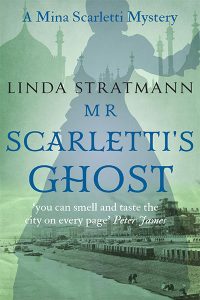
In Linda’s words:
“22 year old Sherlock Holmes, realising that his destiny is to be the world’s first and best consulting detective, has abandoned conventional education and come to London to acquire the very particular and unusual skills and knowledge he needs for his chosen career. This is Holmes before Watson: youthful, fiery, determined, energetic, still learning his craft. This is the legend in the making, the story of how young Holmes became the Holmes we know.
“Sherlock Holmes is the epitome of the great detective, iconic and instantly recognisable. It was a tremendous thrill to be asked to create new adventures and explore those periods of Holmes’s life which Conan Doyle left to the imagination. It is a pleasure to continue working with the wonderfully supportive team at Sapere Books, and to be a part of the Sapere family of authors.”
Click here to order MR SCARLETTI’S GHOST
Click here to find out more about the Mina Scarletti Mysteries
Linda Stratmann is the author of the MINA SCARLETTI INVESTIGATIONS, a traditional British detective series set in Victorian Brighton.
More than a year ago, I determined to write a book in which Mina Scarletti, disabled by the scoliosis that twists her spine and cramps her lungs, is taken ill and solves a mystery while confined to bed. It is not a new concept. In The Wench is Dead, Inspector Morse solves a Victorian murder while in hospital, and in Josephine Tey’s The Daughter of Time, Inspector Alan Grant, hospitalised with a broken leg, explores the fate of the Princes in the Tower.
But these are historical puzzles, and therefore considered suitable to engage the mind of a bored invalid. In His Father’s Ghost, Mina has additional challenges. She is intrigued by a current conundrum, the disappearance of a local man while out sailing, declared legally dead, but his actual fate unknown. Her doctor, however, has advised her against any activity that might tax her delicate health, and that includes solving mysteries. She has to use all her ingenuity to gather the information she needs. In doing so, she finds that she has uncovered evidence of past crimes and scandals. Her enquiries are a catalyst that set off a train of events that ultimately have dramatic and life-changing consequences for several prominent citizens of Brighton.
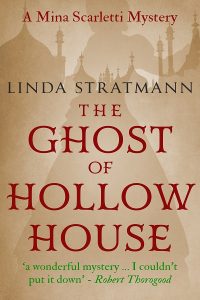 One of the themes which I explore in this book is hallucination. Mina, when stricken by a fever, sees and hears things that reveal what is troubling her. The son of the vanished man, disturbed by significant events, has terrifying visions in those dark hours that lie between sleeping and waking.
I really enjoyed my research for this book. I visited the fascinating Police Cells Museum of Brighton, and read about the curious spiritoscope, an apparatus designed to prove that it was spirits and not the medium who cause the movement of the divination table.
It was my real pleasure to include two characters who have appeared in previous books, the flamboyant actor Marcus Merridew, fresh from his acclaimed season as Hamlet, and the creepy young photographer Mr Beckler.
While editing the manuscript, which was completed at the end of 2019, I was struck by how Mina’s plight echoes our current time. She is ill with a lung infection, and effectively on lockdown. But when she scents a puzzle, it gives her strength. She needs not only warmth and air and nourishment, but material to keep her busy mind alive.
Click here to pre-order HIS FATHER’S GHOST
This Christmas, we’ve put together an anthology of festive crime fiction that is sure to give you the chills! Here’s a taste of what to expect from MIDWINTER MYSTERIES…
In Graham Brack’s AWAY IN A MANGER, a decidedly non-festive Lieutenant Josef Slonský investigates a string of thefts amid Prague’s bustling Christmas market.
At a Christmas Eve gathering, Charles Dickens weaves a gory, atmospheric ghost story that becomes a little too real in J C Briggs’ FOOTPRINTS IN THE SNOW.
Keith Moray’s LOST AND FOUND follows the residents of West Uist as they merrily prepare for their New Year’s Eve traditions – until one of them is found dead…
While trying to provide for his family, young Alfie finds himself investigating the disappearance of gold bars from a bullion store – which have vanished along with his beloved dog, Mutsy – in Cora Harrison’s THE SPIRIT OF CHRISTMAS.
In Seán Gibbons’ THE STOLEN SANTA SACK, unlucky driver Ben Miller is stuck with a dead Santa Claus and a sackful of cash in the back of his cab…
While hurrying to develop her clients’ portraits in time for Christmas, photographer Julia McAllister is landed with a drunken newlywed and a photograph of a ghost in Marilyn Todd’s WILL POWER.
Gaynor Torrance’s CHRISTMAS SPIRITS follows headstrong Detective Inspector Jemima Huxley as she finds herself caught up in an armed robbery while doing her Christmas shopping.
In David Field’s THE ESSEX NATIVITY, Detective Sergeant Jack Enright discovers a destitute couple expecting their first child in the shelter of a barn.
When one of her clients is stalked by a mysterious figure, Private Investigator Eden Grey attempts to uncover the unwelcome follower in Kim Fleet’s SECRET SANTA.
Major Thankful and Thomazine Russell investigate the theft of a scandalous manuscript written by the king in M J Logue’s STIR UP SUNDAY.
In Linda Stratmann’s THE CHRISTMAS GHOST, wilful sleuth Mina Scarletti attempts to bring peace to a woman haunted by the spirit of her dead son.
Click here to order MIDWINTER MYSTERIES!
The heroine of the Mina Scarletti books is not based on a specific individual; however when I created my diminutive protagonist two people were in my thoughts, one of whom I knew personally.
Eva was the aunt of a friend of mine. She had a very severe distortion of the spine, but the thing that I remember most about her was her sweet smile. I never got to know her well and she died when I was a child.
Annie Jane Fanny Maclean was delicate and very small, due to the curvature of her spine and she walked with a limp. In 1879 aged 33, she inherited some family property. She also attracted the attention of Lewis James Paine, a 49 year old insurance salesman in need of money. 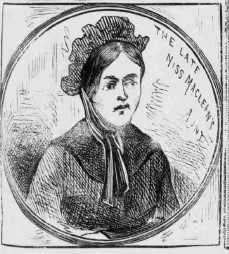
Unknown to Miss Maclean, Paine was a married man, although he denied it when challenged by her suspicious family. By July that year they were living together as husband and wife. Annie had been a moderate drinker, but Paine plied her with alcohol, sometimes forcing her to drink it against her will, and as she fell more and more under his control, he withheld food.
In September, in a very weakened state, she was induced to sign a deed making over her property to Paine. In less than a month she was dead.
Paine was tried for the wilful murder of Annie Maclean at the Central Criminal Court in February 1880. The question for the jurors was had Paine deliberately set out to kill, or had he caused death through recklessness and negligence? He was found not guilty of murder but guilty of manslaughter.
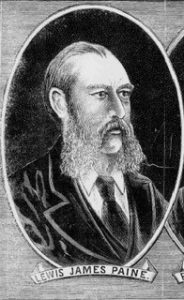 Paine made a long statement to the court, claiming innocence, but the judge, who clearly despised him, stated bluntly that he didn’t believe a word of it. He stated that Paine was guilty of manslaughter ‘in about as cruel and barbarous circumstances as I ever remember having heard of. . . . Had you been guilty of murder, you would most unquestionably have been hanged, as you richly deserve to be.’ (Times 25 Feb 1880 page 11) Paine was sentenced to imprisonment for life. He died in 1897.
In commenting on the case, The Times pointed out that the victim’s appearance was not an insignificant fact, and this led me to reflect on the vulnerability of women in the Victorian marriage market, especially those with a disability, who if they had property could be manipulated by cruel and unscrupulous men.
Marriage and motherhood were considered to be the primary and most desirable roles for Victorian women, and Miss Maclean must have seen Paine, perhaps her only wooer, as her chance of happiness.
In Mina Scarletti, who has been told by her doctors that she must never think to marry, I have created a heroine who is able by her unique insight and force of will to make a challenging and fulfilling life for herself.