

We are pleased to announce that we have signed an exciting new series of Tudor mysteries by Paul Walker.
In Paul’s words:
“History, in pictures, books or old buildings, has always prompted my imagining of what it must have been like all those years ago. The sixteenth century was filled with intrigue, politicking and socio-religious turmoil, and that is where I’ve put my protagonist, Doctor William Constable.
“Constable is a physician and mathematician of the stars, with a house in West Cheap, central London. He becomes involved (unwillingly, at first) in foiling plots against Queen Elizabeth, under the watchful eye of Sir Francis Walsingham.
“I am delighted to have the first four books in the series scheduled for publication by one of the most prized names in historical fiction, Sapere Books. These books cover the years 1578 to 1585 and include some well-known events and names. Work is underway on books five and six.”
Visit Paul’s website to stay up to date with his news and latest releases.
From twisty mysteries and Roman adventures to exciting tales of historical privateers — there’s something exciting here for everyone. Scroll down to discover this month’s titles from your favourite Sapere authors.
January’s Fiction Releases
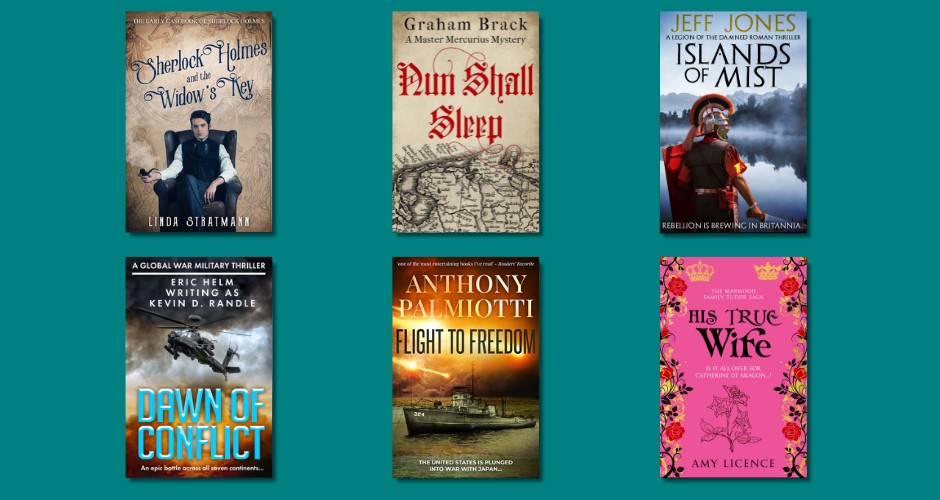
Sherlock Holmes and the Widow’s Key by Linda Stratmann is the tenth book in The Early Casebook of Sherlock Holmes series. In this instalment, Holmes and Stamford investigate the death of a mysterious widow — and make a gruesome discovery in the process.
Nun Shall Sleep by Graham Brack is the ninth book in the Master Mercurius Mystery series: atmospheric crime thrillers set in seventeenth-century Europe. In his latest adventure, Mercurius is drawn into strange — and possibly sinister — happenings at a convent.
Islands of Mist by Jeff Jones is the third book in the Legion of the Damned Roman Thrillers series: action-packed military adventures set in Ancient Rome. For their latest mission, Centurion Marcus Corvo and his men must prevent or crush a suspected rebellion in Britannia.
Dawn of Conflict by Eric Helm is the first book in the Global War Military Thriller Series. In this alternative-history thriller set in the late twentieth century, a series of stunning geopolitical changes destabilizes a dozen major governments around the globe, pitching the armies of each nation into world warfare.
Flight to Freedom by Anthony Palmiotti is a tense World War Two naval adventure. When the Japanese bomb Pearl Harbor, the United States is plunged into war. As one of the few remaining ships in the region, the Tanager is called to evacuate Army nurses and those fleeing from the enemy.
His True Wife by Amy Licence is the fifth book in The Marwood Family Tudor Saga series. In the latest instalment, Catherine of Aragon prepares for the Legatine Court, while lady-in-waiting Thomasin Marwood awaits a marriage proposal from the man she loves.
January’s Fiction Backlist Releases

We are pleased to announce that the fifth, sixth and seventh instalments of Gilbert Hackforth-Jones’ gripping Paul Dexter Naval Adventures series are out now! Don’t miss these entertaining and action-packed tales of life at sea.
January’s Non-Fiction Releases

The Story of the Arab Legion by John Bagot Glubb is a fascinating personal account of the development of the Arab Legion as a formidable fighting force from the 1930s to the Second World War.
SS Kommando by Charles Whiting is a compelling read for anyone interested in Kommando operations throughout World War Two — the men involved, their leaders and rivals under the Führer, and the desperate tactics employed in the face of defeat.
The Privateers by Donald Macintyre charts the golden age of privateering — from its Elizabethan origins, through the daring exploits of British and French buccaneers against Spanish treasure ships, to its eventual outlawing and brief revival during the American Civil War.
Eugene Esmonde, V.C., D.S.O. by Chaz Bowyer is a moving biography of a remarkable pilot who received a posthumous Victoria Cross for courageous but fatal actions during World War Two.
Happy Reading! Team Sapere
From medieval adventures and Gothic mysteries to gripping accounts of military heroism — there’s something exciting here for everyone. Scroll down to discover this month’s titles from your favourite Sapere authors.
December’s Fiction Releases
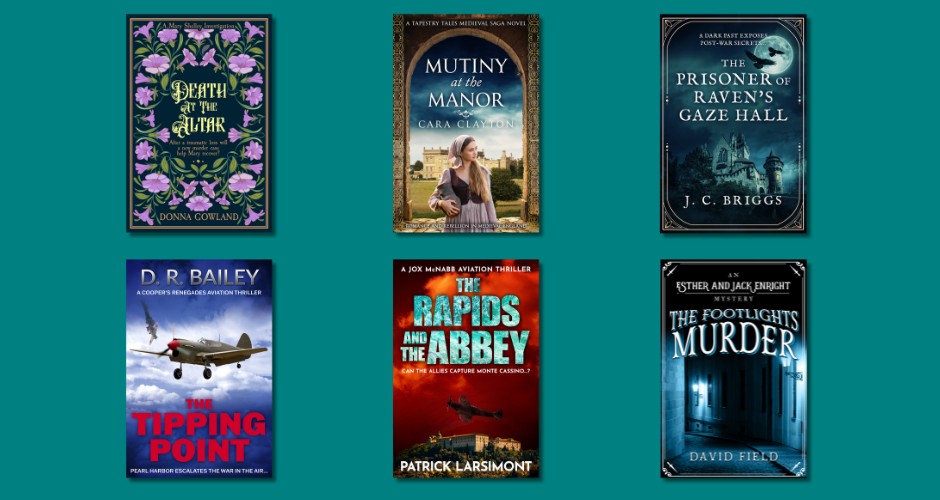
Death at the Altar by Donna Gowland is the third book in the Mary Shelley Investigations. In this instalment, Mary puts her grief aside as she and Percy investigate the murder of a curate at a friend’s wedding.
The Tipping Point by D. R. Bailey is the first book in the Cooper’s Renegades Aviation Thrillers, action-packed aviation adventures set during the Second World War and featuring a team of fighter pilots. When war is declared on Japan by the U.S., American pilot Cooper Donahue soon finds himself in the thick of the action.
Mutiny at the Manor by Cara Clayton is a thrilling tale of romance and rebellion in medieval England. Will this troubled period in history bring ruin to all Elizabeth Amundeville holds dear?
The Rapids and the Abbey by Patrick Larsimont is the sixth book in the Jox McNabb Aviation Thrillers. In this instalment, fighter pilot Jox McNabb takes to the war-torn skies of Italy and the capture of Monte Cassino.
The Prisoner of Raven’s Gaze Hall by J. C. Briggs is a gripping Gothic novel set in Yorkshire. When Catherine Sisley arrives at Raven’s Gaze Hall to nurse an elderly lady, she soon realises that the house — and its occupants — are not all they seem.
The Footlights Murder by David Field is the twelfth crime thriller in the Esther and Jack Enright Mysteries. In this instalment, Jack and Esther take up amateur dramatics in an attempt to track down a murderer and clear Jack’s sister’s name.
December’s Fiction Backlist Releases

We are delighted to announce that the first three instalments in William H. Keith Jr’s adrenalin-fuelled SEALS: The Warrior Breed series are out now! Don’t miss these action-packed military adventures following the U.S. Navy’s elite commando demolition unit.
December’s Non-Fiction Releases

A Captain’s War by Herbert M. Schiller is the remarkable first-hand account of life as a young Confederate officer during the brutal years of the American Civil War.
Disaster at Kasserine by Charles Whiting is a dramatic account of the Allied disaster at Kasserine Pass, where inexperienced American troops clashed with Rommel’s battle-hardened Afrika Korps in North Africa.
Admiral Rodney by Donald Macintyre is a fascinating biography chronicling the life of one of England’s greatest sea commanders, famed for his decisive victory over the French at the Battle of the Saintes during the American War of Independence.
Men of Bomber Command by Chaz Bowyer tells the epic, untold story of the Allied bomber crews who helped turn the tide of World War Two.
Fighting for Defeat by Michael C. C. Adams provides a new perspective on the American Civil War and the reasons behind the Union Army’s early defeats, despite its superiority in manpower, wealth, and industry.
Happy New Year and Happy Reading! Team Sapere
We are delighted to announce that we have signed two new books in Angela Ranson’s Catrin Surovell Tudor Mystery series: exciting historical thrillers set at the court of Elizabeth I.
Here, Angela tells us more about the series and what to expect from the latest instalments:
“I started working with Sapere Books in March 2022, when I was named as a runner-up in their first writing competition. From the very first, the people at Sapere have brought light and positivity to my writing life. They have offered real help and support, and their editing process has improved my writing enormously. Sapere has helped me understand and appreciate the many stages of writing a book.
“Or, as it has turned out, a series of books. We started out with three Catrin Surovell Tudor mysteries, and then it grew to five, and just last month it grew to seven. I was so excited to receive the latest contracts and know that I could continue to explore the character of Lady Catrin, Countess of Ashbourne and favoured lady of the bedchamber for Queen Elizabeth I. Lady Catrin is a clever and courageous woman in a dangerous world — much as Elizabeth’s real ladies of the bedchamber would have been. It was not all music, gossip, fine clothes and embroidery for these women, despite the way they are portrayed in modern movies. In real life, they had difficult battles to fight.
“Thus far, Lady Catrin has remained close to her queen at court. She has battled many villains who have tried to remove Elizabeth from her throne, or destroy the reforms the queen has put in place. She has fought against religious zealots, royal traitors and court conspirators, all with the help of her close friend Lady Lucy and a collection of people as dedicated to the queen’s service as she is. In the fourth book, Grave Merriment (which will be released in March 2026), Lady Catrin will battle two villains, each with a specific goal but one area of common ground: the desire to destroy all the queen holds dear, at the most festive time of the year.
“It is important to me that Lady Catrin’s adventures could have happened and that Lady Catrin herself could have investigated and unmasked the villains. I try very hard not to change history or give Lady Catrin more power than she would have had. I do, however, often answer historical questions that have never been answered, or create fictional scenarios that take place in parallel with a known event. That is why the fifth book in the series will focus on an event that never took place: a meeting between Elizabeth I and Mary, Queen of Scots. This meeting has been included in many fictional accounts of these two queens. Usually, the wise queen of England grows frustrated with how the reckless and impulsive Queen of Scots always ‘feeds her with fair words’ that mean nothing.
“Instead of following this trend, the fifth Catrin Surovell mystery will follow history more closely, and focus instead on why that meeting didn’t happen. Lady Catrin will be the one who learns the secret that keeps these ‘fair cousins’ apart … just in time to save their lives.”
Grave Merriment is available to pre-order now.
Visit Angela’s website to stay up to date with her news and latest releases.
From Tudor adventures and World War Two thrillers to fascinating accounts of historical battles — there’s something exciting here for everyone. Scroll down to discover this month’s titles from your favourite Sapere authors.
November’s Fiction Releases

The Queen’s Game by Raymond Wemmlinger is a thrilling novel of succession set at the Tudor Court. Will Lady Mary Grey see her family name rise to victory, or tumble into obscurity…?
Despair and Triumph by David Mackenzie is the third book in the John Noble Fighter Ace Thrillers series. In this instalment, John finds himself sent on a mission halfway around the world.
The April King by Isolde Martyn is a compelling and romantic biographical historical mystery novel set in Tudor Elizabethan England.
The Man from Morocco by C. P. Giuliani is the seventh book in The Tom Walsingham Mysteries series: page-turning espionage adventures set during the Elizabethan era.
In Danger’s Hour by David Clensy is the second book in the Romulus Hutchinson Naval Adventure series: authentic historical adventures following twin brothers fighting with the Royal Navy and the Merchant Navy during the Second World War. With Operation Dynamo around the corner, will the Hutchinson brothers both make it out alive…?
November’s Fiction Backlist Releases

The Starling by Doris Leslie is a compelling historical novel of passion, new beginnings and the nature of true love, set in London and Florence, Italy.
November’s Non-Fiction Releases

Patton’s Last Battle by Charles Whiting tells the dramatic story of American General George Patton’s final months of command in World War Two.
Jutland by Donald Macintyre uncovers the dramatic, in-depth story of the Battle of Jutland, the most significant naval clash of World War One.
Soldiers of Fortune John Bagot Glubb explores the captivating history of the Mamluk Empire, one of the Middle East’s most powerful forces from 1250 to 1517.
Men of the Desert Air Force by Chaz Bowyer is a gripping, real-life account of the brave pilots who flew over the deserts of North Africa and the Mediterranean during World War Two.
Happy reading! Team Sapere
Linda Stratmann is the author of the Mina Scarletti Mysteries and the Early Casebook of Sherlock Holmes series.
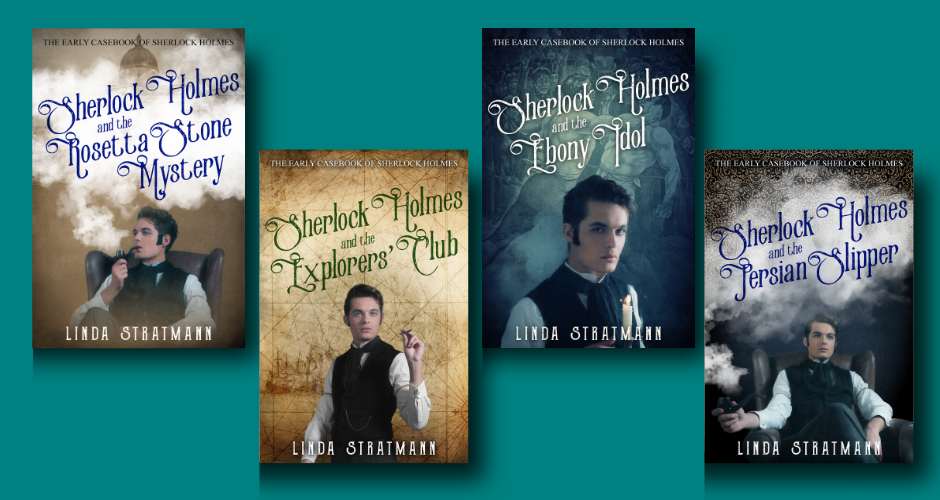
There are many different interpretations of Sherlock Holmes created by authors inspired by the works of Conan Doyle. They might sometimes appear to conflict, but it was my love of science fiction that made me realise that the different versions can all be valid at the same time if they exist in parallel universes. One such interpretation is that Holmes is not human but alien, or possibly even an android.
The Holmes in my books is a human, if an unusual one, but can a good case be made for him not being human? The basis of the case must, I believe, be derived from what I call ‘the canon’ — the original Holmes fiction of Conan Doyle.
So let us examine the canon and look for the clues.
Our first evidence is from Dr Watson himself. In an uncharacteristic feat of observation in The Sign of Four, he declares, ‘“You really are an automaton, — a calculating machine. […] There is something positively inhuman in you at times.”’ Holmes, he says in ‘A Scandal in Bohemia’, is ‘the most perfect reasoning and observing machine the world has seen.’
But what other clues do we have? There are many.
Clue one: An alien or android has no family tree, and Holmes is extremely cagey about his ancestors.
In ‘The Greek Interpreter’, Watson states that Holmes’s gifts for observation and deduction must come from his systematic training, and not his ancestry. Holmes agrees that this is true to some extent and reveals that his ancestors, who he does not name, were country squires who led the life ‘“natural to their class”’. However, he attributes his powers of observation to descent from a family of French artists. His grandmother was the sister of the French artist Vernet. There must, he believes, be some hereditary principle, as his brother Mycroft has the same talent.
If Holmes was an alien or android, a vague reference to unnamed county squires and an artist whose family connections could not have been easily researched would have satisfied Watson’s curiosity. Watson saw some similarities between Holmes and Mycroft, and if Holmes was an alien or android, it would suggest that Mycroft was as well.
Clue two: Holmes has strangely superhuman strength.
Holmes is not a burly man. In ‘The Red-Headed League’, ‘He curled himself up in his chair, with his thin knees drawn up to his hawk -like nose.’ Yet he obviously had a sinewy strength and was skilled in boxing, singlestick and swordsmanship.
To maintain bodily fitness over many years, regular exercise is usually necessary, but with Holmes this is not the case. ‘I have a curious constitution,’ he says in The Sign of Four. ‘I never remember feeling tired by work, though idleness exhausts me completely.’ He then heads off for a smoke.
In ‘The Adventure of the Speckled Band’we have this extraordinary incident. Holmes receives a visit from tall, broad and fierce Dr Grimesby Roylott. Roylott tries to intimidate Holmes by picking up a steel poker and bending it into a curve before flinging it down. After his departure, Holmes picks up the poker ‘and with a sudden effort, straightened it out again.’ Is that even humanly possible?
In ‘The Adventure of the Yellow Face’, Watson tells us that Holmes ‘seldom took exercise for exercise’s sake’ and that he regarded ‘aimless exertion’ as ‘a waste of energy’. Yet he also tells us that ‘Few men were capable of greater muscular effort’ and Holmes was ‘one of the finest boxers of his weight that I have ever seen.’ When there was a requirement for action, he was ‘untiring’. By the time this story was published in 1893, Conan Doyle might have sensed that he needed to explain to his readers the anomaly of a man who hardly ever exercised but excelled at physical activity. ‘That he should have kept himself in training under such circumstances is remarkable,’ says Watson, who goes on to say unconvincingly that ‘his diet was usually of the sparest and his habits were simple to the verge of austerity.’ Holmes, he adds, ‘save for the occasional use of cocaine […] had no vices.’
Clue three: Holmes uses drugs and smokes, apparently without adverse effects.
Conan Doyle introduces us to Holmes’s use of cocaine in The Sign of Four, which includes a brief single reference to the recreational use of morphine. (It is only ever used once again by Holmes, given medicinally in ‘The Adventure of the Illustrious Client’). In ‘The Adventure of the Yellow Face’,published three years after The Sign of Four,ConanDoyle obviously feels the need to dial back, perhaps after some disapproval expressed by his readers, and tells us that ‘he only turned to the drug as a protest against the monotony of existence, when cases were scanty and the papers uninteresting.’ Holmes’s heavy smoking of strong tobacco is never seen by Watson as a vice, or as something that might affect Holmes’s health.
There are numerous references in the stories to Holmes smoking heavily. In ‘The Man with the Twisted Lip’, Holmes smokes an ounce of shag tobacco while deliberating, leaving his room ‘full of a dense tobacco haze.’ In ‘The Adventure of the Engineer’s Thumb’,his before-breakfast pipe is ‘composed of all the plugs and dottles left from his smokes of the day before, all carefully dried and collected on the corner of the mantelpiece.’ If Holmes is an alien or a machine, that explains his apparent imperviousness to the harmful effects of drugs and tobacco. In later adventures, Conan Doyle does however make him more believable by showing Holmes exhausted by his burden of work as he ages. The last year in which a Holmes story is set is 1914 (His Last Bow, published in 1917), by which time he is sixty years of age, and to Watson’s eyes, has hardly changed.
Clue four: Holmes shows little emotion.
Science fiction readers and writers have compared Holmes to an android like Star Trek’s Data, lacking emotion of any kind. If he is an alien, he most closely resembles Star Trek’s coolly logical Vulcans. They have emotions but restrain them; however, they are obliged to let them all out once every seven years in a ritual called pon farr. Does this fit with Holmes’s behaviour? Does a restriction of emotions cause Holmes any stress? If he was a Vulcan, like Mr Spock, could this explain what was really happening in 1891 when Holmes rushed away to the Reichenbach Falls and did not return for three years? Did he feel the approach of pon farr and have to quit England before it took him over? If so, there would be other absences at similar intervals.
I counted back seven years and then I saw it. There are no adventures chronicled by Watson for the years 1884 and 1885. Was this because of a previous pon farr? Holmesian scholars have assumed that during these years Watson was away, perhaps in America, but there might be another explanation? Was Watson with Holmes during these absences, his account carefully crafted to conceal the truth about his friend? Looking ahead another seven years from 1892, there are no adventures dated from between January 1899 (‘The Adventure of Charles Augustus Milverton’) and June 1900 (‘The Adventure of the Six Napoleons’). There are no adventures dated 1906, or 1913. This is all supposition, of course, but the timeline is compelling.
Clue five: Holmes does not wish to marry.
Not only is Holmes averse to marriage, he appears to have no romantic or intimate connections with anyone. If he is not human, this is something he would avoid, or his masquerade as a human might be discovered. Conan Doyle is careful to avoid any suggestion of Holmes having hidden desires which would have alienated his readers. According to Watson, Holmes’s only such interest, is a woman, ‘the woman’, as he calls her, Irene Adler, whom he clearly admires but without allowing any emotions to disturb his finely balanced mind.
On what principles was the alien or android Holmes constructed or programmed?
If Holmes was sent to Earth programmed to solve crimes, he needed to be constructed from many parts. Superhuman strength and constitution. Numerous useful skills. Impervious to the ravages of smoke and drugs. A brilliant reasoning machine undistracted by emotions. The aliens who made or trained him would have studied other detectives of the era and used elements of the finest to create Holmes.
There are three main candidates:
Joseph Bell (1837–1911) was a Scottish surgeon and lecturer who advocated the importance of careful observation. Conan Doyle was a student of Bell from 1877 to 1878. Bell used his observational talents to deduce personal details about complete strangers, a skill which Holmes frequently employed.
Edgar Allan Poe’s C. Auguste Dupin is considered to be the first fictional detective, who used advanced reasoning to solve mysteries. Through observation, he is able to follow the train of thought of his companion, an ability with which Holmes astonishes Watson in ‘The Adventure of the Cardboard Box’.
Le Chevalier Lecoq, a fictional French policeman, inspired by a real criminal investigator, Eugène-François Vidocq (1775–1857). In the works of Émile Gaboriau, published in 1869, Lecoq’s methods when making a detailed examination of a crime scene, using a magnifying glass, are strongly reminiscent of Holmes’s scientific approach. In A Study in Scarlet, Holmes dismisses Dupin as ‘a very inferior fellow’ and Lecoq as ‘a miserable bungler’.
My case is complete. I have laid the facts before you. Make of them what you will.
NOTE:
There were several artists in the Vernet family but only one, Emile Jean Horace (1789-1863) fits the timeline as Holmes’s most probable great uncle. A number of Conan Doyle’s family members were artists, and a friend was a collector of Vernet.
Patrick Larsimont is the author of the Jox McNabb Aviation Thrillers, which follow a fighter pilot through World War Two, and The Brookwood Boys, a paranormal thriller with flashbacks to the lives of deceased soldiers.

In my paranormal military thriller, The Brookwood Boys, ‘Mouse’ Forsyth has watched over Brookwood Cemetery since his death in 1917. For a hundred lonely years, he’s been the caretaker of lost souls, greeting the good, the bad, the damaged, the mad and the sad. Then one day, he is seen and can communicate with the living for the first time. He and his band of fellow soldiers from World War One and World War Two work together to help find a missing living girl. But what was the inspiration for this story and the historical flashbacks about the lives and deaths of the soldiers who are buried here?
My setting is Brookwood Military Cemetery in Surrey, England, the largest in the UK, set within what was once the largest cemetery in Western Europe. Created in the Victorian era, it was destined to hold all of London’s relocated dead and cater for future bodies delivered directly from London Waterloo. It never achieved this goal but is the final resting place of over a quarter of a million souls.
My first interactions with Brookwood began during the COVID-19 lockdowns. It was a quiet place where I could walk and not encounter too many people. I’ve always been fascinated by cemeteries, particularly military ones, and the more I visited, the more I realised the countless rows represented characters in a story — their own, but also our collective one. I thought, in a place like this, there must be ghosts, stranded by trauma and suffering. What if they told their story and together resolved something that happened in the living world?
Those familiar with my stories will know I include real people in my fiction, and there are no shortage of fascinating stories to be told in Brookwood: secrets, scandals, tragedies and horror. Many have made it into the novel and here are a few which you may find interesting.
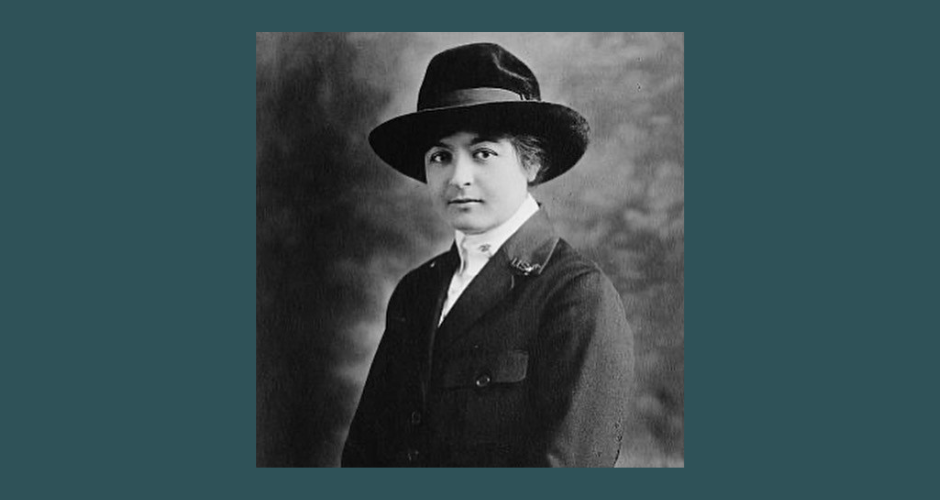
Hedwig ‘Hattie’ Raithel was a thirty-three-year-old American nurse who died of influenza in 1918, at a time when she could have been caring for patients in a war-weary world struck by Spanish flu. This frustration has kept her spirit here in my story, as a gentle, mother-like spirit to the others gathered here. The parallels between the deadly outbreak that led to the crowded graves at Brookwood back then, and the mass fatalities resulting from the current global pandemic were not lost on me.
Pilot Officer John B. Ramsay and Sergeant J. ‘Hugh’ M. Ellis couldn’t have been more different in life. Both were fighter pilots during the Battle of Britain, one a public schoolboy from Dorset, the other nicknamed the ‘Cockney Sparrow’ by his squadron mates. Both were just twenty-one, killed within two weeks of each other during the terrible summer of 1940. Both were lost without a trace. It wasn’t until 1983 that Hugh was found and given a full military funeral at Brookwood, followed by John in 1993. They now lie side by side.
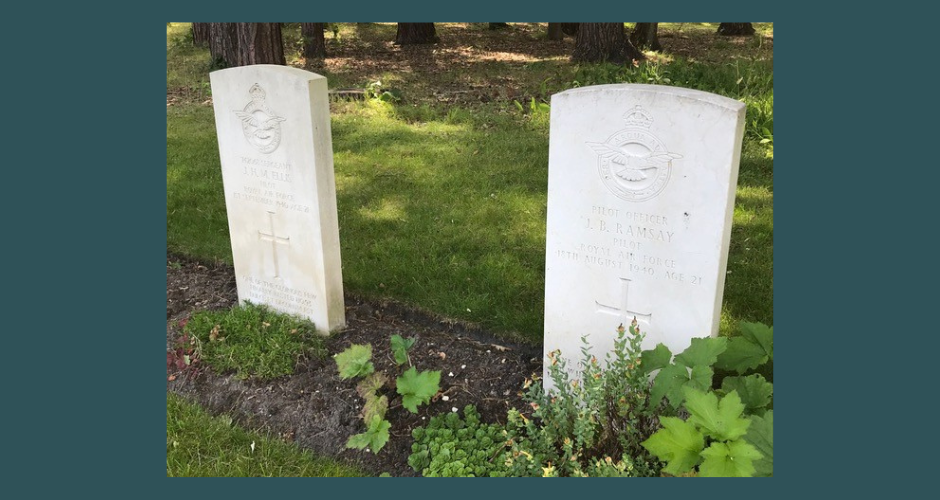
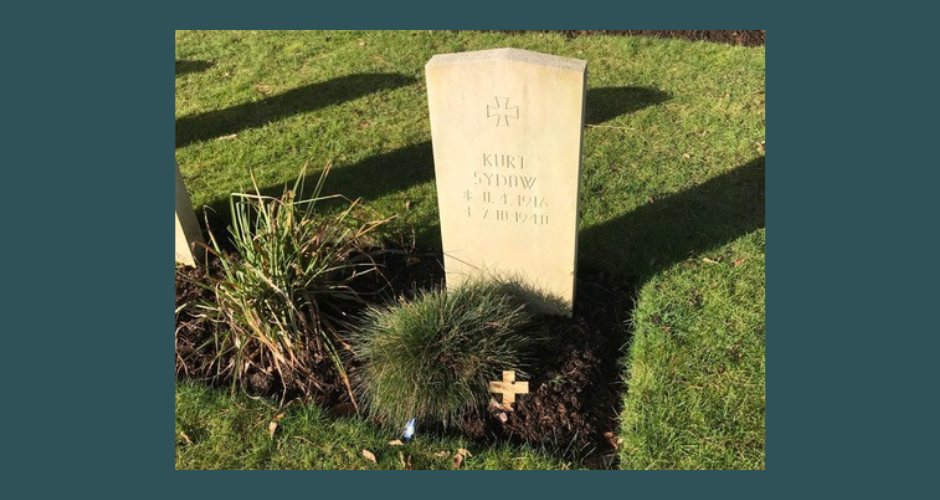
In my story, they become brothers, ‘haunting’ another ghost who might have shot them down. Leutnant Kurt Sidowwas a Luftwaffeace, aged twenty-four, who is also buried at Brookwood with about fifty of his Kameraden. In my story, he is an antagonist, an unrepentant Nazi. But after interacting with John and Hugh, he finds some redemption.
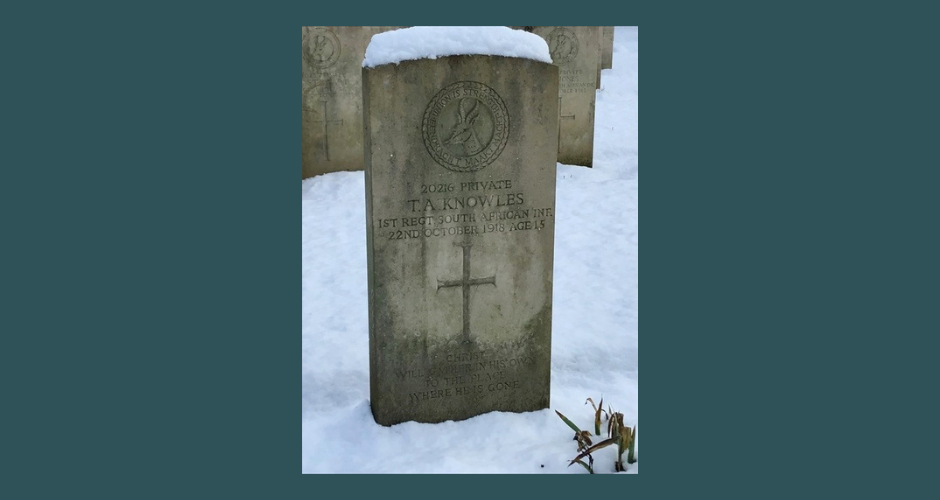
The youngest soldier buried in Brookwood is Tommy Knowles. This is his gravestone on a snowy winter’s day. He too was killed by influenza on the very same day as nine other South African men in the same hospital ward, who never made it to the trenches to do their bit for King and Country. In my story, Tommy plays endless games of football with his friends amongst their gravestones.
There are many other true stories in The Brookwood Boys. What was the fate of the US soldiers killed during rehearsals for D-Day? Who were the US Army’s murderers, and where were they buried after being hanged? Where were the casualties from the Dieppe raid who made it back to Britain buried? Where are the graves of the victims who were killed when the V1 ‘Doodlebug’ landed on the Guards’ Chapel just days after D-Day? And what happened to the countless soldiers of many nations who fought by Britain’s side during the dark days of World War One and World War Two? All are or were at Brookwood. I hope you’ll come and visit.
Image credits:
Image of Hedwig ‘Hattie’ Raithel sourced from Wikimedia Commons (public domain).
All images of graves taken by Patrick Larsimont.
Following the success of his standalone historical novels, Stephen Taylor is now writing the Augustus Swift Investigations: a new detective series set in Georgian England.
The first instalment — Brotherhood of Death — will be released at the end of October, and we are thrilled to have signed the third book in the series.
In Stephen’s words:
“My new series is set in the 1790s, thirty years before the first Metropolitan Police force and fifty years before the first Criminal Investigation Department was founded. The detective I have created is Augustus Swift: a physician and apothecary who has studied modern medicine and logic at Edinburgh University. But he has also travelled to Egypt to study Islamic philosophy and doctoring. He is a humanist who looks to science to explain the world rather than religious beliefs.
“It is the age of the Enlightenment, yet political control is still firmly in the hands of the aristocratic landowners, as it has been for centuries. Dr Swift, however, is a man of the Enlightenment.
“Yet fate raises a capricious eyebrow in his direction when he is recruited by the Home Department to advise on poisons. His life is dedicated to upholding the physician’s ethical principles, but now, by working for the government, his actions perpetuate the injustices of those in power.”
Keep up with Stephen’s latest news via his website.
As a historical novelist, I’d say that what resides in the details is a sense of place and time. Whether found by accurate research, by educated guesswork or by extrapolation, details endow fiction with a near-tangible quality that lets both the writer and the reader experience a measure of truth behind it. We ‘hear’ a long dead spy’s voice in the clipped sentences and spelling quirks of his reports, or we find a mindset in a statesman’s liking for trees and Italy.
Details are also highly addictive.
I usually begin by wanting to know something innocent — say, what fine Moroccan jewellery would have looked like five and a half centuries ago. And at four in the morning, I’m still browsing the web, and writing to friends whose spouses work in museums, or to complete strangers who happen to be historians. In the end, the (broken) Moroccan necklace will make one brief appearance — but it will look like an actual sixteenth-century one.
Once, a few books ago, I spent a happy hour in an antiquary’s shop in Venice, peppering the owner with questions about just what kind of blade a certain kind of Venetian citizen would have bought and worn, so that, in The Road to Murder, Paolo Citolini’s Venetian dagger was not just an element of the plot, but also something that his grandfather could have bought, and his father brought with him in his English exile as a piece of home.
And then there was the session of theatre rehearsals I hijacked into a demonstration of the different styles in Renaissance fencing, to see just what my protagonist, Tom Walsingham, would learn from an Italian swordsmaster. Or the museum curator who asked his mayor for leave in orderpermission to scan old cadastral maps for me. Or the kind librarian at the diocese of Paris’ archives whom I sent on a quest for the name of the bishop’s coadjutor in 1587. Most diocesan records were lost during the Revolution, and the name I wanted couldn’t be found — and yet I became fascinated with the idea of this nameless coadjutor: can he truly be only clinging to the cliff of history by a brief mention in an English diplomatic report? Someday this will be a story, too.
And what would the inn have been called in this village? And where would the great stairs have been in that long-destroyed manor house? Details — often quite small — to be happily hunted down rabbit-holes. They don’t even all necessarily end up on the page: what goes there thickens the atmosphere; what doesn’t still serves to add depth and texture and colour to the story.
Visit C. P. Giuliani’s website to stay up to date with her news and latest releases.
Following the success of her Medieval Ladies Series, we are delighted to have signed a new Thomas Middleton series by Coirle Mooney.
In Coirle’s words:
“While studying for my PhD, I became intrigued by Thomas Middleton. Who was this lesser known, younger, more dashing contemporary of Shakespeare who preferred to be called ‘Plain Tom’?
“In the first book of my new series, schoolboy Tom dreams of becoming a great poet like Kit Marlowe or William Shakespeare and draws inspiration from the daily crime pamphlets sold around St Paul’s Cathedral, as well as the preachers’ passionate sermons on vice and evil-doers. His essay wins the grand prize of a season ticket to the Lord Chamberlain’s Men, but his plan (and childhood) is derailed when his charismatic stepfather attempts to poison his beloved mother, forcing him to give up the precious prize to help pay for the lawsuit that ensues. Alongside his poetic aspiration, Tom develops a lifelong distrust of appearances and an obsession with rooting out poisoners.
“The series follows Tom down the dark alleyways of Southwarke’s lawless baiting dens, taverns, brothels, the Rose and the (newly built) rival Globe theatre, where he meets like-minded playwrights and actors who move easily between all social ranks in late Elizabethan and early Jacobean London. Tom and his fellow artisan dissidents are well placed to root out corruption in the shape of poisoners, like his stepfather, who destroy innocent lives in the pursuit of wealth, status and power.
“All three books reimagine poisonings of the time, with Tom’s character central to discovering the murderers. Book three culminates in the Overbury murder scandal, where members of the Jacobean court and their citizen accomplices were famously put on trial for the poisoning of Sir Thomas Overbury.
“I am thrilled to be working with the marvellous team at Sapere once more and grateful to have a platform worthy of plain Tom!”
Following the success of his many historical series, including the Bailiff Mountsorrel Tudor Mysteries and Esther and Jack Enright Mystery Series, we are delighted to announce that we have signed a new Wars of the Roses series by David Field.
In David’s words:
“For much of the late Medieval period, England was a permanent battlefield, as the rival descendants of the fertile Edward III claimed the right to the crown. Brother fought with brother, cousin sought to depose cousin, heirs to the throne were murdered, and the leading barons of the realm threw in their lot with one side or the other — frequently changing sides in the process.
“It’s a complex network of fast-moving events even for a historian, but for a novelist it’s a daunting challenge. However, it’s one I couldn’t resist, having already taken the story of England’s history forward from the Norman Conquest to the death of Simon de Montfort in my Conquest series for Sapere Books. I’d also picked up the story again in the Tudor series, beginning with the Battle of Bosworth and the accession of Henry VII. This new Wars of the Roses series will fill the gap between these two series.
“Join me as Edward I seeks to put down challenges from the Welsh and the Scots, Edward II squanders his birthright on favourites, and Edward III enjoys a lengthy reign that produces five sons and lights the fuse on the domestic strife to follow with his ill-advised ‘letters patent’ as to who was to succeed him, and in what order. When Richard II was deposed by Henry Bolingbroke in order to become Henry IV, his son, Henry V, brought the nation military triumph across the Channel, only to die tragically young, leaving an inadequate successor to rule as Henry VI. The spurned House of York saw its opportunity, and the ‘Kingmaker’ Earl of Warwick raised Edward IV to the ultimate position of power. But his wily and jealous younger brother Richard of Gloucester wove a treacherous web that left him as the spider in the centre, until the nation threw off his yoke and welcomed back Henry Tudor, the last Lancaster, as Henry VII.
“Behind the scenes, the ultimate fictitious descendants of the man who first rallied the Saxons against the invading Duke William of Normandy seek to survive with honour amid all the mayhem.
“The new series begins in early 2026, and I look forward to sharing it with you.”
Visit David’s website to stay up to date with his news and latest releases.
Congratulations to Linda Stratmann, whose absorbing Victorian mystery, Sherlock Holmes and the Power Principle, is out now!
Sherlock Holmes and the Power Principle is the ninth book in the Early Casebook of Sherlock Holmes series.
1878
Sherlock Holmes and his good friend Mr Stamford are close to completing their education at London’s St Bartholomew’s Medical College, and Holmes is keen to begin a serious career as a detective.
So when a solicitor contacts him about a new case, he quickly accepts.
Mr Ineson is concerned for his client, the widow Mrs Beauregard, who is considering investing most of her considerable assets in a new company called Baumann Motors Ltd.
In an age of industry, machines are rapidly transforming the Victorian world, and fortunes can be made – or lost – by speculating on the latest enterprise.
The Baumann motor promises to change the world transport, make manufactured goods cheaper and allow trains to run without the need for coal.
But it has not been tested, and Ineson is worried that Mrs Beauregard has fallen for the charm of its inventor.
Holmes and Stamford attend a demonstration under the pretence of being interested in investing to try and discover if the motor is as miraculous as it sounds. But soon they are involved in an even deadlier mystery…
With Holmes’ reputation as a highly intelligent and intuitive detective at stake, can he discover the truth about the highly secretive company? Or will this case prove too challenging for even the most astute of men?
Congratulations to R. M. Cullen, whose twisty murder mystery, Death’s Long Shadow, is out now!
Death’s Long Shadow is the second instalment in the Richard Brinsley Sheridan Mystery Series: eighteenth-century crime thrillers set in London at a time of Revolution.
1792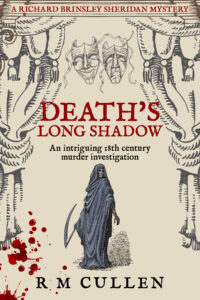
Playwright Richard Brinsley Sheridan’s retreat to the country is interrupted when he stumbles upon a body during a woodland stroll.
The man is identified as Edward Stretton, cousin to Earl Cannock who Sheridan is residing with.
Stretton had a reputation as a scoundrel and seducer and was heavily in debt at the time of his death.
He had been poisoned, and when the Earl’s servants are questioned, unusual evidence puts one man in custody.
But Sheridan is not convinced of his guilt. And one another man is murdered, he suspects there may be a connection.
Can Sheridan uncover the link? Could he save an innocent man from death?
Or will this case prove too complex for this amateur sleuth…?
Congratulations to David Field, whose Victorian thriller, The Long Delayed Revenge, is out now!
The Long Delayed Revenge is the tenth instalment in the Esther and Jack Enright Mystery Series – a traditional British detective series set in Victorian London and packed full of suspense.
London, 1899

Jack and Esther Enright, with their four children in tow, have recently moved to a comfortable new home. Esther has settled into her dream job as headmistress of the local private school, owned by her mentor Emily Allsop.
But things are not going so well for Jack. Though he does not mind the commute to his high-ranking desk job at New Scotland Yard, he is disturbed by the level of recent resignations in by uniformed constables in the East End.
Though the police force has always been used to tackling crime in the more impoverished parts of London, a recent influx of Russian immigrants has led to gang warfare and vigilante justice which is proving impossible to control.
And when Esther’s school is vandalised with a disturbing message, he finds his detective skills are needed closer to home as well.
Things escalate when one of the young pupils is abducted and Jack needs all the help he can get in finding the perpetrator before it is too late.
Can Jack and Esther solve another case together? Will they rescue the child in time?
Or will the unrest in London prove too much for even Jack to handle…?
Following the success of the first three books in J. C. Briggs’ Gothic Mysteries series, we are thrilled to announce that we have signed the fourth instalment.
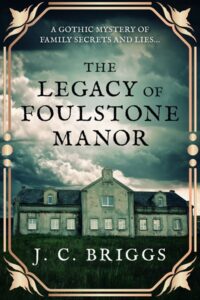
Book 1 in the Gothic Mysteries series
In Briggs’ words:
“I am delighted that Sapere Books have accepted my newest novel, The Prisoner of Raven’s Gaze Hall. This will be my fifteenth book to be published by Sapere, so many thanks to them for their continuing faith in my work.
“This new book is set in an isolated house in Yorkshire, in the fictional Ravendale, a remote dale surrounded by high fells and with few inhabitants. Nurse Catherine Sisley, not long returned from wartime duties, is engaged to nurse an elderly lady, the grandmother of a former patient, but all is not what it seems. Raven’s Gaze Hall harbours a dreadful secret, and its owner, Bennet Lestrange, has a future planned for Catherine from which only tragedy allows her to escape. When she returns ten years later, the terrible truth about the prisoner of Raven’s Gaze Hall is slowly revealed.”
To keep up with J. C. Briggs’ latest releases, visit her website and sign up to her newsletter.
We’re thrilled to announce that we have signed three new instalments of the Early Casebook of Sherlock Holmes series by Linda Stratmann.
The series follows a young Sherlock Holmes and his acquaintance, medical student Mr Stamford, as they unravel mysteries and unmask devious killers.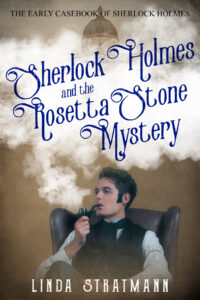
In Linda’s words:
“I am delighted to continue the adventures of a youthful Holmes, before he met Dr Watson. A little about what to expect next: in the Halloween-themed Widow’s Key, an unexpected legacy creates a furore, with deadly mysteries to uncover. In The Aeronauts, murder is sky-high, and escaped balloons cause peril both aloft and below. The Ghost of Lodge Thirteen finds Holmes and Stamford in Brighton. Richard Scarletti has been accused of murder, and his sister Mina (from the Mina Scarletti Mysteries) and Holmes form a powerful detective alliance.”
To keep up to date with Linda’s newest releases, visit her website and sign up to her newsletter.
Congratulations to Richard Kurti, whose absorbing medieval adventure, Carnival of Chaos, is out now!
Carnival of Chaos is the fourth book in the Basilica Diaries Medieval Mysteries series: historical thrillers set in fifteenth-century Rome and featuring a brother and sister investigative duo.
1508, Rome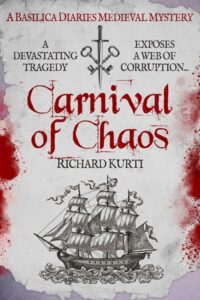
An abandoned ship is drifting in the mouth of the Tiber and a horrific discovery is found inside.
Nearly three-hundred men were packed together in the hold. All of them are dead.
They were migrant workers shipped over from North Africa, cheap labour to cut the cost of building St Peter’s Basilica, and all have died in the most horrendous circumstances.
The Vatican is desperate to distance itself from this atrocity. The guilty contractor must be found and punished, and the entire illegal trade in people must be stamped out.
The Pope charges his Head of Security, Domenico Falchoni with conducting a full investigation.
Domenico turns to his scholar sister Cristina for help and together they delve into the grudges and rivalries of the old dynastic families who are competing for building contracts for the great basilica.
Cristina and Domenico discover that dirty tricks extend across all aspects of the great construction and corruption is rife. So it is not easy to find out who is responsible for the horrific deaths of the migrant workers.
Can they protect other workers from untimely deaths? Will they expose those responsible?
Or will digging into the dark world of human trafficking put their own lives at risk…?
We are thrilled to announce that we have signed the ninth book in the Master Mercurius Mysteries series by Graham Brack.
Set in seventeenth-century Europe, the series follows the adventures of a gifted cleric-turned-sleuth.
In Graham’s words: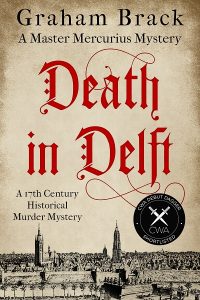
“After eight adventures, Mercurius is very keen that there should not be a ninth. He wants a peaceful life surrounded by his books, and perhaps now that the Stadhouder is King of England he can have it. So long as William III is in England, and Mercurius stays in Leiden, he should be quite safe.
“The long vacation is approaching, and Mercurius decides to make doubly sure by not being in Leiden either. He is planning a tour of great German cathedrals, something that he has long wanted to do. He has even been learning some German in preparation.
“But then comes an invitation he cannot refuse. An old friend would like some advice on buying books for a library. It will take the whole summer, but then those cathedrals will still be there next year, and he has always wanted to spend someone else’s money on books…
“And while he is there, a baffling crime is committed — or is it?
“The Mercurius stories are a delight to write and I am grateful to Sapere Books for showing such faith in them. If he were alive today, I am sure Master Mercurius would love to see his name on the covers. After all, his multi-volume Commentary on the Nicomachean Ethics is rarely read these days, but his memoirs continue to find readers, for which I am very grateful.”
We are thrilled to announce that we have signed a new historical mystery series set in eighteenth-century France by Cheryl Sawyer.
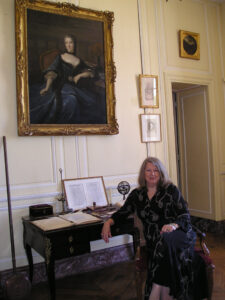
Cheryl Sawyer at the Château de Breteuil with a contemporary portrait of Émilie du Châtelet
In Cheryl’s words:

A cavalier of the Maréchaussée, the French military police, in the early 1700s
“It’s 1735 in the remote Champagne province and a cavalier in France’s mounted police force must investigate a murder at the chateau of Cirey, where the scandalous Marquise du Châtelet is sheltering Voltaire. How could a lower-class gendarme solve major crime in a society where aristocrats held all the power?
“That very question sprang to mind when I visited beautiful, secluded Cirey during my research into Émilie du Châtelet, a brilliant physicist of the Enlightenment. A lone military policeman would struggle to do his duty in this privileged locale, even if Voltaire himself were a likely suspect.
“That is how Victor Constant and his first challenging investigation came to life. I had eight historical novels published in several languages, but this was my first crime story and I sought seasoned opinion. Peter Lovesey wrote to me: ‘Marvellous tensions between the great free-thinker and Victor Constant, the book’s hero. The story dazzles and beguiles and the setting is pitch-perfect.’ The novel went on to be longlisted for awards by the Historical Novel Society and the American Library in Paris, and readers have since called Victor ‘the Jack Reacher of the eighteenth century’.
“I am delighted that Sapere Books have chosen Murder at Cirey to lead this series and thrilled that Victor Constant persists in battling injustice within the rigid society of the Champagne. The new titles are Death in Champagne and Murder on High. A huge thank you to the Sapere team for launching this adventurous series!”
Congratulations to David Field, whose twisty Victorian thriller, The Retirement Murder, is out now!
The Retirement Murder is the ninth instalment in the Esther and Jack Enright Mystery Series – a traditional British detective series set in Victorian London and packed full of suspense.
London, 1898
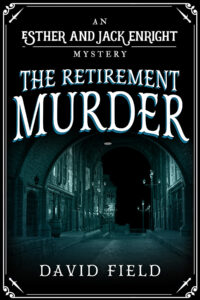
The time has finally come for Percy Enright to retire from Scotland Yard. His nephew, Jack, is sad to lose a partner in the force, but Jack’s wife Esther is glad Percy won’t be getting her husband into any further scrapes.
It seems Esther’s relief might be short lived, though, when a senior officer collapses at Percy’s farewell ceremony.
It soon becomes clear that the officer was poisoned, and Percy delays retirement to help Jack track down the culprit.
It’s a daunting task that involves trawling through all the murdered officer’s recent cases in the search for someone who may still bear him a grudge.
But when it becomes clear the dead man may not have been the intended target, the investigation suddenly turns in a new direction.
Why are the police being targeted? Can Percy make one final arrest before he retires?
Or will the murderer outwit the Enrights in their latest case…?
Congratulations to R. M. Cullen, whose absorbing historical thriller, Harlequin is Dead, is out now!
Harlequin is Dead is the first historical murder investigation in the Richard Brinsley Sheridan Mystery Series: eighteenth-century crime thrillers set in London at a time of Revolution.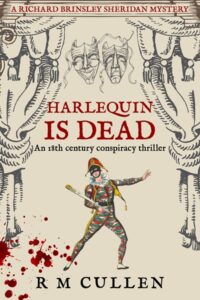
1791
Revolution in France is causing refugees to flee to England and London is fast becoming a hotbed of spies, government agents and fanatics.
When renowned Irish playwright, Richard Brinsley Sheriden is led to the skeletal remains of a harlequin in his theatre, he is determined to get justice for his employee.
With the aid of Bow Street Runner, Constable Nicholls, Sheridan starts to investigate.
He soon realises two more performers have disappeared. And the discovery of a decorative cross suggests there is a link with a dangerous secret society, the Huguenot Brotherhood.
But why would French political migrants be targeting the theatre?
Meanwhile, the Prince of Wales has received an anonymous letter accusing him of Treason and Sheridan is tasked with hunting out the sender.
Could both mysteries be linked? Is London heading for the same bloodthirsty scenes as Paris?
Or can Sheridan help stop the insurgents from taking hold in England…?
Following the success of his many historical series, including the Sandal Castle Medieval Thrillers and Inspector Torquil McKinnon Mystery Series, we are delighted to announce that we have signed a new supernatural series set in Victorian London by Keith Moray.
In Keith’s words:
“The first book in the series is set in London in 1854. Jack Moon is a foundling, brought up in an orphanage and then a workhouse, where he and his best friend Danny are subject to regular beatings. Together they escape, but when Danny dies in tragic circumstances, Jack secretly buries his friend in a cemetery at night.
“Alone and living in a deserted and rat-infested warehouse, Jack starts seeing Danny’s ghost, who warns him that someone is out to kill him and worse, the girl he loves, too. This is Victorian London, with its criminal underworld, body-snatchers, phrenologists, séances, ghosts and ghouls.
“I am delighted to be writing another historical series with Sapere Books, who have permitted me to set my stories in a variety of times and places, from ancient Egypt and medieval England to a contemporary Scottish island. My new mystery series delves into the occult and the psyche of the Victorian mind. It is murky, sinister and just a little bit scary.
“And one of the main characters is a ghost.”
Congratulations to Angela Ranson, whose gripping Tudor mystery, A Glittering Peril, is out now!
A Glittering Peril is the third book in the Catrin Surovell Tudor Mysteries Series: exciting historical thrillers set at the court of Elizabeth I.
1561
Every summer, Queen Elizabeth takes a journey around her kingdom. It is a time of revels and celebration, full of pleasure and extravagance.
But in July 1561, the trip begins badly when the corpse of an unknown man is left in her path.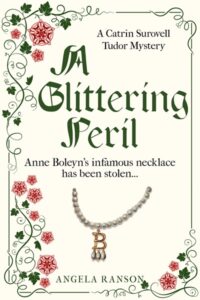
The nervous queen asks Catrin Surovell, her trusted favourite lady-in-waiting, to find out who is trying to sabotage her journey.
But Catrin soon discovers that the queen’s nervousness stems from something greater than the mysterious death.
Someone has been leaving reminders of the queen’s mother, Anne Boleyn, in strange places. A woman appears in the distance who looks like her; the scent of Anne’s perfume is left in the queen’s chamber, and Anne’s favourite French ballads are sung by a disembodied voice as the queen is travelling.
Worst of all, Anne Boleyn’s famous gold-and-pearl necklace with teardrop pearls hanging from a letter ‘B’ is taken from the queen’s bedchamber. The queen is devastated by the loss, for the necklace was one of very few mementos she had of her mother.
The queen begins to suspect one of her courtiers, so Catrin visits his home to conduct a secret investigation into his actions. And that’s when she discovers this is the most difficult mystery she has ever had to solve.
Is Queen Elizabeth being haunted by her ill-fated mother? Or is someone trying to drive her insane?
And can Catrin find the connection between the missing jewels and the unknown corpse…?
Congratulations to Adele Jordan, whose page-turning Tudor mystery, The Body in the Chamber, is published today!
The Body in the Chamber is the third book in the Shadow Cutpurses Tudor Thriller Series.
1536, London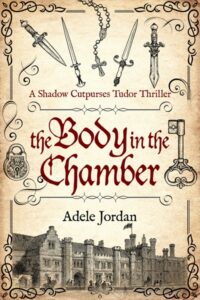
With two queens already removed from King Henry VIII’s side, the Tudor court fears for his new wife, Jane Seymour.
Thief turned espionage agent, Gwynnie Wightham is tasked by her employer Elric Tombstone to watch over the new queen.
And it soon becomes clear that her task will not be an easy one when a dead body is found in the queen’s chambers.
It seems there is a murderer hiding in the palace walls, and a clear suspect has already been named.
Convicted killer, Connal Devlin, escaped the noose at Tyburn and vowed to seek revenge on King Henry for turning his back on the ‘true’ Catholic faith.
Gwynnie is tasked with finding Devlin, but something doesn’t seem right.
Is it possible Devlin isn’t as evil as he was made out to be? Could someone else be behind the murder at the palace?
And can Gwynnie stop them before another Tudor queen’s life comes to an untimely end…?
A few weeks ago, I was standing outside St Peter’s Basilica in Rome, gazing at the ancient Egyptian obelisk that sits in the middle of the square. (It’s also on the front cover of Omens of Death — the first book in The Basilica Diaries series.)

A fresco in the Vatican depicting preparations for the erection of the obelisk in front of St Peter’s Basilica. Photograph taken by Richard Kurti.
The guide who was showing me round said, “There’s an interesting story about this obelisk. When Moses was a young man, he was educated in Heliopolis (modern Cairo), where this obelisk originally stood. As he hurried back and forth to school, Moses would have seen this very stone every day. Even then it was a thousand years old. He would have walked past it, used it as a meeting point for friends, maybe even sat in its shade.
“Now, cut forward across time. The Romans have stolen the obelisk and brought it to Italy, where the Emperor Caligula ordered it to be set up at the Circus of Nero just outside the city walls. And that is the same place where St Peter was executed. Which means the very last thing St Peter saw before he died would have been this obelisk. And now you are gazing at the exact same stone.”
I could feel my brain jolt. Moses, Caligula, St Peter and myself, all connected across 4,500 years by a single object. These were no longer remote characters from the pages of the Bible — if I reached out my hand, I could touch them through this granite obelisk.
What the guide did was a brilliant demonstration of the power of narrative. He could have bombarded me with facts and figures about the height and weight of the obelisk, about where the stone was quarried and when it was carved, and how it was moved from the Circus of Nero to its current site and erected in a single day.
But he didn’t, because he knew that those facts would have gone in and out of my mind in seconds. Instead, he told a story that organised the truth in such a way that it connected me to the distant past.
That’s what I’ve been attempting to do on every page of The Basilica Diaries historical thrillers. I have spent countless hours researching the novels, but rather than bombard the reader with details, I have tried to organise the truth into narratives that will resonate with the modern world whilst also transporting us back across the centuries.
I hope you enjoy the latest adventure in the series, Carnival of Chaos, which will be published in April.
Congratulations to David Field, whose absorbing historical thriller, Death By Gunpowder, is out now!
Death By Gunpowder is the sixth instalment of the Bailiff Mountsorrel Tudor Mystery Series – private investigation crime novels set during the reign of Elizabeth I and beyond.
Nottingham, England, 1605
Frustrated in their two previous attempts to restore the Catholic faith to England, a group of heretics plan to assassinate King James in Parliament in a massive explosion timed for November 5th, 1605.
But when that plot also fails and Guy Fawkes starts revealing the names of accomplices under torture in the Tower, those who had been complicit in the plot run for cover.
Not long after, Nottinghamshire bailiff, Edward Mountsorrel is called to investigate a mysterious explosion in a row of houses that has left four people dead.
And he soon unearths evidence that suggests this crime is linked to the larger plot on the king’s life.
His suspicions are confirmed when an official from London, acting with royal authority, orders Edward and fellow bailiff Francis Barton to hunt down the gunpowder fugitives who are believed to be hiding out in the local area.
But the men won’t go down without a fight. And Edward could find himself in the firing line…
Congratulations to J. C. Briggs, whose intriguing Gothic mystery, The Inheritors of Moonlyght Tower, is out now!
England, 1916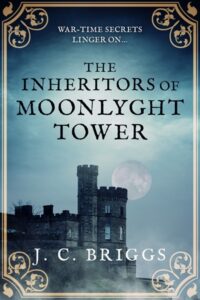
With her mother ill and her father threatening to marry her off to a violent neighbour, Jessie Sedgwick takes up a position as a kitchen maid at Moonlyght Tower to escape her home.
But Moonlyght is far from a sanctuary. Its imposing Gothic Tower looms menacingly over the building and Jessie is surprised to find the only other staff members are a sour housekeeper and an unfriendly nurse who looks after the bedbound lady of the house.
Not long after arriving, Jessie meets a former kitchen maid, Ethel Widdop, who warns Jessie to leave as soon as possible. But before Jessie can find out more, Ethel is found dead…
And something strange is happening at Moonlyght. Jessie sees something strange in the imposing tower and she hears footsteps coming from an empty room. A room she discovers belonged to the heir to the house, Jonathan, who fell from the tower two years ago.
It’s clear there are dark secrets hiding at Moonlyght, and despite herself, Jessie finds herself drawn in.
What ails the lady of the house? Was her son’s death really an accident – or something more sinister?
And is Jessie in danger of ending up like Ethel…?
Congratulations to Elizabeth Bailey, whose absorbing historical mystery, The Killing Cave, is published today!
The Killing Cave is the eleventh book in the Lady Fan Mystery series: traditional British detective novels set in eighteenth-century England.
1799, England
A family holiday to the seaside takes a dramatic turn when Lady Ottilia Fanshawe’s young son Luke accidentally stumbles on a body in a cave.
Lady Fan and her husband Francis quickly rush to the scene and find the corpse bound and blindfolded with a bullet hole in his head.
It appears the man was executed, and with smugglers well-known to operate in the area, the local sergeant suggests it was a quarrel amongst the reprobates.
But Ottilia is not so sure. The crime scene seemed staged, and the dead man too well dressed to be a common criminal.
There is nothing else for it. The Fanshawes must extend their stay on the Norfolk coast to allow Lady Fan to take the lead.
But with her health compromised, four young children to care for and a grumbling mother-in-law in tow, can Lady Fan summon up enough strength to unravel this mystery? Or will this be the case that finally forces her into retirement?
Congratulations to Linda Stratmann, whose absorbing Victorian mystery, Sherlock Holmes and the Cabinet of Wonders, is out now!
Sherlock Holmes and the Cabinet of Wonders is the eighth novel in the Early Casebook of Sherlock Holmes series.
1878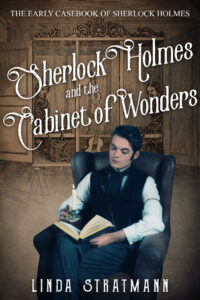
Sherlock Holmes is in a slump of despair and self-doubt following his recent encounter with his brother Mycroft and his good friend Mr Stamford is determined to snap him out of it.
When Stamford hears of a new show being put on at the Egyptian Hall Theatre, he brings Holmes with him for a night of diversion.
But for Holmes, the outing leads to something much more stimulating…
A few days later, a corpse is found inside the cabinet used for one of the conjuror’s acts at the theatre, and at first it appears the death was accidental.
But Holmes soon realises it was the result of something more sinister. And lurking beneath the surface of the magician’s code of conduct is a murky world of false identities and professional jealousy.
There are secrets in the world of illusion that people would kill to keep hidden…
And if they are not careful, Holmes and Stamford could be the next targets…
Congratulations to Adele Jordan, whose captivating espionage adventure, Death At The Tower, is published today!
Death At The Tower is the second book in the Shadow Cutpurses Tudor Thriller Series: gripping adventures set during King Henry VIII’s reign in England with a strong female lead.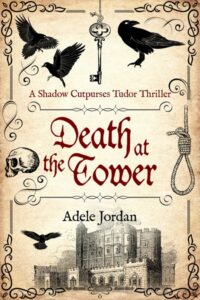
1536, London
Thief Gwynnie Wightham has a new master in Elric Tombstone. She may follow his word, but she has little loyalty for him, and there is even less friendship between them.
She has agreed to assist him to make sure he keeps his word to never go hunting for her mother. For if Emlyn is ever found, she will be tried not just for being a jewel thief, but for murder.
Tombstone’s task for Gwynnie is to investigate Captain Daundelyon, for there has been a tipoff that the Dandy Lyon, as he’s nicknamed, is a French spy, come to ingratiate himself with the king.
Gwynnie follows Captain Daundelyon around, noticing he’s a common thief, almost as skilled as her in her deception, but she finds no hint of his spy work.
But the Tudor court is cracking into factions – a great rift has swelled between King Henry and Queen Anne Boleyn, and what she does find is that Daundelyon’s presence is inextricably linked with Queen Anne’s downfall.
What is Daundelyon’s relationship to Anne Boleyn? Is he plotting against the king?
And can Gwynnie prove her worth and find a way to clear her mother’s name…?
Congratulations to Elizabeth Bailey, whose page-turning Gothic mystery, Nell, is out now!
Nell is the second book in the Governess Trilogy: heart-warming Regency romance novels with strong female leads.
1795, England
Nell Faraday has grown up at the Paddington Charitable Seminary for Indigent Young Ladies and now, like her two best friends Prudence and Kitty, she is ready to take up a position as a governess.
A star pupil, Nell prides herself on her common-sense and practicality. But when she arrives at Castle Jarrow, the imposing abode is enough to test even the steadiest of nerves, and the brooding man in charge of it is enough to test the firmest of hearts…
Lord Jarrow is a widower with a young daughter, Hetty, who Nell is to be in charge of, but it is soon clear that Nell’s job will not be an easy one.
Dark secrets lurk within the walls of the castle, secrets that could threaten the safety of its inhabitants.
Will Nell’s steadfastness keep her from fleeing? Can she earn the trust of Lord Jarrow?
And can she help free the castle from its curse…?
We are thrilled to announce that we have signed three new instalments in the Tom Walsingham Mysteries Series by C.P. Giuliani.
The series follows the espionage adventures of Tom Walsingham during the Elizabethan era in Tudor England.
In C.P. Giuliani’s words:
“Tom Walsingham sleuths on! I’m thrilled to have signed up three more adventures featuring my Elizabethan detective and spy with Sapere Books. I have great plans for Tom. He will be tasked with recovering a misplaced foreign ambassador — whose mission could change the course of Anglo-Spanish relations; he’ll become involved in a personal investigation when death strikes at his family home, Scadbury Manor; and poor Tom will find himself in prison when his money troubles and Sir Francis Walsingham’s plans collide. Plenty of mysteries and dangers lie ahead for Tom!
“I’m really happy to be working with Sapere, whose welcoming and stimulating atmosphere and competent, friendly and helpful team have made (and are making) my publishing journey a truly lovely adventure.”
Congratulations to David Field, whose gripping historical mystery, To Kill A King, is out now!
To Kill A King is the fifth novel in the Bailiff Mountsorrel Tudor Mystery Series – private investigation crime novels set during the reign of Elizabeth I and beyond.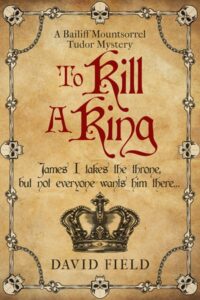
Nottingham, England, 1603
Queen Elizabeth’s long reign has finally come to an end and the Tudor era is over. Scottish King James has been handed the crown of England, but not everyone is happy about that, and there are several plots being hatched to replace him with an alternative.
Bailiff Edward Mountsorrel already has his hands full with an increase in destitute vagrants flooding the county, who seem to be victims of a human trafficker. But before he can find the man responsible, he is tasked by an official with royal authority to infiltrate a local group, who it is rumoured are plotting to assassinate the new king.
Edward enlists the help of fellow bailiff, Francis Barton to find the group, who are hiding out in Sherwood Forest.
But the only way to discover the plot is to place themselves right in the heart of the danger. And there’s a good chance they will be killed before they can save the king…
Who is leading the band of rebels? Can he be stopped?
And is there a connection between the treasonous plot and the desperate vagrants Edward is trying to assist…?
Congratulations to Laura Martin, whose gripping Regency murder mystery, The Dead Curate, is published today!
The Dead Curate is the fifth book in the Jane Austen Investigation series.
1798, Steventon, England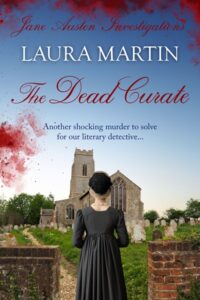
Mr Austen’s role as rector of Steventon church has meant that Jane and her sister Cassandra are well connected in the local community.
With Mr Austen indisposed, Jane and Cassandra walk to church to greet the curate, Mr Williamson, who will be leading the sermon in his place.
But when they arrive the church is locked and the parishioners are already milling around outside.
Already fearing something is amiss, Jane rushes home to find her father’s key and when she returns she makes a horrifying discovery.
At first the church appears to be empty, but a series of blood drops lead Jane up into the belfry.
And there she finds Mr Williamson, propped up with iron nails through his hands and feet.
The Austen sisters are used to investigating murders by now, but this one is too close to home…
Who would have a grudge against the unassuming curate? Why his body displayed in such a manner?
And are any other lives at risk in the sleepy village of Steventon?
Congratulations to David Field, whose twisty Elizabethan mystery, The Clamorous Dead, is published today!
The Clamorous Dead is the fourth historical thriller in the Bailiff Mountsorrel Tudor Mystery Series – private investigation crime novels set during the reign of Elizabeth I and beyond.
Nottingham, England, 1596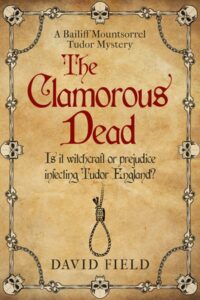
A routine hanging at Gallows Hill is disrupted when a wild woman begins screaming a curse on the execution site, calling down nightly visitations from the undead to claim the souls of the living.
County Bailiff Edward Mountsorrel attempts to pursue her, but she vanishes into thin air.
Nightly thereafter, Gallows Hill is the scene of ghastly happenings that Edward is ordered to investigate. Rumours of witchcraft infiltrate the county and the bailiff is sent to arrest a local woman, suspected of devilry.
Edward finds her and realises she is merely a wise woman with ancient knowledge of herbs and medicine and with no ill intent. He decides to hide her to keep her safe from those calling for blood.
But his efforts are complicated by the arrival of a professional witch-hunter from Scotland, who is scouring the length and breadth of England in a blood-thirsty mission to destroy any woman, man or child found guilty of sorcery.
As mass hysteria and prejudice threaten to engulf the country, can Edward bring justice to his county, while still keeping his morals intact? Or will innocent women be thrown to the wolves…?
In this behind-the-scenes blog series, Sapere Books authors offer an intriguing insight into how, where and why they write.
Today, we are delighted to spotlight Marilyn Todd, author of the Julia McAllister Victorian Mysteries series.

Medieval castle at the bottom of Marilyn’s garden
Living on a French hilltop, with a medieval castle at the bottom of our garden, Roman remains beside a river in the valley, and with the Hennessey Cognac estate on one side, Martell on the other — I couldn’t ask for a lovelier or more tranquil setting.
Okay, there are diggers outside at the moment, replacing water pipes in the very same trenches the electricity people dug (then filled in) exactly one week before. But usually the loudest sound is birdsong, and the mewing of buzzards circling overhead. Just the ticket when you come home bursting with ideas that need to be turned into stories without distractions. From Sicily to Arizona, Sweden to Nova Scotia, I find inspiration everywhere.
Sweden? That was when we were walking a little out-and-back coastal path — worryingly easy to imagine two people going out, but only one of them coming back.
Nova Scotia? Who wouldn’t be inspired by the biggest disaster no one’s ever heard of, when a French ship carrying enough explosives to end the First World War collided with a Norwegian ship coming the wrong way up the channel? The explosion took close to 2,000 lives, injured 9,000 more, destroyed everything in a half-mile radius, spiked a tsunami, and scattered debris several miles inland.
Sicily drew me back to ancient history, inspiring the second book in the Claudia Seferius series, Virgin Territory, as well as Blind Eye — set in Ancient Greece this time, rather than Rome — and debunked the myth of the Cyclops.
As always, Arizona never fails to deliver, especially when my story ‘The Wickedest Town in the West’ scooped an Ellery Queen’s Mystery Magazine award, of which I am ridiculously proud.
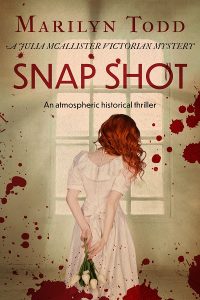 But while we travel a lot, not everything I write is inspired by breathtaking scenery, adventures and legends. My first series with Sapere Books, which kicked off with Snap Shot, was influenced by the emerging science of forensic evidence at the end of the nineteenth century, and the importance of studying crime scenes. Hence Britain’s first crime scene photographer, Julia McAllister.
My new Firefly series, coming soon with Sapere, tackles the inequalities women faced in Edwardian times, especially domestic violence, which was banned between the hours of 10 p.m. and 7 a.m. because the noise interrupted other people’s sleep. Battling the system is Kitty Sullivan, who runs a gentleman’s club with a fleet of … let’s say exotic dancers, to fund a women’s refuge. Environments that, unsurprisingly, provoke dangerous situations, which Kitty faces down with charm, wit and, of course, a silver Derringer.
After all, there’s no point in having double standards, if you don’t live up to both of them.
In this behind-the-scenes blog series, Sapere Books authors offer an intriguing insight into how, where and why they write.
Today, we are delighted to spotlight C.P. Giuliani, author of the Tom Walsingham Mysteries Series.

C.P Giuliani’s garden house
Every year, as soon as summer comes, I move my writing to the garden house. It’s not really cooler, as temperature goes, but it feels summery and pleasant. I love the tall ceiling, the terracotta floor, the desk that used to belong to my great-grandfather, and the view onto the garden. There’s a little pond outside the French windows, and the birds bathing or drinking are, I confess, something of a distraction — but they also provide a cheerful break whenever I find myself stuck. A paragraph refusing to take the right shape? A character mutinying? A dull passage? I step away from the desk and watch while the blackbirds play in the water — and, more often than not, a solution will suggest itself.
For all its rustic pleasantness, the garden house has decent Wi-Fi — which is rather essential when my pile of reference books is not enough to confirm some detail — and is equipped with an electric kettle to make cup after cup of tea, which is a fundamental of my writing method.
In truth, beyond the insane amounts of tea, I have little in the way of a writing routine. Working in theatre means that my hours are flexible. Sometimes I write in the morning, sometimes very late at night, sometimes both; sometimes I must snatch the odd hour here and there, between a rehearsal session and a meeting with the techs. One thing I do is to always keep a notebook with me. Through the years, I’ve learnt to keep a dedicated notebook for each project, beside a general one for everything and anything: notes, stray ideas, snatches of dialogue overheard or imagined, lists, questions… It’s the general notebook that I carry around, so I can jot down anything that occurs to me — to be transferred to the relevant one later. This means that I do some of my writing at the theatre, at the vet’s, as I stand in a queue at the Post Office…
My family, friends and colleagues have developed a high degree of amused tolerance for my ‘Notebook Moments’, when I drop whatever I’m doing to take a note; strangers are occasionally a little put out until I explain that, for one thing, I’m prone to forgetting what I don’t write down and, for another, sometimes an idea will present itself in a very iridescent shape, little more than a flicker of colour under the surface of the water — and will need to be recorded quickly and thought through in writing, at least a little, if it’s to be of any use.
So to recap, I’m absent-minded, easily distracted, forgetful, and can’t keep a routine… I suppose it’s no wonder that a quiet, pleasant place like the garden house is important to my writing process.
Congratulations to Simon Michael, whose exciting legal thriller, Death, Adjourned, is published today!
Death, Adjourned is the ninth crime novel in the Charles Holborne Legal Thrillers series — gritty, hard-boiled mysteries set in 1960s London.
London, 1969
The Kray twins, the nemeses of Charles Holborne, barrister, are finally convicted of multiple murders and sent away for the longest prison terms ever imposed by a British court.
But with London in the grip of a housing crisis and unscrupulous landlords hiking rents, there are new ruthless enforcers terrorising destitute East Enders.
When a tenant dies during a violent altercation with bailiffs, Charles is instructed to represent the businessmen charged with conspiracy to murder. There is motive, an eyewitness and a confession – seemingly an open and shut case.
But Charles suspects his clients are pawns in a much more dangerous game being played by shadowy Establishment figures.
But are his instincts wrong this time? Is he being manipulated into defending a guilty man?
And as dark secrets are revealed, will he have to choose between moral integrity and professional success?
We are delighted to announce that we have signed a new series of Tudor mysteries by Kate Robertson.
In Kate’s words:
“The series follows Anne Winston, a lady at the court of Queen Elizabeth I. Quiet and unassuming, she is a keen observer and has a skill for puzzling out problems.
“When we first meet Anne, she has just returned to court from burying her husband. She soon learns that her nephew has been arrested for sedition and must race against the clock to prove his innocence while also being drawn into the emerging spy network under Sir William Cecil, the Secretary of State.
“As the series progresses, we will see Anne uncover intrigues and conspiracies, using her powers of observation and ability to go unnoticed in most situations. I wanted to write a story about an older female protagonist who discovers the power of her voice and finds her agency in a complicated world, all while trying to right wrongs and find justice for the forgotten.
“I met Amy Durant at the Historical Novel Society Conference in San Antonio in 2023. I initially pitched her a different story but when she asked what else I had, I knew I needed to share Anne, my most personal protagonist, entrenched in the Tudor era, which is my first historical period love.
“I’m excited to work with Sapere — it’s inspiring to work with a publisher that knows and loves historical fiction so well.”
Congratulations to David Field, whose gripping historical mystery, The Slaughtered Widow, is published today!
The Slaughtered Widow is the third instalment of the Bailiff Mountsorrel Tudor Mystery Series – private investigation crime novels set during the reign of Elizabeth I and beyond.
Nottingham, England, 1592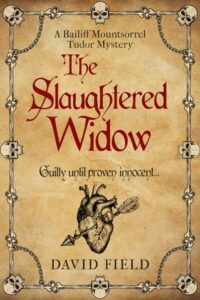
Town Bailiff Francis Barton has been arrested for the murder of his former lover, the widow Agnes Timberlake, and the case against him is a strong one.
Agnes was hacked to death where she lay in her bed and Francis was found standing next to her body, with both his clothing and his sword covered in her blood.
And there is a motive. Agnes had recently loaned Francis her entire life savings and was believed to be demanding an accounting for them.
Despite the overwhelming evidence against him, Francis’s friend, County Bailiff Edward Mountsorrel, refuses to believe that Francis is guilty and sets out to investigate for himself.
Edward wants to speak to the serving girl from the widow’s house who may have been the last to see her mistress alive, but she has vanished.
Is the girl running from a guilty conscience? Or has she also fallen victim to the killer?
Time is running out for Francis. Can Edward clear his friend’s name … or is it time to accept that Francis really is capable of murder…?
Congratulations to Linda Stratmann, whose absorbing historical mystery, Sherlock Holmes and the Mycroft Incident, is published today!
Sherlock Holmes and the Mycroft Incident is the seventh Victorian crime thriller in the Early Casebook of Sherlock Holmes series.
1877
A trusted government courier, Anthony Cloudsdale, has gone missing after delivering some secret documents.
The police are questioning everyone who works at Whitehall, and their attention has been drawn to a young clerk, Joshua Emmett, who is in need of funds and might have been vulnerable to bribery.
Emmett is an old schoolfriend of Mycroft Holmes and Mycroft approaches his private-investigator brother, Sherlock Holmes for help.
Holmes and Mycroft collaborate with the assistance of Holmes’ trusted friend Mr Stamford, but each time they discover new information about Cloudsdale’s disappearance, it appears to provide evidence of Emmett’s involvement.
And when a body is found in the Thames, Emmett is arrested.
But is the body Cloudsdale’s? Can Sherlock prove Emmett’s innocence?
Or is Mycroft trying to protect a guilty man…?
Congratulations to Keith Moray, whose gripping Medieval mystery, The Minstrel’s Malady, is published today!
The Minstrel’s Malady is the fifth book in the Sandal Castle Medieval Thrillers series: historical murder mysteries set in Yorkshire.
1330, Yorkshire, England
Edmund of Woodstock, the Earl of Kent, is executed for High Treason against King Edward III.
At his trial, it is claimed that a demon was conjured up by a monk versed in the Dark Arts, who told him that his brother, King Edward II, still lived.
Keen to quell rumours of sorcery that could do untold damage to the royal house and to the country, Sir Richard Lee, Sergeant-at-Law, is instructed by Sir Roger Mortimer and Queen Isabella, the king’s mother, to seek out the monk who delivered the message.
When a minstrel is struck down by a seizure before Sir Richard’s court, many believe the man to be possessed of a demon. Richard’s assistant, Hubert of Loxley, is given the task of riding to Cawthorne Priory to deliver the minstrel into the care of the monastery hospital.
Also at the priory is the anchorite, Sister Odelina, blessed with visions and the power to heal the sick.
But when a number of sinister deaths take place at the priory, blame falls upon the minstrel and the demon inside him.
Are the deaths the work of evil spirits? Or is there a murderer in their midst…?
With panic on the rise, can Sir Richard discover the truth before evil strikes again…?
Congratulations to David Field, whose absorbing historical thriller, The Assassination Players, is published today!
The Assassination Players is the second instalment in the Bailiff Mountsorrel Tudor Mystery Series – private investigation crime novels set during the reign of Elizabeth I and beyond.
Nottinghamshire, England, 1591
Two of Queen Elizabeth I’s justices have been murdered within a week of each other, along with a woman who was involved with one of them and a man who had been awaiting trial by the other.
County Bailiff Edward Mountsorrel and Town Bailiff Francis Barton are tasked with investigating the deaths, but they are thrown off course by a visit from the queen’s secretary, Baron Burghley.
Burghley has discovered a plot to kill the Protestant queen and replace her with a Catholic alternative.
He tasks the bailiffs with journeying into a neighbouring county to infiltrate the gang of suspected traitors.
Time is of the essence as the threat already seems to have infiltrated Elizabeth’s court.
But the men behind the plot are ruthless and the path to discover them is fraught with danger.
Will Mountsorrel and Barton unmask the traitors? Who is behind the plot to kill the queen?
Can the bailiffs stop them before they change the course of history forever…?
Congratulations to Richard Kurti, whose twisty biographical crime novel, Requiem of Revenge, is out now!
Requiem of Revenge is a page-turning historical thriller based on the mystery surrounding the death of J S Bach.
Bath, England, 1761
A gruesome discovery is made in one of the city’s wealthiest townhouses. A man has been imprisoned and blinded; left to die in his own home.
He is rescued and his wife, Lady Arabella Taylor is arrested for the crimes.
Doctor Erasmus Harvey examines the victim, and finds out he is Chevalier John Taylor, an esteemed surgeon. The chevalier is keen to see his wife punished and Harvey is sent to take her confession.
But when Harvey meets with Arabella, he is astonished to find she shows no remorse. In fact, she insists her crimes were justified.
Repulsed by this she-devil, Harvey is unsure whether to declare her insane. But as he hears her testimony, what she reveals shocks him to his core.
And he soon realises he is not only unravelling the truth behind the crimes inflicted on the chevalier, but also the death of the celebrated composer J.S. Bach.
Who is the victim and who is the criminal? Why did Arabella torture her husband?
Her crimes could expose a scandal that will send shockwaves through Europe…
Congratulations to Angela Ranson, whose gripping murder mystery, Dead Foretold, is published today!
Dead Foretold is the second book in the Catrin Surovell Tudor Mystery Series. It is an exciting historical thriller set at the court of Elizabeth I.
1561
Queen Elizabeth is under pressure from all her advisors to marry, but no one can agree on a potential husband.
The conflict is slowly eroding Elizabeth’s power and authority among the nobility, especially when a prophecy starts to spread that seems to predict the deaths of senior members of the queen’s court.
Tension grows when one of the queen’s maids of honour, Mathilda, is killed and placed on a false altar of hawthorn branches.
Her death follows the first lines of the prophecy, making people fearful about who could be next.
Amid rising hysteria, the queen orders her trusted lady-in-waiting Catrin Surovell to investigate.
Catrin soon learns that there is more to this mysterious death than anyone thought.
Strange symbols and eerie events put her on the trail of the murderer.
What do the symbols mean? Is someone using the guise of magic to destabilise the queen’s reign?
Catrin has to figure it out and stop the murderer before he strikes again…
Congratulations to J. C. Briggs, whose atmospheric Gothic mystery, The Legacy of Foulstone Manor, is published today!
Westmorland, England, 1970
Dark and imposing in a bleak landscape, Foulstone Manor stands abandoned on the edges of the Lake District.
Reclusive Joan Goss inherited Foulstone, but her fragmented memories of her childhood there still disturb her and she keeps her distance in a cottage on the outskirts of the land.
Joan was brought up by adoptive parents after her mother died and her father abandoned her.
And she has spent her adult life haunted by the dark rumours of her past.
When Joan’s niece Amanda comes to stay with her, she is finally forced to confront the secrets behind Foulstone Manor.
Records show that Joan’s father committed suicide. But what happened to her mother? And why was Joan never told the truth about her childhood?
As Joan uncovers her mother’s diary, the full truth of her parents’ marriage is revealed.
Did his traumatic experiences in the First World War force her father into an early grave? What caused Joan’s mother’s untimely death?
Can Joan come to accept the inheritance that she has always rejected…?
Following the success of her Julia McAllister Victorian Mysteries series, we are thrilled to announce that we have signed a new Edwardian series by Marilyn Todd.
Book 1 in the Julia McAllister Victorian Mysteries series
In Marilyn’s words:
“My terrific relationship with Sapere Books continues with the signing of my new series.
“This time it’s crime
In Edwardian time,
With a heroine sharper than lime.
They’re nail-biting thrillers,
And though she catches the killers
She don’t ’arf have a bloody good time.
“The world might have been changing fast back then, but not for women. They still had no rights, no vote, and men could still “chastise” them until 10pm, after which it constituted a noise violation. I wanted to give those women a voice, so I created a character who rips up the rule book by running a refuge for battered wives, funded by a gentleman’s club with a fleet of… Let’s call them exotic dancers. And quite frankly, neither she or I could be in better hands, thanks to the guidance, support and encouragement from this young, dynamic publishing house. Go Sapere!”
Congratulations to Laura Martin, whose absorbing Regency-era mystery, The Body on the Beach, is out now!
The Body on the Beach is the fourth book in the Jane Austen Investigation series: thrilling historical murder mysteries with a tenacious literary heroine working as a female sleuth.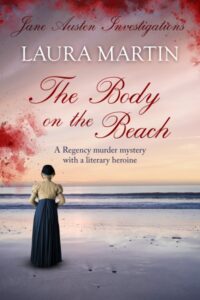
1798, Dorset, England
Jane Austen is on holiday with her parents and her sister, enjoying time at the seaside in Lyme Regis.
But one morning, while out on an early stroll, her peace is shattered.
There is someone lying at the bottom of the cliffs.
After rousing her father and sister, she hurries along the beach to find a young woman, dead.
It is clear to Jane that the young woman has been strangled. There is bruising about her neck and marks of discolouration on her face, yet the magistrate and doctor are quick to dismiss her concerns.
As Jane starts to investigate further, she discovers there have been two other young women found dead on the beach between Charmouth and Lyme Regis in the last five months.
Jane and Cassandra are certain the deaths are connected, but why is no one else looking for their killer?
Were the women known to each other? Are they connected in some way?
Can the Austen sisters unravel the mystery?
Richard Kurti is the author of the Basilica Diaries Medieval Mysteries series and Requiem of Revenge: a page-turning historical thriller based on the mystery surrounding the death of J S Bach.
Despite being the story of a man who leaves a trail of chaos and suffering in his wake, Requiem of Revenge began as a search for inner peace.
I always listen to music when I write, often choosing film scores that resonate with the tone of the story I’m working on. But as populist leaders took power in country after country and the world seemed to retreat from democracy, my mood slumped. Instinctively, I turned to the music of Bach and Handel.
The richness of their music was incredibly healing, and I clung to the thought that whatever dark times they endured, both composers were still able to produce works of incredible beauty. And then I wondered, What exactly did they live through?
I started reading about the lives of Bach and Handel. They were both born in 1685 in Germany, barely 90 miles apart; they spent their lives as composers and musicians, yet they never met. Although they are now recognised as being the greatest composers of their age, both men had very different lives. Handel moved to London, where he enjoyed wealth and fame, while Bach spent much of his life working in Leipzig, scraping a living as the director of church music.
Bach certainly knew of Handel and greatly admired him; he is even quoted as saying “[Handel] is the only person I would wish to see before I die, and the only person I would wish to be.”
And then, as I was rummaging around in the footnotes of history, I discovered an extraordinary coincidence: both composers were destroyed by the same fraudulent English eye surgeon, ‘Chevalier’ John Taylor.
I dug deeper into the Chevalier’s life, and realised there was a shocking resonance across the centuries: the charlatans who were wreaking havoc in the modern world seemed to be cut from the same cloth as the man who destroyed the genius of Bach and Handel 250 years ago.
Perhaps telling the story of one liar and cheat could shed light on how liars and cheats are able to triumph across the world?
And that was when I started writing.
Congratulations to David Field, whose page-turning Tudor mystery, The Castle Abductions, is out now!
The Castle Abductions is the first historical thriller in the Bailiff Mountsorrel Tudor Mystery Series: private investigation crime novels set during the reign of Elizabeth I and beyond.
Nottingham, England, 1590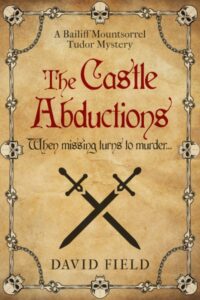
County Bailiff Edward Mountsorrel and Town Bailiff Francis Barton have vowed to root out the criminals of Nottinghamshire and bring them to justice.
But after acting on information from a questionable source, Edward is tricked into allowing several deer to be stolen from a local estate. Furious, he sets about tracking them down.
Meanwhile, Francis is asked to investigate the disappearance of Nell, a young woman who was last seen at a local alehouse with a wealthy stranger.
When the bailiffs’ shared house is burned down and their servant is found stabbed to death, Edward and Francis begin to suspect that their cases are linked.
And when more young women go missing, the two bailiffs worry they are running out of time to retrieve them from danger…
Who wishes to silence to Edward and Francis? What happened to the missing women?
And can the two bailiffs find them before it’s too late…?