

Linda Stratmann is the author of the Mina Scarletti Mysteries and the Early Casebook of Sherlock Holmes series.
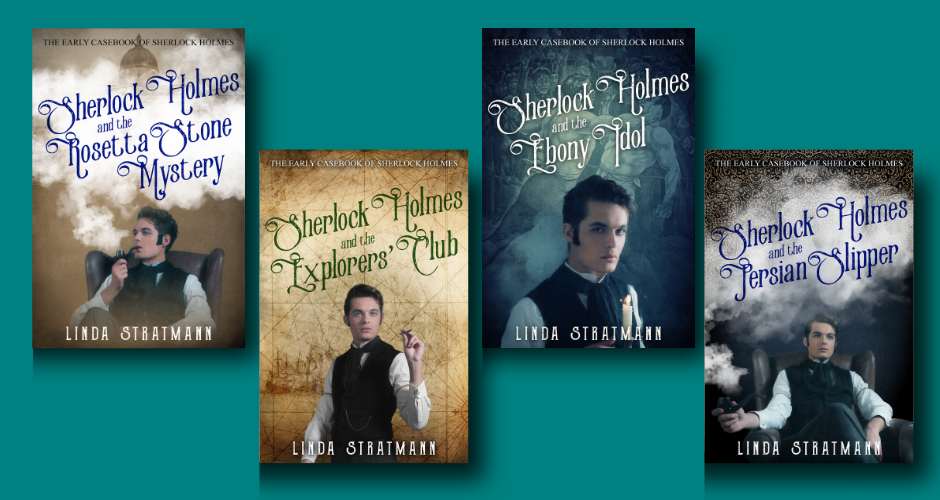
There are many different interpretations of Sherlock Holmes created by authors inspired by the works of Conan Doyle. They might sometimes appear to conflict, but it was my love of science fiction that made me realise that the different versions can all be valid at the same time if they exist in parallel universes. One such interpretation is that Holmes is not human but alien, or possibly even an android.
The Holmes in my books is a human, if an unusual one, but can a good case be made for him not being human? The basis of the case must, I believe, be derived from what I call ‘the canon’ — the original Holmes fiction of Conan Doyle.
So let us examine the canon and look for the clues.
Our first evidence is from Dr Watson himself. In an uncharacteristic feat of observation in The Sign of Four, he declares, ‘“You really are an automaton, — a calculating machine. […] There is something positively inhuman in you at times.”’ Holmes, he says in ‘A Scandal in Bohemia’, is ‘the most perfect reasoning and observing machine the world has seen.’
But what other clues do we have? There are many.
Clue one: An alien or android has no family tree, and Holmes is extremely cagey about his ancestors.
In ‘The Greek Interpreter’, Watson states that Holmes’s gifts for observation and deduction must come from his systematic training, and not his ancestry. Holmes agrees that this is true to some extent and reveals that his ancestors, who he does not name, were country squires who led the life ‘“natural to their class”’. However, he attributes his powers of observation to descent from a family of French artists. His grandmother was the sister of the French artist Vernet. There must, he believes, be some hereditary principle, as his brother Mycroft has the same talent.
If Holmes was an alien or android, a vague reference to unnamed county squires and an artist whose family connections could not have been easily researched would have satisfied Watson’s curiosity. Watson saw some similarities between Holmes and Mycroft, and if Holmes was an alien or android, it would suggest that Mycroft was as well.
Clue two: Holmes has strangely superhuman strength.
Holmes is not a burly man. In ‘The Red-Headed League’, ‘He curled himself up in his chair, with his thin knees drawn up to his hawk -like nose.’ Yet he obviously had a sinewy strength and was skilled in boxing, singlestick and swordsmanship.
To maintain bodily fitness over many years, regular exercise is usually necessary, but with Holmes this is not the case. ‘I have a curious constitution,’ he says in The Sign of Four. ‘I never remember feeling tired by work, though idleness exhausts me completely.’ He then heads off for a smoke.
In ‘The Adventure of the Speckled Band’we have this extraordinary incident. Holmes receives a visit from tall, broad and fierce Dr Grimesby Roylott. Roylott tries to intimidate Holmes by picking up a steel poker and bending it into a curve before flinging it down. After his departure, Holmes picks up the poker ‘and with a sudden effort, straightened it out again.’ Is that even humanly possible?
In ‘The Adventure of the Yellow Face’, Watson tells us that Holmes ‘seldom took exercise for exercise’s sake’ and that he regarded ‘aimless exertion’ as ‘a waste of energy’. Yet he also tells us that ‘Few men were capable of greater muscular effort’ and Holmes was ‘one of the finest boxers of his weight that I have ever seen.’ When there was a requirement for action, he was ‘untiring’. By the time this story was published in 1893, Conan Doyle might have sensed that he needed to explain to his readers the anomaly of a man who hardly ever exercised but excelled at physical activity. ‘That he should have kept himself in training under such circumstances is remarkable,’ says Watson, who goes on to say unconvincingly that ‘his diet was usually of the sparest and his habits were simple to the verge of austerity.’ Holmes, he adds, ‘save for the occasional use of cocaine […] had no vices.’
Clue three: Holmes uses drugs and smokes, apparently without adverse effects.
Conan Doyle introduces us to Holmes’s use of cocaine in The Sign of Four, which includes a brief single reference to the recreational use of morphine. (It is only ever used once again by Holmes, given medicinally in ‘The Adventure of the Illustrious Client’). In ‘The Adventure of the Yellow Face’,published three years after The Sign of Four,ConanDoyle obviously feels the need to dial back, perhaps after some disapproval expressed by his readers, and tells us that ‘he only turned to the drug as a protest against the monotony of existence, when cases were scanty and the papers uninteresting.’ Holmes’s heavy smoking of strong tobacco is never seen by Watson as a vice, or as something that might affect Holmes’s health.
There are numerous references in the stories to Holmes smoking heavily. In ‘The Man with the Twisted Lip’, Holmes smokes an ounce of shag tobacco while deliberating, leaving his room ‘full of a dense tobacco haze.’ In ‘The Adventure of the Engineer’s Thumb’,his before-breakfast pipe is ‘composed of all the plugs and dottles left from his smokes of the day before, all carefully dried and collected on the corner of the mantelpiece.’ If Holmes is an alien or a machine, that explains his apparent imperviousness to the harmful effects of drugs and tobacco. In later adventures, Conan Doyle does however make him more believable by showing Holmes exhausted by his burden of work as he ages. The last year in which a Holmes story is set is 1914 (His Last Bow, published in 1917), by which time he is sixty years of age, and to Watson’s eyes, has hardly changed.
Clue four: Holmes shows little emotion.
Science fiction readers and writers have compared Holmes to an android like Star Trek’s Data, lacking emotion of any kind. If he is an alien, he most closely resembles Star Trek’s coolly logical Vulcans. They have emotions but restrain them; however, they are obliged to let them all out once every seven years in a ritual called pon farr. Does this fit with Holmes’s behaviour? Does a restriction of emotions cause Holmes any stress? If he was a Vulcan, like Mr Spock, could this explain what was really happening in 1891 when Holmes rushed away to the Reichenbach Falls and did not return for three years? Did he feel the approach of pon farr and have to quit England before it took him over? If so, there would be other absences at similar intervals.
I counted back seven years and then I saw it. There are no adventures chronicled by Watson for the years 1884 and 1885. Was this because of a previous pon farr? Holmesian scholars have assumed that during these years Watson was away, perhaps in America, but there might be another explanation? Was Watson with Holmes during these absences, his account carefully crafted to conceal the truth about his friend? Looking ahead another seven years from 1892, there are no adventures dated from between January 1899 (‘The Adventure of Charles Augustus Milverton’) and June 1900 (‘The Adventure of the Six Napoleons’). There are no adventures dated 1906, or 1913. This is all supposition, of course, but the timeline is compelling.
Clue five: Holmes does not wish to marry.
Not only is Holmes averse to marriage, he appears to have no romantic or intimate connections with anyone. If he is not human, this is something he would avoid, or his masquerade as a human might be discovered. Conan Doyle is careful to avoid any suggestion of Holmes having hidden desires which would have alienated his readers. According to Watson, Holmes’s only such interest, is a woman, ‘the woman’, as he calls her, Irene Adler, whom he clearly admires but without allowing any emotions to disturb his finely balanced mind.
On what principles was the alien or android Holmes constructed or programmed?
If Holmes was sent to Earth programmed to solve crimes, he needed to be constructed from many parts. Superhuman strength and constitution. Numerous useful skills. Impervious to the ravages of smoke and drugs. A brilliant reasoning machine undistracted by emotions. The aliens who made or trained him would have studied other detectives of the era and used elements of the finest to create Holmes.
There are three main candidates:
Joseph Bell (1837–1911) was a Scottish surgeon and lecturer who advocated the importance of careful observation. Conan Doyle was a student of Bell from 1877 to 1878. Bell used his observational talents to deduce personal details about complete strangers, a skill which Holmes frequently employed.
Edgar Allan Poe’s C. Auguste Dupin is considered to be the first fictional detective, who used advanced reasoning to solve mysteries. Through observation, he is able to follow the train of thought of his companion, an ability with which Holmes astonishes Watson in ‘The Adventure of the Cardboard Box’.
Le Chevalier Lecoq, a fictional French policeman, inspired by a real criminal investigator, Eugène-François Vidocq (1775–1857). In the works of Émile Gaboriau, published in 1869, Lecoq’s methods when making a detailed examination of a crime scene, using a magnifying glass, are strongly reminiscent of Holmes’s scientific approach. In A Study in Scarlet, Holmes dismisses Dupin as ‘a very inferior fellow’ and Lecoq as ‘a miserable bungler’.
My case is complete. I have laid the facts before you. Make of them what you will.
NOTE:
There were several artists in the Vernet family but only one, Emile Jean Horace (1789-1863) fits the timeline as Holmes’s most probable great uncle. A number of Conan Doyle’s family members were artists, and a friend was a collector of Vernet.
Congratulations to Donna Gowland, whose page-turning historical mystery, The Lost Girls, is published today!
The Lost Girls is the second book in the Mary Shelley Investigations series: Gothic murder mysteries with a tenacious literary heroine working as a female sleuth.
1815, London
After triumphantly solving a murder case in Paris, Mary Wollstonecraft Godwin and Percy Shelly return to London penniless.
As Percy is still married to his estranged wife, he and Mary are shunned from polite society for living together out of wedlock.
Isolated and trapped in squalid lodgings, Mary finds herself alone while Percy escapes to the tavern. But one evening when she goes looking for him, she stumbles upon a body.
She leaves to fetch help and when she returns the dead girl is gone…
When she receives a note from an old friend and discovers another girl is missing, Mary wonders if the crimes are connected.
What happened to the body? Was it taken by the murderer?
Can Mary and Percy come together to solve another tricky case…?
Congratulations to Donna Gowland, whose absorbing murder mystery, The Missing Wife, is out now!
The Missing Wife is the first book in the Mary Shelley Investigation series.
1814, London
It isn’t easy being the daughter of the great Mary Wollstonecraft, harder still to navigate life without her. 16-year-old Mary Godwin is desperate for excitement and trapped in a family she feels stifled in, under the watchful, disapproving glare of her stepmother Mary, she is constantly battling for her father’s attention and approval.
So when the young Romantic poet, Percy Shelley, comes blazing into her life, she falls quickly and deeply in love with him. But Percy has plenty of demons. He is already married with a second child on the way, and he turns up to the Godwin family home with a bottle of laudanum, declaring he will end his life if he cannot be with Mary.
William Godwin forbids contact between them, but Mary’s heart aches for the man she believes to be her soulmate. And so she agrees to elope to Paris.
The excitement of the journey soon wears off and they arrive in the city weary, travel-sick and penniless, though luck finally seems to be on their side when they meet a man who offers them money to find his missing wife.
But with Mary becoming increasingly homesick and concerned for her future, will her love affair with Percy be all she had hoped for? Could the search for the missing wife set her on a new course of self-discovery?
Or will her first daring adventure prove to be her downfall…?
We’re thrilled to announce that we have signed three new instalments of the Early Casebook of Sherlock Holmes series by Linda Stratmann.
The series follows a young Sherlock Holmes and his acquaintance, medical student Mr Stamford, as they unravel mysteries and unmask devious killers.
In Linda’s words:
“I am delighted to continue the adventures of a youthful Holmes, before he met Dr Watson. A little about what to expect next: in the Halloween-themed Widow’s Key, an unexpected legacy creates a furore, with deadly mysteries to uncover. In The Aeronauts, murder is sky-high, and escaped balloons cause peril both aloft and below. The Ghost of Lodge Thirteen finds Holmes and Stamford in Brighton. Richard Scarletti has been accused of murder, and his sister Mina (from the Mina Scarletti Mysteries) and Holmes form a powerful detective alliance.”
To keep up to date with Linda’s newest releases, visit her website and sign up to her newsletter.
Congratulations to Linda Stratmann, whose absorbing Victorian mystery, Sherlock Holmes and the Cabinet of Wonders, is out now!
Sherlock Holmes and the Cabinet of Wonders is the eighth novel in the Early Casebook of Sherlock Holmes series.
1878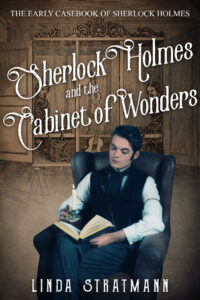
Sherlock Holmes is in a slump of despair and self-doubt following his recent encounter with his brother Mycroft and his good friend Mr Stamford is determined to snap him out of it.
When Stamford hears of a new show being put on at the Egyptian Hall Theatre, he brings Holmes with him for a night of diversion.
But for Holmes, the outing leads to something much more stimulating…
A few days later, a corpse is found inside the cabinet used for one of the conjuror’s acts at the theatre, and at first it appears the death was accidental.
But Holmes soon realises it was the result of something more sinister. And lurking beneath the surface of the magician’s code of conduct is a murky world of false identities and professional jealousy.
There are secrets in the world of illusion that people would kill to keep hidden…
And if they are not careful, Holmes and Stamford could be the next targets…
Following the success of his DS Hunter Kerr Investigations and Dr Hamlet Mottrell Investigations, we are delighted to announce that we have signed a new historical police procedural series by Michael Fowler.
In Michael’s words:
“My new series features Detective Winter Cooper of Scotland Yard and is set in the 1950s.
“Detective Cooper’s first case is based upon a real event, the Eastcastle Street robbery — Britain’s biggest cash-in-transit hold-up at the time. In May 1952, robbers used two cars to sandwich a Post Office van in London and escaped with mailbags containing £287,000 (estimated to be worth approximately £8,500,000 today). It was a case that shocked the nation and embarrassed the Government, with Prime Minister Winston Churchill demanding daily updates from the Police Commissioner. Despite the involvement of over a thousand police officers, and the offer of a £25,000 reward, no one was ever caught.
“This is my take on that case, and while it is a deviation from my contemporary novels, I hope readers will embrace Winter Cooper with the same enthusiasm that I have put into creating him and this new series.
“Working with Sapere Books again was an easy decision to make. Over the past five years, they have given me so much support as a writer and I cannot thank them enough. When I ran the idea of this new series past them, their backing was unflinching.”
Congratulations to David Field, whose twisty Elizabethan mystery, The Clamorous Dead, is published today!
The Clamorous Dead is the fourth historical thriller in the Bailiff Mountsorrel Tudor Mystery Series – private investigation crime novels set during the reign of Elizabeth I and beyond.
Nottingham, England, 1596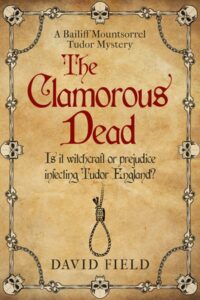
A routine hanging at Gallows Hill is disrupted when a wild woman begins screaming a curse on the execution site, calling down nightly visitations from the undead to claim the souls of the living.
County Bailiff Edward Mountsorrel attempts to pursue her, but she vanishes into thin air.
Nightly thereafter, Gallows Hill is the scene of ghastly happenings that Edward is ordered to investigate. Rumours of witchcraft infiltrate the county and the bailiff is sent to arrest a local woman, suspected of devilry.
Edward finds her and realises she is merely a wise woman with ancient knowledge of herbs and medicine and with no ill intent. He decides to hide her to keep her safe from those calling for blood.
But his efforts are complicated by the arrival of a professional witch-hunter from Scotland, who is scouring the length and breadth of England in a blood-thirsty mission to destroy any woman, man or child found guilty of sorcery.
As mass hysteria and prejudice threaten to engulf the country, can Edward bring justice to his county, while still keeping his morals intact? Or will innocent women be thrown to the wolves…?
Congratulations to David Field, whose gripping historical mystery, The Slaughtered Widow, is published today!
The Slaughtered Widow is the third instalment of the Bailiff Mountsorrel Tudor Mystery Series – private investigation crime novels set during the reign of Elizabeth I and beyond.
Nottingham, England, 1592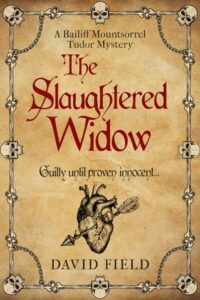
Town Bailiff Francis Barton has been arrested for the murder of his former lover, the widow Agnes Timberlake, and the case against him is a strong one.
Agnes was hacked to death where she lay in her bed and Francis was found standing next to her body, with both his clothing and his sword covered in her blood.
And there is a motive. Agnes had recently loaned Francis her entire life savings and was believed to be demanding an accounting for them.
Despite the overwhelming evidence against him, Francis’s friend, County Bailiff Edward Mountsorrel, refuses to believe that Francis is guilty and sets out to investigate for himself.
Edward wants to speak to the serving girl from the widow’s house who may have been the last to see her mistress alive, but she has vanished.
Is the girl running from a guilty conscience? Or has she also fallen victim to the killer?
Time is running out for Francis. Can Edward clear his friend’s name … or is it time to accept that Francis really is capable of murder…?
Congratulations to Linda Stratmann, whose absorbing historical mystery, Sherlock Holmes and the Mycroft Incident, is published today!
Sherlock Holmes and the Mycroft Incident is the seventh Victorian crime thriller in the Early Casebook of Sherlock Holmes series.
1877
A trusted government courier, Anthony Cloudsdale, has gone missing after delivering some secret documents.
The police are questioning everyone who works at Whitehall, and their attention has been drawn to a young clerk, Joshua Emmett, who is in need of funds and might have been vulnerable to bribery.
Emmett is an old schoolfriend of Mycroft Holmes and Mycroft approaches his private-investigator brother, Sherlock Holmes for help.
Holmes and Mycroft collaborate with the assistance of Holmes’ trusted friend Mr Stamford, but each time they discover new information about Cloudsdale’s disappearance, it appears to provide evidence of Emmett’s involvement.
And when a body is found in the Thames, Emmett is arrested.
But is the body Cloudsdale’s? Can Sherlock prove Emmett’s innocence?
Or is Mycroft trying to protect a guilty man…?
Congratulations to Keith Moray, whose gripping Medieval mystery, The Minstrel’s Malady, is published today!
The Minstrel’s Malady is the fifth book in the Sandal Castle Medieval Thrillers series: historical murder mysteries set in Yorkshire.
1330, Yorkshire, England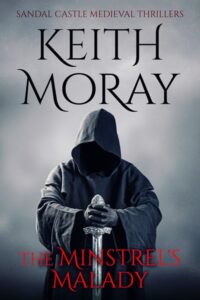
Edmund of Woodstock, the Earl of Kent, is executed for High Treason against King Edward III.
At his trial, it is claimed that a demon was conjured up by a monk versed in the Dark Arts, who told him that his brother, King Edward II, still lived.
Keen to quell rumours of sorcery that could do untold damage to the royal house and to the country, Sir Richard Lee, Sergeant-at-Law, is instructed by Sir Roger Mortimer and Queen Isabella, the king’s mother, to seek out the monk who delivered the message.
When a minstrel is struck down by a seizure before Sir Richard’s court, many believe the man to be possessed of a demon. Richard’s assistant, Hubert of Loxley, is given the task of riding to Cawthorne Priory to deliver the minstrel into the care of the monastery hospital.
Also at the priory is the anchorite, Sister Odelina, blessed with visions and the power to heal the sick.
But when a number of sinister deaths take place at the priory, blame falls upon the minstrel and the demon inside him.
Are the deaths the work of evil spirits? Or is there a murderer in their midst…?
With panic on the rise, can Sir Richard discover the truth before evil strikes again…?
David Field is the author of numerous historical series, including the Bailiff Mountsorrel Tudor Mystery Series: private investigation crime novels set during the reign of Elizabeth I and beyond.
My new series features the exploits of two sheriffs’ bailiffs during the Tudor and later the Stuart eras. For me it was a labour of love because it involved researching the history of Nottingham, where I was born and raised during the immediate post-war years.
In my novels, Edward Mountsorrel and Francis Barton are colleagues in adjoining jurisdictions who have become close friends. Their work involves enforcing the law and investigating crime, under the direction of their respective employers, the Sheriff of Nottinghamshire and the Sheriff of Nottingham. The fact that there are two separate sheriffs, one for the county and the other for the town, arises from a quirk of Nottingham’s history that also explodes one of the elements of the legend of Robin Hood, Nottingham’s most famous alleged resident.
A central character in the Robin Hood myth is the dastardly Sheriff of Nottingham, but the truth is that he did not exist until 1449, at least two hundred years after Robin is said to have lurked in Sherwood Forest, to the north of the town. A charter in that year, granted by Henry VI, made Nottingham its own county, with its own sheriff and its own jurisdiction, not to mention its own courthouse. And therein lies another set of intriguing and quirky facts.
While the town continued to conduct its legal affairs in the old Guildhall in Weekday Cross, the county needed a place to do the same, conveniently located within the town itself. It therefore constructed what for many years was known as the Shire Hall, sitting proudly in the middle of one of the town’s most affluent streets, High Pavement. It was a small chunk of the county located within the town, and given that the boundary line ran through the centre of the original courtroom, the judge could be found seated in the town while the prisoner before him was located in the county. This august building is now the National Justice Museum, a popular destination for tourists.
Hopefully this will make up for several guaranteed disappointments for any tourist visiting Nottingham hoping to step into the Medieval world of Robin Hood. The city does indeed possess a castle, which features heavily in the first book in my forthcoming series, but the current edifice is now in its third manifestation. The original eleventh-century version constructed on the orders of William the Conqueror was destroyed at the behest of its own governor, Colonel John Hutchinson, at the end of the English Civil War, before Oliver Cromwell could get his hands on it. The reconstruction was then burned down by a mob during the Reform Bill Riots of 1831, and the current building — which is now a civic museum that houses old bicycles, coin collections and Japanese armour — became little better than a middle-class boarding house of dull Victorian architecture before being bought up for a song by the embarrassed city fathers.
At least the vandals couldn’t do much to diminish the grandeur of the rock on which the castle stands, a block of sandstone rising for one hundred and thirty feet above ground level. This is full of caves and passages where previous generations cut their way through the soft stone in order to create dwellings that were converted into dungeons when the castle was first constructed. At its foot sits a vintage hostelry, now known as The Ye Olde Trip to Jerusalem, that was once the castle’s in-house brewery before it became an alehouse, linked to the castle above by a series of tunnels through the sandstone. This alehouse would have been there during the time in which my novels are set, so I’ve made use of it in the first instalment, in which young women are abducted from there.
I enjoyed researching the history of my birthplace, and I think it shows in my new series, which hopefully captures the rough-and-tumble nature of law enforcement in a Tudor township.
Richard Kurti is the author of the Basilica Diaries Medieval Mysteries series: historical thrillers set in fifteenth- and sixteenth-century Rome and featuring a brother and sister investigative duo.
Donato Bramante (1444-1514) was the brilliant architect who designed St Peter’s Basilica in Rome and oversaw the initial stages of construction. If you could put him in a time machine, bring him forward five hundred years, and lay out the current problems of the HS2 railway line before him, I doubt he would be very surprised. Bramante discovered the hard way that huge, ambitious construction projects that test the limits of technology always run into the same dilemmas and have the same questions hanging over them:
Why build it at all?
Isn’t the existing structure good enough?
What philosophy should drive the new project?
How can you prevent the costs ballooning out of control?
Will the public lose interest and turn against you?
How will you cope with unforeseen complications?
How will you prevent corrupt builders skimming off vast sums for their own personal enrichment?
Take a moment to think about building something like St Peter’s without the use of computers, high-powered machinery or sophisticated scientific instruments. It took one hundred and twenty years, and Bramante was long dead by the time it was completed, but its construction was still a lot quicker than Notre Dame Cathedral in Paris, or York Minster. And once built, these cathedrals have stood the test of time. How many railway lines will still be operating half a millennia after they were constructed?
The triumph of this superhuman achievement inspired me to write a series of novels centred on the construction of St Peter’s. Each murder mystery swirls around a different theme linked to the vast building project. Omens of Death explores the morality of building St Peter’s in the first place; Palette of Blood focuses on the vicious battle between artists competing to design it; and the newest book, Demon of Truth, shows what happens when you make a catastrophic discovery mid-construction.
Although the novels are fictional thrillers, I spent a lot of time doing research to find elements that grounded the stories in the sixteenth century, but also resonated with the dilemmas of the modern world.
So, the next time you find yourself on a rail replacement bus service, why not download some Basilica Diaries to while away the time?
Congratulations to Richard Kurti, whose absorbing Medieval crime adventure, Demon of Truth, is published today!
Demon of Truth is the third book in the Basilica Diaries Medieval Mysteries series: historical thrillers set in fifteenth-century Rome and featuring a brother and sister investigative duo.
1504, Rome
The construction of the new Basilica is finally making progress when a shocking discovery is made: St Peter’s tomb, which has housed the saint’s remains for over a thousand years, is found to only contain animal bones.
Immediately the Pope panics – St Peter’s tomb is a central part of the mythology of the Rome, underpinning its legitimacy. If the tomb is a fraud, the entire Church could be undermined.
Scholar Cristina Falchoni’s vast and unorthodox learning may provide a solution, and she is summoned to the Vatican. She immediately dives into Rome’s archives, searching for clues to find the real burial place of St Peter.
But just as she believes she’s found the answer, the body of a priest is discovered with a piece of parchment stuffed in its mouth, dedicating the killing to God.
And when more bodies laid out in a similar fashion start appearing, a battle of competing myths tears Rome in two.
Is a benign St Peter blessing Rome with miracles? Or is the city being punished with a spate murders?
With the help of her brother, Domenico, Cristina is determined to discover the truth…
Congratulations to Keith Moray, whose absorbing Egyptian thriller, Fall Of A Scribe, is out now!
Fall Of A Scribe is the second book in the Ancient Egypt Mystery series: historical thrillers set in Alexandria and featuring Overseer of the Police, Hanufer.
275 BC, Alexandria
Hanufer of Crocodilopolis, the captain of the Medjay police is being plagued by nightmares. Strange shadows haunting him in the night that are not banished by the gods he prays to.
He is worried it is a sign of evil to come.
And when two separate murder cases land at his door, he fears he is right.
Two prostitutes have been brutally slain in separate incidents, pointing towards a serial killer.
And a Necropolis guard has been stabbed through the eye by one of his colleagues – the murderer rambling about an evil spirit.
Things are complicated further when Hanufer is summoned to court by the High Priest to investigate rumours of a witch manipulating the Pharoah and his queen.
As his shadowy nightmares intensify, Hanufer struggles to unravel all the threads.
Are the crimes all related? Is some evil force infecting the city? Or are these foul deeds the work of man….?
Congratulations to Laura Martin, whose absorbing Regency mystery, Last Impressions, is out now!
1796, Hampshire, England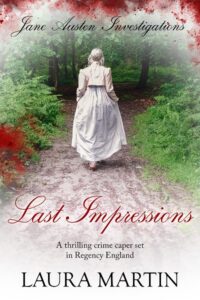
After having her heart broken by the man she thought she was going to marry, Jane Austen is in desperate need of a distraction. So her sister, Cassandra, accepts every social invitation going, and one of them is to stay with a family friend at Melmont Hall.
Mrs Paulson welcomes them to her home and introduces them to the other guests who have arrived for a dinner party. But when they sit down to eat, Mr Paulson is nowhere to be found.
After discovering his study is locked, the guests break in and find a shocking scene. Mr Paulson is dead – and not of natural causes. Someone has stabbed him.
Jane has already helped solve one murder mystery and she is determined to put her skills to use to help her hostess get justice for her husband.
Everyone at the dinner party must be questioned as a suspect, as well as the servants at Melmont Hall.
But what had Mr Paulson done to provoke such anger? Why would someone want to kill him? Can Jane Austen use her quick wit to unmask the killer?
Congratulations to Linda Stratmann, whose atmospheric historical mystery, Sherlock Holmes and the Legend of the Great Auk, is published today!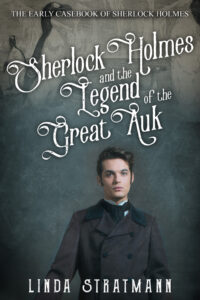
Sherlock Holmes and the Legend of the Great Auk is the fifth Victorian crime thriller in the Early Casebook of Sherlock Holmes series.
London, 1877
The unveiling of a new specimen of the extinct Great Auk leads to accusations of fraud against the British Museum and a ferocious attack on the exhibit by ornithologist Charles Smith.
Sherlock Holmes is tasked with saving the reputation of the museum, but before long, Smith is found murdered.
Police think it was a random robbery gone wrong but when Holmes examines the crime scene, he is sure there is more to it.
Aided by his loyal friend Mr Stamford, Holmes is determined to discover if the museum has something to hide.
Is there more to the legend of the Great Auk? Why has this exhibit attracted so much controversy?
Could more lives be in danger…?
Congratulations to Linda Stratmann, whose gripping historical mystery, Sherlock Holmes and the Ebony Idol, is published today! Sherlock Holmes and the Ebony Idol is the third Victorian crime thriller in the Early Casebook of Sherlock Holmes series.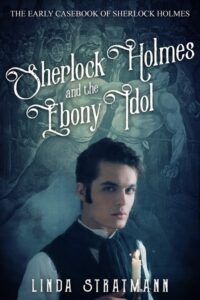
When a pugilist dies at a local boxing demonstration attended by medical student Mr Stamford and his acquaintance Sherlock Holmes, a post-mortem reveals the death is due to natural causes.
But when the corpse of another boxer is discovered clutching a small wooden carving – the ebony idol – Holmes begins to suspect that sinister forces are at work.
His suspicions seem confirmed when the companions hear about a previous death in the ring.
Tasked by the man’s widow to bring his killer to justice, Holmes and Stamford are swiftly drawn into their most curious case to date.
Click here to order Sherlock Holmes and the Ebony Idol
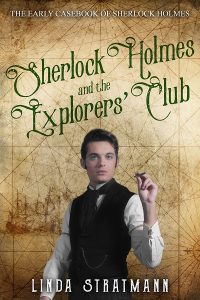
Congratulations to Linda Stratmann, whose fabulous historical mystery, Sherlock Holmes and the Explorers’ Club, is published today!
Sherlock Holmes and the Explorers’ Club is the second Victorian crime thriller in the Early Casebook of Sherlock Holmes series.
 When the preserved foot of a dead man with extra toes arrives at St Bartholomew’s Medical College, the students are fascinated. However, despite this unusual feature being reported in the press, the man’s identity remains a mystery.
Intrigued by the puzzle, medical student Mr Stamford calls on his acquaintance Sherlock Holmes — an eccentric but brilliant young sleuth — to help him learn more about the deceased.
With only the man’s boots and a few possessions to examine, Holmes relishes the challenge. He soon finds a coded message hidden inside the man’s purse, which suggests a possible connection to criminals or spies.
Over the course of their investigations, Holmes’ and Stamford’s suspicions are strengthened when they learn of further shocking deaths. It soon becomes apparent that the men who died all belonged to the mysterious Explorers Club — and the lives of the remaining members may also be in danger.
Although the deaths look like accidents, Holmes is convinced that the men were murdered. And with conspiracy and intrigue lurking at every turn, he must now expose the secrets of the Explorers’ Club before the next member meets a grisly end…
Click here to order Sherlock Holmes and the Explorers’ Club
Congratulations to Marilyn Todd, whose gripping historical mystery, Dead Drop, is published today!
Dead Drop is the fourth book in the Julia McAllister Victorian Mystery series: thrilling British detective novels with a courageous woman sleuth at the centre.
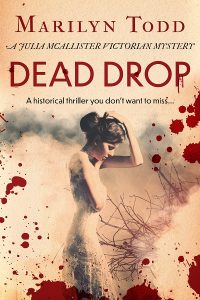 Seeing an easy way to pay off her debts, Julia McAllister takes in three female lodgers from a travelling show.
With musical halls more popular than ever, Buffalo Buck’s Mild West is the perfect antidote to the noise and smoke belching out of the factories, and the tide of Julia’s fortune quickly turns.
Until one of the three girls is found hanging under a bridge.
Julia doesn’t believe it was suicide. Annie had been excited about the future, not depressed.
And when another body is found on the railway line, a distraught widower, inspired by Julia’s role as crime scene photographer, asks for her help as the police are refusing to give out any details.
When Julia raises the matter with Detective Inspector John Collingwood, he explains that they’re keeping the case close to their chest because the body had ligature marks, showing he’d been chained up. Their fears are that this is just the tip of a particularly nasty iceberg.
Is Annie’s death connected to the body on the railway? Can Julia work with Collingwood to solve the mystery?
Or will the secrets they uncover put their lives in grave danger…?
Congratulations to J. C. Briggs, whose absorbing historical mystery, Summons to Murder, is publishing today!
Summons to Murder is set in Victorian England and is the ninth book in the Charles Dickens Investigations series.
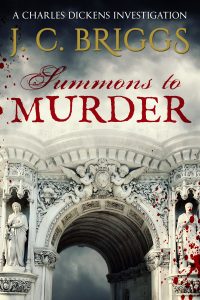 Pierce Mallory, a gentleman journalist, is found dead in his lodgings with a gunshot wound in his head and a duelling pistol beside him.
Though the death is deemed a suicide, Mallory’s friends — including Charles Dickens — don’t believe that he would have taken his own life.
Dickens therefore returns to the scene of Mallory’s demise, along with Superintendent Sam Jones from Bow Street. On further investigation, they soon find evidence that Mallory was murdered.
A notorious philanderer, there are plenty of people who could have wanted Mallory dead — including abandoned lovers and jealous husbands.
And as Dickens and Jones dig further into Mallory’s personal affairs, it seems that there are more shocking scandals waiting to be uncovered…
Click here to order Summons to Murder
Sapere Books are proud to have sponsored the Crime Writers’ Association’s Historical Dagger Award, which is for the best historical crime novel set in any period at least 50 years prior to the year in which the prize is presented.
The 2021 shortlist featured domestic poisons, sinister former spies, military occupations and more.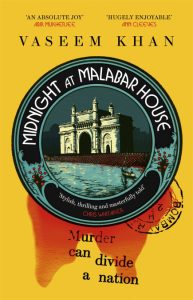
The wonderful Vaseem Khan has now been announced as this year’s winner. His winning novel, Midnight at Malabar House, is the first book in his latest historical crime series.
Compelling and cleverly plotted, Midnight at Malabar House opens on New Year’s Eve in Bombay, 1949. The first female detective in India, Persis Wadia has been repeatedly overlooked and struggles against a hostile, all-male environment. As a new decade dawns, she stands vigil in the basement of Malabar House, consigned to the midnight shift.
But when an English diplomat is murdered, Persis finds herself on the case of a lifetime. Against the backdrop of social and political turmoil, she teams up with Scotland Yard criminalist Archie Blackfinch to uncover the truth — at any cost…
We would like to send a huge congratulations to Vaseem, and to all of the wonderful authors who were longlisted and shortlisted this year.
Sapere Books are proud to be sponsoring the Crime Writers’ Association’s Historical Dagger Award, which is for the best historical crime novel set in any period at least 50 years prior to the year in which the prize is presented.
The 2021 shortlist has now been announced, and features secretive aristocrats, murdered diplomats, dramatic public trials and more.
Snow, John Banville, Faber
A deftly woven country house mystery, Snow immerses us in the wintry depths of 1950s Ireland. The body of a priest has been found in Ballyglass House in County Wexford, the family seat of the mysterious aristocratic Osborne family.
Called in from Dublin to investigate, Detective Inspector St. John Strafford faces opposition at every turn as he attempts to unravel what happened. Up against the secretive attitude of the local community and the fast-falling snow, Strafford must hurry to apprehend the murderer before they can cover their tracks…
Click here to find out more about Snow
Midnight at Malabar House, Vaseem Khan, Hodder & Stoughton
Compelling and cleverly plotted, Midnight at Malabar House opens on New Year’s Eve in Bombay, 1949. The first female detective in India, Persis Wadia has been repeatedly overlooked and struggles against a hostile, all-male environment. As a new decade dawns, she stands vigil in the basement of Malabar House, consigned to the midnight shift.
But when an English diplomat is murdered, Persis is finds herself on the case of a lifetime. Against the backdrop of social and political turmoil, she teams up with Scotland Yard criminalist Archie Blackfinch to uncover the truth — at any cost…
Click here to find out more about Midnight at Malabar House
The Unwanted Dead, Chris Lloyd, Orion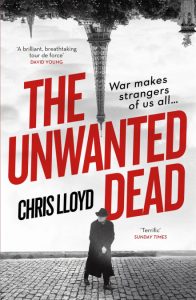
A haunting thriller set in 1940s France under German occupation, The Unwanted Dead follows police detective Eddie Giral, a survivor of the previous World War. As the Nazis march into Paris, Eddie watches in dismay as terror descends over the city.
When four refugees are murdered, he vows to find the perpetrator. No longer knowing who to trust, Eddie must tread carefully between the Occupation and Resistance in order to survive long enough to untangle the brutal killings…
Click here to find out more about The Unwanted Dead
The City Under Siege, Michael Russell, Constable
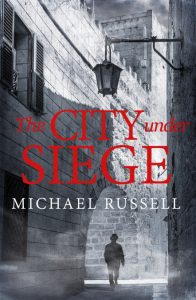 Atmospheric and darkly evocative, The City Under Siege is set between Dublin, London and Valletta during World War Two. After a gay man is brutally murdered, Detective Inspector Stefan Gillespie suddenly finds that this is one of a series of similar killings stretching across Ireland and England. What’s more, none of the deaths were investigated as thoroughly as they should have been.
Meanwhile, in Valletta, Malta, there are rumours that a British soldier killed a Maltese teenager. Determined to retain Malta’s loyalty to Britain, the authorities send Stefan to investigate. And as he delves deeper into the case, Stefan becomes convinced that this killing is somehow linked to the murders back in England and Ireland…
Click here to find out more about The City Under Siege
Skelton’s Guide to Domestic Poisons, David Stafford, Allison & Busby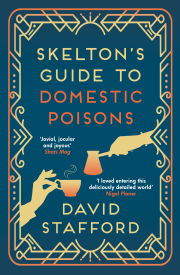
A classic detective novel set in the 1920s, Skelton’s Guide to Domestic Poisons follows celebrated barrister Arthur Skelton as he strives to win another case against the odds. Accused of poisoning her husband after years of abuse, Mary Dutton has already been widely condemned by the press. Unwilling to concede her guilt without hard evidence, Arthur agrees to represent her.
Against the backdrop of the general election, the case becomes increasingly high-profile as Mary wins support from various members of the public. But as Skelton digs deeper into the murky depths of the Dutton family, he begins to wonder whether he will ever expose the whole truth…
Click here to find out more about Skelton’s Guide to Domestic Poisons
The Mimosa Tree Mystery, Ovidia Yu, Constable
 The Mimosa Tree Mystery is the fourth book in Ovidia Yu’s witty, page-turning Crown Colony series, set in 1930s Singapore during the Japanese Occupation. Determined sleuth Su Lin becomes embroiled in another dangerous investigation when a neighbour, Mirza, is found murdered in his garden, a branch of mimosa in his hand.
Mirza was a known blackmailer and a collaborator with the occupying forces. The murder suspects therefore include acquaintances, Japanese officials and his own family. When Su Lin’s Uncle Chen is arrested, Hideki Tagawa — a former spy who has gained power in the new regime — offers her uncle’s life in exchange for Su Lin’s help in finding the real killer. Armed with her local knowledge and fluency in multiple languages, Su Lin must decide who she can trust as she is thrown into a world of treachery and subterfuge…
Click here to find out more about The Mimosa Tree Mystery
Following the publication of David Field’s absorbing Esther & Jack Enright Mysteries, Tudor Saga Series and Carlyle & West Victorian Mysteries, we are delighted to have signed up his new Medieval Saga Series.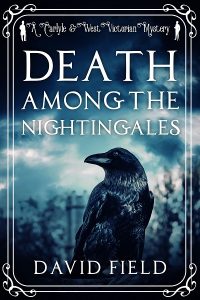
In David’s words:
“I consider myself blessed to have found Sapere Books, who not only share my enthusiasm for historical novels, but also provide the most generous author royalties in the business, and never lose sight of the fact that their many authors have invested a massive amount of emotional energy into creating, nurturing, and revealing their characters.
“It’s therefore with great optimism and a sense of purpose that I’ve embarked on my latest venture with them — the Medieval Saga Series, a set of seven novels that follow the fortunes of the same family from immediately prior to the Battle of Hastings all the way through to the death of Simon de Montfort in the Battle of Evesham in 1265.
“The first in the series — THE CONQUEST — introduces the Riveracres, a Saxon family living on the Sussex coast whose tiny village is directly in the path of Duke William of Normandy’s invasion army, and the Astenmedes, the local Thegn’s brood whose traditional privileged status is about to be shattered. Amidst the turmoil, two brave men, Will Riveracre and Selwyn Astenmede, form an unlikely partnership as they stand against both Duke William and Harald Hardrada’s invading Viking force to the north.”
Click here to find out more about the Esther & Jack Enright Mysteries
Click here to find out more about the Tudor Saga Series
Click here to find out more about the Carlyle & West Victorian Mysteries
Set in seventeenth-century Leiden, The Netherlands, Graham Brack’s funny and immersive Master Mercurius Mysteries follow Mercurius — a witty university lecturer-cum-sleuth.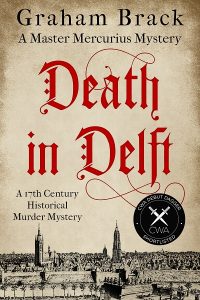
The first four books in the Master Mercurius series are published, and we are delighted to have signed up the next instalment: THE VANISHING CHILDREN.
In Graham’s words:
“I’ve been delighted with the response from readers to the Master Mercurius Mysteries. It’s wonderful to read good reviews, not only for myself, but also for Sapere Books, who always had faith in the stories. Being part of the Sapere family is very encouraging to any author; we enjoy our colleagues’ successes. I wouldn’t want to be anywhere else.
“The fifth book sees Mercurius sent to Amsterdam which — even in 1684 — was not a place where a minister who has led a sheltered life as he has would feel comfortable. On top of that, he has been sent to bully the city authorities into handing over their taxes in full. However, while he is there, he is approached by a local merchant who tells him that three children have gone missing, and their families have been fobbed off by Amsterdam’s powers that be.
“So begins an inquiry that makes Mercurius question his own faith as well as his suitability for the task he has been given…”
Click here to order DEATH IN DELFT
Click here to find out more about the Master Mercurius Mysteries
We are delighted to announce that we have signed a new Tudor mystery series by C P Giuliani.
The Tom Walsingham Mysteries follow a young sleuth as he becomes embroiled in the shady world of espionage. The first instalment will be published in 2021.
In Giuliani’s words:
“Signing with Sapere Books for my first murder mystery series has been truly wonderful!
“Book 1, A Road to Murder, is set in 1581 between England and France, and follows a young diplomatic courier’s efforts to untangle a murder that could have wider, political implications. With France constantly teetering on the brink of religious unrest, and Queen Elizabeth toying with the idea of marrying the French king’s Catholic heir, even the death of a glove-maker can hide sinister machinations. And my hero, Tom Walsingham — a relation to Queen Elizabeth’s powerful spymaster, Sir Francis Walsingham — knows better than most just what could be at stake…
“This is going to be my first publication in the UK, and Amy and the whole team at Sapere Books are being incredibly supportive, friendly and very competent — and they have gathered together a very welcoming author community. A lovely experience through and through.”
Set in England during the Second World War, Charlie Garratt’s Inspector James Given Investigations follow a troubled detective as he uncovers the truth behind a series of suspicious deaths.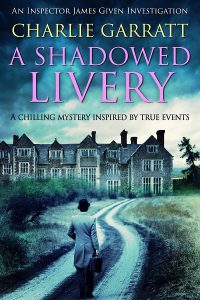
The first four books in the series are already published, and we are delighted to announce that we have now signed up the fifth instalment.
In Charlie’s words:
“I could hardly believe it when Sapere Books accepted my first and second novels, so I’m delighted to have signed a contract for my fifth: A LEAMINGTON DEATH. In this instalment, James returns from war-torn France to settle into a quiet life working for his father, when a request from his old boss to help with a simple factory theft turns into a murder investigation. James’ initial reluctance to become involved is tempered by the debts he owes to the victim.
“The team at Sapere could not have been more supportive to me as an author on this journey, with excellent advice, high-quality editing, great marketing and very fair royalties — paid very promptly. The regular get-togethers they organise for their authors also offer a great exchange of experience and ideas, something other publishers could learn from.”
Click here to order A SHADOWED LIVERY
Click here to find out more about The Inspector James Given Investigations
Sapere Books are proud to sponsor the Crime Writers’ Association’s Historical Dagger Award, which is for the best historical crime novel set in any period at least 50 years prior to the year in which the prize is presented.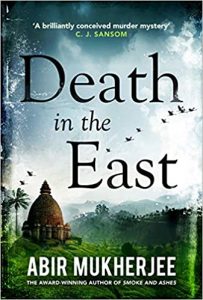
The 2020 shortlist featured eccentric doctors, notorious gangsters, stolen diamonds and much more.
On Thursday night, the fabulous Abir Mukherjee was announced as this year’s winner at the Crime Writers’ Association’s digital awards ceremony. His winning novel, Death in the East, is the fourth instalment in his Wyndham & Banerjee Mysteries Series.
Set in 1920s India, Death in the East follows the continuing adventures of dynamic duo Captain Sam Wyndham and Sergeant Surrender-not Banerjee. Wyndham is haunted by an old case from his early days as a young constable, when his old flame Bessie Drummond was found beaten to death in her own room. Arriving at the ashram of a sainted monk – where he hopes to overcome his opium addiction – Wyndham finds a shadowy figure from his past, a man he believed was long dead. Certain that the man is out for revenge, Wyndham once again calls on Sergeant Banerjee for help. Together, they prepare to take on a sadistic and slippery killer…
We would like to send a huge congratulations to Abir, and to all of the wonderful authors who were longlisted and shortlisted this year.
Marilyn Todd’s witty and atmospheric Julia McAllister Victorian Mysteries follow a courageous female photographer-cum-sleuth as she investigates London’s shadiest characters.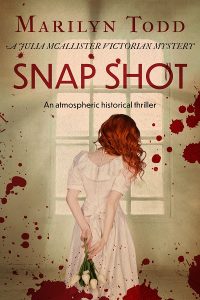
The first two books in the series — SNAP SHOT and CAST IRON — are already published, and we are delighted to have signed up the next two instalments.
In Marilyn’s words:
“I’m thrilled to be continuing Julia’s story, and quite frankly, having this series in the hands of a dynamic publishing team like Sapere is the icing on the cake!
“The third instalment, BAD BLOOD, sees Julia tasked with photographing the scene of a factory owner’s murder. A man who treated his workers like dirt, and his wife even worse. It’s not so much a question of who’d want him dead — more who wouldn’t. But eight years earlier, his son was abducted, and Julia soon realises that the kidnap and murder are connected. The trouble is, knowing who’s responsible is one thing, proving it is quite another. Especially when the killer knows she’s on to them.
“This is followed by DEAD DROP. Music halls were a popular antidote to the noise and smoke belching out of the Industrial Revolution, but the lives of the entertainers were gruelling. When a young showgirl is found hanged, Julia doesn’t believe it was suicide. Too late, she discovers that the truth hurts, but secrets kill, putting her own life on the line…”
Click here to find out more about the Julia McAllister Victorian Mysteries
Following the publication of Linda Stratmann’s sensational Mina Scarletti Mysteries – Victorian crime novels with a courageous woman sleuth at the centre – editorial director Amy Durant has signed up her exciting new series, which follows a young Sherlock Holmes. The first instalment will be published next year.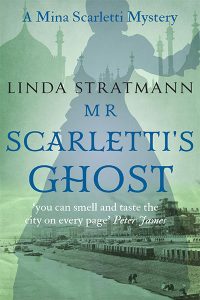
In Linda’s words:
“22 year old Sherlock Holmes, realising that his destiny is to be the world’s first and best consulting detective, has abandoned conventional education and come to London to acquire the very particular and unusual skills and knowledge he needs for his chosen career. This is Holmes before Watson: youthful, fiery, determined, energetic, still learning his craft. This is the legend in the making, the story of how young Holmes became the Holmes we know.
“Sherlock Holmes is the epitome of the great detective, iconic and instantly recognisable. It was a tremendous thrill to be asked to create new adventures and explore those periods of Holmes’s life which Conan Doyle left to the imagination. It is a pleasure to continue working with the wonderfully supportive team at Sapere Books, and to be a part of the Sapere family of authors.”
Click here to order MR SCARLETTI’S GHOST
Click here to find out more about the Mina Scarletti Mysteries