

Linda Stratmann is the author of the Mina Scarletti Mysteries and the Early Casebook of Sherlock Holmes series.
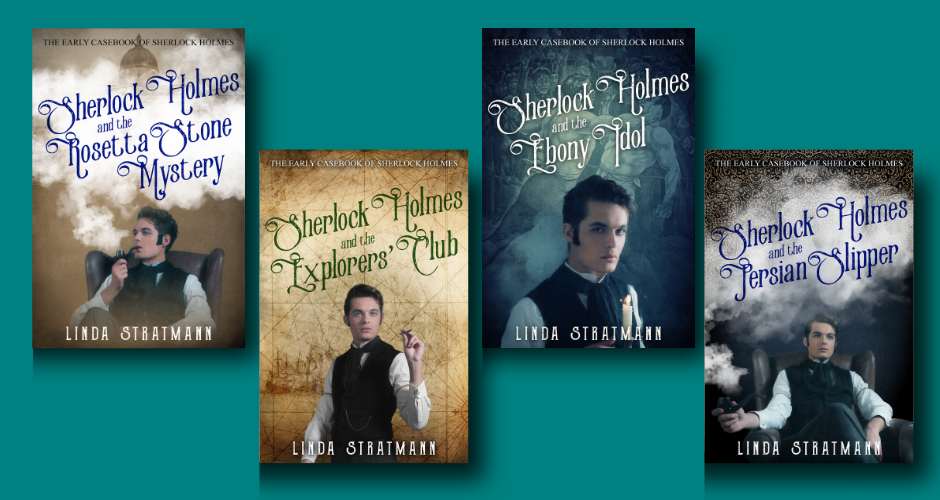
There are many different interpretations of Sherlock Holmes created by authors inspired by the works of Conan Doyle. They might sometimes appear to conflict, but it was my love of science fiction that made me realise that the different versions can all be valid at the same time if they exist in parallel universes. One such interpretation is that Holmes is not human but alien, or possibly even an android.
The Holmes in my books is a human, if an unusual one, but can a good case be made for him not being human? The basis of the case must, I believe, be derived from what I call ‘the canon’ — the original Holmes fiction of Conan Doyle.
So let us examine the canon and look for the clues.
Our first evidence is from Dr Watson himself. In an uncharacteristic feat of observation in The Sign of Four, he declares, ‘“You really are an automaton, — a calculating machine. […] There is something positively inhuman in you at times.”’ Holmes, he says in ‘A Scandal in Bohemia’, is ‘the most perfect reasoning and observing machine the world has seen.’
But what other clues do we have? There are many.
Clue one: An alien or android has no family tree, and Holmes is extremely cagey about his ancestors.
In ‘The Greek Interpreter’, Watson states that Holmes’s gifts for observation and deduction must come from his systematic training, and not his ancestry. Holmes agrees that this is true to some extent and reveals that his ancestors, who he does not name, were country squires who led the life ‘“natural to their class”’. However, he attributes his powers of observation to descent from a family of French artists. His grandmother was the sister of the French artist Vernet. There must, he believes, be some hereditary principle, as his brother Mycroft has the same talent.
If Holmes was an alien or android, a vague reference to unnamed county squires and an artist whose family connections could not have been easily researched would have satisfied Watson’s curiosity. Watson saw some similarities between Holmes and Mycroft, and if Holmes was an alien or android, it would suggest that Mycroft was as well.
Clue two: Holmes has strangely superhuman strength.
Holmes is not a burly man. In ‘The Red-Headed League’, ‘He curled himself up in his chair, with his thin knees drawn up to his hawk -like nose.’ Yet he obviously had a sinewy strength and was skilled in boxing, singlestick and swordsmanship.
To maintain bodily fitness over many years, regular exercise is usually necessary, but with Holmes this is not the case. ‘I have a curious constitution,’ he says in The Sign of Four. ‘I never remember feeling tired by work, though idleness exhausts me completely.’ He then heads off for a smoke.
In ‘The Adventure of the Speckled Band’we have this extraordinary incident. Holmes receives a visit from tall, broad and fierce Dr Grimesby Roylott. Roylott tries to intimidate Holmes by picking up a steel poker and bending it into a curve before flinging it down. After his departure, Holmes picks up the poker ‘and with a sudden effort, straightened it out again.’ Is that even humanly possible?
In ‘The Adventure of the Yellow Face’, Watson tells us that Holmes ‘seldom took exercise for exercise’s sake’ and that he regarded ‘aimless exertion’ as ‘a waste of energy’. Yet he also tells us that ‘Few men were capable of greater muscular effort’ and Holmes was ‘one of the finest boxers of his weight that I have ever seen.’ When there was a requirement for action, he was ‘untiring’. By the time this story was published in 1893, Conan Doyle might have sensed that he needed to explain to his readers the anomaly of a man who hardly ever exercised but excelled at physical activity. ‘That he should have kept himself in training under such circumstances is remarkable,’ says Watson, who goes on to say unconvincingly that ‘his diet was usually of the sparest and his habits were simple to the verge of austerity.’ Holmes, he adds, ‘save for the occasional use of cocaine […] had no vices.’
Clue three: Holmes uses drugs and smokes, apparently without adverse effects.
Conan Doyle introduces us to Holmes’s use of cocaine in The Sign of Four, which includes a brief single reference to the recreational use of morphine. (It is only ever used once again by Holmes, given medicinally in ‘The Adventure of the Illustrious Client’). In ‘The Adventure of the Yellow Face’,published three years after The Sign of Four,ConanDoyle obviously feels the need to dial back, perhaps after some disapproval expressed by his readers, and tells us that ‘he only turned to the drug as a protest against the monotony of existence, when cases were scanty and the papers uninteresting.’ Holmes’s heavy smoking of strong tobacco is never seen by Watson as a vice, or as something that might affect Holmes’s health.
There are numerous references in the stories to Holmes smoking heavily. In ‘The Man with the Twisted Lip’, Holmes smokes an ounce of shag tobacco while deliberating, leaving his room ‘full of a dense tobacco haze.’ In ‘The Adventure of the Engineer’s Thumb’,his before-breakfast pipe is ‘composed of all the plugs and dottles left from his smokes of the day before, all carefully dried and collected on the corner of the mantelpiece.’ If Holmes is an alien or a machine, that explains his apparent imperviousness to the harmful effects of drugs and tobacco. In later adventures, Conan Doyle does however make him more believable by showing Holmes exhausted by his burden of work as he ages. The last year in which a Holmes story is set is 1914 (His Last Bow, published in 1917), by which time he is sixty years of age, and to Watson’s eyes, has hardly changed.
Clue four: Holmes shows little emotion.
Science fiction readers and writers have compared Holmes to an android like Star Trek’s Data, lacking emotion of any kind. If he is an alien, he most closely resembles Star Trek’s coolly logical Vulcans. They have emotions but restrain them; however, they are obliged to let them all out once every seven years in a ritual called pon farr. Does this fit with Holmes’s behaviour? Does a restriction of emotions cause Holmes any stress? If he was a Vulcan, like Mr Spock, could this explain what was really happening in 1891 when Holmes rushed away to the Reichenbach Falls and did not return for three years? Did he feel the approach of pon farr and have to quit England before it took him over? If so, there would be other absences at similar intervals.
I counted back seven years and then I saw it. There are no adventures chronicled by Watson for the years 1884 and 1885. Was this because of a previous pon farr? Holmesian scholars have assumed that during these years Watson was away, perhaps in America, but there might be another explanation? Was Watson with Holmes during these absences, his account carefully crafted to conceal the truth about his friend? Looking ahead another seven years from 1892, there are no adventures dated from between January 1899 (‘The Adventure of Charles Augustus Milverton’) and June 1900 (‘The Adventure of the Six Napoleons’). There are no adventures dated 1906, or 1913. This is all supposition, of course, but the timeline is compelling.
Clue five: Holmes does not wish to marry.
Not only is Holmes averse to marriage, he appears to have no romantic or intimate connections with anyone. If he is not human, this is something he would avoid, or his masquerade as a human might be discovered. Conan Doyle is careful to avoid any suggestion of Holmes having hidden desires which would have alienated his readers. According to Watson, Holmes’s only such interest, is a woman, ‘the woman’, as he calls her, Irene Adler, whom he clearly admires but without allowing any emotions to disturb his finely balanced mind.
On what principles was the alien or android Holmes constructed or programmed?
If Holmes was sent to Earth programmed to solve crimes, he needed to be constructed from many parts. Superhuman strength and constitution. Numerous useful skills. Impervious to the ravages of smoke and drugs. A brilliant reasoning machine undistracted by emotions. The aliens who made or trained him would have studied other detectives of the era and used elements of the finest to create Holmes.
There are three main candidates:
Joseph Bell (1837–1911) was a Scottish surgeon and lecturer who advocated the importance of careful observation. Conan Doyle was a student of Bell from 1877 to 1878. Bell used his observational talents to deduce personal details about complete strangers, a skill which Holmes frequently employed.
Edgar Allan Poe’s C. Auguste Dupin is considered to be the first fictional detective, who used advanced reasoning to solve mysteries. Through observation, he is able to follow the train of thought of his companion, an ability with which Holmes astonishes Watson in ‘The Adventure of the Cardboard Box’.
Le Chevalier Lecoq, a fictional French policeman, inspired by a real criminal investigator, Eugène-François Vidocq (1775–1857). In the works of Émile Gaboriau, published in 1869, Lecoq’s methods when making a detailed examination of a crime scene, using a magnifying glass, are strongly reminiscent of Holmes’s scientific approach. In A Study in Scarlet, Holmes dismisses Dupin as ‘a very inferior fellow’ and Lecoq as ‘a miserable bungler’.
My case is complete. I have laid the facts before you. Make of them what you will.
NOTE:
There were several artists in the Vernet family but only one, Emile Jean Horace (1789-1863) fits the timeline as Holmes’s most probable great uncle. A number of Conan Doyle’s family members were artists, and a friend was a collector of Vernet.
Linda Stratmann is the author of the Mina Scarletti Mysteries and the Early Casebook of Sherlock Holmes series.
One of the great joys of historical research is discovering untold and fascinating true stories. This is one I found during my reading for Sherlock Holmes and the Cabinet of Wonders, which inspired part of the plot.
On 8 January 1878 an unusual statement was printed on the front page of The Scotsman newspaper. The title was ‘YORICK — WHAT IS IT?’ and the author, announcing ‘challenge accepted’, was one of the most accomplished and famous magicians of his day. John Nevil Maskelyne was a mechanical genius, the constructor of a whist-playing automaton called Psycho. He was the lessee of the Egyptian Hall theatre in Piccadilly, known as ‘England’s Home of Mystery’, where he performed illusions and debunked spirit mediums. He was also, judging by the tone of the piece in The Scotsman, extremely annoyed. His ire was aimed at two men: William Alexander, under whose management a rival of Psycho called Yorick was being exhibited, and the conjuror Boz who took the stage.
After briefly holding the licence of the York Hotel in Weston-super-Mare, Alexander had decided on a new career, promoting conjurors and illusionists. It is not known what previous experience he might have had, but he brought to his profession the ability to manufacture glowing endorsements, shameless theft of other men’s material, and a complete ignorance of the laws of libel.
‘Boz’ was born William Arthur Weston, in Brighton, in 1847. His father was a gunsmith and his mother a dyer. In common with many youthful enthusiasts of the art of conjuring, he had become fascinated with the American Davenport Brothers who toured England in 1864-5, bringing with them a miraculous cabinet. When the brothers were securely tied in the cabinet, all kinds of manifestations were produced, both musical and visual, which many onlookers believed to be the work of spirits. Weston, convinced that their act was trickery, determined to work out how it was done. He chanced to meet George William Buck, a skilled and successful professional conjurer born in 1836, who worked under the name Herr Dobler. The two discovered a mutual interest and pooled their information. After collaborating to perform an exposé of the Davenports’ methods, Dobler hired Weston as his assistant, and they went on tour. In 1866, however, Weston’s father died, and he was obliged to return to Brighton and the trade of dyeing. The flame of ambition still burned, and Weston hoped for an opportunity to take to the stage again.
This eventually came about when he met William Alexander, who by 1875 was managing the career of Herr Dobler. Coincidentally, Alexander had just spotted a new money-spinner, and all he needed was a man with some stage experience who could play a part and was happy to comply with his unusual promotional methods. He terminated his arrangement with Dobler and engaged Weston, who was now advertised as ‘Boz’.
Before long, posters were appearing under the heading ‘Alexander’s Sensations’, advertising Boz and the astonishing Yorick, a whist-playing automaton. The glowing reviews of this extraordinary device were probably written either by Alexander or Weston. Herr Dobler was especially shocked to see that the advertisements were using his playbills and lithographs and were posted in towns where he was appearing. Worse still, Weston was now claiming that he alone had devised the method of exposing the Davenports, and taught it to Dobler, who had been profiting ever since from his work. When Dobler objected, he was accused of being an impostor, taking the name and reputation of another man, a conjuror named Ludwig Dobler who had died in 1864.
Dobler sued both Alexander and Weston for libel and they made a counterclaim against him. The case came before the Bristol assizes in July 1877, where Dobler’s counsel pointed out that English conjurors often performed under foreign names to enhance their attractiveness, ‘for foreigners were supposed to be more clever than English people.’ The case was stopped with the agreement that the imputations would be withdrawn on both sides, and the offensive advertisements not repeated.
Boz and Alexander had suffered little from this spat. They continued their career as before, the advertisements and reviews becoming even more exuberant, the claims more fantastical, and the audiences larger. Their confidence was misplaced, since they had reckoned without John Nevil Maskelyne.
Maskelyne, born in 1839, had been apprenticed to a watchmaker. He became fascinated by stage illusions and seances when he was asked to repair a mysterious mechanical device. The owner was unusually coy about describing its function, and Maskelyne realised that it was used by mediums to fake spirit rapping. After he and his friend George Cooke successfully replicated the Davenport Brothers’ act without the aid of spirits, they commenced a career as conjurers and illusionists and first appeared at the Egyptian Hall in 1873.
Maskelyne had spent more than two years devising and assembling his whist-playing automaton Psycho, the workings of which were a closely guarded secret. He was therefore highly displeased to see Alexander’s advertisements claiming that the young pretender Yorick, which as illustrated on a handbill appeared identical to Psycho, was superior in both construction and operation. However, he had strong suspicions that Yorick, whatever wonders it might perform, was not an automaton.
Yorick and Boz had commenced their glittering career early in 1877 at Weston-super-Mare. Yorick, billed as ‘the most perfect automatic clairvoyant in the world’ was said not only to play whist but also perform mental arithmetic, read, write and spell. It could even, so it was claimed, submit to the test of a naked sword being passed through its body in four distinct places, and being taken to pieces in full view of the audience. There is no evidence that these tests were ever applied.
Yorick moved on to Bristol, the advertisements now boldly claiming that Psycho had been superseded. The tour was in full flow, with bookings pouring in: Liverpool, Manchester and Leicester were to follow.
It was during the Edinburgh appearances in December 1877 that Maskelyne’s patience expired. He and Cooke published newspaper announcements cautioning the public against a ‘gross imposition’ by conjurors exhibiting ‘a trick consisting of a child concealed in an Octagon Box about 24 inches wide and 12 inches deep upon which the bust of a figure is placed’. It was the child, not machinery, that caused the figure to move. Maskelyne did not mind sincere imitations but objected to crude copies said to be superior to Psycho, in an attempt to injure his hard-earned reputation. At the Egyptian Hall, members of the audience were invited to come up onto the stage and examine the interior of Psycho and the box on which it sat, but, he said, the exhibitors of ‘spurious imitations’ could allow no-one to examine theirs.
On 4 January, The Scotsman published Alexander’s response. He claimed that audience members were permitted to examine Yorick, which he insisted was a genuine automaton on the same principle as Psycho. He challenged Maskelyne and Cooke, who he now alleged were simply the exhibitors of a figure made by another man named Clark [sic], to disprove his claims. The wager was worth £100, the loser to hand this sum to the Edinburgh Infirmary.
Maskelyne eagerly accepted the challenge in his statement of 8 January. He had always acknowledged that a friend of his called Clarke had assisted with the theory and early development of Psycho, but he alone had built the mechanism. Crucially, he now revealed the whole of Yorick’s secret. For the last two years, copies of Psycho had been made and sold in London. Although claimed to be genuine automata, they were designed so that their movements could be controlled by a child concealed in the apparatus. Mr Alexander had purchased one and engaged a little boy to work it, and Mr Weston, as Boz, to present it to the public. It was then advertised as the most wonderful automaton in the world, costing £1,000 to construct. During the performance, Boz told his audience that Yorick operated on the same principle as Psycho but was superior. He even claimed that he was the inventor and Mr Maskelyne the imitator.
Maskelyne now issued a devastating counterchallenge. He proposed to send a representative to Edinburgh who would spare no labour or expense to prove that he had just cause for his caution to the public. He offered to place £200 with a committee of Edinburgh gentlemen, to be paid to the infirmary if his statement was shown to be untrue. If it was true, then Mr Alexander was to pay £100 to the infirmary. The loser of the wager was to pay all the expenses of obtaining the evidence and advertising the result in The Scotsman.
William Alexander now knew that the man he had taunted was willing to do everything in his considerable power to defend his reputation. Maskelyne repeated his challenge, which was never accepted.
Alexander continued to expand his operation. He obtained a second figure worked by a child, which he presented as the original Yorick. In February 1878 he had a new sensation to announce. Extraordinarily, he had partnered again with Herr Dobler — the same man who had previously sued him for libel — who would be appearing with a marvellous automaton, similar to Psycho, dressed as a king and called Rex. This association did not last long. Dobler returned to his former act and sued Alexander for unpaid wages.
The performances of Boz and Yorick continued, the advertisements now carefully avoiding libel, but the secret was out, and bookings dried up before the end of 1878.
The magical career of Arthur Weston was in decline. On 1 April 1880, in Dunfermline where he had an engagement as ‘Signor Boz’, he was found dead in his lodgings. He had tied a piece of wetted silk (variously described as a handkerchief or a cravat) about his neck, and twisted it tightly with a poker, thus garrotting himself, a highly unusual form of suicide. He was thirty-three years of age and left a widow and two children.
Herr Dobler continued to perform as a popular and respected conjuror. He died in 1904. William Alexander remains an obscure figure. It is to be hoped that he decided to abandon his dubious career as a promoter of talent.
Sources
Family records on Ancestry.co.uk
White Magic: The Story of Maskelynes by Jasper Maskelyne
Newspaper reports and advertisements, principally The Scotsman and the Era*.
Also the Western Daily Press and Glasgow Evening Citizen.
*Regarding the Era’s report of the libel trial, on Sunday, 5 August 1877 p. 4, titled ‘Rival Conjurers’. Some statements are untrue, when checked against other records. Weston’s father was not a dyer but a journeyman gunsmith and William Alexander was licensee of the York Hotel under that name.
Congratulations to Linda Stratmann, whose atmospheric historical mystery, Sherlock Holmes and the Legend of the Great Auk, is published today!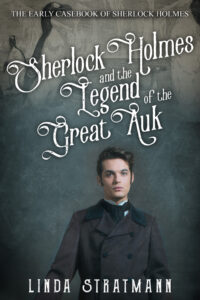
Sherlock Holmes and the Legend of the Great Auk is the fifth Victorian crime thriller in the Early Casebook of Sherlock Holmes series.
London, 1877
The unveiling of a new specimen of the extinct Great Auk leads to accusations of fraud against the British Museum and a ferocious attack on the exhibit by ornithologist Charles Smith.
Sherlock Holmes is tasked with saving the reputation of the museum, but before long, Smith is found murdered.
Police think it was a random robbery gone wrong but when Holmes examines the crime scene, he is sure there is more to it.
Aided by his loyal friend Mr Stamford, Holmes is determined to discover if the museum has something to hide.
Is there more to the legend of the Great Auk? Why has this exhibit attracted so much controversy?
Could more lives be in danger…?