

Ahead of the publication of The Mighty Ocean, the third book in the Romulus Hutchinson Naval Adventure Series, author David Clensy takes a closer look at the infamous Arctic Convoy PQ17, which plays a central role in the story.
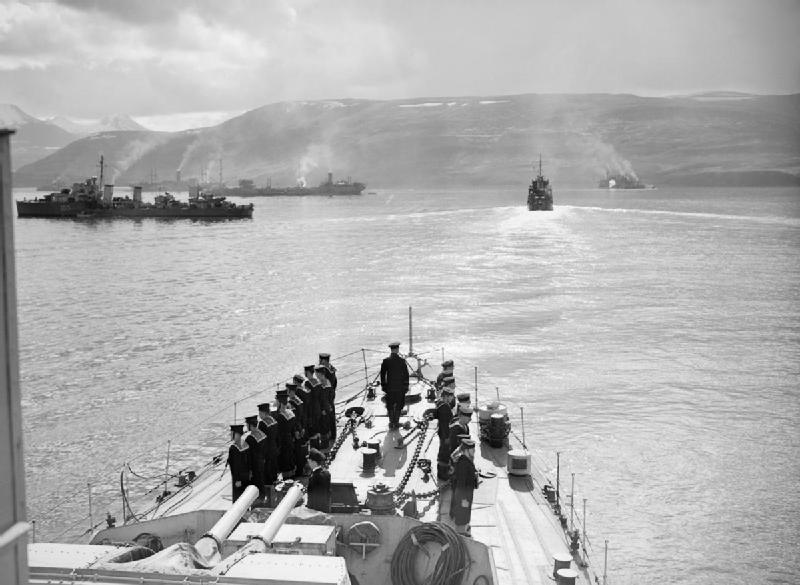
In the summer of 1942, a fleet of merchant ships set out from Iceland on a mission that would become one of the most extraordinary episodes of the Second World War. Convoy PQ17 was tasked with delivering vital supplies to the Soviet Union via the Arctic route — a lifeline for the Eastern Front. What followed was a disaster on a route that Churchill himself described as “the worst journey in the world.”
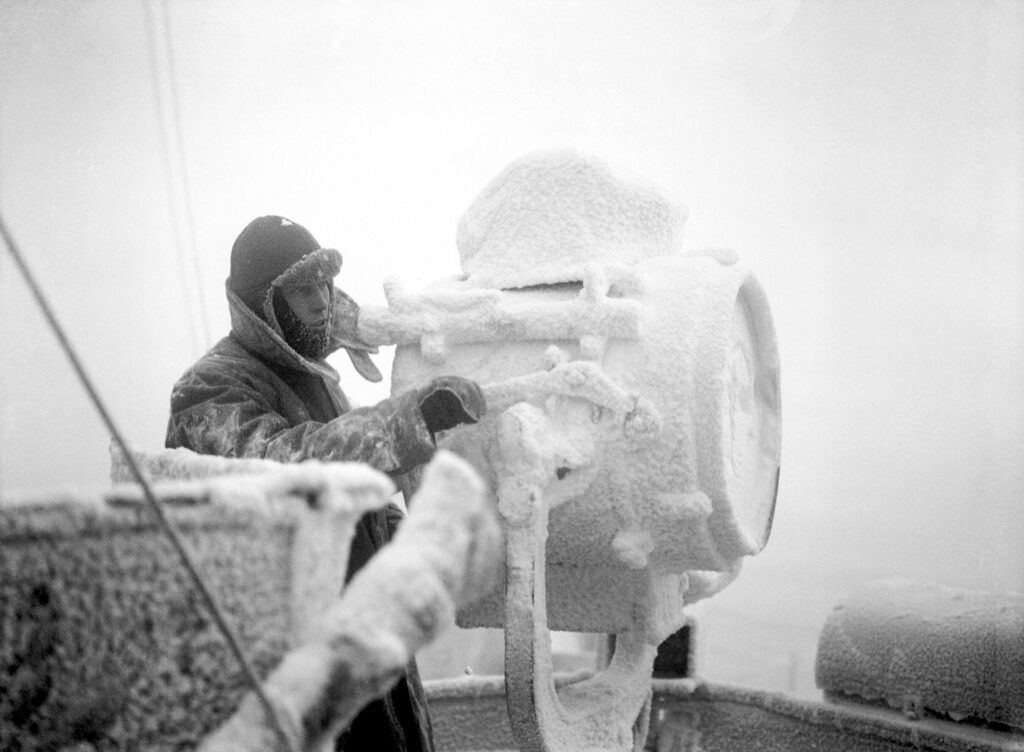
The Arctic convoys were not for the faint-hearted. Ships faced freezing seas, drifting ice, and relentless daylight that made them easy prey for enemy aircraft. PQ17 comprised thirty-five merchant vessels carrying tanks, aircraft, ammunition and food — escorted by destroyers, cruisers, and a distant covering force, including battleships. The stakes were immense: without these supplies, Soviet resistance against Hitler could falter.
The shadow of the Tirpitz
As PQ17 steamed towards the Barents Sea, British intelligence warned that the German battleship Tirpitz might sortie from its Norwegian fjord base. The mere threat of this leviathan — supported by cruisers and U-boats — was enough to trigger alarm in the Admiralty. On 4 July 1942, First Sea Lord Admiral Dudley Pound made a fateful decision: he ordered the convoy to scatter and the escorts to withdraw.
The order to scatter left the merchant ships defenceless in hostile waters. German aircraft and U-boats pounced. Over the next few days, PQ17 was decimated. Of the thirty-five ships that sailed, only eleven reached Archangel. Twenty-four were sunk, along with thousands of tons of cargo and hundreds of sailors. It was the worst loss in the history of the Arctic convoys.
Survivors recalled scenes of horror: ships ablaze, men clinging to rafts in freezing seas, strafed by enemy aircraft. Rescue was often impossible. Yet amid the carnage, acts of courage shone through — crews who stayed at their guns until the end, and those who risked their lives to save shipmates. For many, the ordeal lasted days as they drifted in icy waters, praying for a miracle.
HMS Ayrshire
Lieutenant Leo Gradwell RNVR commanded HMS Ayrshire (FY 225), a modest anti-submarine trawler pressed into convoy escort duty for PQ17. When the Admiralty ordered the convoy to scatter, Gradwell refused to abandon his charges. Instead, he gathered three merchant ships — Troubadour, Ironclad and Silver Sword — and led them northwards toward the Arctic ice pack, determined to seek safety rather than face destruction.
With no charts at hand, Gradwell navigated by sextant and a pocket geographic guide, eventually finding refuge amid the ice fields. When the convoy became stuck, he orchestrated an ingenious defence: the vessels were all painted white — with linen covering the decks — and their cargo of Sherman tanks formed a defensive perimeter armed for anti-aircraft use. This silent white convoy successfully eluded Luftwaffe aircraft while trapped in the ice.
Eventually, the vessels slipped free of the ice and made their way to Matochkin Strait, where they were met by Allied corvettes. Together, they completed the journey to Archangel, arriving on 25 July 1942 — a remarkable feat, given the chaos elsewhere in PQ17. For his outstanding improvisation and leadership under fire, Gradwell was awarded the Distinguished Service Cross later that year.
The PQ17 disaster sparked outrage and soul-searching. Critics condemned the scatter order as premature, arguing that Tirpitz never engaged the convoy. The episode strained Allied relations, with Stalin furious at the losses. Yet the convoys continued, and lessons were learned: future operations featured stronger escorts and better coordination. Despite the risks, the Arctic route remained a vital artery until war’s end.
The Mighty Ocean is available to pre-order now.
Stay up to date with David’s news and latest releases here.
Image credits: Both the image of PQ17 in Hvalfjord and HMS Sheffield are from Wikimedia Commons (public domain).
With the forthcoming publication of In Danger’s Hour, the second book in his Romulus Hutchinson Naval Adventure Series, author David Clensy takes a closer look at the events surrounding Operation Excess during the Second World War.
In January 1941, the Mediterranean was a tense theatre of war. The British Royal Navy, stretched thin and under constant threat from Axis forces, launched a bold and complex operation known as Operation Excess. It was a high-stakes convoy mission designed to deliver vital supplies to Malta, Greece and Alexandria, while simultaneously striking a blow against enemy naval and air power in the region.
The convoy itself was a patchwork of merchant vessels and warships, departing from Gibraltar and heading eastward through waters teeming with danger. Malta, then under siege and of immense strategic importance, was a key destination. Supplies were desperately needed to sustain its defences and civilian population. The convoy was escorted by a formidable force of Royal Navy ships, including aircraft carriers, cruisers and destroyers, all tasked with protecting the vulnerable merchantmen from attack.
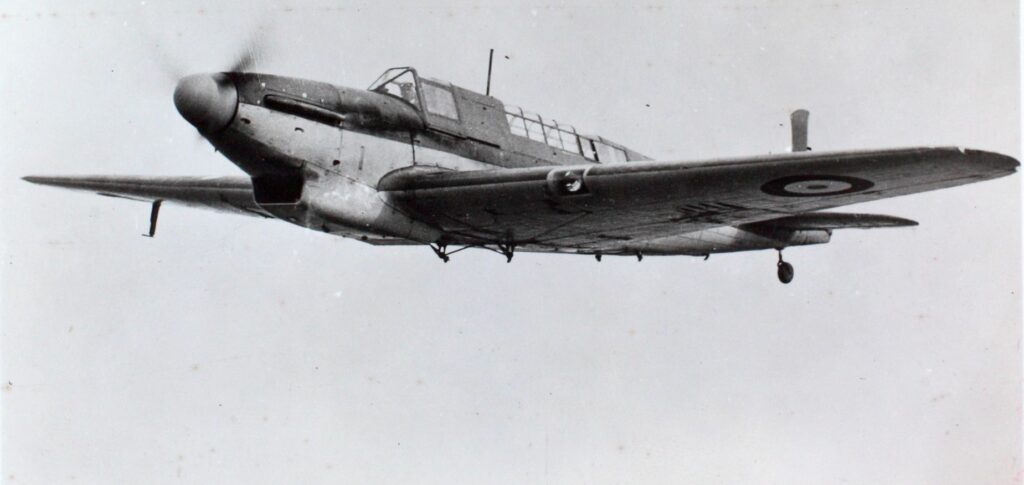
Operation Excess was a particularly challenging task for the Allied forces. Italian and German aircraft launched repeated assaults, particularly as the ships neared Sicily. The Royal Navy’s carrier-based aircraft, including Fairey Fulmars and Swordfish, fought valiantly to repel the attacks, often flying in difficult conditions and against superior numbers.
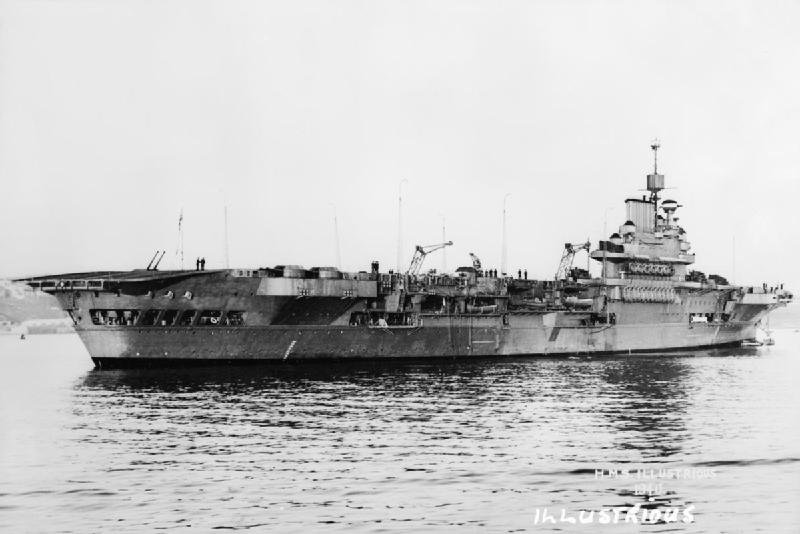
One of the most dramatic episodes of the operation occurred on the 10th of January, when HMS Illustrious, a key British aircraft carrier, came under ferocious air attack near Malta. The damage was severe, and casualties were high. Yet the carrier remained afloat and was eventually able to limp into Grand Harbour, where she became a symbol of resilience for the Maltese people.
Meanwhile, other elements of the operation were unfolding. British forces used the opportunity to launch diversionary attacks against Italian positions in the Dodecanese and to reinforce troops in Greece.
As part of Force B, HMS Southampton’s role was to transport troops from the Aegean to Malta before joining the main convoy. On the 11th of January, while operating south of Sicily, HMS Southampton came under sustained attack from German dive bombers of the Luftwaffe’s X Fliegerkorps. The Stukas struck with deadly precision, scoring multiple hits that ignited fires and caused catastrophic damage. With the cruiser listing and engulfed in flames, the order was given to abandon ship. HMS Southampton was eventually scuttled by torpedoes from HMS Gloucester to prevent her from falling into enemy hands.
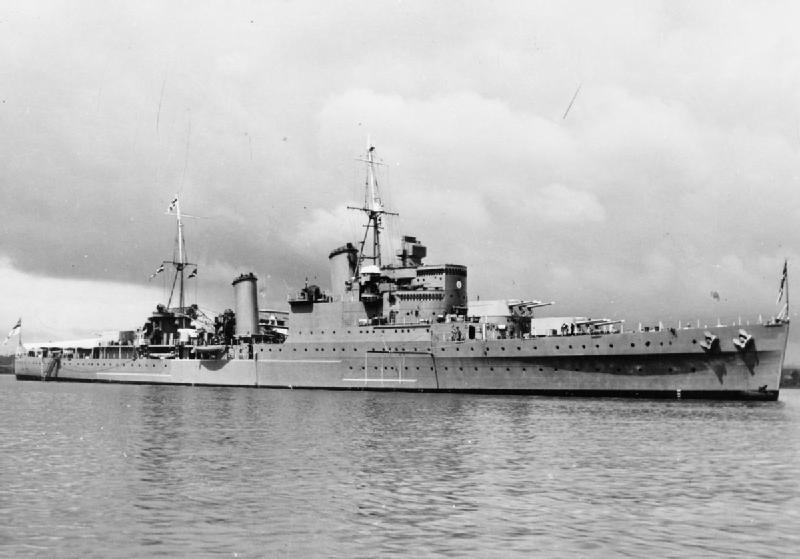
Though the operation came at a cost, it was ultimately deemed a success. Supplies reached their destinations, and the Royal Navy showed it could still operate effectively in contested waters. Operation Excess was more than a supply run. It was a statement of intent, a show of defiance against Axis control of the Mediterranean.
November 2025 sees the release of In Danger’s Hour, the second book in the Romulus Hutchinson Naval Adventure Series. Following their earlier adventures in For Those In Peril, we follow twin brothers Romulus and Remus throughout 1941, from the Mediterranean to the coast of West Africa. It covers a series of key strategic operations, including Operation Demon — the British-led evacuation of Allied forces from mainland Greece in April 1941. At the opening, readers will join our central character, Rom, as he faces an enemy attack while serving on HMS Southampton at the height of Operation Excess.
In Danger’s Hour will be published on the 28th November 2025.
Stay up to date with David’s news and latest releases here.
Congratulations to D. R. Bailey, whose thrilling aviation novel, The Night Angels, is published today!
The Night Angels is the second novel in the Secret Sirens Aviation Thrillers Series, heart-pounding Second World War escapades with strong female leads.
1943
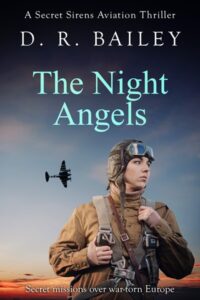
Sisters Anna and Jennifer Nightingale are recruits in the top-secret Siren Squadron: a group of women trained in the RAF to fight against the enemy.
The Sirens are tasked with flying a series of night stealth missions as part of Operation Scorpion. The first mission is successful, and on returning to base they are told that new members will be joining their ranks.
Hopeful that this means the all-female squadron has been deemed a success, the sisters welcome the new recruits and start training them on the Mosquitos.
They head out on another night mission. But this time not everyone returns.
With a downed plane found empty off the English coast, fears grow that one of the Sirens hasn’t survived.
But the show must go on. And Anna Nightingale has to destroy the crashed plane so the Sirens can remain classified.
As their night missions continue, increased skirmishes with enemy pilots suggest someone may be leaking information to the Germans.
Have the Sirens been compromised? Can they find the mole?
Or will these daring female agents be forced out of the war…?
Congratulations to D. R. Bailey, whose page-turning military adventure, The Sunrise Raiders, is out now!
The Sunrise Raiders is the fourth book in the Spitfire Mavericks Thrillers series: action-packed aviation novels set during the second world war and featuring a team of vigilante pilots.
Autumn, 1941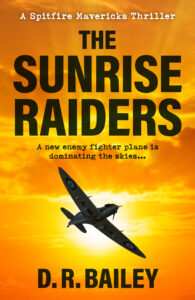
During a routine patrol, Flying Officer Angus Mackennelly ends up in a skirmish with the enemy over the English Channel and is nearly captured.
It is clear the Germans have unleashed a new weapon.
Back at base, Maverick Squadron are told the new German fighter plane is the Focke-Wulf 190. And it is far more manoeuvrable and nimbler than anything the British have got.
Soon the FW is causing problems for every unit. Squadron Leader Bentley exhorts the Mavericks to do their best no matter what and continue to fly in combat against the new plane.
The Mavericks struggle on against the enemy but the odds are falling further out of their favour.
Something needs to change and Angus is tasked with capturing one of the enemy craft for British intelligence.
But that’s easier said than done…
Will Angus succeed in his mission? Can the British match the new German technology?
Or will Maverick Squadron be forced to admit defeat…?
We are thrilled to announce that the first three books in Patrick Larsimont’s page-turning wartime adventure series, the Jox McNabb Aviation Thrillers, will be released as audiobooks by Tantor Media.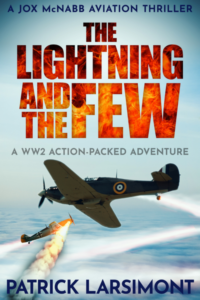
The series follows the progress of Jox McNabb, a young RAF officer, as he fights his way through the fiery skies of the Second World War.
In Patrick’s words:
“I’m delighted that Tantor Media has agreed to publish the first three novels in my Jox McNabb series. It is testament to my growing number of readers, who have already demonstrated remarkable loyalty to Jox and his comrades, and to the skill and support of Sapere Books and its family of authors.
“Going from being a debut writer, who started scribbling during lockdown, to having a five-book deal with Sapere and a three-book audio deal with Tantor is very gratifying. Much of that is down to Sapere recognising that I might have some talent, for which I’m very grateful.
“I’m very intrigued to discover who will be cast as the narrator of Jox McNabb’s stories. He is loosely based on a dear old friend, a softly spoken Scotsman, so I’m hoping we can do justice to that and the many other accents in my books. I can’t wait.”
Congratulations to D. R. Bailey, whose gripping military adventure, Dawn of Hope, is out now!
Dawn of Hope is the first book in the Spitfire Mavericks Thrillers series: action-packed aviation adventures set during the Second World War and featuring a team of vigilante pilots.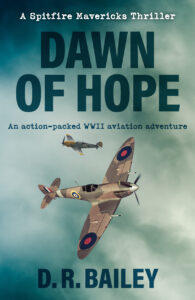
1940, England
After a series of run-ins with his superiors, Flying Officer Angus Mackennelly is posted to Squadron 696 – the Maverick unit full of misfits and outsiders.
Angus has just returned from gunning down enemy aircraft when he is given a shocking top-secret mission.
A spy is in their midst, feeding information to the Germans, and Angus is tasked with exposing him.
MI6 pin their suspicions on one of the squadron’s foreign pilots, but Angus is not convinced. He needs to get closer to the men in his unit to try and unravel their secrets.
As the fight in the skies intensifies, it is clear the Germans are anticipating their every move, putting the lives of the pilots in the Maverick squadron at a deadly risk.
Can Angus unmask the traitor? Will he save the men in his squadron?
Or will the enemy remain one step ahead…?