

As a historical novelist, I’d say that what resides in the details is a sense of place and time. Whether found by accurate research, by educated guesswork or by extrapolation, details endow fiction with a near-tangible quality that lets both the writer and the reader experience a measure of truth behind it. We ‘hear’ a long dead spy’s voice in the clipped sentences and spelling quirks of his reports, or we find a mindset in a statesman’s liking for trees and Italy.
Details are also highly addictive.
I usually begin by wanting to know something innocent — say, what fine Moroccan jewellery would have looked like five and a half centuries ago. And at four in the morning, I’m still browsing the web, and writing to friends whose spouses work in museums, or to complete strangers who happen to be historians. In the end, the (broken) Moroccan necklace will make one brief appearance — but it will look like an actual sixteenth-century one.
Once, a few books ago, I spent a happy hour in an antiquary’s shop in Venice, peppering the owner with questions about just what kind of blade a certain kind of Venetian citizen would have bought and worn, so that, in The Road to Murder, Paolo Citolini’s Venetian dagger was not just an element of the plot, but also something that his grandfather could have bought, and his father brought with him in his English exile as a piece of home.
And then there was the session of theatre rehearsals I hijacked into a demonstration of the different styles in Renaissance fencing, to see just what my protagonist, Tom Walsingham, would learn from an Italian swordsmaster. Or the museum curator who asked his mayor for leave in orderpermission to scan old cadastral maps for me. Or the kind librarian at the diocese of Paris’ archives whom I sent on a quest for the name of the bishop’s coadjutor in 1587. Most diocesan records were lost during the Revolution, and the name I wanted couldn’t be found — and yet I became fascinated with the idea of this nameless coadjutor: can he truly be only clinging to the cliff of history by a brief mention in an English diplomatic report? Someday this will be a story, too.
And what would the inn have been called in this village? And where would the great stairs have been in that long-destroyed manor house? Details — often quite small — to be happily hunted down rabbit-holes. They don’t even all necessarily end up on the page: what goes there thickens the atmosphere; what doesn’t still serves to add depth and texture and colour to the story.
Visit C. P. Giuliani’s website to stay up to date with her news and latest releases.
Congratulations to David Field, whose twisty Elizabethan mystery, The Clamorous Dead, is published today!
The Clamorous Dead is the fourth historical thriller in the Bailiff Mountsorrel Tudor Mystery Series – private investigation crime novels set during the reign of Elizabeth I and beyond.
Nottingham, England, 1596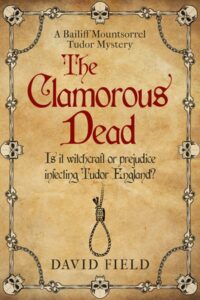
A routine hanging at Gallows Hill is disrupted when a wild woman begins screaming a curse on the execution site, calling down nightly visitations from the undead to claim the souls of the living.
County Bailiff Edward Mountsorrel attempts to pursue her, but she vanishes into thin air.
Nightly thereafter, Gallows Hill is the scene of ghastly happenings that Edward is ordered to investigate. Rumours of witchcraft infiltrate the county and the bailiff is sent to arrest a local woman, suspected of devilry.
Edward finds her and realises she is merely a wise woman with ancient knowledge of herbs and medicine and with no ill intent. He decides to hide her to keep her safe from those calling for blood.
But his efforts are complicated by the arrival of a professional witch-hunter from Scotland, who is scouring the length and breadth of England in a blood-thirsty mission to destroy any woman, man or child found guilty of sorcery.
As mass hysteria and prejudice threaten to engulf the country, can Edward bring justice to his county, while still keeping his morals intact? Or will innocent women be thrown to the wolves…?
Congratulations to Phillipa Vincent-Connolly, whose fabulous Tudor adventure, The Anne Boleyn Cypher, is out now!
The Anne Boleyn Cypher is the first book in the Timeless Falcon Dual Timeline series, a timeslip alternative history novel with a time-travelling protagonist set between the modern day and the Tudor period.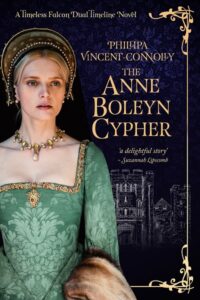
When twenty-year-old history student, Beth Wickers starts her second year of university, she has no idea that her whole world is about to be turned upside down.
Beth’s favourite lecturer gives Beth a box of books on Tudor history to borrow, and nestled among them is an ornate cypher ring with the letters ‘AB’ inscribed onto it.
When Beth tries the ring on, the unimaginable happens.
It carries her back through time to Hever Castle in 1521. And she is no longer in her professor’s office, but in the bedroom of none other than Lady Anne Boleyn.
Beth quickly becomes enchanted by Tudor England and is captivated by Anne. But she knows she can’t leave her loved ones behind forever.
Tormented by the knowledge of what will happen to Anne in the future, can Beth stop herself from intervening and rewriting history? Can she use the cypher ring to return home?
Or will Tudor life be too hard to leave behind…?