

From action-packed naval thrillers and gripping stories of military heroism to captivating travel memoirs, there’s something exciting here for everyone. Scroll down to discover this month’s titles from your favourite Sapere authors.
April’s Fiction Releases
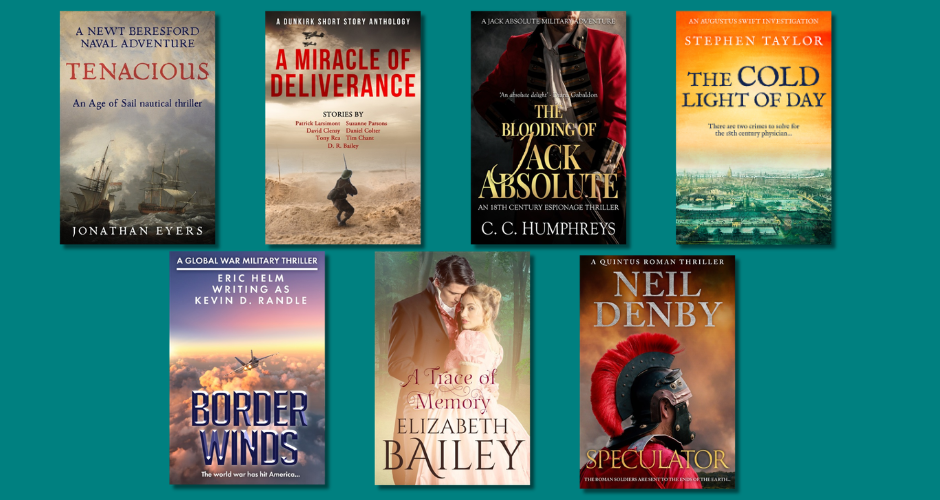
Tenacious by Jonathan Eyers is the first book in the Newt Beresford Naval Adventures series: Age of Sail historical adventures set in the 18th century. When Newt Beresford joins the frigate HMS Tenacious, he soon finds himself increasingly isolated on a ship full of whispered secrets, coded names, mysterious symbols and threatening messages.
A Miracle of Deliverance: A Dunkirk Short Story Anthology is a collection of linked short stories that commemorate the evacuation of Dunkirk in 1940. From a British soldier reflecting on the chaos of war, to a naval lieutenant doing his best to save the army from complete disaster, each of these stories reveals the heroic actions and deeply moving stories of the men and women who took part in this remarkable evacuation.
The Blooding of Jack Absolute by C. C. Humphreys is the first book in the Jack Absolute Military Adventure series: page-turning historical thrillers set in the 18th century. Can young Jack endure bloody battles in a wild landscape?
The Cold Light of Day by Stephen Taylor is the second book in the Augustus Swift Investigations series: chilling historical mysteries set in 18th-century London. Can Augustus Swift track down the ‘Beast of London’ before there are any more deaths?
Border Winds by Eric Helm is the second book in the Global War Military Thriller series. The world war has reached America’s backyard in this alternative-history military adventure set in the 20th century.
A Trace of Memory by Elizabeth Bailey is a quirky historical romance set in Georgian England with an intriguing twist. How can Elaine trust her heart if she can’t remember who she is?
Speculator by Neil Denby is the sixth book in the Quintus Roman Thrillers series. Centurion Julius Quintus Quirinius and his comrades are pushed to their limits in this action-packed military adventure set in Ancient Rome.
April’s Fiction Backlist Releases

We are pleased to announce that Flotilla Attack and Operation Chariot by Charles Whiting writing as Duncan Harding are now available from Amazon. Don’t miss these page-turning historical naval adventures set during the Second World War.
April’s Audio Releases
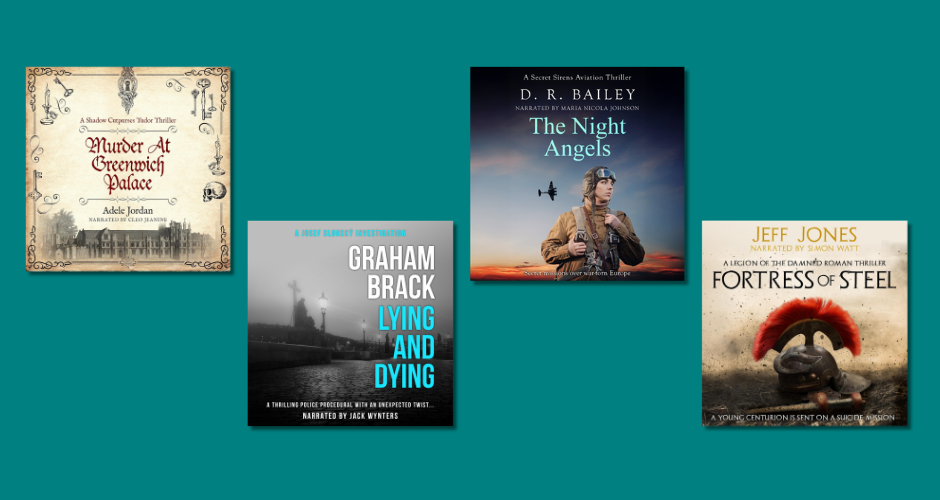
Lose yourself in a great audiobook this month!
Can an enterprising thief unmask a murderer? Find out in Murder at Greenwich Palace by Adele Jordan.
Discover a thrilling police procedural with an unexpected twist in Lying and Dying by Graham Brack.
The war is intensifying for the Secret Sirens in The Night Angels by D. R. Bailey.
A young centurion is sent on a suicide mission in Fortress of Steel by Jeff Jones.
April’s Non-Fiction Releases

Bomber Barons by Chaz Bowyer is a powerful and compelling history of Bomber Command and the extraordinary men who risked everything in the skies over Nazi Germany.
Pommie Migrant by Sydney Hart is a vivid and entertaining memoir of a “Ten Pound Pom” who left post-war Britain to begin a new life in Australia, capturing both the highs and lows of the migrant experience.
Andalucia by Nicholas Luard offers a vivid portrait of the region’s landscapes, traditions, and tumultuous past — a must-read for everyone who loves travel, history, and Spain.
British Liberation Army: 1944–1945 by Charles Whiting is a gripping account of the British Infantry’s final push to liberate Europe from Nazi control in the last year of the Second World War, 1944–1945.
Happy Reading! Team Sapere
Vibrant Voices. Sensational Stories. Beautiful Books.

Following the success of his standalone historical novels, Stephen Taylor is now writing the Augustus Swift Investigations: a new detective series set in Georgian England.
The first instalment — Brotherhood of Death — will be released at the end of October, and we are thrilled to have signed the third book in the series.
In Stephen’s words:
“My new series is set in the 1790s, thirty years before the first Metropolitan Police force and fifty years before the first Criminal Investigation Department was founded. The detective I have created is Augustus Swift: a physician and apothecary who has studied modern medicine and logic at Edinburgh University. But he has also travelled to Egypt to study Islamic philosophy and doctoring. He is a humanist who looks to science to explain the world rather than religious beliefs.
“It is the age of the Enlightenment, yet political control is still firmly in the hands of the aristocratic landowners, as it has been for centuries. Dr Swift, however, is a man of the Enlightenment.
“Yet fate raises a capricious eyebrow in his direction when he is recruited by the Home Department to advise on poisons. His life is dedicated to upholding the physician’s ethical principles, but now, by working for the government, his actions perpetuate the injustices of those in power.”
Keep up with Stephen’s latest news via his website.
Congratulations to Stephen Taylor, whose absorbing dual-timeline mystery, The Mystery of Rufford Abbey, is out now!
When historian Toby Wyatt receives a collection of chronicles written by Brother Roger of Hathern — a medieval monk who lived at Rufford Abbey — he is plunged into a nine-hundred-year-old mystery.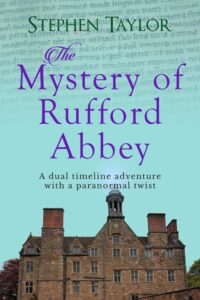
The monk tells the story of Margaret of Wellow, a fifteen-year-old girl who was accused of witchcraft after experiencing strange visions. After careful reading, Toby realises that Margaret seems to have been able to see into the future.
Back in the present day, a woman vanishes without a trace and the police are drawing a blank. Toby’s research takes a bizarre turn when he discovers a link between the woman’s disappearance and Margaret’s visions.
Faced with a seemingly impossible solution to the mystery, Toby begins to question his instincts. And as the past collides with the present, he must decide whether he can put his faith in a girl who has been dead for nine-hundred years…
Stephen Taylor is the author of A CANOPY OF STARS, a thrilling historical 19th century saga stretching from the legal courts of Georgian London to the Jewish ghetto in Frankfurt.
When I start to write a novel, the first thing I always do is open a document that I call ‘Conceptualising’. I put down my initial thoughts, sketch out a skeleton storyline. Then I start researching and populate this document with historical facts and ideas that I can use.
When I came to write A CANOPY OF STARS, my first port of call was a website — Punishment at the Old Bailey: Old Bailey Proceedings Online. Here I could view actual cases going back hundreds of years. I came across the trial of Peter Shalley (REF: T17900113-17) that took place in 1790. Shalley was a German immigrant who was accused of the theft of half a sheep’s carcass worth just 40 shillings. His story, through an interpreter, was that he was offered a shilling to carry the carcass to Oxford Road from a field outside London. When he said he didn’t know where Oxford Road was, the man said: ‘Don’t worry, I’ll walk behind you and each time you come to a junction, look behind you, and I’ll point which way to go.’ When he got to Oxford Road, the Watchman challenged him, and the other man ran away. To me, this was a reasonable defence — he had been duped.
But the system was stacked against him, for while he was an educated man, he was a Jewish immigrant and spoke little English; he was seen as just another piece of London’s low life to be dispatched by the hangman with little ceremony and no one to mourn him. Even the valuation of the sheep at exactly 40 shillings made it a felony (not a misdemeanour) and therefore punishable by death.
I found this disturbing; it may have been over two hundred years ago, but I was stung by the injustice of the case. I was upset; the wrong done to this man was so plain to see and became like a nagging toothache. So I resolved to restructure A CANOPY OF STARS; it would still be a Georgian courtroom drama, but — through the character David Neander — I would also write Peter’s own story as I saw it. Images danced in my mind; what sort of man was this Peter? Why had he left his native Germany; why had he come to England?
In England, this was a time of the enlightenment; there was a clamour for reform. Power, however, lay in the hands of the aristocratic landowners who viewed reform as a threat. In the German states, this was a time of nationalism, a distrust of all things un-German. This is the backdrop to David’s story. How did he navigate his way through it?
Click here to order A CANOPY OF STARS
Stephen Taylor is the author of A CANOPY OF STARS, a thrilling historical 19th century saga stretching from the legal courts of Georgian London to the Jewish ghetto in Frankfurt.
Hi Stephen! Welcome to the Sapere Books blog. Could you tell us a bit about what first got you into writing?
My addiction has been with me for over twenty years now. When I was younger, if somebody told me a good joke, when I retold it it was twice as long, embellished, the story enhanced, the characters fleshed out. With me, it was never just about and Englishmen, an Irishman, and a Scotsman. It was an Englishman in a bowler hat with a monocle, an Irishman in a donkey jacket with a pint of Guinness and a Scotsman in a kilt with a set of bagpipes (and yes I know that this is stereotypical).
Tell us about where you write and your writing habits.
I started by writing during my lunchtime at work, but now I write in my home office. I keep a working week, Monday to Friday and write for two and a half hours a day. I seem to need that discipline.
What part of the writing process do you find most difficult?
Probably research: it’s a double edged sword — part good, part tiresome. The rewrites are also tricky, as you can edit forever, endlessly trying to improve what you have written. I aim to stop after five rewrites.
Do your characters ever seem to control their own storyline?
The received wisdom is that you determine your storyline and not let your characters deviate from that. However, after I develop my characters, they tell me where they want to go, what they want to do. I follow them, and my stories are character led. I still have a structure in my mind — A to B, but the characters say how I get there.
Do you find it hard to know when to end a story?
Not usually. I have a prompt to myself that sits just below the line I am typing. It reminds me to keep some control over the characters. It says: INTRIGUE — CONFLICT — CLIMAX — RESOLUTION. i.e:
Open with a big question or hook: INTRIGUE. Then you have the problems your hero is up against: CONFLICT. This builds to a CLIMAX. This is followed by the RESOLUTION.
What is your favourite book?
If you ask me this next week, you may get a different answer. I would say my favourite book is To Kill a Mockingbird by Harper Lee. My favourite character is Uriah Heep, from David Copperfield. Dickens’ image of him is wonderfully unpleasant — he’s so slimy.
What book do you wish you had written?
Anything by Norman Mailer. As a writer, he is so far above me. He’s much more than a storyteller.
Tell us something surprising about you.
I was brought up in Manchester, but I was born in Yorkshire. My mother traveled back to Yorkshire so that my birth there would give me residential status to play cricket for Yorkshire — nobody ever believes that, but I promise that it’s true. Unfortunately, it was a feat that I never achieved, the White Rose County being unappreciative of my cricketing skills.