

As we celebrate National Crime Reading Month, an annual initiative spearheaded and developed by the Crime Writers’ Association which runs throughout the month of June, we asked C. V. Chauhan, author of the Inspector Sharma Thrillers set in Leicester, to tell us what crime fiction means to him and how it has influenced his own writing.
“I was born and brought up in a small town in the Rift Valley in Kenya. Despite the breathtaking natural beauty of the location, my childhood was highly deprived. My local school had ninety-seven pupils, but no resources and no library. At home, my six siblings and I shared three books. I still remember them vividly, because they kickstarted my love affair with reading. Two featured European fairy tales: Hansel and Gretel, Cinderella and Rapunzel. The third book was about Greek myths and legends. They were probably given to my father, a cobbler, by an ex-pat British customer. I read and re-read those books by the light of a hurricane lamp in the evening, fascinated by the magical world of fairy tales and the adventures of Perseus and Medusa, Theseus and the Minotaur. This is where my fascination with heroes tussling with dark forces and sinister figures began.
“At the age of eleven I moved with my family to a Victorian terraced house in Leicester and joined a small secondary school without any playing fields. For all its faults, it did have a library, from which I borrowed copious books, and a good English teacher who introduced us to Shakespeare — I loved the themes of passion, greed, power and corruption in Macbeth, Hamlet and Julius Caesar. The battle between good and evil was a constant theme in many of the books I read.
“As an undergraduate at the University of York, my reading became turbocharged. I suddenly had access to thousands of books and met many like-minded people who were hungry for knowledge. In addition to reading the core textbooks for history and economics, I started reading more widely: Graham Greene, Agatha Christie, Aldous Huxley, James Baldwin, George Orwell. I was such a voracious reader that I often read three books simultaneously — a few chapters from one, a few from another, and so on until I went back to the first. My contemporaries thought I was mad, but I was happily lost in the many different worlds and characters created by these fabulous writers.
“Immersing myself properly in crime fiction came not long after. I trained to be a teacher and taught history in some challenging secondary schools in London and Birmingham. At one of these schools, I became good friends with an English teacher called Jim MacLachlan. He introduced me to a wonderful range of crime fiction authors, many of whom I wasn’t previously aware. I soon became embroiled in the lives of the characters in the 87th Precinct series of police procedural novels by Ed McBain, as well as the thrilling plots created by Elmore Leonard, Dorothy L. Sayers, Ngaio Marsh, Raymond Chandler, Lawrence Block, Donald E. Westlake, Patricia Cornwell and Joseph Hansen. Like Shakespeare, the genre delved into complex human behaviours, grappling with morality and justice whilst immersing the reader into danger from a safe distance. I was hooked.
“As a writer, I continue to read widely in all genres. Raymond Chandler, Dashiell Hammett and James M. Cain are perennial favourites, as are Lee Child, Stephen King, Jeffery Deaver and James Lee Burke. The Laidlaw books by the late William McIlvanney are fabulous. I also love historical fiction with a criminal element and, more recently, have discovered the many wonderful Japanese writers of crime fiction.
“I gave up full-time work a few years ago to focus on writing crime-fiction. My thrillers are set in Leicester and feature Inspector Rohan Sharma and his idiosyncratic African Grey parrot, Fernando. I have drawn upon my love of detective fiction and police procedurals to write about the city I live in, whilst exploring contemporary themes of diversity, organised crime and human trafficking.
“As we celebrate Crime Fiction Month this June, I often reflect on the fact that crime fiction is a wonderful vehicle through which to examine social and moral dilemmas. I try to bring that to the forefront in my writing and if a reader reflects on something they have read in one of my books, then I’m happy. It’s how I remember the books that have made an impression on me. Even today, I still remember the stories of Perseus and Medusa, Theseus and the Minotaur.”

Visit C. V. Chauhan’s website for all his latest news.
For more information on National Crime Reading Month, visit: https://crimereading.com/
From historical sagas and legal thrillers to a pilgrim’s journey across France and Spain, there’s something exciting here for everyone. Scroll down to discover this month’s titles from your favourite Sapere authors.
May’s Fiction Releases
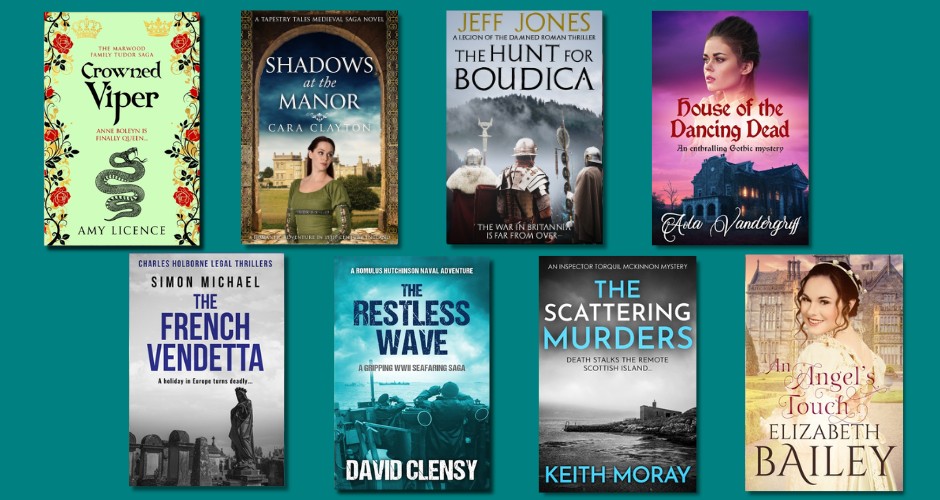
The Crowned Viper by Amy Licence is the sixth book in the Marwood Family Tudor Saga Series, set at Henry VIII’s court. When her uncle dies, newly-married Thomasin travels to London to settle his estate, and once more finds herself at the centre of court intrigue.
Shadows at the Manor by Cara Clayton is the third book in the Tapestry Tales Medieval Sagas. After a spate of robberies occur on the roads around the manor, seventeen-year-old Grace Amundeville d’Albert is determined to work out who is behind them. But could the culprit be close to home?
The Hunt for Boudica by Jeff Jones is the fourth instalment in the Legion of The Damned Roman Thrillers. Centurion Marcus Corvo and his Legion of The Damned are given a choice: face execution or accept another suicide mission — hunt down and capture Queen Boudica.
House of the Dancing Dead by Aola Vandergriff is an atmospheric Gothic mystery set in New Mexico. Abandoned by her partner and grieving the death of her mother, Christie Lynne agrees when her boss offers a year’s paid vacation in the mountains. But regrets are swift to follow when she arrives at the remote Harper abode, whose strange inhabitants sleep all day and dance all night. And when a horrifying discovery is made, everything around her is thrown into question.
The French Vendetta by Simon Michael is the eleventh novel in the Charles Holborne Legal Thrillers. When a rare gap opens in barrister Charles Holborne’s court diary, he and Sally seize the chance for their long-postponed honeymoon. But deep in the heart of rural Gascony Charles discovers a community still fighting the Second World War, where old crimes refuse to stay buried.
The Restless Wave by David Clancy is the fourth book in the Romulus Hutchinson Naval Adventures, set during the Second World War. While Romulus sees action in the Mediterranean for the Allied landings at Sicily and Salerno, as well as helping to lift the siege of Malta as part of Operation Pedestal, his twin brother Remus is once again unlucky enough to experience the wrong end of a torpedo strike.
The Scattering Murders by Keith Moray is the eighth crime thriller in the Inspector Torquil McKinnon Mystery Series, set on a remote Scottish island. When a well-liked farmer is found dead, Detective Inspector McKinnon soon finds himself with more than one mystery to solve.
An Angel’s Touch by Elizabeth Bailey is a touching Georgian romance featuring a spirited and passionate heroine. Can a young woman’s love bring a grieving recluse back into the world?
May’s Audio Releases
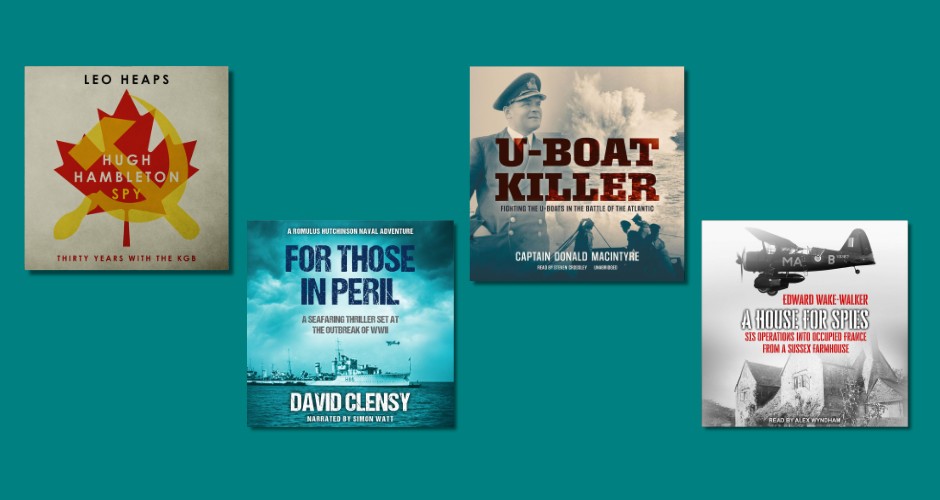
Lose yourself in a great audiobook this month!
Professor, friend, Soviet spy; who was the real Hugh Hambleton? Find out in Hugh Hambleton, Spy by Leo Heaps.
Two brothers are keen to start their naval careers. But could it all be over before they’ve barely begun? Find out in For Those in Peril by David Clensy.
Don’t miss this unique account of the Battle of the Atlantic from the perspective of a British destroyer captain in U-Boat Killer by Donald Macintyre.
Discover the unforgettable history of French intelligence agents and courageous British pilots who risked everything in the fight against Hitler in A House for Spies: SIS Operations into Occupied France from a Sussex Farmhouse by Edward Wake-Walker.
May’s Non-Fiction Releases

Hurricanes over Murmansk by John Golley tells the remarkable story of the RAF’s daring defence of the Soviet Union against the brutal Nazi onslaught of 1941. Drawing on first-hand accounts from RAF pilots as well as senior Soviet officials, Golley has crafted a thoroughly researched, vividly told account of bravery, sacrifice, and wartime ingenuity.
The Battle for European Skies by Chaz Bowyer is a comprehensive account of the savage aerial war fought over Europe during the Second World War. This book stands as a poignant tribute to the bravery and dedication of the men on both sides who took to the skies time and again, uncertain of their fate, in the service of their country.
To Drive the Enemy from Southern Soil by Michael W. Taylor draws upon the personal correspondence of Confederate Colonel Francis Marion Parker to recount the history of the brave men of the 30th Regiment North Carolina Troops, from its inception in September 1861 to its final surrender at Appomattox in 1865. The result is a deeply personal record of the daily life and cares of a Civil War soldier.
The Field of the Star is a searingly honest account of author Nicholas Luard’s pilgrimage along the Camino de Compostela, undertaken after the devastating illness and death of his eldest daughter.
Happy Reading! Team Sapere
Vibrant Voices. Sensational Stories. Beautiful Books.

We are thrilled to announce that we have signed three new instalments in the Tom Walsingham Mystery Series by C. P. Giuliani.
The series follows the espionage adventures of Tom Walsingham during the Elizabethan era in Tudor England.
In C. P. Giuliani’s words:
“I’m thrilled to be working with Sapere Books on three more instalments in my Tom Walsingham mystery series. As I researched the previous books, I kept coming across material and inspiration for more stories, so I proposed them to Amy Durant, and she accepted at once. This is one of the reasons why working with Sapere is so rewarding: the enthusiasm of a very skilled and friendly team.
“Following the death of Tom Walsingham’s influential kinsman and mentor, spymaster Sir Francis Walsingham, Tom thinks his career in intelligence is finished — but he will soon discover that one is never quite done with a life in espionage! As he becomes reluctantly entangled in the troubles of wayward poet Kit Marley and Queen Elizabeth’s physician Dr Roderigo Lopes, Tom will encounter new foes, new allies, visit new places, and grapple with new cases of murder and intrigue — and he will have to do it all without Sir Francis’s powerful network at his back.
“I can’t wait to plunge into Tom’s new adventures — actually, I’m already at work on Book Ten — and all because the lovely team at Sapere still make the journey as enjoyable and stimulating as they did with Book One.”
Death at Home is available from Amazon now.
Visit C. P. Giuliani’s website for all her latest news or follow her on X.
Ahead of the publication of The Restless Wave, the fourth book in the Romulus Hutchinson Naval Adventure Series, author David Clensy takes a closer look at why Operation Pedestal was such a critical moment in the Second World War.
By the summer of 1942, Malta was perilously close to defeat. Isolated in the centre of the Mediterranean, the island had endured almost two years of relentless siege. Axis aircraft and submarines had reduced its ports, airfields and towns to rubble, while starvation and fuel shortages threatened to bring military operations to a standstill. Yet Malta remained strategically indispensable. From its harbours and airstrips, British forces could strike at Axis supply lines to North Africa, choking Rommel’s Afrika Korps just as it prepared for a decisive push towards Egypt.
Operation Pedestal was the Allies’ last throw of the dice to save the island. Conceived as a massive convoy operation and executed at extraordinary risk, it stands as one of the Royal Navy’s most hard-fought and costly triumphs of the Second World War.
It is at the heart of The Restless Wave, the fourth book in the Romulus Hutchinson Naval Adventure series: action-packed, authentic historical adventures following twin brothers fighting with the Royal Navy and the Merchant Navy during the Second World War.
Rom is now a first lieutenant, rapidly getting the chance to show his mettle on the bridge, seeing action in the Mediterranean for the Allied landings at Sicily and Salerno, as well as helping to lift the siege of Malta as part of Operation Pedestal.
In this blog, I wanted to take a closer look at why the operation was so significant.
Malta under siege
By mid-1942, Malta’s position was desperate. Previous attempts to resupply the island had suffered severe losses, with convoys harried from the air by the Luftwaffe and Regia Aeronautica, and attacked at sea by submarines and fast torpedo boats. Fuel for aircraft and ships was critically low, forcing the RAF to limit operations at the very moment when air defence was most urgently needed. Food stocks were so reduced that rationing had reached near-starvation levels for both civilians and servicemen alike.
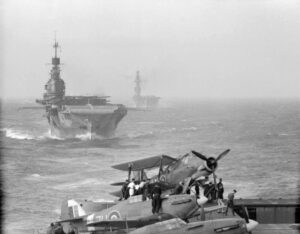
HMS Victorious’ flight deck showing HMS Indomitable and HMS Eagle
Despite this, the island continued to disrupt Axis operations. Intelligence from signals interception and reconnaissance imposed a heavy toll on shipping bound for North Africa. The Axis understood that neutralising Malta was essential. The Royal Navy knew that losing it could turn the Mediterranean decisively against the Allies.
Launched in August 1942, Operation Pedestal was the largest and most heavily escorted convoy yet to attempt to supply the island. Fourteen merchant ships were assembled, carrying food, ammunition and fuel. Their cargo included aviation fuel in bulk and, most critically, the oil tanker SS Ohio, the survival of which would prove vital to keeping the island in Allied hands.
The escort was formidable. Under the command of Admiral Sir Neville Syfret, the Royal Navy committed two battleships, four aircraft carriers, seven cruisers and more than thirty destroyers. It was an extraordinary concentration of naval power, reflecting the strategic stakes involved. Even so, planners knew losses would be heavy. The convoy had to pass through the narrow Sicilian Channel, within range of Axis airfields, submarines and surface craft.
Running the gauntlet
The convoy sailed from Gibraltar on 10 August 1942. Almost immediately, it came under attack. Axis aircraft struck repeatedly, launching coordinated bombing and torpedo attacks designed to overwhelm the escorts. U-boats and Italian submarines waited ahead, while fast torpedo boats prepared night assaults.
The Royal Navy’s carriers played a crucial early role, providing fighter cover that blunted the worst of the air attacks in the opening days. However, as the convoy pressed eastwards, the carriers were forced to turn back in accordance with operational limits, leaving the merchant ships increasingly exposed.
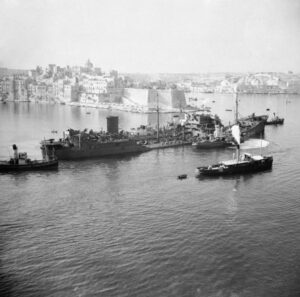
SS Ohio arrives at Malta
Losses mounted. The aircraft carrier HMS Eagle was sunk by submarine attack. Several cruisers and destroyers were badly damaged or sunk while defending the convoy. Merchant ships were picked off one by one, yet the escorts continued to fight tenaciously, laying smokescreens, counterattacking submarines and engaging enemy surface forces at close range.
At the centre of the drama was SS Ohio. Heavily damaged by bombing and torpedo strikes, the tanker was left barely afloat. Her engine failed, her deck was shattered, and she was down by the bows. Yet abandoning her was not an option. Without her fuel, Malta’s air defences and naval forces would grind to a halt.
In one of the most remarkable episodes of the naval war, Royal Navy destroyers and minesweepers refused to give up. Ohio was lashed between escorting ships and painstakingly shepherded towards Malta, under constant threat of further attack. When she finally entered Grand Harbour on 15 August, broken-backed but still afloat, she was greeted by cheering crowds. It was also the Feast of the Assumption, later commemorated on the island as the day Malta was saved.
A landmark moment
Of the fourteen merchant ships that set out, only five reached Malta. The Royal Navy suffered grievous losses: a carrier, two cruisers, a destroyer and numerous aircraft. By any conventional measure, it was a costly operation.
Yet strategically, Operation Pedestal was a success. The supplies that arrived, especially the fuel carried by Ohio, enabled Malta to survive the siege. Within weeks, the island’s air and naval forces were back in action, once again savaging Axis supply lines to North Africa. This pressure played a significant role in undermining Rommel’s offensive and set the conditions for the Allied victory at El Alamein later that year.
For Malta, the convoy became a defining moment, later recognised through the award of the George Cross to the island as a whole. For the Royal Navy, Pedestal remains one of its most hard-fought convoy battles, a stark reminder that maritime logistics, often overlooked, can determine the outcome of entire campaigns.
The Restless Wave is available to pre-order now.
Stay up to date with David’s news and latest releases here.
Image credits: Operation Pedestal Carriers and SS Ohio are from Wikimedia Commons (public domain).
From action-packed naval thrillers and gripping stories of military heroism to captivating travel memoirs, there’s something exciting here for everyone. Scroll down to discover this month’s titles from your favourite Sapere authors.
April’s Fiction Releases

Tenacious by Jonathan Eyers is the first book in the Newt Beresford Naval Adventures series: Age of Sail historical adventures set in the 18th century. When Newt Beresford joins the frigate HMS Tenacious, he soon finds himself increasingly isolated on a ship full of whispered secrets, coded names, mysterious symbols and threatening messages.
A Miracle of Deliverance: A Dunkirk Short Story Anthology is a collection of linked short stories that commemorate the evacuation of Dunkirk in 1940. From a British soldier reflecting on the chaos of war, to a naval lieutenant doing his best to save the army from complete disaster, each of these stories reveals the heroic actions and deeply moving stories of the men and women who took part in this remarkable evacuation.
The Blooding of Jack Absolute by C. C. Humphreys is the first book in the Jack Absolute Military Adventure series: page-turning historical thrillers set in the 18th century. Can young Jack endure bloody battles in a wild landscape?
The Cold Light of Day by Stephen Taylor is the second book in the Augustus Swift Investigations series: chilling historical mysteries set in 18th-century London. Can Augustus Swift track down the ‘Beast of London’ before there are any more deaths?
Border Winds by Eric Helm is the second book in the Global War Military Thriller series. The world war has reached America’s backyard in this alternative-history military adventure set in the 20th century.
A Trace of Memory by Elizabeth Bailey is a quirky historical romance set in Georgian England with an intriguing twist. How can Elaine trust her heart if she can’t remember who she is?
Speculator by Neil Denby is the sixth book in the Quintus Roman Thrillers series. Centurion Julius Quintus Quirinius and his comrades are pushed to their limits in this action-packed military adventure set in Ancient Rome.
April’s Fiction Backlist Releases
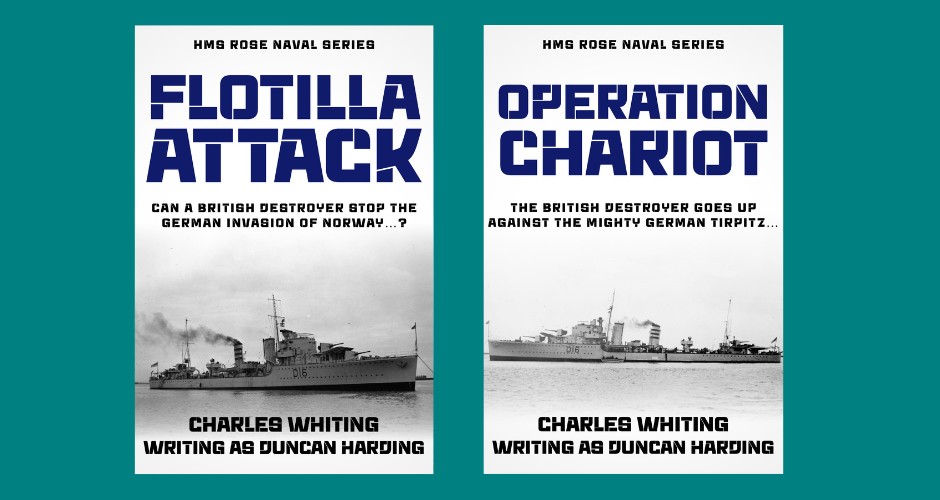
We are pleased to announce that Flotilla Attack and Operation Chariot by Charles Whiting writing as Duncan Harding are now available from Amazon. Don’t miss these page-turning historical naval adventures set during the Second World War.
April’s Audio Releases

Lose yourself in a great audiobook this month!
Can an enterprising thief unmask a murderer? Find out in Murder at Greenwich Palace by Adele Jordan.
Discover a thrilling police procedural with an unexpected twist in Lying and Dying by Graham Brack.
The war is intensifying for the Secret Sirens in The Night Angels by D. R. Bailey.
A young centurion is sent on a suicide mission in Fortress of Steel by Jeff Jones.
April’s Non-Fiction Releases
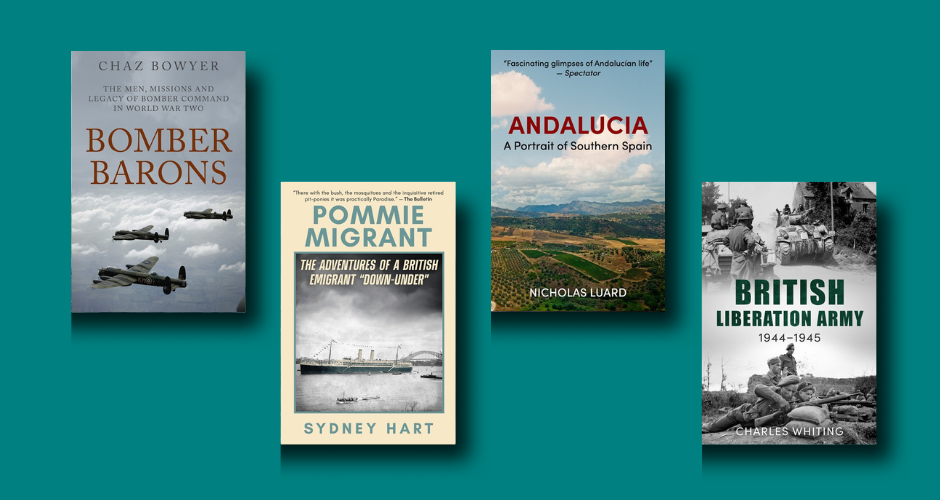
Bomber Barons by Chaz Bowyer is a powerful and compelling history of Bomber Command and the extraordinary men who risked everything in the skies over Nazi Germany.
Pommie Migrant by Sydney Hart is a vivid and entertaining memoir of a “Ten Pound Pom” who left post-war Britain to begin a new life in Australia, capturing both the highs and lows of the migrant experience.
Andalucia by Nicholas Luard offers a vivid portrait of the region’s landscapes, traditions, and tumultuous past — a must-read for everyone who loves travel, history, and Spain.
British Liberation Army: 1944–1945 by Charles Whiting is a gripping account of the British Infantry’s final push to liberate Europe from Nazi control in the last year of the Second World War, 1944–1945.
Happy Reading! Team Sapere
Vibrant Voices. Sensational Stories. Beautiful Books.

We are delighted to announce that we have signed the fourth book in C V Chauhan’s Inspector Sharma Thrillers: page-turning police procedurals set in Leicester and packed full of suspense.
Here, C V Chauhan tells us what to expect from the latest instalment:
“The plot for the fourth book in the series, A Grave Mistake, is set in motion when a young South Asian man’s body is discovered in Leicester’s historic Welford Road Cemetery, laid out on the grave of Thomas Cook, the travel agent. The body shows signs of surgical intervention: a long scar, expertly stitched. When pathologist Dr Nasreen Khan performs the post-mortem, she discovers a syringe containing a cryptic note addressed to Detective Inspector Sharma inside the body.
“So starts a fast-paced thriller which takes DI Sharma and his team across Leicestershire and further afield as they delve into the sinister world of organised crime and human trafficking.
“A Grave Mistake is more than a police procedural; it is about contemporary British society. It explores issues of immigration, racism, the exploitation of vulnerable people, and the challenges of policing in a diverse, urban environment. The novel also delves into the personal cost of police work, the importance of family, and the resilience required to confront both external and internal demons. This book, as with the previous three in the series, reflects my deep affection for the city of Leicester and its diverse communities.

“I am delighted that Sapere Books have offered me the opportunity to continue writing the DI Sharma series. I couldn’t have done it without their support and encouragement, as well as all the people who enjoy reading my books.”
Visit C V Chauhan’s website for all his latest news.
From medieval intrigues and Tudor mysteries to absorbing accounts of momentous battles, there’s something exciting here for everyone. Scroll down to discover this month’s titles from your favourite Sapere authors.
March’s Fiction Releases
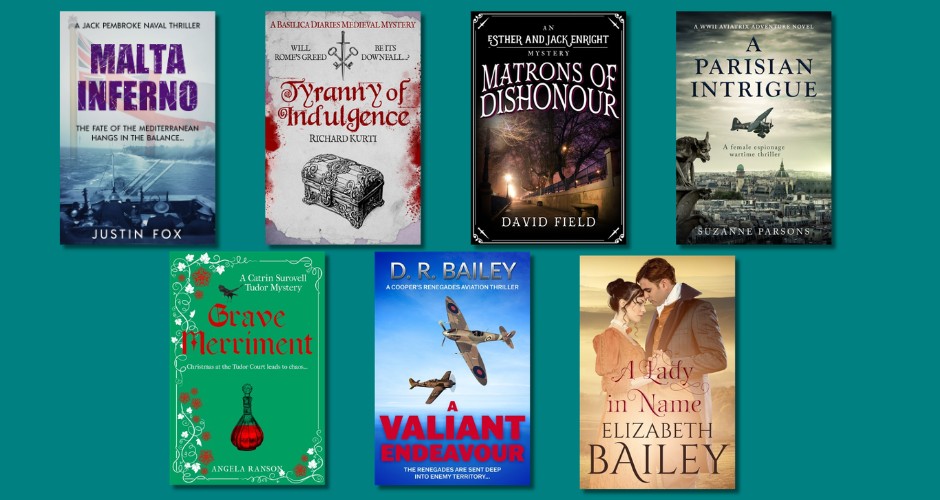
Malta Inferno by Justin Fox is the fourth book in the Jack Pembroke Naval Thrillers series. In this instalment, Lieutenant Jack Pembroke and his small escort ship, HMSAS Southern Gannet, join a secret convoy from Egypt to relieve the beleaguered island of Malta.
Tyranny of Indulgence by Richard Kurti is the fifth book in the Basilica Diaries Medieval Mysteries series. Determined to accelerate the building of St Peter’s Basilica, the new Pope, Leo X, initiates the selling of indulgences, whereby the rich can buy forgiveness for their sins.
Matrons of Dishonour by David Field is the thirteenth book in the Esther & Jack Enright Mysteries series. Jack is tasked with assuring his superiors that rumours of unlawful assaults on suffragettes in police custody are baseless. But when he learns otherwise, he is obliged to reassess his loyalties.
A Parisian Intrigue by Suzanne Parsons is the first book in the WWII Aviatrix Adventures series. Miriam Nugent and her fiancé, Archie Bowater, are both doing their bit for the war effort. While Archie struggles to get to grips with flying Spitfires, at Bletchley Park Miriam quickly makes her mark fixing the machines that will decode enemy messages.
Grave Merriment by Angela Ranson is the third book in the Catrin Surovell Tudor Mystery series. It’s Christmas at Whitehall Palace, but Lady Catrin Surovell cannot find her celebratory spirit. The queen has asked her to stop a brute who has forced the waifs of London to work for him. And it seems the culprit may be someone at court…
A Valiant Endeavour by D. R. Bailey is the second book in the Cooper’s Renegades Aviation Thrillers series. American pilot Cooper Donahue has been sent to the RAF base at Banley to train with the British Mavericks Squadron. Before long, he finds himself flying sorties along the Sussex coast, where the threat of dogfights with the Germans lurks around every corner.
A Lady in Name by Elizabeth Bailey is a heart-warming Georgian romance. When Lucinda Graydene’s father imparts a shattering secret on his deathbed, her world is turned upside down. Bereft, she confronts the author of her unorthodox origins — but instead she finds his heir. And the autocratic Stefan Ankerville, Earl of Pennington, takes charge of her life, despite her protests.
March’s Fiction Backlist Releases
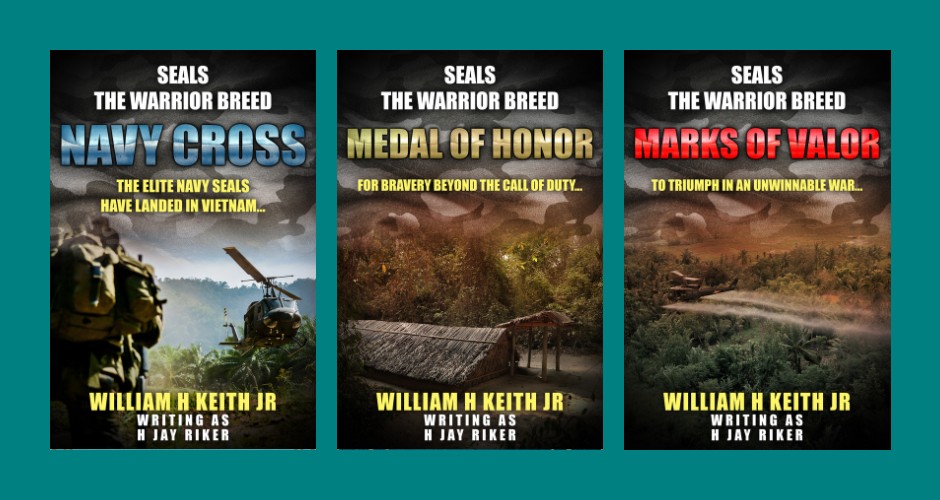
We are pleased to announce that the fourth, fifth and sixth instalments of H. Jay Riker’s gripping SEALS: The Warrior Breed series are out now. Don’t miss these action-packed military adventures, following the U.S. Navy’s elite commando demolition unit.
March’s Non-Fiction Releases
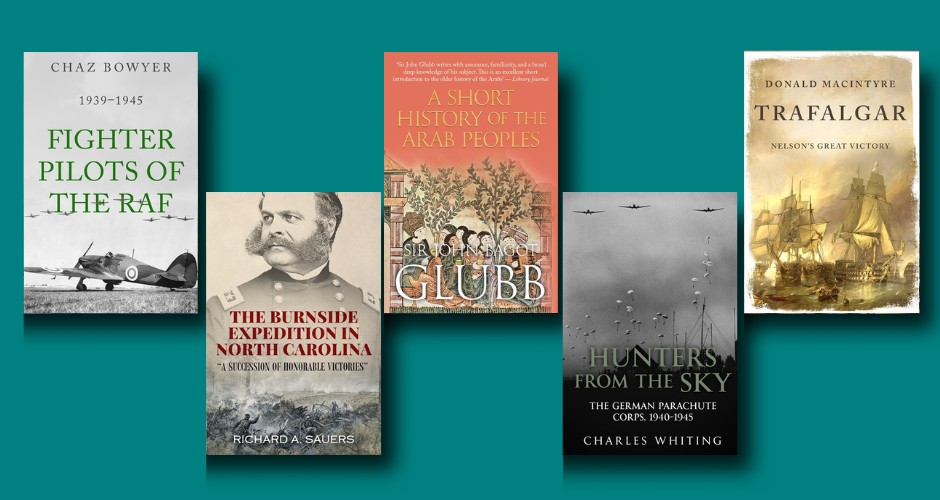
Fighter Pilots of the RAF by Chaz Bowyer is a powerful and deeply human portrait of the men who risked everything in the skies over Europe. Drawing on meticulous research, Bowyer goes beyond the famous names to uncover the untold stories of twenty pilots — many of whom received little public recognition, yet were crucial in the fight against the Luftwaffe.
The Burnside Expedition in North Carolina by Richard A. Sauers is a definitive account of Union General Ambrose E. Burnside’s North Carolina Campaign — a pivotal moment in the American Civil War.
A Short History of the Arab Peoples by Sir John Bagot Glubb draws on the author’s considerable knowledge of the Arab world gleaned from his time spent living and working in the region to explore its history, culture and politics. Spanning from the seventh century to the mid-twentieth century, this book brings to life several tumultuous and extraordinary periods of history.
Hunters From the Sky by Charles Whiting tells the fascinating true story of the Fallschirmjäger — the elite German Parachute Corps — and their role during the Second World War, 1940–1945.
Trafalgar: Nelson’s Great Victory by Donald Macintyre charts the dramatic prelude to the momentous battle — from Horatio Nelson’s rise to fame at the battles of the Nile and Copenhagen, to Pierre-Charles Villeneuve’s bold attempt to unite French naval forces in the Caribbean, before slipping past the British blockade to challenge their command of the seas.
Happy Reading! Team Sapere
To mark the publication of the first book in the WWII Aviatrix Adventures, author Suzanne Parsons takes a closer look at the inspirations behind the series.
Entering Sapere Books’ first writing competition back in 2021, I was thrilled to be awarded a contract for a three-book series. Strong female characters, wartime espionage and aviation — what a brief! The WWII Aviatrix Adventure series is the result. Before long I was immersed in everything to do with the Second World War, especially those members of the Special Operations Executive (SOE) who in Churchill’s words ‘set Europe ablaze’. There were so many inspirational stories, like that of the beautiful Violette Szabo, who worked as a courier for the SOE and was posthumously awarded the George Cross for bravery, and wireless operator — or ‘pianist’ — Noor Inayat Khan, an Indian princess. There were other stories deemed unnewsworthy, so I was determined my female protagonist would be part of that group: unremarkable, unobtrusive, someone who might even make the odd mistake.
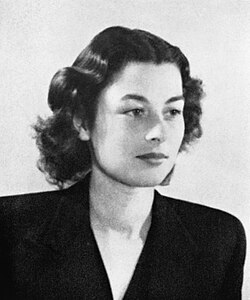
Enter Miriam Nugent, who enjoys hill-walking, dancing and reading. Her journey to France is convoluted, beginning at that place of codes and Enigma machines, Bletchley Park, before the draw of the SOE proves irresistible. Miriam is young, naïve, and away from home for the first time. But she is a fast learner. The training is tough, the assault course at Arisaig House in the West Highlands worthy of the SAS. The gadgets are also extraordinary, making those in any Bond film appear dull, but the message is clear: war turns the ordinary into the extraordinary. Years ago, I met a work colleague’s mother. There was always something behind her warm smile and friendly manner. What was it? Then I was told she had been an SOE spy.
The spectre of World War One loomed large for those in this war, and having read The General by C. S. Forester, the image of a man who sips tea and discusses fine wine in a French château as his men go ‘over the top’, was strong. What would any man think of that, twenty years on?
Enter Archie Bowater, who is ashamed of his father. He is also desperate to join the RAF and goes to extraordinary lengths to do so. He drifts from plane to plane, flying Spitfires, Hurricanes, Bristol Beaufighters and the wooden De Havilland Mosquito in his quest to be the hero his father never was.
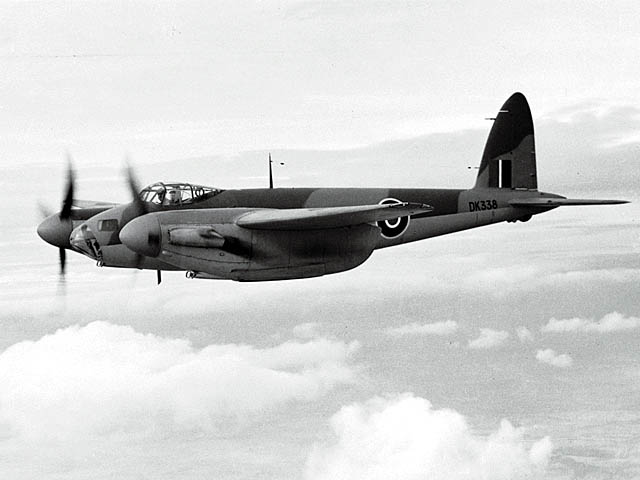
The Moon Squadrons that supported the SOE were another inspiration, the iconic painting They Landed by Moonlight by Robert Taylor — capturing a night landing in an isolated field — hard to forget. Flying deep into France under a full moon, transporting agents and rescuing downed airmen, was dangerous. But what if a woman flew those missions? In wartime, women attracted less suspicion than men, their role to nurture uppermost in most minds. Surely an experienced aviatrix could pull off flying a bulky Lysander Mark II? In Britain, women only ever flew as part of the Air Transport Auxiliary (ATA), but then, isn’t fiction all about the what ifs?
In book two, Red Sky at Night, the ATA takes a prominent role, we see a new aviatrix in action, and a spy is sent to Russia, where she encounters the ‘Night Witches’.
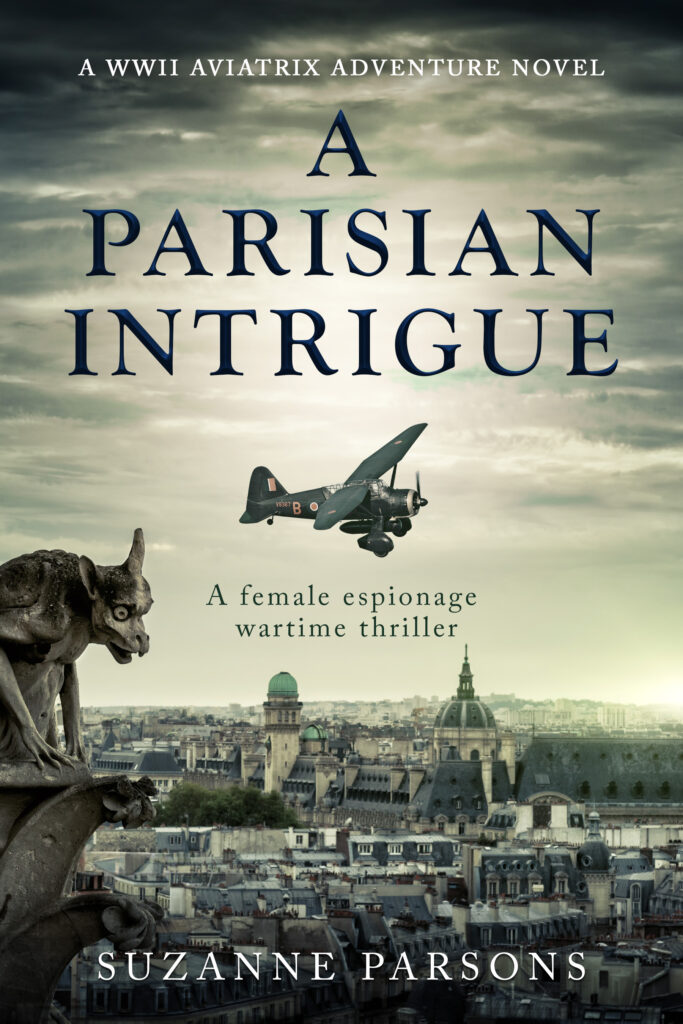
A Parisian Intrigue is available from Amazon now.
You can follow Suzanne on Facebook and X.
All images are from Wikimedia Commons (public domain).
We are thrilled to announce that we have signed the next three books in the Anne Boleyn Chronicles by Rozsa Gaston.
Set during Anne Boleyn’s formative years, the series follows Anne through the Habsburg Netherlands to France, then back to England before rising to become one of England’s most legendary queens.
In Rozsa’s words:
“The adventure of chronicling Anne Boleyn’s teenage years in Europe has catapulted me far beyond my original plan for a three-book series. Anne’s story deepened as I researched the historically significant figures who shaped her, both psychologically and politically, including Margaret of Austria, the future Charles V, Erasmus, Francis I of France, Mary Tudor, Louise of Savoy, Diane de Poitiers, Clément Marot, and Leonardo da Vinci.
“The next three books in the Anne Boleyn Chronicles see Anne at the 1520 Field of the Cloth of Gold, where her unique advantage as an Englishwoman with French sensibilities allow her to stand out. Her final year in France, however, is fraught with rumblings of religious reformation spurred by Martin Luther, and the coming war with England.
“In 1521 Anne is summoned home to England, where she shines after eight years spent at two of the most powerful courts in Europe. Her father is determined to see Anne marry well. But Anne’s sights are set even higher than her father’s. In book six we shall see how high she soars following her extraordinary years abroad.”
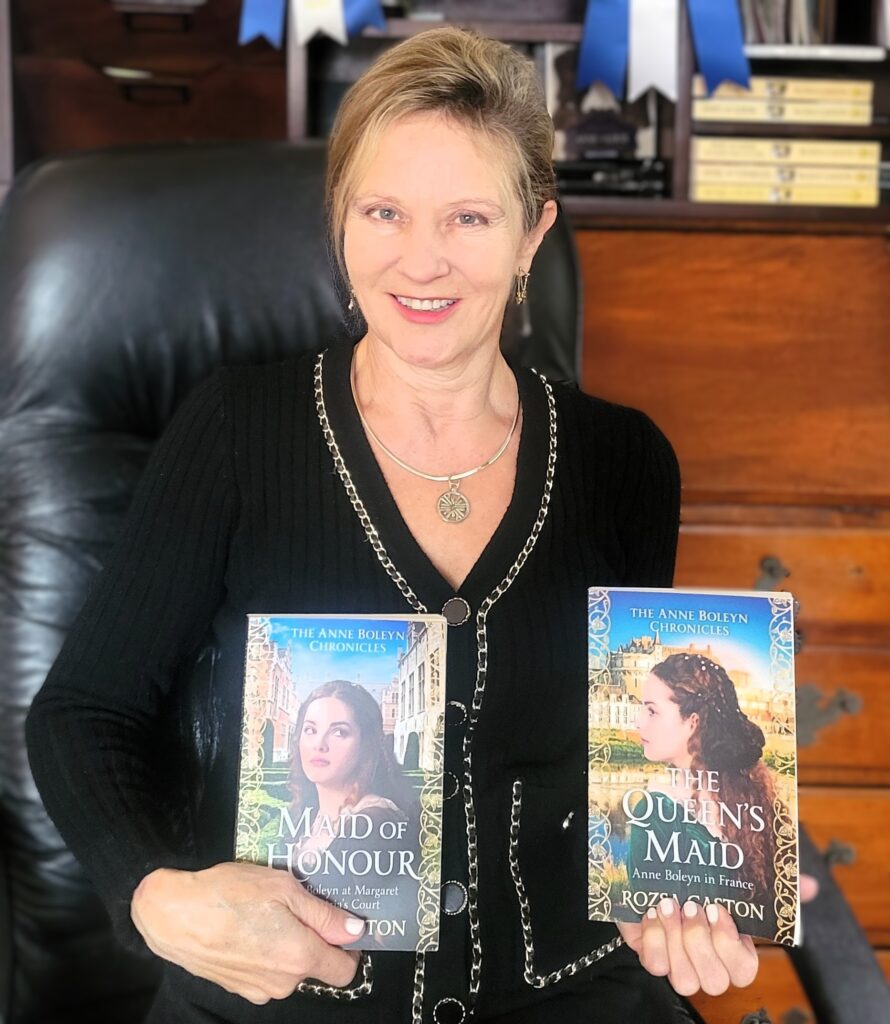
Queen of Diamonds is available to pre-order now.
From Georgian romance and Tudor espionage to compelling tales of wartime bravery — there’s something exciting here for everyone. Scroll down to discover this month’s titles from your favourite Sapere authors.
February’s Fiction Releases

The Queen’s Maid by Rozsa Gaston is the second book in the Anne Boleyn Chronicles: historical novels set in sixteenth-century Europe. In this instalment, Anne arrives at the Palace of Tournelles, only to learn that not everyone is pleased about the union between the ageing French king and his young English queen.
A Fragile Mask by Elizabeth Bailey is a touching historical love story set in Georgian England with a courageous heroine at its heart.
Death at Home by C. P. Giuliani is the eighth book in the Tom Walsingham Mystery series: page-turning espionage adventures set during the Elizabethan era. When his older brother dies suddenly, Tom Walsingham finds himself a suspect in a murder investigation.
The Mighty Ocean by David Clensy is the third book in the Romulus Hutchinson Naval Adventure series: action-packed adventures set during the Second World War. As the twins’ ships cut through the Arctic seas, will the brothers survive the gauntlet of U-Boats, icebergs and icy seas?
The King’s Stolen Jewels by Adele Jordan is the fourth book in the Shadow Cutpurses Tudor Thrillers, set during the reign of King Henry VIII. When her mother returns to Whitehall Palace during the Christmas festivities, thief-turned-espionage-agent Gwynnie Wightham must decide whether to help her once more or renounce the Shadow Cutpurses for good.
February’s Non-Fiction Releases

They Died to Make Men Free by William M. Anderson tells the gripping story of the 19th Michigan Infantry Regiment, fighting for the Union in the American Civil War. Drawing on more than 800 preserved letters and diaries, it is essential reading for everyone interested in the American Civil War, military history, and the enduring sacrifice of ordinary soldiers.
Britain and the Arabs by John Glubb is a comprehensive history of British–Arab relations over fifty years, spanning two world wars and the struggle for independence — and offering vital insight into the roots of today’s Middle East conflicts.
Hitler’s Werewolves by Charles Whiting is the terrifying true story of how a secret guerrilla force were recruited and trained by SS General Gutenberger to terrorize and murder not only the Allies but fellow Germans who might collaborate with the enemy.
Sea Power in the Pacific by Donald Macintyre charts the fierce struggle for supremacy over the world’s greatest ocean — the Pacific — from the sixteenth century to the Korean War.
Happy Reading! Team Sapere
We are pleased to announce that we have signed an exciting new series of Tudor mysteries by Paul Walker.
In Paul’s words:
“History, in pictures, books or old buildings, has always prompted my imagining of what it must have been like all those years ago. The sixteenth century was filled with intrigue, politicking and socio-religious turmoil, and that is where I’ve put my protagonist, Doctor William Constable.
“Constable is a physician and mathematician of the stars, with a house in West Cheap, central London. He becomes involved (unwillingly, at first) in foiling plots against Queen Elizabeth, under the watchful eye of Sir Francis Walsingham.
“I am delighted to have the first four books in the series scheduled for publication by one of the most prized names in historical fiction, Sapere Books. These books cover the years 1578 to 1585 and include some well-known events and names. Work is underway on books five and six.”
Visit Paul’s website to stay up to date with his news and latest releases.
Following the success of his Romulus Hutchinson Naval Adventure Series, we are delighted to have signed a new naval military series by David Clensy.
In David’s words:
“U-Boat Aces will be a sweeping, seafaring saga that charts the rise and fall of Germany’s submarine elite across two world wars.
“Spanning three decades, from 1914 to 1945, the five-book series will follow a handful of officers from idealistic cadets to disillusioned veterans, set against the relentless evolution of undersea warfare. Readers will travel the world alongside some of history’s most ruthless U-boat commanders, in a series that will be charged with the claustrophobic conditions of life aboard the German U-boat fleet.
“I am delighted to be working with Sapere Books once again on a second series of action-packed, authentic historical adventures. The team at Sapere brilliantly understand the passions of their audience, making them an absolute delight to work with.”
The Romulus Hutchinson Naval Adventures follow twin brothers fighting with the Royal Navy and the Merchant Navy during the Second World War. The third instalment in the series, The Mighty Ocean, is available to pre-order now.
Sign up to David’s newsletter and stay up to date with his news and latest releases here.
Featured image credit: German U-boat UB 14 with its crew from Wikimedia Commons (public domain).
Ahead of the publication of The Mighty Ocean, the third book in the Romulus Hutchinson Naval Adventure Series, author David Clensy takes a closer look at the infamous Arctic Convoy PQ17, which plays a central role in the story.
In the summer of 1942, a fleet of merchant ships set out from Iceland on a mission that would become one of the most extraordinary episodes of the Second World War. Convoy PQ17 was tasked with delivering vital supplies to the Soviet Union via the Arctic route — a lifeline for the Eastern Front. What followed was a disaster on a route that Churchill himself described as “the worst journey in the world.”
The Arctic convoys were not for the faint-hearted. Ships faced freezing seas, drifting ice, and relentless daylight that made them easy prey for enemy aircraft. PQ17 comprised thirty-five merchant vessels carrying tanks, aircraft, ammunition and food — escorted by destroyers, cruisers, and a distant covering force, including battleships. The stakes were immense: without these supplies, Soviet resistance against Hitler could falter.
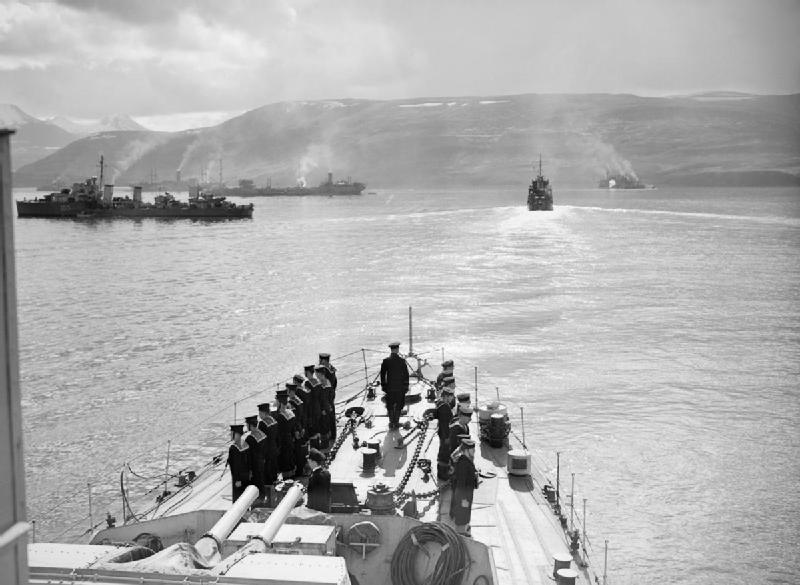
The shadow of the Tirpitz
As PQ17 steamed towards the Barents Sea, British intelligence warned that the German battleship Tirpitz might sortie from its Norwegian fjord base. The mere threat of this leviathan — supported by cruisers and U-boats — was enough to trigger alarm in the Admiralty. On 4 July 1942, First Sea Lord Admiral Dudley Pound made a fateful decision: he ordered the convoy to scatter and the escorts to withdraw.
The order to scatter left the merchant ships defenceless in hostile waters. German aircraft and U-boats pounced. Over the next few days, PQ17 was decimated. Of the thirty-five ships that sailed, only eleven reached Archangel. Twenty-four were sunk, along with thousands of tons of cargo and hundreds of sailors. It was the worst loss in the history of the Arctic convoys.
Survivors recalled scenes of horror: ships ablaze, men clinging to rafts in freezing seas, strafed by enemy aircraft. Rescue was often impossible. Yet amid the carnage, acts of courage shone through — crews who stayed at their guns until the end, and those who risked their lives to save shipmates. For many, the ordeal lasted days as they drifted in icy waters, praying for a miracle.
HMS Ayrshire
Lieutenant Leo Gradwell RNVR commanded HMS Ayrshire (FY 225), a modest anti-submarine trawler pressed into convoy escort duty for PQ17. When the Admiralty ordered the convoy to scatter, Gradwell refused to abandon his charges. Instead, he gathered three merchant ships — Troubadour, Ironclad and Silver Sword — and led them northwards toward the Arctic ice pack, determined to seek safety rather than face destruction.
With no charts at hand, Gradwell navigated by sextant and a pocket geographic guide, eventually finding refuge amid the ice fields. When the convoy became stuck, he orchestrated an ingenious defence: the vessels were all painted white — with linen covering the decks — and their cargo of Sherman tanks formed a defensive perimeter armed for anti-aircraft use. This silent white convoy successfully eluded Luftwaffe aircraft while trapped in the ice.
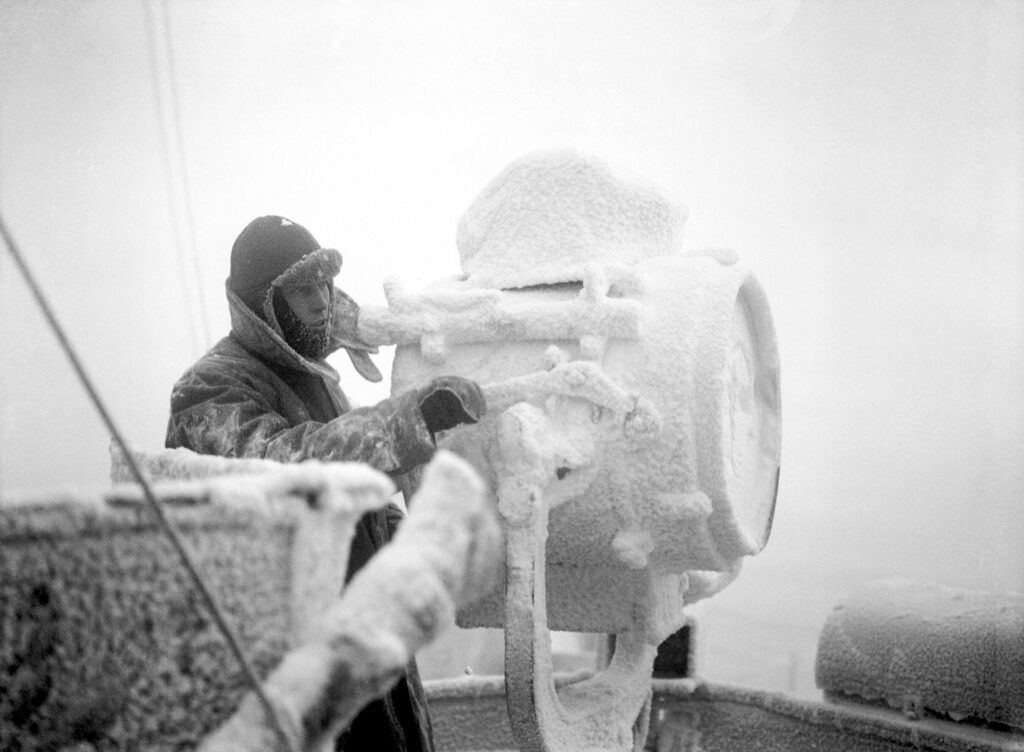
Eventually, the vessels slipped free of the ice and made their way to Matochkin Strait, where they were met by Allied corvettes. Together, they completed the journey to Archangel, arriving on 25 July 1942 — a remarkable feat, given the chaos elsewhere in PQ17. For his outstanding improvisation and leadership under fire, Gradwell was awarded the Distinguished Service Cross later that year.
The PQ17 disaster sparked outrage and soul-searching. Critics condemned the scatter order as premature, arguing that Tirpitz never engaged the convoy. The episode strained Allied relations, with Stalin furious at the losses. Yet the convoys continued, and lessons were learned: future operations featured stronger escorts and better coordination. Despite the risks, the Arctic route remained a vital artery until war’s end.
The Mighty Ocean is available to pre-order now.
Stay up to date with David’s news and latest releases here.
Image credits: Both the image of PQ17 in Hvalfjord and HMS Sheffield are from Wikimedia Commons (public domain).
From twisty mysteries and Roman adventures to exciting tales of historical privateers — there’s something exciting here for everyone. Scroll down to discover this month’s titles from your favourite Sapere authors.
January’s Fiction Releases
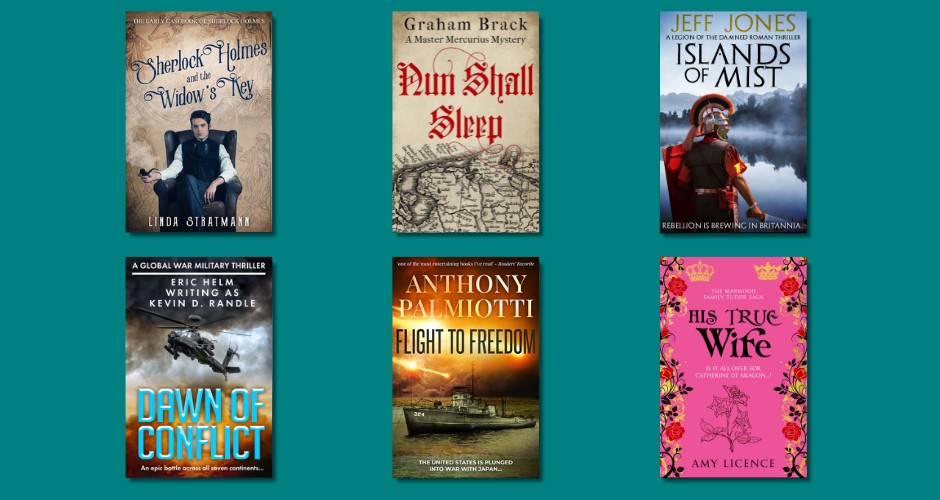
Sherlock Holmes and the Widow’s Key by Linda Stratmann is the tenth book in The Early Casebook of Sherlock Holmes series. In this instalment, Holmes and Stamford investigate the death of a mysterious widow — and make a gruesome discovery in the process.
Nun Shall Sleep by Graham Brack is the ninth book in the Master Mercurius Mystery series: atmospheric crime thrillers set in seventeenth-century Europe. In his latest adventure, Mercurius is drawn into strange — and possibly sinister — happenings at a convent.
Islands of Mist by Jeff Jones is the third book in the Legion of the Damned Roman Thrillers series: action-packed military adventures set in Ancient Rome. For their latest mission, Centurion Marcus Corvo and his men must prevent or crush a suspected rebellion in Britannia.
Dawn of Conflict by Eric Helm is the first book in the Global War Military Thriller Series. In this alternative-history thriller set in the late twentieth century, a series of stunning geopolitical changes destabilizes a dozen major governments around the globe, pitching the armies of each nation into world warfare.
Flight to Freedom by Anthony Palmiotti is a tense World War Two naval adventure. When the Japanese bomb Pearl Harbor, the United States is plunged into war. As one of the few remaining ships in the region, the Tanager is called to evacuate Army nurses and those fleeing from the enemy.
His True Wife by Amy Licence is the fifth book in The Marwood Family Tudor Saga series. In the latest instalment, Catherine of Aragon prepares for the Legatine Court, while lady-in-waiting Thomasin Marwood awaits a marriage proposal from the man she loves.
January’s Fiction Backlist Releases
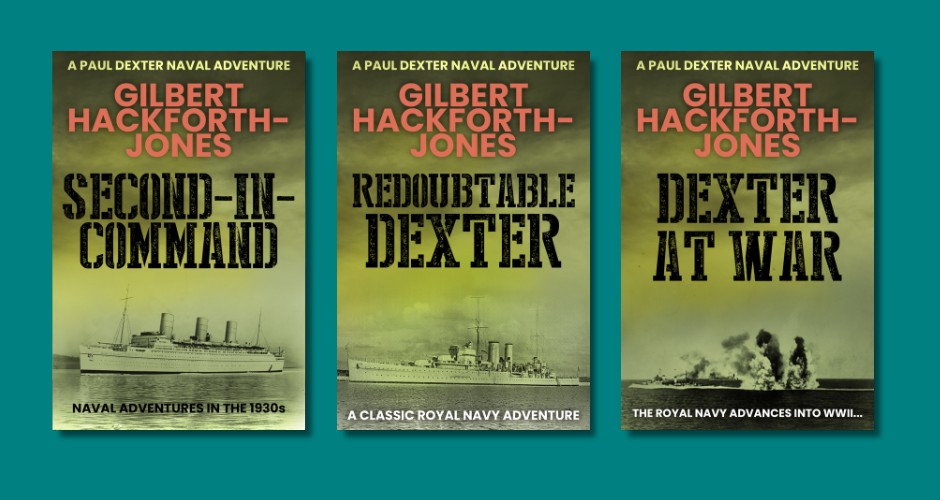
We are pleased to announce that the fifth, sixth and seventh instalments of Gilbert Hackforth-Jones’ gripping Paul Dexter Naval Adventures series are out now! Don’t miss these entertaining and action-packed tales of life at sea.
January’s Non-Fiction Releases
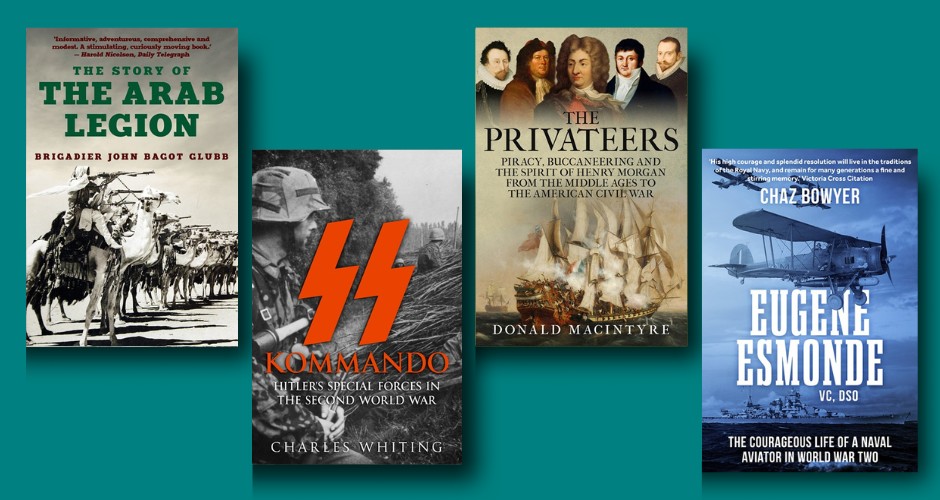
The Story of the Arab Legion by John Bagot Glubb is a fascinating personal account of the development of the Arab Legion as a formidable fighting force from the 1930s to the Second World War.
SS Kommando by Charles Whiting is a compelling read for anyone interested in Kommando operations throughout World War Two — the men involved, their leaders and rivals under the Führer, and the desperate tactics employed in the face of defeat.
The Privateers by Donald Macintyre charts the golden age of privateering — from its Elizabethan origins, through the daring exploits of British and French buccaneers against Spanish treasure ships, to its eventual outlawing and brief revival during the American Civil War.
Eugene Esmonde, V.C., D.S.O. by Chaz Bowyer is a moving biography of a remarkable pilot who received a posthumous Victoria Cross for courageous but fatal actions during World War Two.
Happy Reading! Team Sapere
From medieval adventures and Gothic mysteries to gripping accounts of military heroism — there’s something exciting here for everyone. Scroll down to discover this month’s titles from your favourite Sapere authors.
December’s Fiction Releases
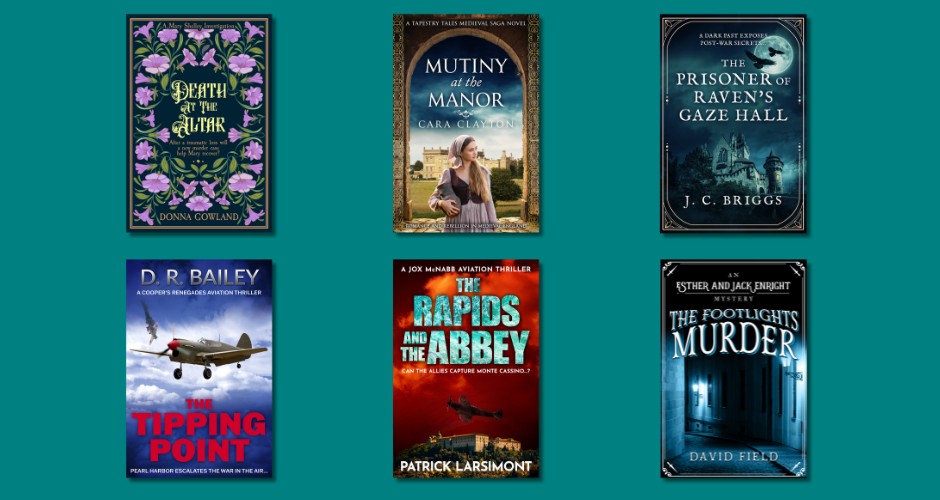
Death at the Altar by Donna Gowland is the third book in the Mary Shelley Investigations. In this instalment, Mary puts her grief aside as she and Percy investigate the murder of a curate at a friend’s wedding.
The Tipping Point by D. R. Bailey is the first book in the Cooper’s Renegades Aviation Thrillers, action-packed aviation adventures set during the Second World War and featuring a team of fighter pilots. When war is declared on Japan by the U.S., American pilot Cooper Donahue soon finds himself in the thick of the action.
Mutiny at the Manor by Cara Clayton is a thrilling tale of romance and rebellion in medieval England. Will this troubled period in history bring ruin to all Elizabeth Amundeville holds dear?
The Rapids and the Abbey by Patrick Larsimont is the sixth book in the Jox McNabb Aviation Thrillers. In this instalment, fighter pilot Jox McNabb takes to the war-torn skies of Italy and the capture of Monte Cassino.
The Prisoner of Raven’s Gaze Hall by J. C. Briggs is a gripping Gothic novel set in Yorkshire. When Catherine Sisley arrives at Raven’s Gaze Hall to nurse an elderly lady, she soon realises that the house — and its occupants — are not all they seem.
The Footlights Murder by David Field is the twelfth crime thriller in the Esther and Jack Enright Mysteries. In this instalment, Jack and Esther take up amateur dramatics in an attempt to track down a murderer and clear Jack’s sister’s name.
December’s Fiction Backlist Releases
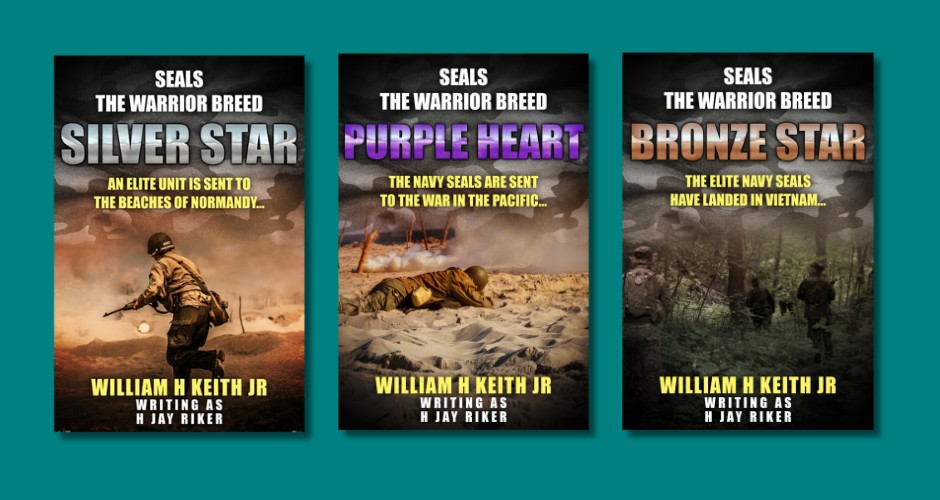
We are delighted to announce that the first three instalments in William H. Keith Jr’s adrenalin-fuelled SEALS: The Warrior Breed series are out now! Don’t miss these action-packed military adventures following the U.S. Navy’s elite commando demolition unit.
December’s Non-Fiction Releases

A Captain’s War by Herbert M. Schiller is the remarkable first-hand account of life as a young Confederate officer during the brutal years of the American Civil War.
Disaster at Kasserine by Charles Whiting is a dramatic account of the Allied disaster at Kasserine Pass, where inexperienced American troops clashed with Rommel’s battle-hardened Afrika Korps in North Africa.
Admiral Rodney by Donald Macintyre is a fascinating biography chronicling the life of one of England’s greatest sea commanders, famed for his decisive victory over the French at the Battle of the Saintes during the American War of Independence.
Men of Bomber Command by Chaz Bowyer tells the epic, untold story of the Allied bomber crews who helped turn the tide of World War Two.
Fighting for Defeat by Michael C. C. Adams provides a new perspective on the American Civil War and the reasons behind the Union Army’s early defeats, despite its superiority in manpower, wealth, and industry.
Happy New Year and Happy Reading! Team Sapere
We are delighted to announce that we have signed two new books in Angela Ranson’s Catrin Surovell Tudor Mystery series: exciting historical thrillers set at the court of Elizabeth I.
Here, Angela tells us more about the series and what to expect from the latest instalments:
“I started working with Sapere Books in March 2022, when I was named as a runner-up in their first writing competition. From the very first, the people at Sapere have brought light and positivity to my writing life. They have offered real help and support, and their editing process has improved my writing enormously. Sapere has helped me understand and appreciate the many stages of writing a book.
“Or, as it has turned out, a series of books. We started out with three Catrin Surovell Tudor mysteries, and then it grew to five, and just last month it grew to seven. I was so excited to receive the latest contracts and know that I could continue to explore the character of Lady Catrin, Countess of Ashbourne and favoured lady of the bedchamber for Queen Elizabeth I. Lady Catrin is a clever and courageous woman in a dangerous world — much as Elizabeth’s real ladies of the bedchamber would have been. It was not all music, gossip, fine clothes and embroidery for these women, despite the way they are portrayed in modern movies. In real life, they had difficult battles to fight.
“Thus far, Lady Catrin has remained close to her queen at court. She has battled many villains who have tried to remove Elizabeth from her throne, or destroy the reforms the queen has put in place. She has fought against religious zealots, royal traitors and court conspirators, all with the help of her close friend Lady Lucy and a collection of people as dedicated to the queen’s service as she is. In the fourth book, Grave Merriment (which will be released in March 2026), Lady Catrin will battle two villains, each with a specific goal but one area of common ground: the desire to destroy all the queen holds dear, at the most festive time of the year.
“It is important to me that Lady Catrin’s adventures could have happened and that Lady Catrin herself could have investigated and unmasked the villains. I try very hard not to change history or give Lady Catrin more power than she would have had. I do, however, often answer historical questions that have never been answered, or create fictional scenarios that take place in parallel with a known event. That is why the fifth book in the series will focus on an event that never took place: a meeting between Elizabeth I and Mary, Queen of Scots. This meeting has been included in many fictional accounts of these two queens. Usually, the wise queen of England grows frustrated with how the reckless and impulsive Queen of Scots always ‘feeds her with fair words’ that mean nothing.
“Instead of following this trend, the fifth Catrin Surovell mystery will follow history more closely, and focus instead on why that meeting didn’t happen. Lady Catrin will be the one who learns the secret that keeps these ‘fair cousins’ apart … just in time to save their lives.”
Grave Merriment is available to pre-order now.
Visit Angela’s website to stay up to date with her news and latest releases.
From Tudor adventures and World War Two thrillers to fascinating accounts of historical battles — there’s something exciting here for everyone. Scroll down to discover this month’s titles from your favourite Sapere authors.
November’s Fiction Releases
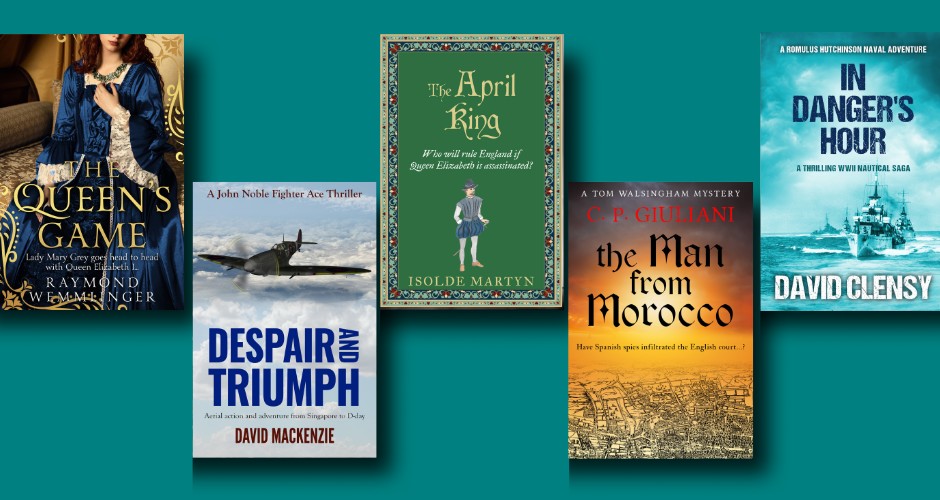
The Queen’s Game by Raymond Wemmlinger is a thrilling novel of succession set at the Tudor Court. Will Lady Mary Grey see her family name rise to victory, or tumble into obscurity…?
Despair and Triumph by David Mackenzie is the third book in the John Noble Fighter Ace Thrillers series. In this instalment, John finds himself sent on a mission halfway around the world.
The April King by Isolde Martyn is a compelling and romantic biographical historical mystery novel set in Tudor Elizabethan England.
The Man from Morocco by C. P. Giuliani is the seventh book in The Tom Walsingham Mysteries series: page-turning espionage adventures set during the Elizabethan era.
In Danger’s Hour by David Clensy is the second book in the Romulus Hutchinson Naval Adventure series: authentic historical adventures following twin brothers fighting with the Royal Navy and the Merchant Navy during the Second World War. With Operation Dynamo around the corner, will the Hutchinson brothers both make it out alive…?
November’s Fiction Backlist Releases

The Starling by Doris Leslie is a compelling historical novel of passion, new beginnings and the nature of true love, set in London and Florence, Italy.
November’s Non-Fiction Releases
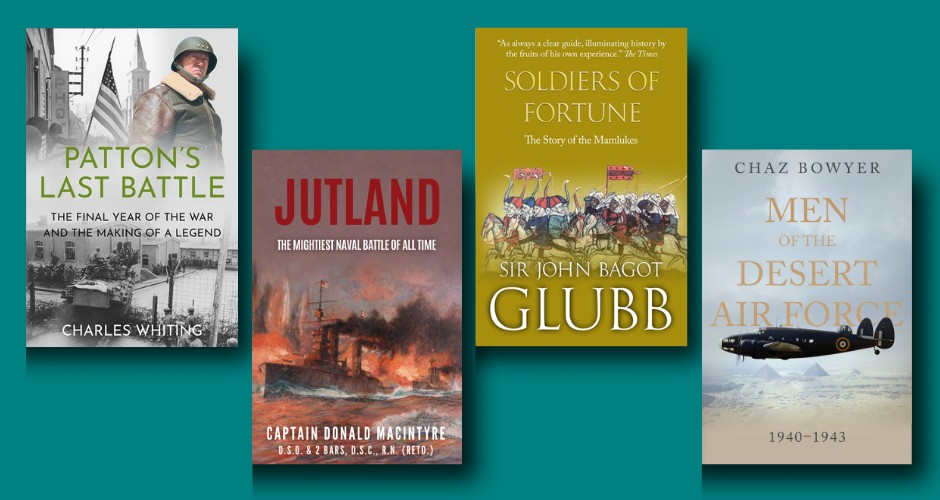
Patton’s Last Battle by Charles Whiting tells the dramatic story of American General George Patton’s final months of command in World War Two.
Jutland by Donald Macintyre uncovers the dramatic, in-depth story of the Battle of Jutland, the most significant naval clash of World War One.
Soldiers of Fortune John Bagot Glubb explores the captivating history of the Mamluk Empire, one of the Middle East’s most powerful forces from 1250 to 1517.
Men of the Desert Air Force by Chaz Bowyer is a gripping, real-life account of the brave pilots who flew over the deserts of North Africa and the Mediterranean during World War Two.
Happy reading! Team Sapere
With the forthcoming publication of In Danger’s Hour, the second book in his Romulus Hutchinson Naval Adventure Series, author David Clensy takes a closer look at the events surrounding Operation Excess during the Second World War.
In January 1941, the Mediterranean was a tense theatre of war. The British Royal Navy, stretched thin and under constant threat from Axis forces, launched a bold and complex operation known as Operation Excess. It was a high-stakes convoy mission designed to deliver vital supplies to Malta, Greece and Alexandria, while simultaneously striking a blow against enemy naval and air power in the region.
The convoy itself was a patchwork of merchant vessels and warships, departing from Gibraltar and heading eastward through waters teeming with danger. Malta, then under siege and of immense strategic importance, was a key destination. Supplies were desperately needed to sustain its defences and civilian population. The convoy was escorted by a formidable force of Royal Navy ships, including aircraft carriers, cruisers and destroyers, all tasked with protecting the vulnerable merchantmen from attack.
Operation Excess was a particularly challenging task for the Allied forces. Italian and German aircraft launched repeated assaults, particularly as the ships neared Sicily. The Royal Navy’s carrier-based aircraft, including Fairey Fulmars and Swordfish, fought valiantly to repel the attacks, often flying in difficult conditions and against superior numbers.
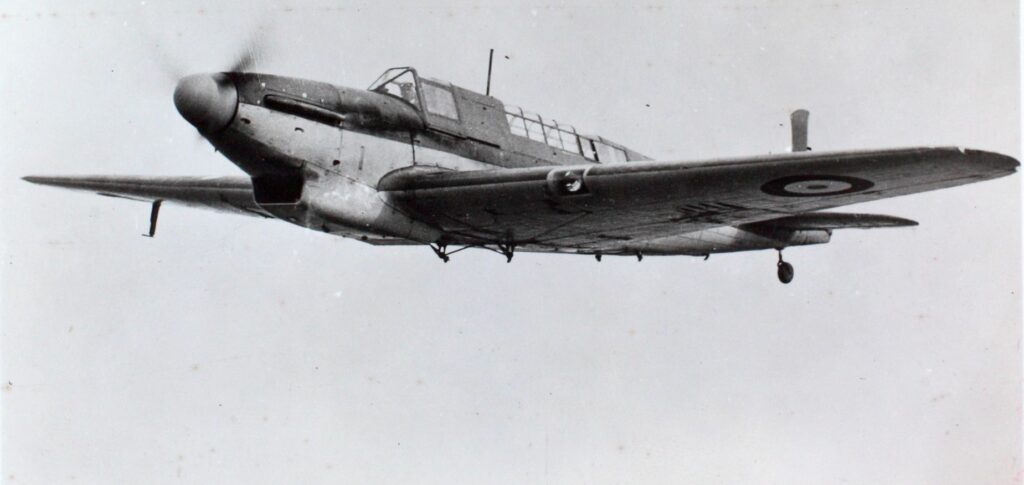
One of the most dramatic episodes of the operation occurred on the 10th of January, when HMS Illustrious, a key British aircraft carrier, came under ferocious air attack near Malta. The damage was severe, and casualties were high. Yet the carrier remained afloat and was eventually able to limp into Grand Harbour, where she became a symbol of resilience for the Maltese people.
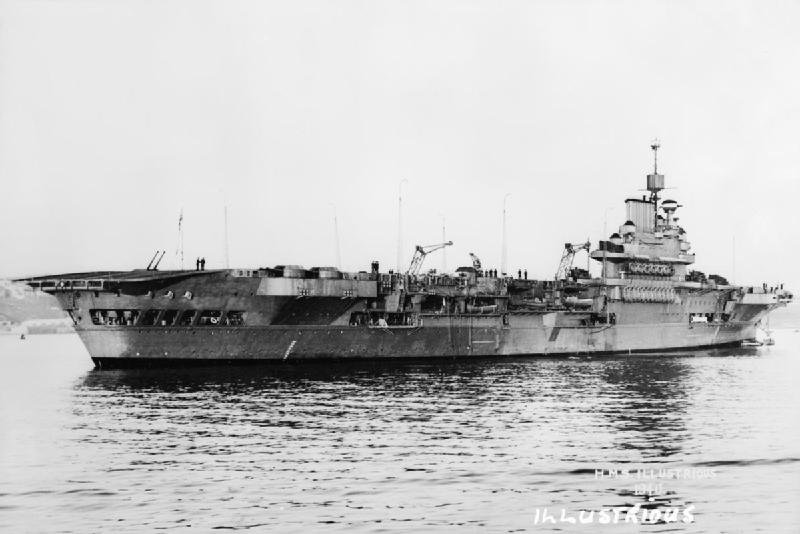
Meanwhile, other elements of the operation were unfolding. British forces used the opportunity to launch diversionary attacks against Italian positions in the Dodecanese and to reinforce troops in Greece.
As part of Force B, HMS Southampton’s role was to transport troops from the Aegean to Malta before joining the main convoy. On the 11th of January, while operating south of Sicily, HMS Southampton came under sustained attack from German dive bombers of the Luftwaffe’s X Fliegerkorps. The Stukas struck with deadly precision, scoring multiple hits that ignited fires and caused catastrophic damage. With the cruiser listing and engulfed in flames, the order was given to abandon ship. HMS Southampton was eventually scuttled by torpedoes from HMS Gloucester to prevent her from falling into enemy hands.
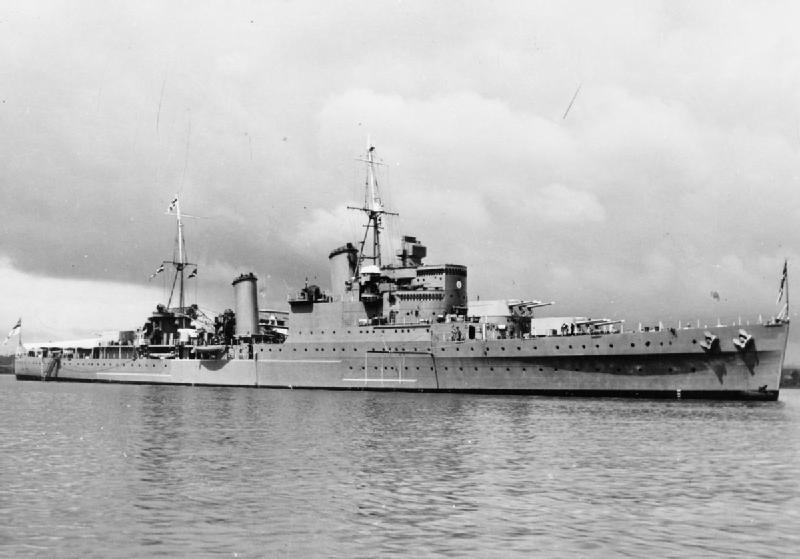
Though the operation came at a cost, it was ultimately deemed a success. Supplies reached their destinations, and the Royal Navy showed it could still operate effectively in contested waters. Operation Excess was more than a supply run. It was a statement of intent, a show of defiance against Axis control of the Mediterranean.
November 2025 sees the release of In Danger’s Hour, the second book in the Romulus Hutchinson Naval Adventure Series. Following their earlier adventures in For Those In Peril, we follow twin brothers Romulus and Remus throughout 1941, from the Mediterranean to the coast of West Africa. It covers a series of key strategic operations, including Operation Demon — the British-led evacuation of Allied forces from mainland Greece in April 1941. At the opening, readers will join our central character, Rom, as he faces an enemy attack while serving on HMS Southampton at the height of Operation Excess.
In Danger’s Hour will be published on the 28th November 2025.
Stay up to date with David’s news and latest releases here.
From Medieval Europe and Georgian England to naval warfare and military autobiographies — there’s something exciting here for everyone. Scroll down to discover this month’s titles from your favourite Sapere authors.
October’s Fiction Releases
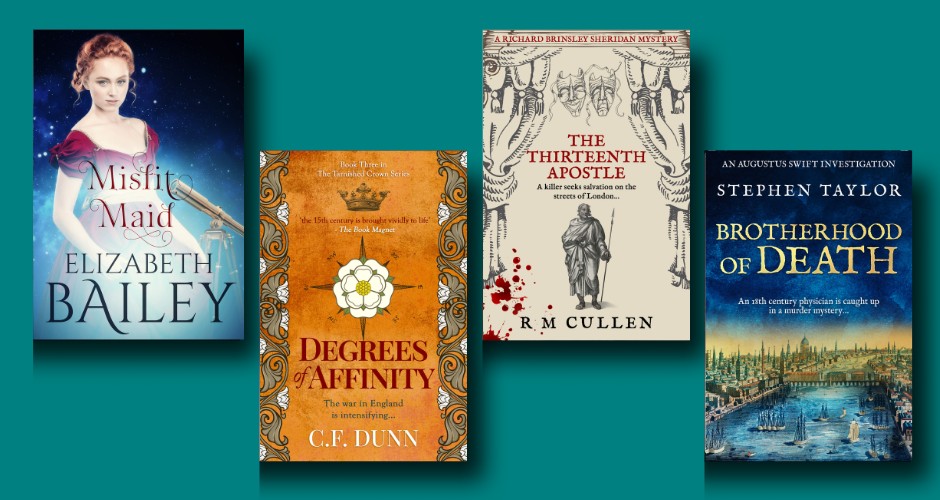
The Misfit Maid by Elizabeth Bailey is a lively, humorous historical romance set in Georgian England with an engaging and unconventional heroine.
Degrees of Affinity by C. F. Dunn is the third book in The Tarnished Crown series: historical fiction set during the Wars of the Roses. Isobel Fenton has overcome her enemies and regained her manor of Beaumancote. Now she looks forward to a future with the man she loves. But when she is unwittingly drawn into the political intrigue at Court, Isobel’s life is once more thrown into turmoil.
The Thirteenth Apostle by R. M. Cullen is the third historical murder investigation in the Richard Brinsley Sheridan Mystery Series: eighteenth-century crime thrillers set in London at a time of Revolution. Can Sheridan unmask a ruthless killer stalking the streets of London?
Brotherhood of Death by Stephen Taylor is the first historical murder investigation in the Augustus Swift Investigations Series, a new detective series set in Georgian England. When a series of cabinet members are poisoned, physician Augustus Swift must employ science and logic to prevent more deaths.
October’s Fiction Backlist Release

We are delighted to announce that the first book in the Robert Porter Alternative History Thrillers is out now! Ultimatum by Richard Rohmer is a heart-pounding political thriller that hits close to home. The fate of millions hangs in the balance when a crisis right out of today’s headlines sets the President of the USA on a course from which there can be no retreat.
October’s Non-Fiction Releases
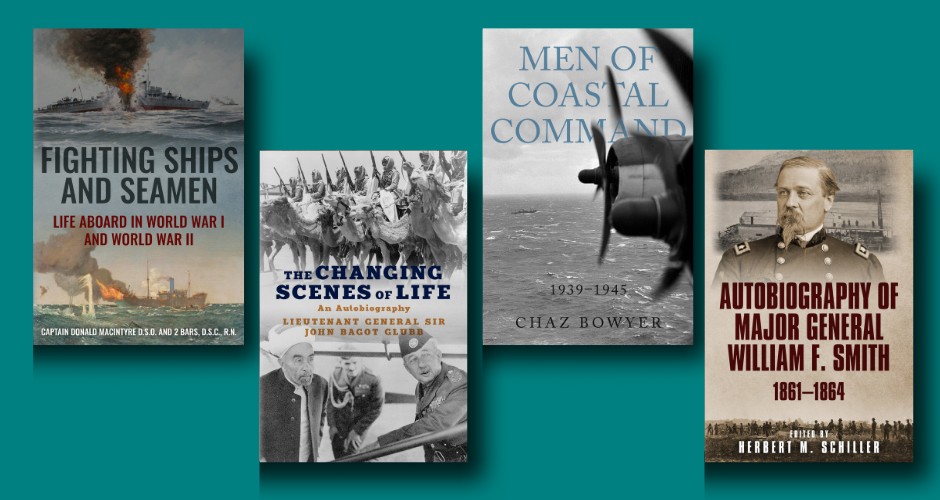
Fighting Ships and Seamen: Life Aboard in World War I and World War II by Donald Macintyre charts the experiences of sailors and their ships during naval engagements and is an essential account of naval warfare across the two world wars.
The Changing Scenes of Life: An Autobiography is a gripping account of the life and legacy of Sir John Bagot Glubb — soldier, scholar, and legendary commander of the Arab Legion.
Men of Coastal Command: 1939-1945 by Chaz Bowyer is an eye-opening account of a much-overlooked branch of the Royal Air Force, who protected Britain’s seas from the air during the Second World War.
Autobiography of Major General William F. Smith: 1861-1864 by Herbert M. Schiller is a candid autobiography of one of the Union’s most controversial generals — praised as a saviour, condemned as a scapegoat.
Happy reading! Team Sapere
Clare Hawkins was born and brought up in Scotland and now lives in Essex. She is the author of the forthcoming Gothic House Mystery series for Sapere Books.
My earlier life in Scotland is now distanced by more decades than I like to admit, but the country and its history, landscapes and languages have had a powerful influence on my writing. (The books in my forthcoming Gothic House Mystery series all have Scottish settings.) Personal recollections sometimes surface with surprising vividness too. For example, my grandchildren’s excitement at the prospect of trick-or-treating reawakens memories of how we as children celebrated Hallowe’en in the 1950s in the west of Scotland.
The practice of ‘guising’, or dressing as something other than oneself, has existed in Scotland for hundreds of years. It may even be related to the pagan tradition of ‘Samhuinn’, Summer’s End, the transition from summer to winter, when grotesque spirits of the dead roam abroad, intent on mischief. The best protection is to disguise oneself as one of them.
So we children became a fearsome collection of little witches and ghouls in our homemade cardboard masks, witches’ cloaks and hats made of old blackout curtains, with props such as inky pipe-cleaner spiders and lurid papier mâché severed fingers. We visited our neighbours’ houses, armed with torches and high expectations of receiving sweet treats. However, these gifts were not entirely free; some sort of entertainment had to be provided by us, the guisers, in return. Our sheepish, tuneless renditions of such ditties as ‘Donald where’s yer troosers?’ or ‘Ye cannae shove yer granny aff a bus’ were greeted with sympathetic applause and a handful of sweets from the adults, who no doubt had to suppress their laughter after a few drams as their own celebration of Hallowe’en.
Visit Clare’s website to stay up to date with her news and latest releases.
Featured image credit: Photo by Szabó János on Unsplash.
Following the success of his standalone historical novels, Stephen Taylor is now writing the Augustus Swift Investigations: a new detective series set in Georgian England.
The first instalment — Brotherhood of Death — will be released at the end of October, and we are thrilled to have signed the third book in the series.
In Stephen’s words:
“My new series is set in the 1790s, thirty years before the first Metropolitan Police force and fifty years before the first Criminal Investigation Department was founded. The detective I have created is Augustus Swift: a physician and apothecary who has studied modern medicine and logic at Edinburgh University. But he has also travelled to Egypt to study Islamic philosophy and doctoring. He is a humanist who looks to science to explain the world rather than religious beliefs.
“It is the age of the Enlightenment, yet political control is still firmly in the hands of the aristocratic landowners, as it has been for centuries. Dr Swift, however, is a man of the Enlightenment.
“Yet fate raises a capricious eyebrow in his direction when he is recruited by the Home Department to advise on poisons. His life is dedicated to upholding the physician’s ethical principles, but now, by working for the government, his actions perpetuate the injustices of those in power.”
Keep up with Stephen’s latest news via his website.
Following the success of his Quintus Roman Thrillers series, we are thrilled to announce that we have signed a new trilogy by Neil Denby.
In Neil’s words:
“The Leinster Chronicles are set in twelfth-century Ireland, a time and place little covered by contemporary historical novels, but one rich in story.
“Geographically, there are three major groups involved in the timeline — the native Irish, the invading Vikings and the Normans across the water.
“The Irish were bound by ancient law. Brehon law was a detailed system with compensation for criminal acts called éraic at its heart. It was not Roman law, but a system better suited to its times. Included was the rule that kings did not inherit their titles. The chieftain was elected — from an eligible pool of royal blood — by his family or clan.
“They were also Christian. St Patrick is credited with bringing Christianity to Ireland in the fifth century, but there was tension between Christian law and Brehon law. The Church in Rome saw the Irish Church as rebellious and depraved, in dire need of reform. The Roman Church was happy to grant overlordship of Ireland to the ‘good’ Christian Norman lords of England and France.
“The Vikings had been raiding and trading for hundreds of years. There were many holy houses for them to plunder, carrying precious relics, silver and slaves back to their homelands. Eventually they settled. There were established Viking trading ports, the chief amongst them being Dublin, probably the biggest slave-trading port in the northern hemisphere. Further south sat Wexford, Waterford and Cork. Other centres were at Wicklow and Arklow (which yielded silver). On the Shannon river, navigable to longships, sat Limerick.
“At this time Ireland had over a hundred kings, many little more than local chieftains. The senior kings ruled the seven kingdoms of Leinster, Munster, Connaught, Meath, Ailech, Airghilia and Ulaid. (The last three later became known as Ulster.)
“From these was drawn the ‘Ard Rí’, the High King of Ireland, traditionally — for at least five hundred years — one of the northern branch of the Uí Neill, whose high seat was in Tara. Though the title sounds impressive, in actuality it bestowed little unless the holder could keep it, usually by invading enemy territory and demanding hostages.
“Many battles were fought between greater kings and lesser kings. The tradition was to let a battle decide an argument; the losing side would then give up hostages against their good behaviour. The warriors would head home.
“These books will tell the tale of one of these kings — one who was castigated and damned in terrible terms by the Victorians for inviting the Normans into Ireland. But the story is more complex than that, the reasons more nuanced; perhaps the central character is not as evil as is made out.
“It is a tale I have wanted to tell for some time and I am grateful to Sapere Books for giving me the opportunity to share it.”
IN THE QUINTUS ROMAN THRILLERS SERIES:
BOOK ONE: Legionary
BOOK TWO: Decanus
BOOK THREE: Optio
BOOK FOUR: Centurion
BOOK FIVE: Scutarius
As a historical novelist, I’d say that what resides in the details is a sense of place and time. Whether found by accurate research, by educated guesswork or by extrapolation, details endow fiction with a near-tangible quality that lets both the writer and the reader experience a measure of truth behind it. We ‘hear’ a long dead spy’s voice in the clipped sentences and spelling quirks of his reports, or we find a mindset in a statesman’s liking for trees and Italy.
Details are also highly addictive.
I usually begin by wanting to know something innocent — say, what fine Moroccan jewellery would have looked like five and a half centuries ago. And at four in the morning, I’m still browsing the web, and writing to friends whose spouses work in museums, or to complete strangers who happen to be historians. In the end, the (broken) Moroccan necklace will make one brief appearance — but it will look like an actual sixteenth-century one.
Once, a few books ago, I spent a happy hour in an antiquary’s shop in Venice, peppering the owner with questions about just what kind of blade a certain kind of Venetian citizen would have bought and worn, so that, in The Road to Murder, Paolo Citolini’s Venetian dagger was not just an element of the plot, but also something that his grandfather could have bought, and his father brought with him in his English exile as a piece of home.
And then there was the session of theatre rehearsals I hijacked into a demonstration of the different styles in Renaissance fencing, to see just what my protagonist, Tom Walsingham, would learn from an Italian swordsmaster. Or the museum curator who asked his mayor for leave in orderpermission to scan old cadastral maps for me. Or the kind librarian at the diocese of Paris’ archives whom I sent on a quest for the name of the bishop’s coadjutor in 1587. Most diocesan records were lost during the Revolution, and the name I wanted couldn’t be found — and yet I became fascinated with the idea of this nameless coadjutor: can he truly be only clinging to the cliff of history by a brief mention in an English diplomatic report? Someday this will be a story, too.
And what would the inn have been called in this village? And where would the great stairs have been in that long-destroyed manor house? Details — often quite small — to be happily hunted down rabbit-holes. They don’t even all necessarily end up on the page: what goes there thickens the atmosphere; what doesn’t still serves to add depth and texture and colour to the story.
Visit C. P. Giuliani’s website to stay up to date with her news and latest releases.
Welcome to Sapere Books’ September round-up of new releases!
From Ancient Rome and Victorian London to an American Civil War siege and air gunners of World War Two — there’s something exciting here for everyone. Scroll down to discover this month’s titles from your favourite Sapere authors.
September’s Fiction Releases

The Ladies’ Lounge by Graham Brack is the eighth international crime thriller in the Josef Slonský Investigations series: atmospheric police procedurals full of dark humour. In the latest instalment, Captain Slonský investigates the suspicious death of a cabaret club manager.
Targets of Opportunity by D. R. Bailey is the seventh book in the Spitfire Mavericks Thrillers: action-packed aviation adventures set during the Second World War and featuring a team of vigilante pilots. Flight Lieutenant Angus Mackennelly and his squadron have been given a new mission, but with a thief in their midst will mistrust interfere with operations in the skies…?
Forests of Death by Jeff Jones is the second book in the Legion of the Damned Roman Thrillers series: action-packed, authentic historical military adventures set in Ancient Rome. Can Centurion Marcus Corvo and his Legion of the Damned survive the harsh forests of Germania?
The Belvedere Scandal by David Field is the eleventh crime thriller in an exciting historical series, the Esther and Jack Enright Mysteries, a traditional British detective series set in Victorian London and packed full of suspense. When the heir apparent is suspected of murder, the Enrights must prevent a scandal and secure the throne.
September’s Fiction Backlist Releases
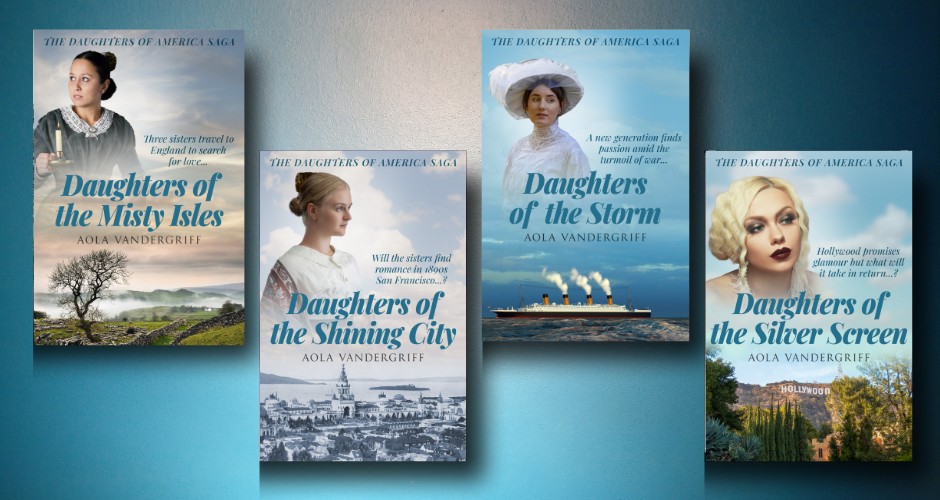
We are delighted to announce that four new instalments of Aola Vandergriff’s gripping Daughters of America saga are out now! The series follows the tumultuous story of three sisters in 1800s America.
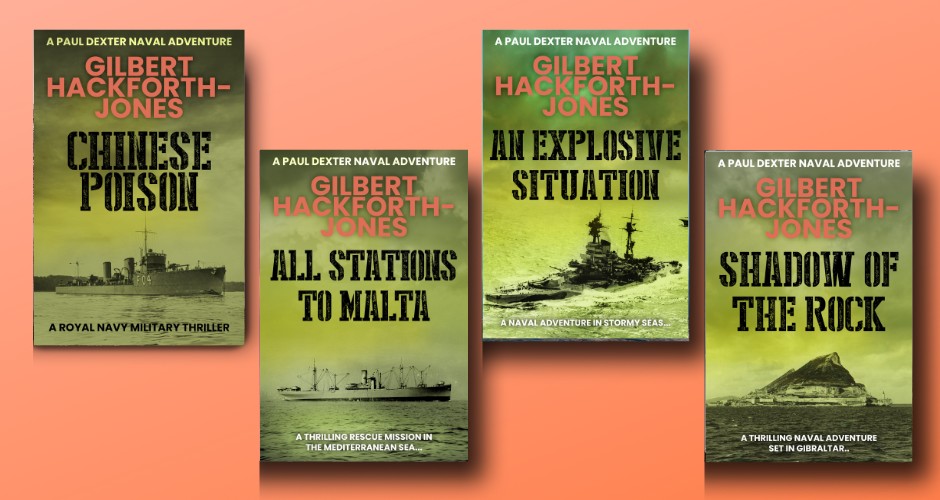
We are also thrilled to bring you the first four books in the Paul Dexter Naval Adventures by Gilbert Hackforth-Jones: action-packed historical naval adventures featuring young naval officer Paul Dexter.
September’s Non-Fiction Releases
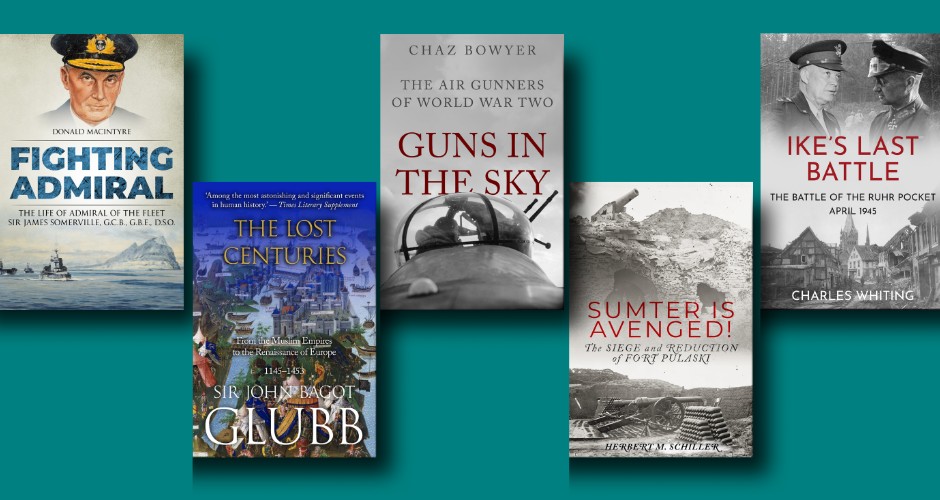
Fighting Admiral: The Life of Admiral of the Fleet Sir James Somerville by Donald Macintyre is a remarkable biography of an extraordinary man. It is essential reading for anyone interested in the naval history of the Second World War.
The Lost Centuries by John Bagot Glubb is an engaging and detailed history of the Islamic world from the twelfth to the fifteenth century, tracing events from the Crusades to the fall of Constantinople.
Guns In The Sky by Chaz Bowyer pays tribute to the air gunners of Word War Two, vividly recreating their harrowing experiences while offering an in-depth exploration of the origins, evolution, and tactics of air gunnery.
Sumter Is Avenged by Herbert M. Schiller tells the dramatic story of the siege of Fort Pulaski during the American Civil War and how it changed the shape of warfare forever.
Ike’s Last Battle by Charles Whiting is a fascinating history of the Battle of the Ruhr Pocket — a crucial engagement that destroyed the last major German force in Western Europe.
Happy reading! Team Sapere
Following the success of her Medieval Ladies Series, we are delighted to have signed a new Thomas Middleton series by Coirle Mooney.
In Coirle’s words:
“While studying for my PhD, I became intrigued by Thomas Middleton. Who was this lesser known, younger, more dashing contemporary of Shakespeare who preferred to be called ‘Plain Tom’?
“In the first book of my new series, schoolboy Tom dreams of becoming a great poet like Kit Marlowe or William Shakespeare and draws inspiration from the daily crime pamphlets sold around St Paul’s Cathedral, as well as the preachers’ passionate sermons on vice and evil-doers. His essay wins the grand prize of a season ticket to the Lord Chamberlain’s Men, but his plan (and childhood) is derailed when his charismatic stepfather attempts to poison his beloved mother, forcing him to give up the precious prize to help pay for the lawsuit that ensues. Alongside his poetic aspiration, Tom develops a lifelong distrust of appearances and an obsession with rooting out poisoners.
“The series follows Tom down the dark alleyways of Southwarke’s lawless baiting dens, taverns, brothels, the Rose and the (newly built) rival Globe theatre, where he meets like-minded playwrights and actors who move easily between all social ranks in late Elizabethan and early Jacobean London. Tom and his fellow artisan dissidents are well placed to root out corruption in the shape of poisoners, like his stepfather, who destroy innocent lives in the pursuit of wealth, status and power.
“All three books reimagine poisonings of the time, with Tom’s character central to discovering the murderers. Book three culminates in the Overbury murder scandal, where members of the Jacobean court and their citizen accomplices were famously put on trial for the poisoning of Sir Thomas Overbury.
“I am thrilled to be working with the marvellous team at Sapere once more and grateful to have a platform worthy of plain Tom!”
Following the success of his many historical series, including the Bailiff Mountsorrel Tudor Mysteries and Esther and Jack Enright Mystery Series, we are delighted to announce that we have signed a new Wars of the Roses series by David Field.
In David’s words:
“For much of the late Medieval period, England was a permanent battlefield, as the rival descendants of the fertile Edward III claimed the right to the crown. Brother fought with brother, cousin sought to depose cousin, heirs to the throne were murdered, and the leading barons of the realm threw in their lot with one side or the other — frequently changing sides in the process.
“It’s a complex network of fast-moving events even for a historian, but for a novelist it’s a daunting challenge. However, it’s one I couldn’t resist, having already taken the story of England’s history forward from the Norman Conquest to the death of Simon de Montfort in my Conquest series for Sapere Books. I’d also picked up the story again in the Tudor series, beginning with the Battle of Bosworth and the accession of Henry VII. This new Wars of the Roses series will fill the gap between these two series.
“Join me as Edward I seeks to put down challenges from the Welsh and the Scots, Edward II squanders his birthright on favourites, and Edward III enjoys a lengthy reign that produces five sons and lights the fuse on the domestic strife to follow with his ill-advised ‘letters patent’ as to who was to succeed him, and in what order. When Richard II was deposed by Henry Bolingbroke in order to become Henry IV, his son, Henry V, brought the nation military triumph across the Channel, only to die tragically young, leaving an inadequate successor to rule as Henry VI. The spurned House of York saw its opportunity, and the ‘Kingmaker’ Earl of Warwick raised Edward IV to the ultimate position of power. But his wily and jealous younger brother Richard of Gloucester wove a treacherous web that left him as the spider in the centre, until the nation threw off his yoke and welcomed back Henry Tudor, the last Lancaster, as Henry VII.
“Behind the scenes, the ultimate fictitious descendants of the man who first rallied the Saxons against the invading Duke William of Normandy seek to survive with honour amid all the mayhem.
“The new series begins in early 2026, and I look forward to sharing it with you.”
Visit David’s website to stay up to date with his news and latest releases.
We are delighted to announce that we have signed the eleventh book in the Charles Holborne Legal Thrillers series: gritty, hard-boiled mysteries featuring maverick barrister Charles Holborne.
In Simon’s words:
“As regular readers of the Charles Holborne Legal Thrillers will be aware, every book has been set in a different year, tracking the corrupt Metropolitan Police force and the gangs like the Krays’ ‘Firm’ through the 1960s. I’m afraid I’ve never had much patience with writers whose formulaic books never allow their characters to grow up (or old). There’s one particular tough guy (you may remember him being portrayed on film by a certain very famous diminutive actor) who, thirty books in, should now be approaching the ripe old age of sixty-six. Yet, chained to a steel table with a broken wrist, he is still capable of choking a big guard into unconsciousness.
“I prefer realism. If the Charles Holborne books are based on real cases, real political events and real people, my hero barrister should also be real: he must get older and, one hopes, wiser. In The Brief, set in 1960, he was thirty-five years of age. By the time we get to book 11, he’s a decade older. And what did most good looking, easy-going, solvent professional men do in 1970? They got married, maybe started a family and … went on holiday.
“The playful title I had in my head as I wrote the book was ‘Charlie Holborne Goes to France’. Sapere Books have been wonderful publishers (evidence: this will be my eleventh book with them) but even I knew their patience might be stretched by such a title. Wrong vibe altogether. In any case, this holiday turns nasty. Charles and Sally find themselves embroiled in a vendetta in the heart of stunning rural Gascony, a vendetta with its roots in the war between those who resisted and those who collaborated with Vichy. Their Gascon idyll turns dark, putting their lives and that of their daughter at risk. And, because no Charles Holborne novel can omit a courtroom drama, Charles finds himself on a busman’s holiday, fighting the good fight as always.
“I have enjoyed writing this book because it is set in a beautiful part of the world that I know and love well. In addition to action, mystery and courtroom drama, there’s magnificent countryside and wonderful food to go with the true historical facts. I can’t wait for you to read it.”
Visit Simon’s website to stay up to date with his news, events and latest releases.
We are delighted to announce that we have signed a Viking trilogy and Medieval Templar series by Michael Burr.
In Michael’s words:
“I’m thrilled about joining the Sapere family of authors, because not only is that how the company has been represented to me, but it’s also the impression created by my first contact with Amy, Caoimhe and Natalie. I care a great deal about historical fiction and I believe that readers of that genre really tend to know their stuff, so Sapere’s reputation for excellence in matters editorial, cover design and marketing certainly lives up to that standard.
“As someone who made a career out of teaching History, I’m fussy about the twin imperatives of telling interesting stories and telling them properly. Central to this is keeping real people and their motivations as the focus, because those tend not to change, whatever else does. In fact, that’s the central premise of my trilogy, Chronicles of the Scraeling, in which a disabled teenager is snatched as a trophy from a French convent devastated by a band of marauding Vikings. His initial and derisory nickname of ‘scraeling’ becomes a badge of acknowledgement and respect among his gung-ho pagan companions through his ability to manipulate and outmanoeuvre acquaintances, enemies, and the occasional friend using an outrageous mixture of intelligence, cheek, bluff and superb man-management.
“His story rollicks in three volumes through most of the eleventh century and any number of unscrupulous kings, scheming empresses and demented eunuchs. The books encompass genuine history, graphic violence, outright comedy and even bits of down-home ordinariness.
“Similarly, I was prompted to write my Medieval Templar series by my fascination with the legendary appearance of a phalanx of Templar knights on the battlefield of Bannockburn. Where did these elite and terrible warriors of the medieval period come from? Why were they there, especially since they were supposedly dispersed, proscribed and persecuted years before? And what happened to the fabled and fabulous treasure of an Order that produced history’s first capitalists?
“So many questions, and my story of the life of the first, secret Master of the Temple after it was driven underground, is sort of an answer to them.”
Visit Michael’s website to stay up to date with his news and latest releases.
We are delighted to announce that we have signed the thirty-first book in the Vietnam: Ground Zero series: action-packed, authentic historical thrillers set during the Vietnam War.
When an enemy force attacks Camp A-398, Sergeant Major Anthony B. Fetterman joins a striker force to chase the enemy back into Cambodia. When the strikers run into the enemy rear guard, they are forced to give up their pursuit.
A reporter at Camp A-398 believes that the strikers, as well as Fetterman, had illegally crossed the border into Cambodia, creating an international incident. When the allegation reaches the highest levels of the United States Army, Fetterman is arrested and court-martialed for crossing the border. It makes no difference that Fetterman was not in command of the strikers, and that they said they were never in Cambodia.
The case has to be settled, not by getting at the truth but by reaching the approved solution. If an old soldier like Fetterman needs to be sacrificed, then that is a small price to pay.
In the Vietnam: Ground Zero series:
BOOK 1: Vietnam: Ground Zero
BOOK 2: P.O.W.
BOOK 3: Unconfirmed Kill
BOOK 4: The Fall of Camp A-555
BOOK 5: Soldier’s Medal
BOOK 6: The Kit Carson Scout
BOOK 7: The Hobo Woods
BOOK 8: Guidelines
BOOK 9: The Ville
BOOK 10: Incident at Plei Soi
BOOK 11: Tet
BOOK 12: The Iron Triangle
BOOK 13: Red Dust
BOOK 14: Hamlet
BOOK 15: Moon Cusser
BOOK 16: Dragon’s Jaw
BOOK 17: Cambodian Sanctuary
BOOK 18: Payback
BOOK 19: MACV
BOOK 20: Tan Son Nhut
BOOK 21: Puppet Soldiers
BOOK 22: Gunfighter
BOOK 23: Warrior
BOOK 24: Target
BOOK 25: Warlord
BOOK 26: Spike
BOOK 27: Recon
BOOK 28: Pioneer Post
BOOK 29: Proxy War
BOOK 30: Bromhead’s War
Congratulations to Linda Stratmann, whose absorbing Victorian mystery, Sherlock Holmes and the Power Principle, is out now!
Sherlock Holmes and the Power Principle is the ninth book in the Early Casebook of Sherlock Holmes series.
1878
Sherlock Holmes and his good friend Mr Stamford are close to completing their education at London’s St Bartholomew’s Medical College, and Holmes is keen to begin a serious career as a detective.
So when a solicitor contacts him about a new case, he quickly accepts.
Mr Ineson is concerned for his client, the widow Mrs Beauregard, who is considering investing most of her considerable assets in a new company called Baumann Motors Ltd.
In an age of industry, machines are rapidly transforming the Victorian world, and fortunes can be made – or lost – by speculating on the latest enterprise.
The Baumann motor promises to change the world transport, make manufactured goods cheaper and allow trains to run without the need for coal.
But it has not been tested, and Ineson is worried that Mrs Beauregard has fallen for the charm of its inventor.
Holmes and Stamford attend a demonstration under the pretence of being interested in investing to try and discover if the motor is as miraculous as it sounds. But soon they are involved in an even deadlier mystery…
With Holmes’ reputation as a highly intelligent and intuitive detective at stake, can he discover the truth about the highly secretive company? Or will this case prove too challenging for even the most astute of men?
Congratulations to Natalie Kleinman, whose second-chance love story, After All These Years, is out out now!

When Guy Ffoulkes walks into Honeysuckle ‘Honey’ Bunting’s tea shop in the little town of Rills Ford, she’s transported back in a flash to her teenage years – and to the pain of first love.
As a young girl she worshipped Guy from afar – but to him, she knows, she was simply his best friend’s scruffy younger sister.
Over the years Honey has poured her energy into her business and caring for her elderly mother, telling herself it’s enough for her. But no man has ever replaced Guy in her heart…
Now, fourteen years on, Guy has returned from Australia, a rich and successful architect, but a lonely man. And when he and Honey reconnect, neither can deny the spark between them.
But Honey’s loyalties are tested to the extreme when Guy reveals the reason for his return…
Does Honey know her old flame as well as she thinks? Will Guy let pride and ambition drive away the only woman he has ever loved?
And as the pair find themselves at the heart of a local scandal, can they find the strength to take a chance on love?
Congratulations to Eric Helm, whose action-packed Vietnam War adventure, Bromhead’s War, is published today!
Bromhead’s War is the thirtieth book in the Vietnam: Ground Zero series: action-packed, authentic historical thrillers set during the Vietnam War.
Republic of Vietnam, 1969
An Army general, on a recon mission near the Vietnamese/Cambodian border disappears when his aircraft is engaged by anti-aircraft fire.
A search using Air Force and Army assets is hastily set in motion because the general has information about planned critical missions.
Men are deployed from a Special Forces camp commanded by Captain Jonathan Bromhead, and he enlists the help of Major Mack Gerber and Sergeant Major Anthony Fetterman.
But Gerber and Fetterman have been given their own secret mission: to gather intelligence about the build-up of North Vietnamese Army forces just over the border in Cambodia.
And when those forces encroach on the camp, the situation suddenly becomes deadly…
Can they recover the Army general? Will the US missions remain confidential?
Or will enemy forces take over the Special Forces camp…?
Congratulations to
England, 1605
Anne of Denmark, Queen of England, gives birth to her daughter Mary, her first child since coming to England in 1603 when her husband James succeeded to the English throne.
Although they would have preferred a son, both parents are pleased the child is healthy, and their courtiers are thrilled with the birth of the first royal child on English soil in nearly seventy years.
The Scottish family has been welcomed by the English and the reign has started out well, despite continuing tension between the Catholics and the Protestants.
Although Anne has enjoyed the opportunities in England for promoting her artistic interests, she feels inferior to James, and finds satisfaction in rearing her four children, in particular her eldest son Henry.
Anne is determined to bring about an engagement for him with the Spanish infanta. But with anti-Catholic sentiment on the rise, it is not necessarily the wisest match.
Anne becomes pregnant again, but almost immediately afterward the news is clouded by the discovery of the Gunpowder Plot, aimed at the near total destruction of the royal family.
The troubling psychological impact on James is enormous, and Anne worries for the stability of their family.
Can she secure a suitable match for Henry? Will her children survive to adulthood?
Or could the Stuart reign already be doomed to fail…?
Congratulations to David Clensy, whose thrilling war-time naval thriller, For Those In Peril, is published today!
For Those In Peril is the first book in the Romulus Hutchinson Naval Adventure series.
Liverpool, 1939
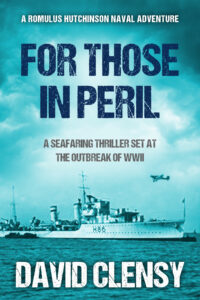
Twin brothers Romulus and Remus Hutchinson grew up in a proud seafaring Liverpool family. So when war breaks out in Europe, they are both keen to sign up and do their part.
With their parents’ consent, both boys join up on their 16th birthday in October 1939 – Romulus as an RNVR sub-lieutenant on a Royal Navy destroyer and his brother as a deck hand with their father’s employer, John Holt & Company.
But with Romulus’s sadistic training officer seemingly intent on breaking the cadets’ spirits before their careers have even set sail, he struggles with the intense training.
There is no time for doubts, however, as the two brothers are quickly thrown into combat.
With Operation Dynamo around the corner, will the Hutchinson brothers both make it out alive…? Can they make their mark as their forefathers did before them?
Or will the bottomless deep claim yet more victims…?
Following the success of her many historical and mystery romances, including the Lady Fan Mystery Series and The Governess Trilogy, we are delighted to announce that we will be republishing eight backlist titles by Elizabeth Bailey.
In Elizabeth’s words:
“As a child, I found and read with relish Georgette Heyer’s historical romances. For several years, my parents gave me the latest Heyer as one of my presents at Christmas, thereby ensuring I would bury myself in the book until I finished it. It was inevitable, perhaps, that when I came to write myself, I chose to try my luck with historical romance. It took time, but I was successful at last.
“Of the eight books that Sapere is taking on, almost all feature a hero or heroine disadvantaged in some way. It is an ever-fascinating thing to me how the human spirit manages to overcome all manner of life’s apparent cruelties. Yet these are not necessarily dark tales, although they have their moments. It is the pleasure of writing romance that one’s task is to lead the protagonists through the scary woods and out into the light of happiness.
“I could not have hoped for a better home for these stories than Sapere Books. I’ve worked with them since the publishing house was formed and the editors are both meticulous and sympathetic to the author’s intentions. They are friendly, helpful and supportive. Moreover, Sapere covers are superb! I’m delighted to entrust my books to Sapere’s hands.”
The forthcoming titles are:
A Trace of Memory
A Lady In Name
Friday Dreaming
The Count’s Charade
An Angel’s Touch
The Veiled Bride
The Conqueror’s Dilemma
A Fragile Mask
Find out more about Elizabeth here.
Congratulations to R. M. Cullen, whose twisty murder mystery, Death’s Long Shadow, is out now!
Death’s Long Shadow is the second instalment in the Richard Brinsley Sheridan Mystery Series: eighteenth-century crime thrillers set in London at a time of Revolution.
1792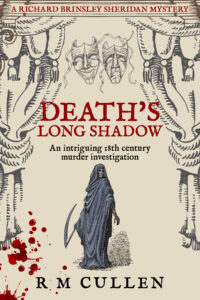
Playwright Richard Brinsley Sheridan’s retreat to the country is interrupted when he stumbles upon a body during a woodland stroll.
The man is identified as Edward Stretton, cousin to Earl Cannock who Sheridan is residing with.
Stretton had a reputation as a scoundrel and seducer and was heavily in debt at the time of his death.
He had been poisoned, and when the Earl’s servants are questioned, unusual evidence puts one man in custody.
But Sheridan is not convinced of his guilt. And one another man is murdered, he suspects there may be a connection.
Can Sheridan uncover the link? Could he save an innocent man from death?
Or will this case prove too complex for this amateur sleuth…?
We are delighted to announce that we have signed a new naval fiction novel set during the Second World War by Anthony Palmiotti.

Anthony Palmiotti
In Anthony’s words:
“When searching for subjects to write about, I look for little-known stories or actions within bigger events that emphasize the strength of character and the contributions made by ordinary people — the individuals that make a difference to the outcome. Invariably, it is the strength of character of the common man or woman that determines the outcome — that makes the difference between winning and losing. It could be a single heroic action or simply a steadfast stubbornness. It might be the will to go on when common sense says this is not a good idea. They are the unknown people who make the seemingly impossible, possible.
“Operation Pedestal was just one convoy in a war that saw hundreds of convoys. Malta was just one island in a sea of islands. What makes these two different is that they faced extreme odds and yet, through a steadfast perseverance, they beat the odds. The citizens of Malta and the common men on the convoys showed an uncommon resolve. They simply did not give up, even when giving up was the smart thing to do.
“My take on Malta during the summer of 1942 and Operation Pedestal is not a history but a novel. A novel allows the writer to get personal. It not only offers the facts, but, hopefully, a feel for what it’s like when ordinary people are asked to do extraordinary things.”
Discover more about Anthony here.
Congratulations to David Field, whose Victorian thriller, The Long Delayed Revenge, is out now!
The Long Delayed Revenge is the tenth instalment in the Esther and Jack Enright Mystery Series – a traditional British detective series set in Victorian London and packed full of suspense.
London, 1899

Jack and Esther Enright, with their four children in tow, have recently moved to a comfortable new home. Esther has settled into her dream job as headmistress of the local private school, owned by her mentor Emily Allsop.
But things are not going so well for Jack. Though he does not mind the commute to his high-ranking desk job at New Scotland Yard, he is disturbed by the level of recent resignations in by uniformed constables in the East End.
Though the police force has always been used to tackling crime in the more impoverished parts of London, a recent influx of Russian immigrants has led to gang warfare and vigilante justice which is proving impossible to control.
And when Esther’s school is vandalised with a disturbing message, he finds his detective skills are needed closer to home as well.
Things escalate when one of the young pupils is abducted and Jack needs all the help he can get in finding the perpetrator before it is too late.
Can Jack and Esther solve another case together? Will they rescue the child in time?
Or will the unrest in London prove too much for even Jack to handle…?
Following the success of The Marwood Family Tudor Saga, we are delighted to announce that we have signed a new Sherlock Holmes-inspired cosy crime series by Amy Licence.
In Amy’s words:
“Tucked away in a sleepy Sussex village, Sherlock Holmes’ great-great niece Charlotte Holmes wants nothing more than to run her antiquarian bookshop in peace and quiet. Divorced, and with her grown-up children having flown the nest, she’s looking forward to reading her way through the shelves, attending quiz nights with best friend Nell, and going out for dinner with handsome lecturer Toby. But then a young woman unexpectedly turns up in answer to an advert she placed for a housemate, whose name just happens to be Scarlet Watson. It seems too much of a coincidence, but when the landlady of the local pub is murdered, the pair team up to solve the crime, and Scarlet’s infectious enthusiasm wins Charlotte over. But is the new arrival all she seems? What secrets is Scarlet hiding?
“A Study in Scarlet is the first book in my new cosy crime series, inspired by the Sherlock Holmes stories. I’ve always loved reading detective fiction and, as an English teacher, I have been reading the Holmes stories with my classes for twenty years. I felt it was a perfect addition to the genre, imagining a modern setting for some familiar devices, swapping the gender of the detective, and keeping a literary twist — my heroine loves reading! Each book is based on one of the original stories and Holmes fans will love spotting the overlap and solving the crime.
“I’m delighted to be branching out with Sapere Books into another genre that I’ve always loved. Books two and three in the series are already planned and ready to be written, with more sleepy village intrigue, plus some local festival glamour, but always remaining true to the Holmes genre.”
Discover more about Amy here.
Congratulations to D. R. Bailey, whose heart-pounding military adventure, The Fire Maidens, is out now!
The Fire Maidens is the third book in the Secret Sirens Aviation Thrillers, set during the Second World War.
Autumn, 1943
Sisters Anna and Jennifer Nightingale have been flying in top missions with the Secret Sirens all-female RAF unit for nearly a year.
Their squadron of twelve Mosquitos stages a raid on Rouen to divert the enemy’s attention from the Lancasters which are coming in to bomb the marshalling yards and port.
But while Jennifer makes it through the mission safely, Anna and her navigator, Maria, are forced to ditch into the Channel.
Luckily they are picked up by a British Destroyer. And on board is none other than Winston Churchill himself.
Impressed by the skill-level and bravery of the female pilots, Churchill is keen to learn more about their training.
He escorts them back to base where they are given a new mission: to attack the Nazi-occupied Mimoyecques Fortress.
The Allies know that the Fortress is being armed with high calibre guns capable of reaching London in a massive, unending bombardment. The Sirens need to drop bombs into the railway tunnel entrance of the Fortress as soon as possible before the unthinkable happens.
But with very little time to train, will the Sirens be able to pull off the task? Can they reach the Fortress unscathed?
Or will these Fire Maidens join the many thousands who have already lost their lives in this brutal war…?
As we celebrate 250 years since the birth of one of England’s most beloved authors, we asked Laura Martin, author of the Jane Austen Investigations series, to tell us what Jane Austen’s work means to her and how it has influenced her own writing.
2025 marks the 250th anniversary of Jane Austen’s birth and is the perfect opportunity to reflect on her literary legacy and the influences that shaped her writing.

The Royal Crescent, Bath
Jane Austen is one of Britain’s most well-known and influential authors. Over two hundred years after her death her books are still immensely popular and there are numerous film and television adaptations, as well as books inspired by her life and her characters. Much has been theorised about the sort of woman she was, a picture built from the letters she wrote to her sister Cassandra as well as other friends and relatives; she has become immortalised by her work and the people who celebrate it.
One reason Jane Austen’s books are so popular is her ability to build complex and layered characters, a reflection of the people we meet in real life. No two characters are the same, and even the minor players are well defined. It allows the characters and their flaws to linger in the reader’s mind — how often have I met someone and thought how similar they are to anxious Mr Woodhouse or foolish Lydia Bennet.
Undoubtedly there were many influences on Jane Austen and her books. Her main themes revolved around marriage, love, class divisions and morality. Her stories often centred on intelligent and spirited heroines — Elizabeth Bennet, Elinor Dashwood, Anne Elliot — who are forced to navigate societal expectations in the pursuit of happiness. Through these characters Jane Austen explored the roles of women in society, economic dependence and social mobility with a clarity and subtlety that remains impressive to this day.

Pulteney Bridge at twilight
Although Jane Austen did not live past the age of forty-one, she led a rich and varied life for a woman of her time. Her early life was spent in rural Hampshire, but in 1801 she moved to the city of Bath — a move that her letters suggest she was not overly happy with. However, there is no doubt that her time spent in the city — a place of genteel society and social ambition — offered her the perfect opportunity to observe human behaviour, which she then used to help form the flawed but interesting characters that we have all come to love.
For an author writing about Jane Austen, Bath is the perfect place to immerse yourself in the Georgian era. The streets are lined with beautiful examples of Georgian architecture and when you stroll around the curve of the Royal Crescent, you can almost imagine you might catch a glimpse of Jane Austen herself.
In my Jane Austen Investigations series I have attempted to capture the essence of Jane as an author and a person, especially her unparalleled insight into human nature. It is always daunting, writing a story where the main character once existed, especially when it is someone universally beloved, but I hoped to celebrate her genius and explore the life of the woman behind the books.
I have no doubt that in another two hundred and fifty years Jane Austen’s books will still be as popular as they are today — her wit and wisdom will still be as compelling as they are now.
Discover more about Laura here.
IN THE JANE AUSTEN INVESTIGATIONS SERIES:
Featured image credit: Photo by Dominika Walczak on Unsplash.
Congratulations to
Scotland, 1594
Nineteen-year-old Anne of Denmark, Queen of Scotland, is thrilled and triumphant at the birth of a healthy baby boy, destined to reign as King of Scotland and, possibly, England.
But Anne’s enjoyment of maternal glory quickly fades as her husband King James, fearing his son will be politically manipulated against him as he was against his mother, the deceased Mary Queen of Scots, removes the child permanently from her care.
Outraged, Anne tries to regain control of her son, initiating a bitter marital struggle which sours what had been a loving and harmonious marriage.
Anne is haunted by the giant legacies of Mary Stuart and Elizabeth Tudor on the thrones of Scotland and England, and is determined to make her own mark.
And central to that ambition is securing the succession to the English throne from her husband’s cousin, the elderly and childless Queen Elizabeth.
Can Anne regain favour with the Scottish King? Will they join forces to secure the English throne?
Or will this daring Queen of Scotland fade into obscurity…?
Canadian paratrooper Leo Heaps (1923–1995) was seconded to the British Army during the Second World War and participated in the Battle of Arnhem. He was captured by the Germans and upon his escape, his work with the Dutch Resistance to help rescue hundreds of Allied soldiers behind enemy lines resulted in his being awarded the Royal Military Cross for “outstanding gallantry”. To commemorate the eightieth anniversary of the end of the Second World War, Leo’s son Adrian reflects on his father’s life in 1945.
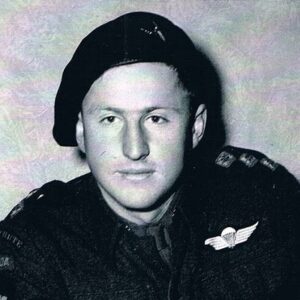
Leo Heaps
In 1945, Leo Heaps was just twenty-two, a young Canadian whose experiences in the Second World War shaped him into the complex figure I knew.
Born in Winnipeg in 1923, growing up as the son of Abraham Albert Heaps, a prominent Parliamentarian, wasn’t easy, but Leo forged his own path. Educated at Queen’s University, the University of California, and McGill, he was restless by 1944, bored with the Canadian Infantry Holding Unit. His commanders underestimated him, calling him “not of officer caliber, no initiative, not aggressive enough.” Sarcastic and defiant, he failed to qualify for the Infantry. His father urged him to work on his aunt’s farm, an exemption from service, but Leo sought action. He volunteered for the CANLOAN program, seconding Canadian officers to the British Army, a choice that plunged him into Operation Market Garden.
Leo (upper right) before his first jump into Arnhem
In September 1944, Leo joined the British 1st Airborne Division, commanding the 1st Parachute Battalion’s Transport — without ever having jumped before. He described his first drop on 17 September 1944 with vivid clarity: “I floated down gently from heaven at 1:30 p.m. on Sunday… The sun shone, the fields of Wolfheze were bathed in warm light and the green meadow bloomed with large bursts of yellow sunflowers.” That beauty was short-lived. The Battle of Arnhem, part of a failed plan to seize Rhine bridges, ended in defeat. Captured by the Germans, Leo didn’t stay a prisoner for long. With the help of the Dutch Resistance, he escaped, hiding in a chicken coop at Ennyshoeve. There, he met members of the Resistance risking their lives for Allied evaders.
Leo with his father and brother David
His work with the Dutch Resistance earned him the Military Cross, a rare honour for a Canadian in British service. His brother, David, also received the Military Cross, making them the only Jewish brothers during the Second World War to win the decoration. Leo’s role in Operation Pegasus, the escape of over 100 Allied soldiers across the Rhine, was a triumph he chronicled in his book The Grey Goose of Arnhem. He called it “the most amazing mass escape of World War II.”
But some memories were harder to share. In April 1945, Leo was among the first to enter Bergen-Belsen concentration camp after the Germans fled, leaving behind a typhoid outbreak and unimaginable suffering. As a Jewish soldier, the sight of skeletal survivors, the stench of death, and the chaos of the camp struck him profoundly. In Escape from Arnhem (1945) he described the eerie silence broken by the groans of the starving, the piles of unburied bodies, and the desperate eyes of those clinging to life. The scale of the horror overwhelmed him. He rarely spoke of Belsen, but when he did, his voice was subdued. I can picture him there, a young man of twenty-two, confronting a darkness that no one could fully process.
Leo with his father following his decoration
By May 1945, Leo was no longer the kid who frustrated his commanders, but a decorated veteran, a survivor of capture, combat, and collaborator with the Dutch underground. However, the war left its mark on Leo in what we now recognise as PTSD. The loss of friends killed by the Germans ushered a quiet guilt for those surviving when so many didn’t. Yet Leo channelled his unease into action, as if movement could keep the ghosts at bay. His writing, his adventures, his relentless drive — they were, in part, his way of coping with a war that never fully left him.
In 1994, my son and I accompanied Leo to Arnhem for the fiftieth anniversary, as one of forty Canadian veterans. I often wonder what he felt in those sunflower fields, thinking of his lost comrades and his own life’s pursuits. Some of these feelings can be found in his records and letters in the Ontario (Canada) Jewish Archives, which offer a glimpse of the man and the many moments beyond his stories.
Leo died in 1995, leaving a legacy I’m still unravelling. In 1945, he emerged from the war not just as a survivor but as a storyteller who gave voice to the unsung. His books are a testament to a war that left its scars, but also of the man who became my father.
By Leo Heaps:
We are thrilled to announce that we have signed the fifth book in The Marwood Family Tudor Saga by Amy Licence.
Set at the court of King Henry VIII, the series follows the drama and intrigue at the heart of the Tudor court.
In Amy’s words:
“I’m really excited to be publishing the next instalment in Thomasin Marwood’s journey with Sapere Books. Readers of the series will recall her turbulent experiences at the court of Henry VIII in the 1520s. The young Thomasin arrived aged seventeen, fresh from her Suffolk childhood, to navigate the various intrigues and romances of court life. She is dazzled by the elegance of Anne Boleyn, before she finds a place in the household of Catherine of Aragon. Watching the royal marriage unravel, Thomasin becomes close to her mistress, who trusts her implicitly, whilst trying to protect her own heart from the handsome Rafe Danvers and other suitors.
“Now, two years later, the eagerly anticipated Legatine Court is about to open at Blackfriars, to test the validity of Henry and Catherine’s marriage and hopefully bring them all some resolution. Not all is as straightforward as it seems, though, as friends and lovers just as quickly turn into enemies, and long-term scandals in the Marwood family threaten to re-surface. Then there is Thomas Cromwell, keen to do Henry’s bidding, leading to some dangerous clashes with Thomasin’s father.
“I love writing the Marwood series, with all the colour, textures and details of life at the Tudor court. It’s the closest we can come to travelling back in time there ourselves. When I was planning this series, I wanted to create a heroine outside the cast of usual characters, a complete outsider with whom the reader could identify, and set her within the dynamic of known individuals like Anne Boleyn and Catherine of Aragon. There must have been many similar silent witnesses to the crucial events of the 1520s who have gone unnamed and unrecorded, so Thomasin also represents them.
“There’ll be some twists and turns in this book, but it’s building towards a mid-series mini-conclusion, with both Thomasin and her cousin Ellen settled by the end. I thought it time to give them both some happiness at last, after everything they’ve been through. After that, I hope to give Thomasin a little breathing space, then bring her back to court in 1532, for Book Six. She will find herself at Anne’s side through the coming years, as a witness to her queenship and downfall.”
To keep up to date with Amy’s latest releases, visit her website.
The Marwood Family Tudor Saga:
Air Commodore Roderick Chisholm, CBE, DSO, DFC & Bar (1911–1994), author of Cover of Darkness, was a night fighter pilot, flying ace and a highly decorated British airman of the Second World War. To commemorate the eightieth anniversary of the end of the Second World War, his son Julian reflects on his father’s life in 1945.
Roderick Aeneas Chisholm by Sir William Rothenstein. Image used with permission from Museums Sheffield
In 1930 Roderick Chisholm joined 604 Squadron of the Royal Auxiliary Air Force. He learnt to fly and was commissioned as an officer. He left the squadron in 1935 when his work took him to Iran. Before rejoining his squadron in late June 1940, he took a refresher course to become a night fighter pilot and fly the squadron’s Blenheims. During the war, while flying Beaufighters and Mosquitos, he shot down nine enemy aircraft with the assistance of his airborne observers and the ground controllers, he commanded the Night Fighter Interception Unit at Ford, and was the second-in-command of Bomber Command’s 100 Group, which was charged with defending RAF bombers over enemy territory. He recorded his wartime experiences in Cover of Darkness, which was first published in 1953.
Immediately after hostilities ended, Roderick led a team of twelve charged with gaining as much intelligence as possible about the impact of 100 Group’s radar-assisted night fighters, Mosquitos, and Radio Counter Measures. The team did their work at the final base of the Luftwaffe in Schleswig, just before it was disbanded and its personnel transferred to POW camps. They carried out interrogations of Luftwaffe night fighter commanders and pilots, observers, flight controllers and technicians, held technical discussions, and examined the vast number of German aircraft parked on the airfields. The team gained confirmation of the effectiveness of 100 Group’s efforts, and had the satisfaction that as a result RAF losses were significantly reduced. The Mosquito had an awesome reputation amongst the German airmen.
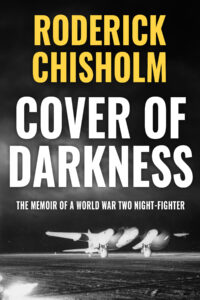 Major Schnauffer was one of the pilots whose interrogation Roderick witnessed. Schnauffer was a brave and skilful night fighter pilot who was credited with shooting down no less than 124 bombers in defence of his country. He wore uniform, and on the last day the Germans were allowed to wear medals, he wore the highest order of the Iron Cross around his neck. The exchanges with the Germans were generally civilised and friendly, but my father could not ignore that they were Nazis, and that nearby were camps for Russian prisoners living in ghastly conditions, and mini-Belsens for Jews and other displaced persons.
Roderick’s mission complete, he flew back to Norfolk. While doing so, he envisioned a future Europe in which frontiers would mean no more and individual nationalities were less important, as per the multi-national squadrons of the Battle of Britain. After the collapse of France in 1940, British, French, Belgian, Czech, Polish and other nationalities had flown in harmony in polyglot fighter squadrons. Their aims were identical, and their understanding effective thanks to the basic English of the radio. Sadly, later, as national squadrons were formed, national identities asserted themselves and the unity achieved in the Battle of Britain became compromised.
Major-General Hubert Essame, CBE, DSO, MC (1896–1976) was a British Army officer who fought in the First and Second World Wars. Following his retirement from the army, Hubert lectured in military history at King’s College London, and published several books and articles. He was also an advisor to television producers for military programmes. To commemorate the eightieth anniversary of the end of the Second World War, his granddaughter Antonia shares her memories of him below.
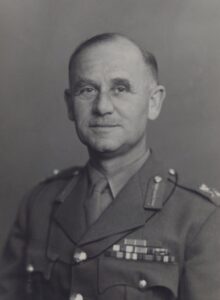
Hubert Essame
Brigadier, later Major-General, Hubert Essame led 214 Independent Infantry Brigade, part of 43rd Wessex Division, in the capture of Mont Pincon, the key to Normandy, as well as of Hill 112, the successful yet most costly single battalion action of the Overlord campaign.
He was a sharp-witted and determined man remembered by the actor and raconteur Dirk Bogarde, his one-time liaison officer, for his “brilliant blue eyes and tongue like a whip”. He had a caustic sense of humour and was a formidable leader from the front.
Soon after the war, Hubert wrote the Division’s official history, The 43rd Wessex Division at War, 1944-45, and later Battle for Normandy, Normandy Bridgehead, The Battle for Germany, and a biography of General Patton. His perspective as a leader of troops into battle, alongside his use of a wide-ranging variety of sources as a historian, makes for a great read even for those who know about Operation Overlord.
His 214 Independent Infantry Brigade, which together with 129 and 130 Brigade and their supporting arms formed Major General Ivor Thomas’s 43rd Wessex Division, were in turn part of the XXX Corps commanded by Lieutenant-General Sir Brian Horrocks all the way from Normandy to Bremerhaven.
The Wessex Division story spans the stormy Overlord crossing and later the crucial Battle for Hill 112. This point south-west of Caen was defined by Eberbach, commander of Panzer Group West, as the “pivotal point of the whole position” and it saw the first of the grim battles of attrition immediately following Caen’s fall. The battle involved heavy casualties and tested the 43rd Division against some of the most seasoned German divisions, well dug in and skilfully hidden.
Road and rail lines lay at right angles to the direction of advance. The bocage of tiny, often boggy fields with sunken lanes and thick hedges reduced visibility for artillery and impeded all movement. And it was high summer. Hubert describes vividly how he crawled forward in the August heat to assess Mont Pincon’s southern slopes before its eventual capture by the Division and 8th Armoured Brigade.
Hubert was a writer whose extraordinarily immediate account includes, for example, the information he gained from German prisoners, subsequent revelations about Hitler’s orders to his generals, and his own point of view at the head of 214 Brigade. His perspective sheds light on some of the huge challenges of the campaign, such as that of establishing a key bridgehead over the Seine at Vernon despite the civilian population’s determination to celebrate as though the campaign was already won.
 214 Brigade fought on through northern France and the Netherlands, including Operation Market Garden, and were among the first Allied troops to enter Germany. They played a key part in the turning of the tide in the Reichswald. I am proud that ‘Brigadier Twinkletoes’ was my grandfather and attempt to read across from his high standards of resolve and determination to the greyer demands of the here and now.
By Hubert Essame:
The Battle for Germany, September 1944-May 1945
Jeremy Howard-Williams DFC (1922–1995), author of Night Intruder, had a distinguished career in the RAF as a night-fighter pilot during the Second World War and was awarded the Distinguished Flying Cross for gallantry. To commemorate the eightieth anniversary of the end of the Second World War, Jeremy’s son, Anthony Inglis Howard-Williams, reflects on the arrival of peace in 1945 and how it influenced his father’s life.
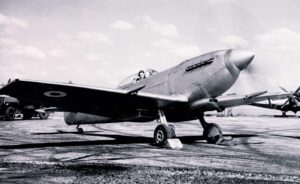
Jeremy Howard-Williams warming up the engines of a clipped wing Spitfire
When peace came to Europe in May 1945, Flight Lieutenant Jeremy Howard-Williams DFC was stationed at HQ, 11 Group Uxbridge. Three days before Germany’s unconditional surrender, a party was held to celebrate peace. Jeremy and his brother Peter did so by marching a guest — Flight Lieutenant Andrew from RAF Intelligence — between them up and down an anteroom. The junior flight lieutenant just happened to have been their pre-war boarding school housemaster, and the brothers had found it too good an opportunity to miss. When, years later, he was asked how the lieutenant had taken the ribbing, Jeremy replied, “with remarkable good humour!”
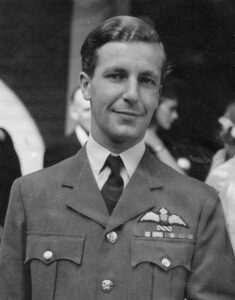
Jeremy at his wedding in 1951
Like so many in 1945, Jeremy was headed for an uncertain future. With peace came the pressing question: what happens now? For most, life outside of the forces beckoned. With millions demobilising, the assimilation of those who had been at war back into civilian society became one of the new post-war government’s biggest challenges. For those who did not want to leave the forces came a different challenge. With Jeremy’s father a retired RAF pilot, Peter a Battle of Britain day-fighter pilot and Jeremy a night-fighter pilot with the Fighter Interception Unit — an elite force at the forefront of the RAF’s early experiments with radar equipment — both brothers understandably wished to remain serving.
With the Royal Air Force downsizing, deployment meant less flying — not a very exciting prospect for a twenty-three-year-old war veteran. Jeremy had specifically joined the RAF in order to fly when the Nazis had tried to seize control of Western Europe. However, in the new modern era of the jet engine, aircraft were flying ever faster and higher. Now that was exciting!
 In the end, both brothers remained in the RAF. Jeremy was first posted in an admin job to Singapore during the Malayan Emergency, where he met his wife, uniting two distinguished RAF families. He later worked as an assistant air attaché in the Paris and Berlin embassies. He did fly during these postings, but mainly a desk. He resigned in 1957.
Ultimately, Jeremy’s parents divorced and his father remarried into the Ratsey family, where Jeremy became sales manager for the famous sail-making firm Ratsey & Lapthorn in Cowes on the Isle of Wight. After leaving the company, he wrote many authoritative books on sailing, as well as Night Intruder, republished by Sapere Books, a personal account of his wartime service as a pilot and the radar war between the RAF and Luftwaffe night-fighter forces.
Sir Frank Whittle, author of Jet: The Story of a Pioneer, was a Royal Air Force pilot and aviation engineer known as the inventor of the jet engine. He obtained his first patent for a turbo-jet engine in 1930, and in 1936 co-founded Power Jets Ltd. In May 1941, his engine was fitted to a Gloster E.28/39 airframe — the plane’s maiden flight from RAF Cranwell in Lincolnshire heralded the beginning of the jet age. Frank retired from the RAF in 1948 with the rank of air commodore, and that same year he was knighted. He was awarded the Order of Merit in 1986. To commemorate the eightieth anniversary of the end of World War Two, his son Ian reflects on Sir Frank’s life in 1945.
Frank as a junior officer in 1929, when he proposed the turbojet
My father’s company, Power Jets, was nationalised in 1944. From then until 1946, he was on the board of the government company that emerged under a slightly different name. At the time, he was working on the design for the aft-fan engine that also incorporated the after-burner system he had patented in 1936 — the modified W2/700. This was expected to propel the experimental Miles aircraft (M52) intended to be the first in the world to go supersonic. He was also working on the development of what would have been the world’s first hi-bypass turbo-fan engine — the LR1. Both projects were cancelled by the government in 1946 — as was the M52. These decisions resulted in Frank resigning from the board and putting himself in the hands of the RAF to do whatever they would wish him to do.
Frank holding his slide rule
1945 was a year of change for my father. He was still a serving officer in the RAF, but Power Jets had become publicly owned and entirely dependent on government funding. He found himself subject to the needs of the large independent aero-engine manufacturers who objected to a government company in competition. However, on three occasions he briefly got away from it all and flew the Meteor jet fighter. Apart from the Wright brothers, he was the first person to pilot an aeroplane powered by an engine of his own design. At other times, he found himself sent off to deliver lectures at various venues to describe the impact and differences when changing from piston engine/propeller propulsion to jet propulsion.
As a little boy, I remember him coming home after flying the Meteor along the high-speed run at Herne Bay. “How fast did you go, Daddy?” I asked. “Oh, about 450,” he replied. “Is that all?” I said with some disgust, and turned away to do whatever it was that I was doing. I had expected him to tell me 600 miles per hour. When I asked him about this, many years later, he said he was quite crestfallen by my reaction. He also explained that, as he was flying at about 50 feet above the surface of the sea, he really was unable to pay much attention to his airspeed indicator — his attention was focussed on keeping the aeroplane steady and level. And anyway, he would have been speaking of knots, not mph!
Featured image credit: Photo of Gloster Meteor by Alexis Threlfall on Unsplash.
Sir Peter Gretton DSO** OBE DSC (1912–1992) was an officer in the Royal Navy. He was active in the Battle of the Atlantic during the Second World War, and was a successful convoy escort commander. He eventually rose to become Fifth Sea Lord and retired as a Vice-Admiral before entering university life as a bursar and academic. To commemorate the eightieth anniversary of the end of World War Two, Sir Peter’s son, Vice-Admiral Mike Gretton, shares his memories of him below.
Lieutenant Commander Peter Gretton with the Ship’s Company of HMS Wolverine
On 8 May 1945 — Victory in Europe Day — Peter Gretton was thirty-three years old and utterly exhausted. He had been continuously in seagoing appointments since the outbreak of war in September 1939. He had married Wren Judy Du Vivier in 1943 during a short break between convoys, and they had had their first child, Anne, who was not yet one year old. They were renting a flat in Kensington so that he could readily get to work: his job at the time was in the Joint Planning Staff in the Cabinet Office working on strategic plans to end the war in Europe and then in the Far East — not exactly a rest cure.
Peter had served continuously in seagoing ships from September 1939 until he came ashore in March 1944 — still only thirty-one years old. He had served in five ships during that time, starting as a First Lieutenant, including HMS Cossack in which he was mentioned in Dispatches for his performance during the Second Battle of Narvik under the very demanding Captain Philip Vian VC. From February 1941, he was in command of destroyers, starting with HMS Sabre in which he was awarded an OBE, and then HMS Wolverine (March to November 1942) when his ship was an escort for Operation Pedestal, the relief of Malta. He was awarded his first DSO for ramming and sinking an Italian submarine at the expense of wrecking his bows and having to proceed astern to port at Gibraltar.
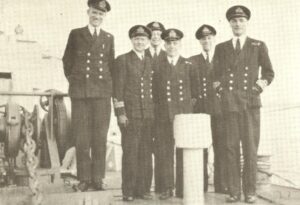
Commander Peter Gretton with the Commanding Officers of ships in B7 Escort Group
From there, he was recalled to the UK as a Commander to become the Senior Officer of Escort Group B7, to be based in Derry, and he initially embarked on HMS Duncan. The Escort Group supported Atlantic convoys for two years and five months. He was awarded the two bars to his DSO during that time, the first of which reflected the successful battle for convoy ONS5, which historians regard as the tipping point in Allied fortunes in the Atlantic convoy campaign.
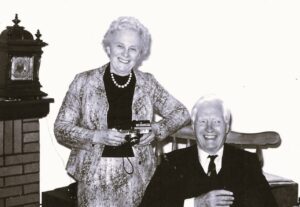
Peter with wife Judy in 1965
In March 1944, Peter dedicated himself to writing a new book — The Admiralty Convoy Instructions — based on his and others’ experience at war, with a readership in the Royal Navy, Royal Air Force and Merchant Navy. This became the bible for convoy protection and the same book, with minor amendments, was the basis of my own training as a naval officer in the 1970s.
Peter and my mother rejoiced exuberantly at the victory in Europe: he writes that they ‘walked up Picadilly and thence to St James’ Park … remarkable scenes’. They would have reflected proudly on their own contribution to the outcome: my father at sea and my mother as a Wren in the Western Approaches Tactical Unit (WATU), which developed and taught tactics for the Atlantic battle. I was born nine months after VE Day, in March 1946.
By Peter Gretton:
Congratulations to David Mackenzie, whose wartime aviation thriller, Spitfires Rising, is published today.
Spitfires Rising is the first book in the John Noble Fighter Ace Thrillers: action-packed military adventures following an RAF pilot during the Second World War.
1938
Having been raised on a farm, young New Zealander John Noble longs for an adventure away from his family’s homestead.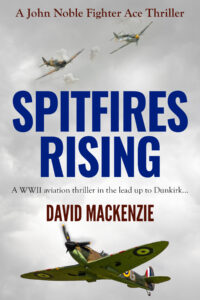
Enthralled by the sight of a Tiger Moth flying overhead, he decides to pursue a career as an RAF pilot and travels to the United Kingdom to complete his training.
After receiving his Wings, John is sent to RAF Catterick, where he finds himself flying the formidable Spitfire.
When tensions in Europe reach breaking point and Britain declares war on Germany, John’s training and courage are put to the ultimate test.
As the squadron prepares to face the Luftwaffe, John starts to question the effectiveness of their tactics, leading to clashes with senior officers.
And as his missions grow ever more dangerous, John begins to wonder just how far he will go to survive the war…
Is John ready for battle? Will he be able to follow orders while preserving his life?
Or is he destined to become a casualty of war…?