

Ahead of the publication of The Restless Wave, the fourth book in the Romulus Hutchinson Naval Adventure Series, author David Clensy takes a closer look at why Operation Pedestal was such a critical moment in the Second World War.
By the summer of 1942, Malta was perilously close to defeat. Isolated in the centre of the Mediterranean, the island had endured almost two years of relentless siege. Axis aircraft and submarines had reduced its ports, airfields and towns to rubble, while starvation and fuel shortages threatened to bring military operations to a standstill. Yet Malta remained strategically indispensable. From its harbours and airstrips, British forces could strike at Axis supply lines to North Africa, choking Rommel’s Afrika Korps just as it prepared for a decisive push towards Egypt.
Operation Pedestal was the Allies’ last throw of the dice to save the island. Conceived as a massive convoy operation and executed at extraordinary risk, it stands as one of the Royal Navy’s most hard-fought and costly triumphs of the Second World War.
It is at the heart of The Restless Wave, the fourth book in the Romulus Hutchinson Naval Adventure series: action-packed, authentic historical adventures following twin brothers fighting with the Royal Navy and the Merchant Navy during the Second World War.
Rom is now a first lieutenant, rapidly getting the chance to show his mettle on the bridge, seeing action in the Mediterranean for the Allied landings at Sicily and Salerno, as well as helping to lift the siege of Malta as part of Operation Pedestal.
In this blog, I wanted to take a closer look at why the operation was so significant.
Malta under siege
By mid-1942, Malta’s position was desperate. Previous attempts to resupply the island had suffered severe losses, with convoys harried from the air by the Luftwaffe and Regia Aeronautica, and attacked at sea by submarines and fast torpedo boats. Fuel for aircraft and ships was critically low, forcing the RAF to limit operations at the very moment when air defence was most urgently needed. Food stocks were so reduced that rationing had reached near-starvation levels for both civilians and servicemen alike.
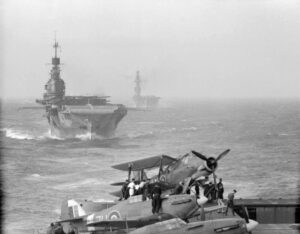
HMS Victorious’ flight deck showing HMS Indomitable and HMS Eagle
Despite this, the island continued to disrupt Axis operations. Intelligence from signals interception and reconnaissance imposed a heavy toll on shipping bound for North Africa. The Axis understood that neutralising Malta was essential. The Royal Navy knew that losing it could turn the Mediterranean decisively against the Allies.
Launched in August 1942, Operation Pedestal was the largest and most heavily escorted convoy yet to attempt to supply the island. Fourteen merchant ships were assembled, carrying food, ammunition and fuel. Their cargo included aviation fuel in bulk and, most critically, the oil tanker SS Ohio, the survival of which would prove vital to keeping the island in Allied hands.
The escort was formidable. Under the command of Admiral Sir Neville Syfret, the Royal Navy committed two battleships, four aircraft carriers, seven cruisers and more than thirty destroyers. It was an extraordinary concentration of naval power, reflecting the strategic stakes involved. Even so, planners knew losses would be heavy. The convoy had to pass through the narrow Sicilian Channel, within range of Axis airfields, submarines and surface craft.
Running the gauntlet
The convoy sailed from Gibraltar on 10 August 1942. Almost immediately, it came under attack. Axis aircraft struck repeatedly, launching coordinated bombing and torpedo attacks designed to overwhelm the escorts. U-boats and Italian submarines waited ahead, while fast torpedo boats prepared night assaults.
The Royal Navy’s carriers played a crucial early role, providing fighter cover that blunted the worst of the air attacks in the opening days. However, as the convoy pressed eastwards, the carriers were forced to turn back in accordance with operational limits, leaving the merchant ships increasingly exposed.
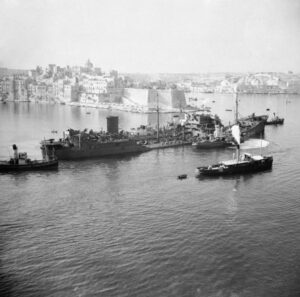
SS Ohio arrives at Malta
Losses mounted. The aircraft carrier HMS Eagle was sunk by submarine attack. Several cruisers and destroyers were badly damaged or sunk while defending the convoy. Merchant ships were picked off one by one, yet the escorts continued to fight tenaciously, laying smokescreens, counterattacking submarines and engaging enemy surface forces at close range.
At the centre of the drama was SS Ohio. Heavily damaged by bombing and torpedo strikes, the tanker was left barely afloat. Her engine failed, her deck was shattered, and she was down by the bows. Yet abandoning her was not an option. Without her fuel, Malta’s air defences and naval forces would grind to a halt.
In one of the most remarkable episodes of the naval war, Royal Navy destroyers and minesweepers refused to give up. Ohio was lashed between escorting ships and painstakingly shepherded towards Malta, under constant threat of further attack. When she finally entered Grand Harbour on 15 August, broken-backed but still afloat, she was greeted by cheering crowds. It was also the Feast of the Assumption, later commemorated on the island as the day Malta was saved.
A landmark moment
Of the fourteen merchant ships that set out, only five reached Malta. The Royal Navy suffered grievous losses: a carrier, two cruisers, a destroyer and numerous aircraft. By any conventional measure, it was a costly operation.
Yet strategically, Operation Pedestal was a success. The supplies that arrived, especially the fuel carried by Ohio, enabled Malta to survive the siege. Within weeks, the island’s air and naval forces were back in action, once again savaging Axis supply lines to North Africa. This pressure played a significant role in undermining Rommel’s offensive and set the conditions for the Allied victory at El Alamein later that year.
For Malta, the convoy became a defining moment, later recognised through the award of the George Cross to the island as a whole. For the Royal Navy, Pedestal remains one of its most hard-fought convoy battles, a stark reminder that maritime logistics, often overlooked, can determine the outcome of entire campaigns.
The Restless Wave is available to pre-order now.
Stay up to date with David’s news and latest releases here.
Image credits: Operation Pedestal Carriers and SS Ohio are from Wikimedia Commons (public domain).
With the forthcoming publication of In Danger’s Hour, the second book in his Romulus Hutchinson Naval Adventure Series, author David Clensy takes a closer look at the events surrounding Operation Excess during the Second World War.
In January 1941, the Mediterranean was a tense theatre of war. The British Royal Navy, stretched thin and under constant threat from Axis forces, launched a bold and complex operation known as Operation Excess. It was a high-stakes convoy mission designed to deliver vital supplies to Malta, Greece and Alexandria, while simultaneously striking a blow against enemy naval and air power in the region.
The convoy itself was a patchwork of merchant vessels and warships, departing from Gibraltar and heading eastward through waters teeming with danger. Malta, then under siege and of immense strategic importance, was a key destination. Supplies were desperately needed to sustain its defences and civilian population. The convoy was escorted by a formidable force of Royal Navy ships, including aircraft carriers, cruisers and destroyers, all tasked with protecting the vulnerable merchantmen from attack.
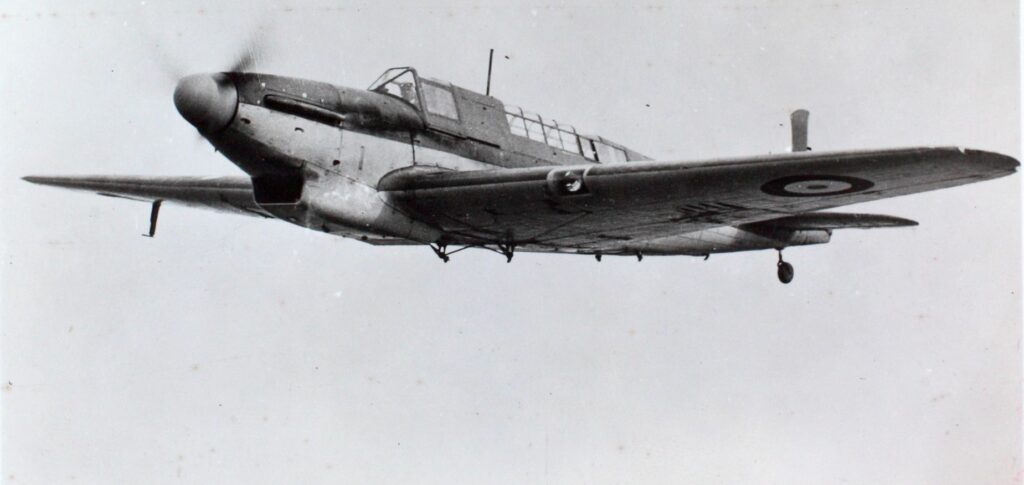
Operation Excess was a particularly challenging task for the Allied forces. Italian and German aircraft launched repeated assaults, particularly as the ships neared Sicily. The Royal Navy’s carrier-based aircraft, including Fairey Fulmars and Swordfish, fought valiantly to repel the attacks, often flying in difficult conditions and against superior numbers.
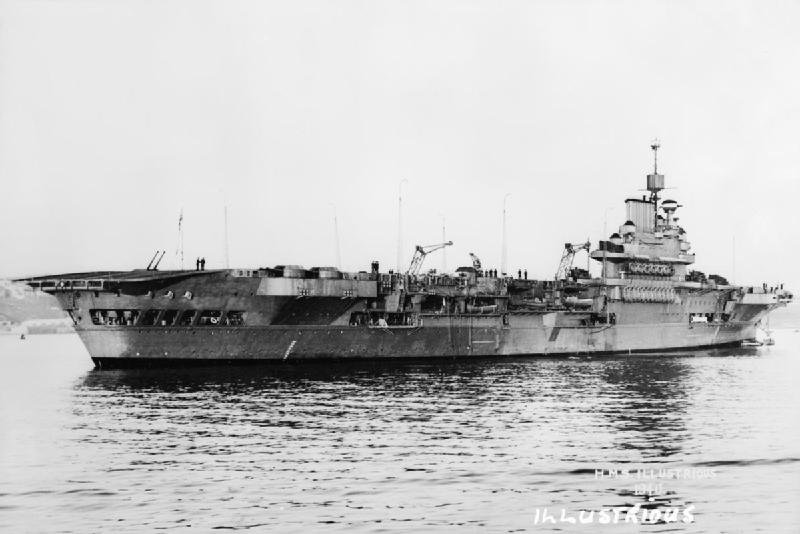
One of the most dramatic episodes of the operation occurred on the 10th of January, when HMS Illustrious, a key British aircraft carrier, came under ferocious air attack near Malta. The damage was severe, and casualties were high. Yet the carrier remained afloat and was eventually able to limp into Grand Harbour, where she became a symbol of resilience for the Maltese people.
Meanwhile, other elements of the operation were unfolding. British forces used the opportunity to launch diversionary attacks against Italian positions in the Dodecanese and to reinforce troops in Greece.
As part of Force B, HMS Southampton’s role was to transport troops from the Aegean to Malta before joining the main convoy. On the 11th of January, while operating south of Sicily, HMS Southampton came under sustained attack from German dive bombers of the Luftwaffe’s X Fliegerkorps. The Stukas struck with deadly precision, scoring multiple hits that ignited fires and caused catastrophic damage. With the cruiser listing and engulfed in flames, the order was given to abandon ship. HMS Southampton was eventually scuttled by torpedoes from HMS Gloucester to prevent her from falling into enemy hands.
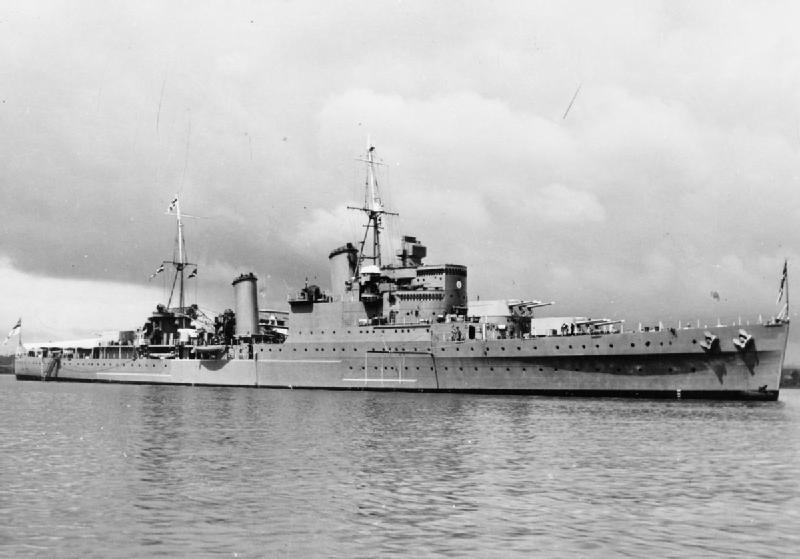
Though the operation came at a cost, it was ultimately deemed a success. Supplies reached their destinations, and the Royal Navy showed it could still operate effectively in contested waters. Operation Excess was more than a supply run. It was a statement of intent, a show of defiance against Axis control of the Mediterranean.
November 2025 sees the release of In Danger’s Hour, the second book in the Romulus Hutchinson Naval Adventure Series. Following their earlier adventures in For Those In Peril, we follow twin brothers Romulus and Remus throughout 1941, from the Mediterranean to the coast of West Africa. It covers a series of key strategic operations, including Operation Demon — the British-led evacuation of Allied forces from mainland Greece in April 1941. At the opening, readers will join our central character, Rom, as he faces an enemy attack while serving on HMS Southampton at the height of Operation Excess.
In Danger’s Hour will be published on the 28th November 2025.
Stay up to date with David’s news and latest releases here.
Sir Peter Gretton DSO** OBE DSC (1912–1992) was an officer in the Royal Navy. He was active in the Battle of the Atlantic during the Second World War, and was a successful convoy escort commander. He eventually rose to become Fifth Sea Lord and retired as a Vice-Admiral before entering university life as a bursar and academic. To commemorate the eightieth anniversary of the end of World War Two, Sir Peter’s son, Vice-Admiral Mike Gretton, shares his memories of him below.
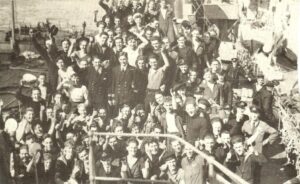
Lieutenant Commander Peter Gretton with the Ship’s Company of HMS Wolverine
On 8 May 1945 — Victory in Europe Day — Peter Gretton was thirty-three years old and utterly exhausted. He had been continuously in seagoing appointments since the outbreak of war in September 1939. He had married Wren Judy Du Vivier in 1943 during a short break between convoys, and they had had their first child, Anne, who was not yet one year old. They were renting a flat in Kensington so that he could readily get to work: his job at the time was in the Joint Planning Staff in the Cabinet Office working on strategic plans to end the war in Europe and then in the Far East — not exactly a rest cure.
Peter had served continuously in seagoing ships from September 1939 until he came ashore in March 1944 — still only thirty-one years old. He had served in five ships during that time, starting as a First Lieutenant, including HMS Cossack in which he was mentioned in Dispatches for his performance during the Second Battle of Narvik under the very demanding Captain Philip Vian VC. From February 1941, he was in command of destroyers, starting with HMS Sabre in which he was awarded an OBE, and then HMS Wolverine (March to November 1942) when his ship was an escort for Operation Pedestal, the relief of Malta. He was awarded his first DSO for ramming and sinking an Italian submarine at the expense of wrecking his bows and having to proceed astern to port at Gibraltar.
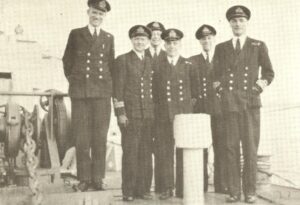
Commander Peter Gretton with the Commanding Officers of ships in B7 Escort Group
From there, he was recalled to the UK as a Commander to become the Senior Officer of Escort Group B7, to be based in Derry, and he initially embarked on HMS Duncan. The Escort Group supported Atlantic convoys for two years and five months. He was awarded the two bars to his DSO during that time, the first of which reflected the successful battle for convoy ONS5, which historians regard as the tipping point in Allied fortunes in the Atlantic convoy campaign.
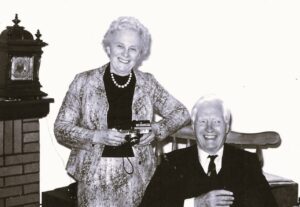
Peter with wife Judy in 1965
In March 1944, Peter dedicated himself to writing a new book — The Admiralty Convoy Instructions — based on his and others’ experience at war, with a readership in the Royal Navy, Royal Air Force and Merchant Navy. This became the bible for convoy protection and the same book, with minor amendments, was the basis of my own training as a naval officer in the 1970s.
Peter and my mother rejoiced exuberantly at the victory in Europe: he writes that they ‘walked up Picadilly and thence to St James’ Park … remarkable scenes’. They would have reflected proudly on their own contribution to the outcome: my father at sea and my mother as a Wren in the Western Approaches Tactical Unit (WATU), which developed and taught tactics for the Atlantic battle. I was born nine months after VE Day, in March 1946.
By Peter Gretton:
Congratulations to Tim Chant, whose gripping naval adventure, The Guns of Zanzibar, is out now!
The Guns of Zanzibar is the fourth book in the Marcus Baxter naval thriller series: action-packed historical adventures following former Royal Navy officer Marcus Baxter during the early 1900s and through the first world war.
August, 1914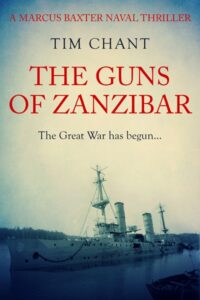
Lieutenant Marcus Baxter has been sent from cold, grey London to the tropical climes of Zanzibar in East Africa on the pretence of carrying out a survey on the local naval station.
In reality, the Royal Navy’s Intelligence Division have sent Baxter to find out if one of their ex-members, Mr Arbuthnott is now working for a potentially hostile foreign power and sharing British secrets.
Baxter is under strict orders not to reveal his true mission to anyone in the small naval contingent he’s been sent to, which makes executing his orders complicated.
He leaves the British protectorate of Zanzibar and crosses the water to the German-occupied port of Dar Es-Salaam to try and subtly gain intelligence.
But once he arrives, he is certain he is being followed.
Returning to Zanzibar, he discovers that the Austrian Archduke Franz Ferdinand has been shot, escalating tensions between the British and German forces and making Baxter’s mission more urgent.
Where is Arbuthnott? Is he betraying the British?
Can Baxter complete his mission before his shadowy stalker catches up with him…?
Congratulations to Justin Fox, whose thrilling wartime adventure, The Wolf Hunt, is out now! The Wolf Hunt is the second book in the Jack Pembroke Naval Thriller series.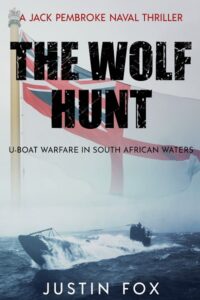
1941
Lieutenant Jack Pembroke has found a new home and new love at the Cape, but it will all hang in the balance with the arrival of the enemy in South African waters.
With the Mediterranean all but closed to maritime traffic, and Rommel’s forces rampaging through North Africa, this sea route is vital to supplying the Allied forces in Egypt.
But German U-boats have been sent by Admiral Donitz from their bases on the west coast of France to cripple the convoy route.
Jack is put in command of a small anti-submarine flotilla in the Royal Navy base of Simon’s Town, South Africa.
But he has very little time to train his officers and men, and prepare his ships, for the arrival of the Nazi wolf packs.
With the Cape under attack, Jack has to escort a vital convoy from Cape Town to Durban.
But with the enemy U-boats lying in wait in the storm-ravaged waters, he’ll be luck to make it out alive…