

Between 1940 and 1944, Donald Macintyre was among the most successful submarine hunters in any Allied navy, transforming the Battle of the Atlantic with his successes against the U-boat menace. To commemorate the eightieth anniversary of the end of World War Two, Donald’s daughter, Dani, shares a personal memory from her father’s life after the conflict.
In 1960, when Dad was employed by MGM as Nautical Advisor on Mutiny on the Bounty starring Marlon Brando and Trevor Howard, he left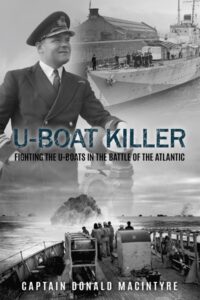 my mother in charge of the pig farm. I can only suppose that she felt annoyed to be left with this responsibility, because she sold all the pigs and demanded a flight to California!
Dad complied, and I was able to join them for a fascinating holiday, mainly spent in Culver City’s MGM Studios every day. I watched the crew film scenes of a half replica of the Bounty on rollers, with wind and water machines simulating a storm on the high seas. To my joy I also spent time with the crew of Rawhide, a Western TV series. They made a fourteen-year-old girl feel very welcome!
If you have ever watched Mutiny on the Bounty, you might have noticed that in one scene Marlon Brando comes out of his cabin wearing a ridiculous red velvet smoking jacket. When Dad was asked to approve this costume change, he said it would never have been acceptable in those days. Hollywood being Hollywood thought it made handsome Marlon irresistible, so they kept it in. This made Dad wonder what he was being paid for, apart from sitting and playing cards with Gordon Jackson in Tahiti!
Sir Peter Gretton DSO** OBE DSC (1912–1992) was an officer in the Royal Navy. He was active in the Battle of the Atlantic during the Second World War, and was a successful convoy escort commander. He eventually rose to become Fifth Sea Lord and retired as a Vice-Admiral before entering university life as a bursar and academic. To commemorate the eightieth anniversary of the end of World War Two, Sir Peter’s son, Vice-Admiral Mike Gretton, shares his memories of him below.
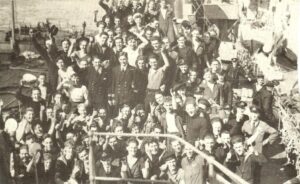
Lieutenant Commander Peter Gretton with the Ship’s Company of HMS Wolverine
On 8 May 1945 — Victory in Europe Day — Peter Gretton was thirty-three years old and utterly exhausted. He had been continuously in seagoing appointments since the outbreak of war in September 1939. He had married Wren Judy Du Vivier in 1943 during a short break between convoys, and they had had their first child, Anne, who was not yet one year old. They were renting a flat in Kensington so that he could readily get to work: his job at the time was in the Joint Planning Staff in the Cabinet Office working on strategic plans to end the war in Europe and then in the Far East — not exactly a rest cure.
Peter had served continuously in seagoing ships from September 1939 until he came ashore in March 1944 — still only thirty-one years old. He had served in five ships during that time, starting as a First Lieutenant, including HMS Cossack in which he was mentioned in Dispatches for his performance during the Second Battle of Narvik under the very demanding Captain Philip Vian VC. From February 1941, he was in command of destroyers, starting with HMS Sabre in which he was awarded an OBE, and then HMS Wolverine (March to November 1942) when his ship was an escort for Operation Pedestal, the relief of Malta. He was awarded his first DSO for ramming and sinking an Italian submarine at the expense of wrecking his bows and having to proceed astern to port at Gibraltar.
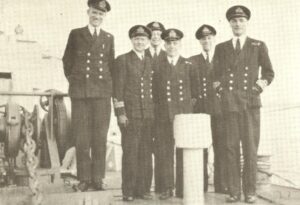
Commander Peter Gretton with the Commanding Officers of ships in B7 Escort Group
From there, he was recalled to the UK as a Commander to become the Senior Officer of Escort Group B7, to be based in Derry, and he initially embarked on HMS Duncan. The Escort Group supported Atlantic convoys for two years and five months. He was awarded the two bars to his DSO during that time, the first of which reflected the successful battle for convoy ONS5, which historians regard as the tipping point in Allied fortunes in the Atlantic convoy campaign.
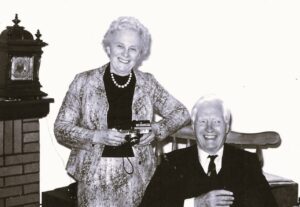
Peter with wife Judy in 1965
In March 1944, Peter dedicated himself to writing a new book — The Admiralty Convoy Instructions — based on his and others’ experience at war, with a readership in the Royal Navy, Royal Air Force and Merchant Navy. This became the bible for convoy protection and the same book, with minor amendments, was the basis of my own training as a naval officer in the 1970s.
Peter and my mother rejoiced exuberantly at the victory in Europe: he writes that they ‘walked up Picadilly and thence to St James’ Park … remarkable scenes’. They would have reflected proudly on their own contribution to the outcome: my father at sea and my mother as a Wren in the Western Approaches Tactical Unit (WATU), which developed and taught tactics for the Atlantic battle. I was born nine months after VE Day, in March 1946.
By Peter Gretton:
Congratulations to Justin Fox, whose thrilling military adventure, Hell Run Tobruk, is out now!
Hell Run Tobruk is the third book in the Jack Pembroke Naval Thriller series: authentic British Navy war stories set during the Second World War.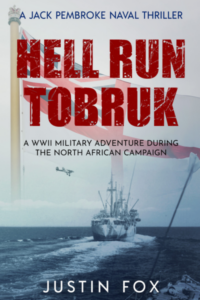
December, 1941
Lieutenant Jack Pembroke is ordered to join a convoy and sail his small escort ship, HMSAS Gannet, from the Royal Navy base in Simon’s Town, South Africa, to Egypt.
With the Mediterranean all but closed to maritime traffic, and Rommel’s forces rampaging through North Africa, it seems unlikely that Gannet will survive the coming battles.
Jack arrives in Alexandria and is soon thrust into the action, escorting ships running supplies to the beleaguered town of Tobruk in Libya.
With the pressure building and ships around him being sunk by enemy bombers, Jack must deal with his own PTSD while leading his men to safety.
And with Tobruk surrounded, about to fall to Axis forces, Gannet is still trapped in the port…
Can Jack lead his men to safety? Will he make it out of Tobruk in one piece?
Or will this Hell Run be his last…?
Congratulations to David Field, whose enthralling naval adventure, Westward To Freedom, is out now!
Westward To Freedom is the third Tudor/Renaissance novel in The New World Nautical Saga Series – historical novels set during the reign of Elizabeth I and beyond.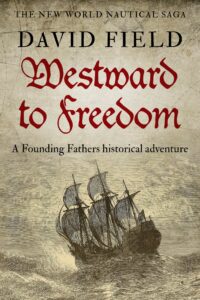
1607
The English Separatists seek only the right to be allowed to worship in their own way in their humble North Nottinghamshire village, but their beliefs are anathema to King James.
When they are given cause to believe that their clandestine meetings have come to the notice of the authorities they move to Gainsborough with a view to taking ship to the Low Countries.
After being betrayed three times they eventually make it to the comparative safety of Holland, but even there they are in danger of persecution.
So in one final throw of the dice they sign up to be members of a ‘settler’ community financed by merchant adventurers.
But to start their new life they must survive the perilous crossing on The Mayflower.
And the wilderness waiting for them on the other side is not quite what they had hoped for.
Will they succumb to the elements, disease or starvation?
Or will fortune shine on this assembly of pilgrims and finally allow them a sanctuary of their own creation?
Congratulations to Tim Chant, whose page-turning nautical adventure, The War for Tripoli, is out now! The War for Tripoli is the third book in the Marcus Baxter Naval Thrillers series.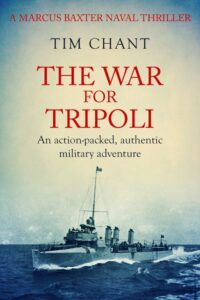
1911
Itinerant seaman Marcus Baxter has landed in Constantinople. Short of funds and lacking allegiance to any government, he is keen to sell his services to the highest bidder.
With Italy intent on capturing the Ottoman provinces of Tripolitania and Cyrenaica, it seems that war is on the horizon and fighting men will soon be in demand.
As a battle-hardened sailor, it isn’t long before Baxter is approached by Hiram Bogue, an American sea captain in league with the Committee of Union and Progress — an Ottoman revolutionary organisation.
Enticed by the amount of money on offer, Baxter agrees to train new recruits aboard the Residye, a proposed blockade runner, as well as overseeing the refit of the vessel.
With the growing threat of attack by the Italian navy, the assignment grows ever more dangerous.
And when war finally erupts, Baxter is forced to propel his inexperienced crew and ill-equipped vessel into action.
But with such a formidable enemy, will he survive long enough to claim his earnings…?
Justin Fox is the author of the Jack Pembroke Naval Thriller series: authentic British Navy war stories set during the Second World War.
I grew up around boats and the sea has always been an important part of my life and my writing. Our family spent holidays in an old house in Simon’s Town, the former Royal Navy base in South Africa, and from an early age I knocked about in anything that floats: rowing boats, sailing dinghies, windsurfers and yachts. My reading as a boy was also nautically orientated, particularly naval yarns by the likes of Douglas Reeman, Patrick O’Brian, Nicholas Monsarrat and CS Forester.
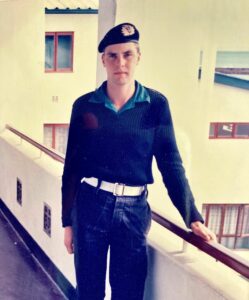
Midshipman Justin Fox, aged 17.
After leaving school, my two years of national service in the South African Defence Force were spent in the navy, based in Simon’s Town. During that period, I had six months at sea on a replica medieval caravel sailing down the Atlantic from Portugal to South Africa in a re-enactment of the voyage of Bartholomew Dias in 1487. The first book I ever wrote (never published) was the story of that voyage.
When I later joined Getaway travel magazine as a photojournalist, I volunteered for any boating assignment: sailing a brigantine around the Seychelles, a felucca down the Nile, a pirogue to Timbuktu, island-hopping by catamaran around Madagascar, taking the mail ship to St Helena Island and sailing a dhow up the Kenyan coast (which provided material for my Somali pirate novel, Whoever Fears the Sea, published by Sapere).
My Jack Pembroke series is inspired by my love of history and the sea, but I also aimed to bring to the fore a theatre of World War II that is not well known and is little written about: the fighting off the South African coast that resulted in the loss of more than 150 Allied ships.
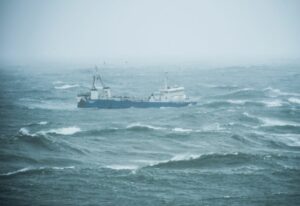
View from Justin’s flat in Cape Town.
I live in a flat in Cape Town and my desk overlooks the city’s anchorage. Watching the ships come and go each day, I often think of the war years when thousands of vessels were routed around the Cape. When a convoy was in town, Table Bay would be crammed with more than fifty ships, all of them needing protection. In place of today’s yachts and pleasure craft puttering jauntily out of the V&A Waterfront, minesweepers and anti-submarine vessels would make their daily round of the bay.
During the war, the Cape of Good Hope became a vital strategic point on the sea route around the continent and was particularly important during the North African campaign. Once Italy entered the war in 1940, the Mediterranean became too dangerous for Allied convoys, and most were diverted around the Cape. Much preparation was needed before Nazi warships made their way to Africa’s southern tip. The Royal Navy base in Simon’s Town had to be expanded and reinforced, and a fledgling South African Navy created almost from scratch.
First came the German surface raiders, then the U-boats. They attacked within sight of the coast and near the entrance to the harbours of Cape Town and Durban. There are incredible stories of heroism and cloak-and-dagger raids around our coast. For instance, one U-boat slipped into Table Bay and its captain allowed his crew on deck to see the bright lights of Sea Point (of course, all German cities were blacked out at the time). There are many apocryphal stories that surfaced in the folklore of coastal towns, such as German sailors coming ashore and playing soccer with Nazi-sympathising locals, spies passing on information about Allied ship movements and farmers replenishing U-boats around Cape Agulhas.
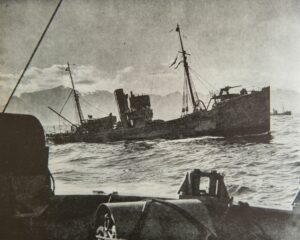
Cape Town minesweepers during WWII.
Like many South African children of my generation, I had a fascination with World War II. I built model ships and aeroplanes, played war games in our suburban garden and devoured books about the great campaigns. But I was always mildly disappointed that most of the stories were about the North, and that South Africa seldom featured in the accounts.
During my time in the navy, I began to learn a little bit about the battles fought in local waters and became interested in the exploits of South Africa’s ‘little ships’. If the actions of raiders, U-boats and convoys were soon forgotten by the general public after the war, the exploits of minesweepers and anti-submarine vessels hardly received mention at all. Yet the industrious, daily patrols by these ships kept South African ports open and took the fight to the U-boat wolf packs. It is that story that forms the backdrop to the first two Jack Pembroke adventure novels, The Cape Raider and The Wolf Hunt.