

Ahead of the publication of The Restless Wave, the fourth book in the Romulus Hutchinson Naval Adventure Series, author David Clensy takes a closer look at why Operation Pedestal was such a critical moment in the Second World War.
By the summer of 1942, Malta was perilously close to defeat. Isolated in the centre of the Mediterranean, the island had endured almost two years of relentless siege. Axis aircraft and submarines had reduced its ports, airfields and towns to rubble, while starvation and fuel shortages threatened to bring military operations to a standstill. Yet Malta remained strategically indispensable. From its harbours and airstrips, British forces could strike at Axis supply lines to North Africa, choking Rommel’s Afrika Korps just as it prepared for a decisive push towards Egypt.
Operation Pedestal was the Allies’ last throw of the dice to save the island. Conceived as a massive convoy operation and executed at extraordinary risk, it stands as one of the Royal Navy’s most hard-fought and costly triumphs of the Second World War.
It is at the heart of The Restless Wave, the fourth book in the Romulus Hutchinson Naval Adventure series: action-packed, authentic historical adventures following twin brothers fighting with the Royal Navy and the Merchant Navy during the Second World War.
Rom is now a first lieutenant, rapidly getting the chance to show his mettle on the bridge, seeing action in the Mediterranean for the Allied landings at Sicily and Salerno, as well as helping to lift the siege of Malta as part of Operation Pedestal.
In this blog, I wanted to take a closer look at why the operation was so significant.
Malta under siege
By mid-1942, Malta’s position was desperate. Previous attempts to resupply the island had suffered severe losses, with convoys harried from the air by the Luftwaffe and Regia Aeronautica, and attacked at sea by submarines and fast torpedo boats. Fuel for aircraft and ships was critically low, forcing the RAF to limit operations at the very moment when air defence was most urgently needed. Food stocks were so reduced that rationing had reached near-starvation levels for both civilians and servicemen alike.
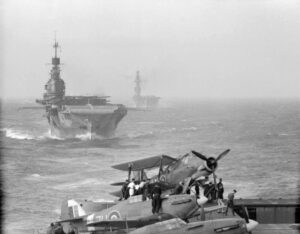
HMS Victorious’ flight deck showing HMS Indomitable and HMS Eagle
Despite this, the island continued to disrupt Axis operations. Intelligence from signals interception and reconnaissance imposed a heavy toll on shipping bound for North Africa. The Axis understood that neutralising Malta was essential. The Royal Navy knew that losing it could turn the Mediterranean decisively against the Allies.
Launched in August 1942, Operation Pedestal was the largest and most heavily escorted convoy yet to attempt to supply the island. Fourteen merchant ships were assembled, carrying food, ammunition and fuel. Their cargo included aviation fuel in bulk and, most critically, the oil tanker SS Ohio, the survival of which would prove vital to keeping the island in Allied hands.
The escort was formidable. Under the command of Admiral Sir Neville Syfret, the Royal Navy committed two battleships, four aircraft carriers, seven cruisers and more than thirty destroyers. It was an extraordinary concentration of naval power, reflecting the strategic stakes involved. Even so, planners knew losses would be heavy. The convoy had to pass through the narrow Sicilian Channel, within range of Axis airfields, submarines and surface craft.
Running the gauntlet
The convoy sailed from Gibraltar on 10 August 1942. Almost immediately, it came under attack. Axis aircraft struck repeatedly, launching coordinated bombing and torpedo attacks designed to overwhelm the escorts. U-boats and Italian submarines waited ahead, while fast torpedo boats prepared night assaults.
The Royal Navy’s carriers played a crucial early role, providing fighter cover that blunted the worst of the air attacks in the opening days. However, as the convoy pressed eastwards, the carriers were forced to turn back in accordance with operational limits, leaving the merchant ships increasingly exposed.
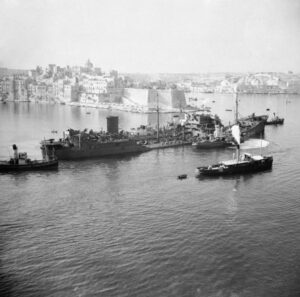
SS Ohio arrives at Malta
Losses mounted. The aircraft carrier HMS Eagle was sunk by submarine attack. Several cruisers and destroyers were badly damaged or sunk while defending the convoy. Merchant ships were picked off one by one, yet the escorts continued to fight tenaciously, laying smokescreens, counterattacking submarines and engaging enemy surface forces at close range.
At the centre of the drama was SS Ohio. Heavily damaged by bombing and torpedo strikes, the tanker was left barely afloat. Her engine failed, her deck was shattered, and she was down by the bows. Yet abandoning her was not an option. Without her fuel, Malta’s air defences and naval forces would grind to a halt.
In one of the most remarkable episodes of the naval war, Royal Navy destroyers and minesweepers refused to give up. Ohio was lashed between escorting ships and painstakingly shepherded towards Malta, under constant threat of further attack. When she finally entered Grand Harbour on 15 August, broken-backed but still afloat, she was greeted by cheering crowds. It was also the Feast of the Assumption, later commemorated on the island as the day Malta was saved.
A landmark moment
Of the fourteen merchant ships that set out, only five reached Malta. The Royal Navy suffered grievous losses: a carrier, two cruisers, a destroyer and numerous aircraft. By any conventional measure, it was a costly operation.
Yet strategically, Operation Pedestal was a success. The supplies that arrived, especially the fuel carried by Ohio, enabled Malta to survive the siege. Within weeks, the island’s air and naval forces were back in action, once again savaging Axis supply lines to North Africa. This pressure played a significant role in undermining Rommel’s offensive and set the conditions for the Allied victory at El Alamein later that year.
For Malta, the convoy became a defining moment, later recognised through the award of the George Cross to the island as a whole. For the Royal Navy, Pedestal remains one of its most hard-fought convoy battles, a stark reminder that maritime logistics, often overlooked, can determine the outcome of entire campaigns.
The Restless Wave is available to pre-order now.
Stay up to date with David’s news and latest releases here.
Image credits: Operation Pedestal Carriers and SS Ohio are from Wikimedia Commons (public domain).
Following the success of his Romulus Hutchinson Naval Adventure Series, we are delighted to have signed a new naval military series by David Clensy.
In David’s words:
“U-Boat Aces will be a sweeping, seafaring saga that charts the rise and fall of Germany’s submarine elite across two world wars.
“Spanning three decades, from 1914 to 1945, the five-book series will follow a handful of officers from idealistic cadets to disillusioned veterans, set against the relentless evolution of undersea warfare. Readers will travel the world alongside some of history’s most ruthless U-boat commanders, in a series that will be charged with the claustrophobic conditions of life aboard the German U-boat fleet.
“I am delighted to be working with Sapere Books once again on a second series of action-packed, authentic historical adventures. The team at Sapere brilliantly understand the passions of their audience, making them an absolute delight to work with.”
The Romulus Hutchinson Naval Adventures follow twin brothers fighting with the Royal Navy and the Merchant Navy during the Second World War. The third instalment in the series, The Mighty Ocean, is available to pre-order now.
Sign up to David’s newsletter and stay up to date with his news and latest releases here.
Featured image credit: German U-boat UB 14 with its crew from Wikimedia Commons (public domain).
Congratulations to David Clensy, whose thrilling war-time naval thriller, For Those In Peril, is published today!
For Those In Peril is the first book in the Romulus Hutchinson Naval Adventure series.
Liverpool, 1939
Twin brothers Romulus and Remus Hutchinson grew up in a proud seafaring Liverpool family. So when war breaks out in Europe, they are both keen to sign up and do their part.
With their parents’ consent, both boys join up on their 16th birthday in October 1939 – Romulus as an RNVR sub-lieutenant on a Royal Navy destroyer and his brother as a deck hand with their father’s employer, John Holt & Company.
But with Romulus’s sadistic training officer seemingly intent on breaking the cadets’ spirits before their careers have even set sail, he struggles with the intense training.
There is no time for doubts, however, as the two brothers are quickly thrown into combat.
With Operation Dynamo around the corner, will the Hutchinson brothers both make it out alive…? Can they make their mark as their forefathers did before them?
Or will the bottomless deep claim yet more victims…?
Congratulations to Tim Chant, whose thrilling naval adventure Vengeance at the Falklands, is out now!
Vengeance at the Falklands is the fifth book in the Marcus Baxter Naval Thriller Series: action-packed historical adventures following former Royal Navy officer Marcus Baxter during the early 1900s and through the First World War.
Winter, 1914
Lieutenant Marcus Baxter is working in the supply department at HM Dockyard Devonport, when word arrives that the German East Asia Squadron has destroyed a British squadron at the battle of Coronel.
Baxter seizes an opportunity to impress the First Sea Lord, Jackie Fisher, during a snap inspection of the dockyard and secures an appointment to HMS Astute, a scout cruiser, which is being sent to join the squadron in the South Atlantic.
Surviving a storm in the mid-Atlantic, Astute has a run-in with a mysterious passenger liner sailing under the Stars and Stripes, and duels with a German light cruiser stalking the rich hunting grounds off the South American coast.
After an intense engagement, which sees the Astute fleeing along the coast to Montevideo for emergency repairs, Baxter once again encounters the suspicious liner. And this time he is determined not to let it get away.
Baxter risks everything to sneak aboard, and makes a shocking discovery. He needs to reach the safety of the Falklands before any intelligence falls into the wrong hands.
But with the enemy on his tail, the race along the South Atlantic won’t be an easy one…
Congratulations to David Field, whose thrilling maritime adventure, Beyond The Setting Sun, is published today!
Beyond The Setting Sun is the second Tudor novel in The New World Nautical Saga Series – historical adventures set during the reign of Elizabeth I and beyond.
England, 1580
Walter Raleigh dreams of the unknown lands that lie over the distant western horizon. He had grown up believing that if you journey too far you risk falling off the side of the earth. But now, intrepid mariners are telling stories of new lands, blessed with limitless riches that await those bold enough to claim them.
Raleigh’s patron, Queen Elizabeth is easily seduced by the prospect of amassing a great fortune for her war chest and agrees to finance his quest.
But the seas are unpredictable, and when his first attempt fails, he fears his adventuring days may be over.
Weaving tales of the legendary land of El Dorado, city of gold, Raleigh successfully persuades Elizabeth to grant him a charter to explore a passage through the Americas to the South Seas.
And this time, he successfully sets up a colony in the New World.
Virginia is born, in honour of the great monarch who sanctioned its creation.
But what dangers are waiting the intrepid settlers? Will they find themselves in a new heaven – or a fresh Hell?
Congratulations to Tim Chant, whose page-turning nautical adventure, The War for Tripoli, is out now! The War for Tripoli is the third book in the Marcus Baxter Naval Thrillers series.
1911
Itinerant seaman Marcus Baxter has landed in Constantinople. Short of funds and lacking allegiance to any government, he is keen to sell his services to the highest bidder.
With Italy intent on capturing the Ottoman provinces of Tripolitania and Cyrenaica, it seems that war is on the horizon and fighting men will soon be in demand.
As a battle-hardened sailor, it isn’t long before Baxter is approached by Hiram Bogue, an American sea captain in league with the Committee of Union and Progress — an Ottoman revolutionary organisation.
Enticed by the amount of money on offer, Baxter agrees to train new recruits aboard the Residye, a proposed blockade runner, as well as overseeing the refit of the vessel.
With the growing threat of attack by the Italian navy, the assignment grows ever more dangerous.
And when war finally erupts, Baxter is forced to propel his inexperienced crew and ill-equipped vessel into action.
But with such a formidable enemy, will he survive long enough to claim his earnings…?
Justin Fox is the author of the Jack Pembroke Naval Thriller series: authentic British Navy war stories set during the Second World War.
I grew up around boats and the sea has always been an important part of my life and my writing. Our family spent holidays in an old house in Simon’s Town, the former Royal Navy base in South Africa, and from an early age I knocked about in anything that floats: rowing boats, sailing dinghies, windsurfers and yachts. My reading as a boy was also nautically orientated, particularly naval yarns by the likes of Douglas Reeman, Patrick O’Brian, Nicholas Monsarrat and CS Forester.
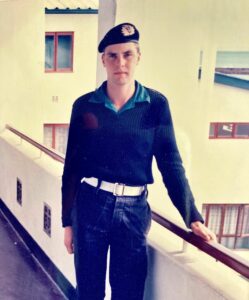
Midshipman Justin Fox, aged 17.
After leaving school, my two years of national service in the South African Defence Force were spent in the navy, based in Simon’s Town. During that period, I had six months at sea on a replica medieval caravel sailing down the Atlantic from Portugal to South Africa in a re-enactment of the voyage of Bartholomew Dias in 1487. The first book I ever wrote (never published) was the story of that voyage.
When I later joined Getaway travel magazine as a photojournalist, I volunteered for any boating assignment: sailing a brigantine around the Seychelles, a felucca down the Nile, a pirogue to Timbuktu, island-hopping by catamaran around Madagascar, taking the mail ship to St Helena Island and sailing a dhow up the Kenyan coast (which provided material for my Somali pirate novel, Whoever Fears the Sea, published by Sapere).
My Jack Pembroke series is inspired by my love of history and the sea, but I also aimed to bring to the fore a theatre of World War II that is not well known and is little written about: the fighting off the South African coast that resulted in the loss of more than 150 Allied ships.
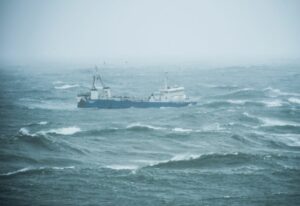
View from Justin’s flat in Cape Town.
I live in a flat in Cape Town and my desk overlooks the city’s anchorage. Watching the ships come and go each day, I often think of the war years when thousands of vessels were routed around the Cape. When a convoy was in town, Table Bay would be crammed with more than fifty ships, all of them needing protection. In place of today’s yachts and pleasure craft puttering jauntily out of the V&A Waterfront, minesweepers and anti-submarine vessels would make their daily round of the bay.
During the war, the Cape of Good Hope became a vital strategic point on the sea route around the continent and was particularly important during the North African campaign. Once Italy entered the war in 1940, the Mediterranean became too dangerous for Allied convoys, and most were diverted around the Cape. Much preparation was needed before Nazi warships made their way to Africa’s southern tip. The Royal Navy base in Simon’s Town had to be expanded and reinforced, and a fledgling South African Navy created almost from scratch.
First came the German surface raiders, then the U-boats. They attacked within sight of the coast and near the entrance to the harbours of Cape Town and Durban. There are incredible stories of heroism and cloak-and-dagger raids around our coast. For instance, one U-boat slipped into Table Bay and its captain allowed his crew on deck to see the bright lights of Sea Point (of course, all German cities were blacked out at the time). There are many apocryphal stories that surfaced in the folklore of coastal towns, such as German sailors coming ashore and playing soccer with Nazi-sympathising locals, spies passing on information about Allied ship movements and farmers replenishing U-boats around Cape Agulhas.
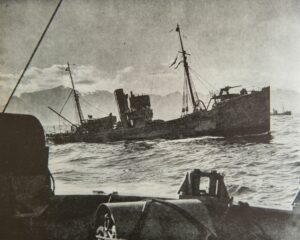
Cape Town minesweepers during WWII.
Like many South African children of my generation, I had a fascination with World War II. I built model ships and aeroplanes, played war games in our suburban garden and devoured books about the great campaigns. But I was always mildly disappointed that most of the stories were about the North, and that South Africa seldom featured in the accounts.
During my time in the navy, I began to learn a little bit about the battles fought in local waters and became interested in the exploits of South Africa’s ‘little ships’. If the actions of raiders, U-boats and convoys were soon forgotten by the general public after the war, the exploits of minesweepers and anti-submarine vessels hardly received mention at all. Yet the industrious, daily patrols by these ships kept South African ports open and took the fight to the U-boat wolf packs. It is that story that forms the backdrop to the first two Jack Pembroke adventure novels, The Cape Raider and The Wolf Hunt.