

From medieval intrigues and Tudor mysteries to absorbing accounts of momentous battles, there’s something exciting here for everyone. Scroll down to discover this month’s titles from your favourite Sapere authors.
March’s Fiction Releases
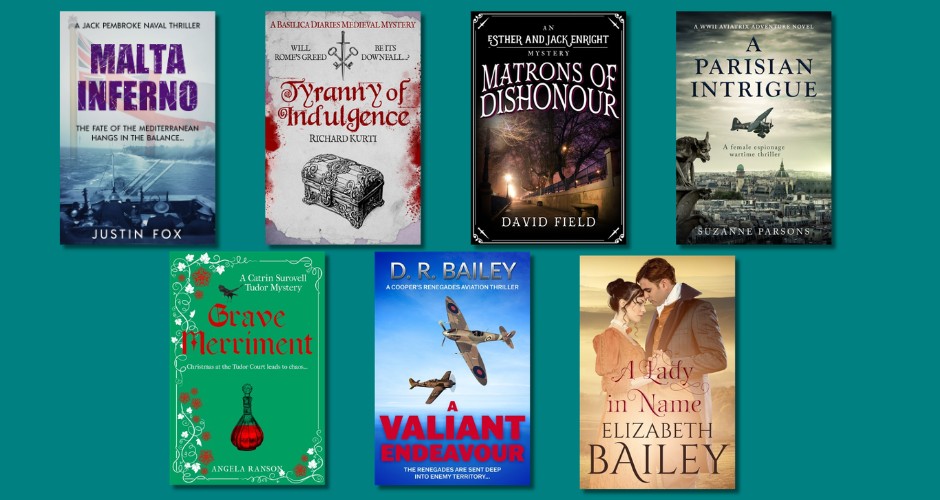
Malta Inferno by Justin Fox is the fourth book in the Jack Pembroke Naval Thrillers series. In this instalment, Lieutenant Jack Pembroke and his small escort ship, HMSAS Southern Gannet, join a secret convoy from Egypt to relieve the beleaguered island of Malta.
Tyranny of Indulgence by Richard Kurti is the fifth book in the Basilica Diaries Medieval Mysteries series. Determined to accelerate the building of St Peter’s Basilica, the new Pope, Leo X, initiates the selling of indulgences, whereby the rich can buy forgiveness for their sins.
Matrons of Dishonour by David Field is the thirteenth book in the Esther & Jack Enright Mysteries series. Jack is tasked with assuring his superiors that rumours of unlawful assaults on suffragettes in police custody are baseless. But when he learns otherwise, he is obliged to reassess his loyalties.
A Parisian Intrigue by Suzanne Parsons is the first book in the WWII Aviatrix Adventures series. Miriam Nugent and her fiancé, Archie Bowater, are both doing their bit for the war effort. While Archie struggles to get to grips with flying Spitfires, at Bletchley Park Miriam quickly makes her mark fixing the machines that will decode enemy messages.
Grave Merriment by Angela Ranson is the third book in the Catrin Surovell Tudor Mystery series. It’s Christmas at Whitehall Palace, but Lady Catrin Surovell cannot find her celebratory spirit. The queen has asked her to stop a brute who has forced the waifs of London to work for him. And it seems the culprit may be someone at court…
A Valiant Endeavour by D. R. Bailey is the second book in the Cooper’s Renegades Aviation Thrillers series. American pilot Cooper Donahue has been sent to the RAF base at Banley to train with the British Mavericks Squadron. Before long, he finds himself flying sorties along the Sussex coast, where the threat of dogfights with the Germans lurks around every corner.
A Lady in Name by Elizabeth Bailey is a heart-warming Georgian romance. When Lucinda Graydene’s father imparts a shattering secret on his deathbed, her world is turned upside down. Bereft, she confronts the author of her unorthodox origins — but instead she finds his heir. And the autocratic Stefan Ankerville, Earl of Pennington, takes charge of her life, despite her protests.
March’s Fiction Backlist Releases

We are pleased to announce that the fourth, fifth and sixth instalments of H. Jay Riker’s gripping SEALS: The Warrior Breed series are out now. Don’t miss these action-packed military adventures, following the U.S. Navy’s elite commando demolition unit.
March’s Non-Fiction Releases

Fighter Pilots of the RAF by Chaz Bowyer is a powerful and deeply human portrait of the men who risked everything in the skies over Europe. Drawing on meticulous research, Bowyer goes beyond the famous names to uncover the untold stories of twenty pilots — many of whom received little public recognition, yet were crucial in the fight against the Luftwaffe.
The Burnside Expedition in North Carolina by Richard A. Sauers is a definitive account of Union General Ambrose E. Burnside’s North Carolina Campaign — a pivotal moment in the American Civil War.
A Short History of the Arab Peoples by Sir John Bagot Glubb draws on the author’s considerable knowledge of the Arab world gleaned from his time spent living and working in the region to explore its history, culture and politics. Spanning from the seventh century to the mid-twentieth century, this book brings to life several tumultuous and extraordinary periods of history.
Hunters From the Sky by Charles Whiting tells the fascinating true story of the Fallschirmjäger — the elite German Parachute Corps — and their role during the Second World War, 1940–1945.
Trafalgar: Nelson’s Great Victory by Donald Macintyre charts the dramatic prelude to the momentous battle — from Horatio Nelson’s rise to fame at the battles of the Nile and Copenhagen, to Pierre-Charles Villeneuve’s bold attempt to unite French naval forces in the Caribbean, before slipping past the British blockade to challenge their command of the seas.
Happy Reading! Team Sapere
From medieval adventures and Gothic mysteries to gripping accounts of military heroism — there’s something exciting here for everyone. Scroll down to discover this month’s titles from your favourite Sapere authors.
December’s Fiction Releases

Death at the Altar by Donna Gowland is the third book in the Mary Shelley Investigations. In this instalment, Mary puts her grief aside as she and Percy investigate the murder of a curate at a friend’s wedding.
The Tipping Point by D. R. Bailey is the first book in the Cooper’s Renegades Aviation Thrillers, action-packed aviation adventures set during the Second World War and featuring a team of fighter pilots. When war is declared on Japan by the U.S., American pilot Cooper Donahue soon finds himself in the thick of the action.
Mutiny at the Manor by Cara Clayton is a thrilling tale of romance and rebellion in medieval England. Will this troubled period in history bring ruin to all Elizabeth Amundeville holds dear?
The Rapids and the Abbey by Patrick Larsimont is the sixth book in the Jox McNabb Aviation Thrillers. In this instalment, fighter pilot Jox McNabb takes to the war-torn skies of Italy and the capture of Monte Cassino.
The Prisoner of Raven’s Gaze Hall by J. C. Briggs is a gripping Gothic novel set in Yorkshire. When Catherine Sisley arrives at Raven’s Gaze Hall to nurse an elderly lady, she soon realises that the house — and its occupants — are not all they seem.
The Footlights Murder by David Field is the twelfth crime thriller in the Esther and Jack Enright Mysteries. In this instalment, Jack and Esther take up amateur dramatics in an attempt to track down a murderer and clear Jack’s sister’s name.
December’s Fiction Backlist Releases

We are delighted to announce that the first three instalments in William H. Keith Jr’s adrenalin-fuelled SEALS: The Warrior Breed series are out now! Don’t miss these action-packed military adventures following the U.S. Navy’s elite commando demolition unit.
December’s Non-Fiction Releases

A Captain’s War by Herbert M. Schiller is the remarkable first-hand account of life as a young Confederate officer during the brutal years of the American Civil War.
Disaster at Kasserine by Charles Whiting is a dramatic account of the Allied disaster at Kasserine Pass, where inexperienced American troops clashed with Rommel’s battle-hardened Afrika Korps in North Africa.
Admiral Rodney by Donald Macintyre is a fascinating biography chronicling the life of one of England’s greatest sea commanders, famed for his decisive victory over the French at the Battle of the Saintes during the American War of Independence.
Men of Bomber Command by Chaz Bowyer tells the epic, untold story of the Allied bomber crews who helped turn the tide of World War Two.
Fighting for Defeat by Michael C. C. Adams provides a new perspective on the American Civil War and the reasons behind the Union Army’s early defeats, despite its superiority in manpower, wealth, and industry.
Happy New Year and Happy Reading! Team Sapere
C. F. Dunn is the author of The Tarnished Crown Series: Wars of the Roses historical fiction set in Medieval Europe.
“Double, double toil and trouble” — Shakespeare’s famous refrain from Macbeth — remains one of the most recognisable lines in Western literature. When it was first performed in the early seventeenth century, Shakespeare was drawing on a long tradition of folklore and belief that his audience would have immediately understood. Even if some of the finer details escaped them, they knew the framework: witchcraft, prophecy, and the unsettling idea that unseen forces might determine human fate.
Fast forward to the twenty-first century, and many still imagine witches as medieval figures — women ducked, pricked, and burned amid cries of superstition. In truth, the great witch hunts of Europe belong not to the Middle Ages but to the Early Modern period, from the sixteenth century onwards. From a medieval perspective, witchcraft as we now think of it was relatively uncommon. The frenzied persecutions of later centuries would have seemed alien to most people of the fourteenth or fifteenth centuries.
In fifteenth-century English law there was no specific statute making witchcraft a capital offence. The Church regarded it largely as a form of heresy — a spiritual error, not a criminal conspiracy. It was not until the Witchcraft Act of 1542 that England paved the way to criminalise witchcraft as punishable by death. Before then, most cases resulted only in fines, penance, or public admonition.
The meaning of ‘witchcraft’ in the Middle Ages also differed from the later concept. The boundary between magic and medicine was fluid. Healing practices incorporated charms, incantations, astrological timing, and a range of -mancies — divination by fire (pyromancy), by names (onomancy), or by reflections in mirrors or water (scrying). Medieval healers drew on classical learning, Christian devotion, and folk wisdom alike. A prayer could be as powerful as a potion, an amulet as trusted as a relic.
This was not sorcery in the later, sinister sense, but an expression of a worldview in which the divine and natural worlds were deeply intertwined. The medieval cosmos was one in which the supernatural existed alongside the physical — a realm of possibilities where God, angels, and spirits could all play a part in human health and fate.
By the later Middle Ages, however, witchcraft and divination began to intersect with politics. When accusations touched those close to the throne, the implications became far more serious. The Church might have seen such practices as misguided or at worst, heresy; the state viewed them as potentially treasonous.
Terminology was crucial. ‘Witchcraft’ often implied healing or protection and was tolerated to a degree. But necromancy—a form of divinationthat involved summoning the dead to foretell the future — crossed a dangerous line. When divination involved predicting the monarch’s death, it fell under the crime of “compassing or imagining the death of the king”, one of the key clauses of Edward III’s Treason Act of 1352. Necromancy became not only a spiritual threat but a political weapon.
An infamous example is that of Eleanor de Cobham, Duchess of Gloucester. Accused in 1441 of “treasonable necromancy” for attempting to divine the death of Henry VI, she was sentenced to life imprisonment. Her alleged accomplice, Margery Jourdemayne, the Witch of Eye, was convicted of heresy and burned at the stake. Eleanor’s real offence, however, was more political than supernatural: she denied the allegations of necromancy and treason, but admitted to having sought potions to help her conceive a child with her husband, Humphrey, Duke of Gloucester, whose proximity to the line of succession made him many enemies.
Eleanor’s case was not unique. Similar accusations were levelled against Walter Langton, bishop of Coventry and Lichfield in the early fourteenth century, and later against Jacquetta of Luxembourg and her daughter Elizabeth Woodville, queen to Edward IV. Each was a figure of power and influence, close to the throne and a focus for political attack. When an enemy could not be defeated in open conflict, an accusation of sorcery could prove equally effective and more difficult to defend.
In 1477, the Oxford scholar John Stacy, a man with previous form and known as a magnus necromanticus (great sorcerer) and astrologer of repute, was accused of “imagining the king’s death by necromancy.” Under torture he implicated Thomas Burdet, a member of the household of George, Duke of Clarence, brother to King Edward IV. It was perhaps no coincidence Burdet was also a main suspect in the penning and deployment of seditious writings that questioned Edward IV’s legitimacy and his right to rule — as well as that of his heir.
The oft quoted, but unsubstantiated Prophecy of G has also been linked with subversive writings supposedly foretelling that Edward IV’s rule would be followed by someone with a name beginning with G. As Edward’s son and heir was another Edward, the prediction in itself was treasonable.
It might have been an unfortunate coincidence for the hapless duke that his name was George, or perhaps convenient for those who would malign him before — or after — his death. Whether the Prophecy of G was merely apocryphal, the reference to it in later writings nonetheless reflected a common perception that the power of divination could — and did — exist.
When Clarence publicly defended Burdet and questioned the justice of his trial, he drew attention to himself. His criticism of royal authority and his association with alleged necromancers were enough to throw his loyalty to the Crown into question. Nor did Clarence hold back from accusing Edward of using the black arts to “poison his Subgettes, suche as hym pleased”.
Were accusations of witchcraft and necromancy simply cynical tools to eliminate rivals? At times, perhaps, yet they also reflected genuine belief. When Henry VI heard predictions of his own death, he did not dismiss them as nonsense or political machinations; he ordered his astrologers to investigate. To medieval minds, the natural and supernatural were interwoven. The heavens, the body, and the soul were all thought to lie under divine influence — and, by extension, vulnerable to darker forces.
The fear of the dark arts in late medieval England was not born of ignorance but of imagination — the conviction that unseen powers could alter the course of events. To “imagine the king’s death” through necromancy was not simply treasonous speech; it was a symbolic act that might disturb the divinely ordered world. The real danger from divination in the later Middle Ages was not the village healer or the cunning woman, but the whisper of sorcery at the heart of the royal court.
Notes
The question of magic and politics in England during the later medieval period challenges my ability to encapsulate such a myriad and vast subject in so short a blog. For the curious, there are many useful works available, including the few listed below:
Courting Disaster: Astrology at the English Court and University in the Later Middle Ages by Hilary M. Carey, Palgrave Macmillan, 1992
‘Medieval necromancy, the art of controlling demons’ by Sebastià Giralt. View via Sciencia.cat: https://www.sciencia.cat/temes/medieval-necromancy-art-controlling-demons
Magic in the Middle Ages by Richard Kieckhefer, Cambridge University Press, 2021
‘Thomas Burdet of Arrow, MP for Warwickshire in 1455, and the execution of George, duke of Clarence’ by Simon Payling: https://historyofparliament.com/2022/08/02/thomas-burdet/
‘Witch Hunts in Medieval England: The Trial of Walter Langton’ by Kathryn Walton: https://www.medievalists.net/2021/03/witch-hunts-medieval-england/
Magic as a Political Crime in Medieval and Early Modern England by Francis Young, Bloomsbury, 2020
We are delighted to announce that we have signed a Viking trilogy and Medieval Templar series by Michael Burr.
In Michael’s words:
“I’m thrilled about joining the Sapere family of authors, because not only is that how the company has been represented to me, but it’s also the impression created by my first contact with Amy, Caoimhe and Natalie. I care a great deal about historical fiction and I believe that readers of that genre really tend to know their stuff, so Sapere’s reputation for excellence in matters editorial, cover design and marketing certainly lives up to that standard.
“As someone who made a career out of teaching History, I’m fussy about the twin imperatives of telling interesting stories and telling them properly. Central to this is keeping real people and their motivations as the focus, because those tend not to change, whatever else does. In fact, that’s the central premise of my trilogy, Chronicles of the Scraeling, in which a disabled teenager is snatched as a trophy from a French convent devastated by a band of marauding Vikings. His initial and derisory nickname of ‘scraeling’ becomes a badge of acknowledgement and respect among his gung-ho pagan companions through his ability to manipulate and outmanoeuvre acquaintances, enemies, and the occasional friend using an outrageous mixture of intelligence, cheek, bluff and superb man-management.
“His story rollicks in three volumes through most of the eleventh century and any number of unscrupulous kings, scheming empresses and demented eunuchs. The books encompass genuine history, graphic violence, outright comedy and even bits of down-home ordinariness.
“Similarly, I was prompted to write my Medieval Templar series by my fascination with the legendary appearance of a phalanx of Templar knights on the battlefield of Bannockburn. Where did these elite and terrible warriors of the medieval period come from? Why were they there, especially since they were supposedly dispersed, proscribed and persecuted years before? And what happened to the fabled and fabulous treasure of an Order that produced history’s first capitalists?
“So many questions, and my story of the life of the first, secret Master of the Temple after it was driven underground, is sort of an answer to them.”
Visit Michael’s website to stay up to date with his news and latest releases.
Congratulations to Cara Clayton, whose absorbing historical saga, Mistress of the Manor, is published today!
Mistress of the Manor is the first book in the Tapestry Tales Medieval Saga: English historical fiction set in the fourteenth century.
1342, Lincolnshire, England
Clémence Masson has always yearned for more than her expected marriage to an apprentice or farmer’s son.
So when an opportunity arises at the nearby Grimsthorpe Manor House to be a companion to a newly-arrived bride-to-be, Clémence is excited by the opportunity.
The young bride is soon to be handfasted to the lord of the manor, Ruadhán Amundeville, who is recently returned from battles with the Scots.
Ruadhán’s uncle Aedric has been overseeing the estates in the young lord’s absence, and it soon becomes clear to Clémence that Aedric does not have Ruadhán’s best interests at heart.
But Clémence does. She has found herself falling for the charming lord of Grimsthorpe.
When Ruadhán leaves for war with the French, Clémence is left with Emma to deter Aedric’s unwanted advances.
And with the Black Death threatening, all of their lives could be at stake…
Will Clémence achieve her dream of rising above her station? Could Grimsthorpe hold the key to her happiness?
Or will the darkness surrounding the manor destroy everything in its grasp…?
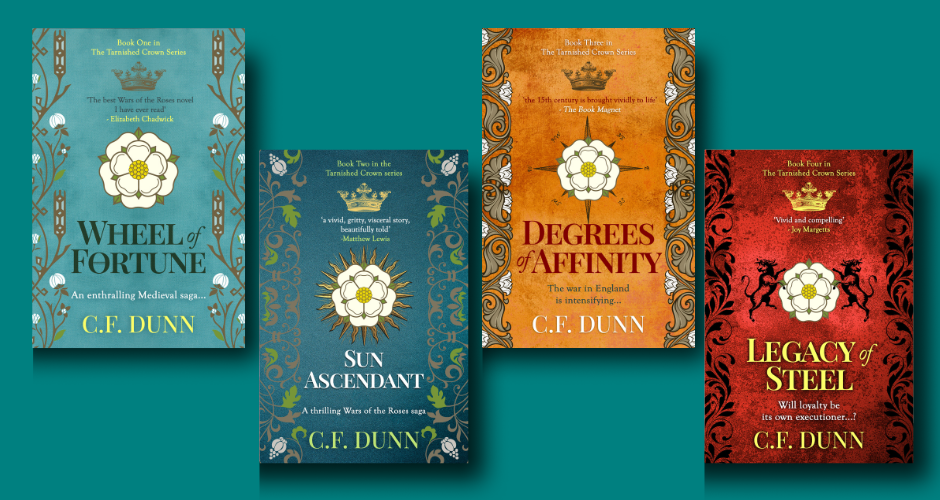
We are thrilled to announce that we have signed the next three books in The Tarnished Crown series by C. F. Dunn.
Set during the Wars of the Roses, the series follows Isobel Fenton — a brave and determined heiress — and the intrigues that surround her.
In Dunn’s words:
“I am delighted to continue working with the team at Sapere Books to bring the Wars of the Roses and this tempestuous period in English medieval history to life.
“I take the view that everything that happened in the past resonates down the centuries. The great names in history didn’t exist in isolation, but were part of a rich web that made up as complex a society as any that exists today. It is relationships at every level that enabled society to work, and when these broke down, conflict ensued. And like people throughout time, actions were driven by love and loyalty, fear, feuds and ambition.
“The next three books in The Tarnished Crown series see Isobel and her beloved Robert confront unforeseen twists of fortune, testing their allegiance to the Crown and to each other as England faces challenges from abroad and treachery at home. And when those closest to the throne call upon Robert and Isobel’s support, bonds of friendship and fealty are stretched to breaking point.”
Congratulations to C. F. Dunn, whose powerful medieval saga, Sun Ascendant, is out now!
Sun Ascendant is the second book in The Tarnished Crown series: historical novels set during the Wars of the Roses.
1470, England
England is in turmoil as the battle between supporters of the Yorkist king, Edward IV and the old Lancastrian king, Henry VI escalates.
And for Isobel Fenton the war is personal. Her father’s sudden death made her an heiress to Beaumoncote Manor, a desirable estate in the midlands. But as conflict threatens England’s unstable peace, Isobel and her lands become the focus of bitter tensions and a long-held feud.
Taken from her manor, Isobel becomes the unwilling mistress of an indomitable Earl. Unable to protect her own lands or herself, she sees her only chance of happiness in the Earl’s brother, Robert Langton, newly sworn to serve Richard, Duke of Gloucester.
Isobel’s life in the castle becomes increasingly difficult as the Countess plots against her rival, and Isobel finds herself trapped and alone in her gilded prison.
She is determined to take her fate into her own hands, but how can she gain her freedom and find her way back to Beaumoncote…?
Congratulations to Richard Kurti, whose absorbing medieval adventure, Carnival of Chaos, is out now!
Carnival of Chaos is the fourth book in the Basilica Diaries Medieval Mysteries series: historical thrillers set in fifteenth-century Rome and featuring a brother and sister investigative duo.
1508, Rome
An abandoned ship is drifting in the mouth of the Tiber and a horrific discovery is found inside.
Nearly three-hundred men were packed together in the hold. All of them are dead.
They were migrant workers shipped over from North Africa, cheap labour to cut the cost of building St Peter’s Basilica, and all have died in the most horrendous circumstances.
The Vatican is desperate to distance itself from this atrocity. The guilty contractor must be found and punished, and the entire illegal trade in people must be stamped out.
The Pope charges his Head of Security, Domenico Falchoni with conducting a full investigation.
Domenico turns to his scholar sister Cristina for help and together they delve into the grudges and rivalries of the old dynastic families who are competing for building contracts for the great basilica.
Cristina and Domenico discover that dirty tricks extend across all aspects of the great construction and corruption is rife. So it is not easy to find out who is responsible for the horrific deaths of the migrant workers.
Can they protect other workers from untimely deaths? Will they expose those responsible?
Or will digging into the dark world of human trafficking put their own lives at risk…?
A few weeks ago, I was standing outside St Peter’s Basilica in Rome, gazing at the ancient Egyptian obelisk that sits in the middle of the square. (It’s also on the front cover of Omens of Death — the first book in The Basilica Diaries series.)
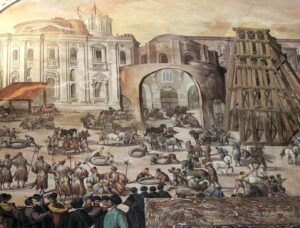
A fresco in the Vatican depicting preparations for the erection of the obelisk in front of St Peter’s Basilica. Photograph taken by Richard Kurti.
The guide who was showing me round said, “There’s an interesting story about this obelisk. When Moses was a young man, he was educated in Heliopolis (modern Cairo), where this obelisk originally stood. As he hurried back and forth to school, Moses would have seen this very stone every day. Even then it was a thousand years old. He would have walked past it, used it as a meeting point for friends, maybe even sat in its shade.
“Now, cut forward across time. The Romans have stolen the obelisk and brought it to Italy, where the Emperor Caligula ordered it to be set up at the Circus of Nero just outside the city walls. And that is the same place where St Peter was executed. Which means the very last thing St Peter saw before he died would have been this obelisk. And now you are gazing at the exact same stone.”
I could feel my brain jolt. Moses, Caligula, St Peter and myself, all connected across 4,500 years by a single object. These were no longer remote characters from the pages of the Bible — if I reached out my hand, I could touch them through this granite obelisk.
What the guide did was a brilliant demonstration of the power of narrative. He could have bombarded me with facts and figures about the height and weight of the obelisk, about where the stone was quarried and when it was carved, and how it was moved from the Circus of Nero to its current site and erected in a single day.
But he didn’t, because he knew that those facts would have gone in and out of my mind in seconds. Instead, he told a story that organised the truth in such a way that it connected me to the distant past.
That’s what I’ve been attempting to do on every page of The Basilica Diaries historical thrillers. I have spent countless hours researching the novels, but rather than bombard the reader with details, I have tried to organise the truth into narratives that will resonate with the modern world whilst also transporting us back across the centuries.
I hope you enjoy the latest adventure in the series, Carnival of Chaos, which will be published in April.
Congratulations to C. F. Dunn, whose thrilling War of the Roses saga, Wheel of Fortune, is out now!
Wheel of Fortune is the first book in the Tarnished Crown series: historical novels set in medieval Europe.
1469, England
For almost ten years, attractive and charismatic Edward IV has ruled with the Earl of Warwick’s support, but now rebellion threatens England’s fragile peace.
With the Midlands in uproar, King Edward wants peace in the shires and the last thing he needs is potential trouble in the form of an unwed heiress.
But, strong-willed and single-minded, Isobel Fenton is determined that nothing will separate her from her beloved manor of Beaumancote, even if she does have to marry to stay there.
Isobel is unaware of the importance she and her land represent, nor of the agenda of the formidable Earl in whose care she finds herself.
And as unrest boils into war, she is drawn into the very heart of the conflict.
Can Isobel escape from the web in which she is trapped? Will she find a way to decide her own fate?
Or will the Wheel of Fortune fail to turn in her favour…?
Congratulations to Isolde Martyn, whose enchanting medieval romance, The Lady of Mirascon, is out now!
1208
When cruel King John makes advances on her, young Adela de Whitchurch is forced to flee her comfortable position as hairbraider to the Queen of England.
After stowing away on a ship, Adela finds herself in France. Surviving on her wits and courage, she is soon accepted into the retinue of Lady Alys FitzPoyntz — a noblewoman who is on her way to meet her betrothed, Lord Ricart, Vicomte of Mirascon.
On the journey, disaster strikes when the party is attacked by brigands. As one of the only survivors, Adela decides to make her way to Mirascon to deliver Lady Alys’s jewels to Lord Ricart and throw herself on his mercy.
But when the vicomte mistakes Adela for his betrothed, she is swiftly pulled into a web of deception. With Mirascon threatened by the Pope’s brutal crusade against heretics, Lord Ricart is occupied with protecting his people, and Adela is unable to find an opportunity to tell him the truth.
And as she begins to fall for his charm and passion, she wonders whether she will ever summon the strength to leave his side…
Will Lord Ricart discover Adela’s true identity? Can he return her love?
Or will Adela’s deception cost her her life?
In this behind-the-scenes blog series, Sapere Books authors offer an intriguing insight into how, where and why they write.

Isolde’s writing space
Today, we are delighted to spotlight Isolde Martyn, the author of a number of historical novels including The Lady and the Unicorn and The Knight and the Rose.
Instead of looking out at rose bushes and oak trees or hearing blackbirds, I face an office window that is flanked by palm lilies, and the bird noises come from kookaburras and sulphur-crested cockatoos. None of which is very helpful when I am attempting to describe a scene in fifteenth-century England or thirteenth-century France. Living in Sydney, my research is limited to the occasional overseas trip or the internet. Fortunately, the latter is so fantastic these days and British History Online is now one of my go-to places.
Inspiration? Visiting Carcassonne and Minerve in France and hearing how the Northern French crusaders ransacked the land of the troubadours. Or sometimes it’s someone’s talk quivering my antennae. My second novel, The Knight and the Rose, resulted from hearing a fellow historian cite a rare medieval divorce case that involved a ‘green card’ situation. My third book, The Silver Bride, was hatched from reading of a daughter dressing in armour to fight a duel for her cowardly dad, plus wondering what it would have been like to be a clairvoyant woman back in the 1480s. The Golden Widows arose out of a friend taking me to visit Shute Barton in Devon and hearing about Warwick the Kingmaker’s youngest sister losing seven menfolk in battle. That gave rise to the idea of two young widows on opposite sides in the Wars of the Roses in the early 1460s: Katherine Neville and Elizabeth Woodville.
 Historical novelists tend to go over the ground with a metal detector trying to find new angles. It becomes a challenge, especially with the Tudors. Fortunately, the character who was trying to get my attention was from the previous century and one of history’s most mysterious wheelers and dealers, the twenty-nine-year-old Duke of Buckingham, Richard III’s cousin, and so the tale of a villain and a loser came to life in The Devil in Ermine.
‘Write a woman next, a shameless gold-digger,’ suggested my agent. It didn’t work. Instead, on further acquaintance that most appealing of royal mistresses, Elizabeth Lambard — aka ‘Shore’s wife’ — took charge of the writing, and away we went with Mistress to the Crown.
I still envy novelists living in the UK for being able to easily do location research, but living in Australia hasn’t stifled my lifelong interest in… Oh, there goes another kookaburra!
Congratulations to David Field, whose gripping historical mystery, The Slaughtered Widow, is published today!
The Slaughtered Widow is the third instalment of the Bailiff Mountsorrel Tudor Mystery Series – private investigation crime novels set during the reign of Elizabeth I and beyond.
Nottingham, England, 1592
Town Bailiff Francis Barton has been arrested for the murder of his former lover, the widow Agnes Timberlake, and the case against him is a strong one.
Agnes was hacked to death where she lay in her bed and Francis was found standing next to her body, with both his clothing and his sword covered in her blood.
And there is a motive. Agnes had recently loaned Francis her entire life savings and was believed to be demanding an accounting for them.
Despite the overwhelming evidence against him, Francis’s friend, County Bailiff Edward Mountsorrel, refuses to believe that Francis is guilty and sets out to investigate for himself.
Edward wants to speak to the serving girl from the widow’s house who may have been the last to see her mistress alive, but she has vanished.
Is the girl running from a guilty conscience? Or has she also fallen victim to the killer?
Time is running out for Francis. Can Edward clear his friend’s name … or is it time to accept that Francis really is capable of murder…?
Congratulations to Daniel Colter, whose page-turning Crusader adventure, Blood of Lions, is published today!
Blood of Lions is the third book in the Knights Templar Thriller series.
Jerusalem, 1186
Baldwin V, the Boy King of Jerusalem, is dead and the nobles of the Crusader States scheme to fill his empty throne.
Alliances are fraying and in the midst of the politicking, the Templars, and their brother order, the Hospitallers, suffer a humiliating defeat at Cresson Springs, weakening both Orders.
All the while, in Damascus, the Sultan Saladin scents blood on the air and prepares to make good on his vows to reclaim the Holy City.
Templar knight Finn of Struan has been tasked with venturing across The Black, the no-man’s land between Christian and Muslim territories, to find Saladin’s war machine and assess its threat.
The balance of power in the Holy Lands is tipping. Two forces are converging on the Horns of Hattin, where the fate of a kingdom will be decided.
Finn must wade into a bloody fight and commit pitiless deeds, while relying on the loyalty of his brothers…
Will Finn emerge victorious? Can the Brotherhood prevail?
Or will Saladin finally fulfil his deadly promise?
Austin Hernon is the author of The Wars of the Magna Carta series — military historical sagas — and the Berengaria of Navarre Medieval Trilogy: early Plantagenet novels set during the Third Crusade and the reign of Richard the Lionheart.
For the second instalment of my Berengaria of Navarre trilogy, The Abandoned Queen, I wanted to provide a little historical background. Why did England have a Basque queen between 1191 and 1199? Queen Berengaria didn’t chase or lobby for that crown. She was fully occupied managing her widowed father’s court.
Her father, King Sancho VI of Navarre was an enlightened man and ensured that all his children received the same comprehensive education. Therefore, by the time she was in her twenties, Berengaria was educated, multilingual, intelligent, and a keen observer of European politics and diplomacy of the time. The person who invited her to become Queen of England was none other than Richard the Lionheart’s mother: the dowager Queen of England, Eleanor of Aquitaine. She, the matriarch of the Plantagenet dynasty, was anxious to preserve the royal bloodline. With Richard already bound for Palestine, there was no guarantee he would return, and she was also determined to keep the runt Prince John off the throne.
But why was Richard bound for the Holy Land? The answer to that lies in the Third Crusade. Pope Gregory VIII called for the Crusade, which was intended to conquer the Holy Land and bring it under Christian control. Three kings responded to his call: King Phillip II of France; Frederick I, the Holy Roman Emperor; and Richard I of England.
A glance at a map of the time reveals that the kingdom of Navarre abutted Eleanor’s duchy of Aquitaine. In proposing that Berengaria marry Richard, Eleanor was able to satisfy her desire for a daughter-in-law and secure a useful ally on her southern border. And what princess would refuse the opportunity to be made a queen?
Once Berengaria had agreed to the plan, she and Eleanor set off together in hot pursuit of the war-bound king. And what an unexpected adventure the brave princess had volunteered for.
We are thrilled to announce that we have signed a series of Medieval sagas by Isolde Martyn.
Isolde is the author of nine novels and, recently, a history picture book for children. Her debut novel, set during the Wars of the Roses, won significant awards in the USA and Australia.
In Isolde’s words:
“The Wars of the Roses era is often overshadowed by the Tudor century, yet it is full of so many fascinating people, so I am delighted that Sapere Books are republishing my novels set in this time period. There are some strong, fantastic women I’d love readers to get to know better: Mistress Shore, seeking a way out of a loveless marriage; young mothers Elizabeth Woodville and Katherine Neville, struggling to survive in the aftermath of battles that took their husbands; and Margaret Neville, Warwick the Kingmaker’s bastard daughter, secret agent in France for the King of England.
“It’s a great pleasure to be working with the wonderful team at Sapere books and I look forward to getting to know my fellow authors and Sapere’s great family of readers.”
Richard Kurti is the author of the Basilica Diaries Medieval Mysteries series: historical thrillers set in fifteenth- and sixteenth-century Rome and featuring a brother and sister investigative duo.
Donato Bramante (1444-1514) was the brilliant architect who designed St Peter’s Basilica in Rome and oversaw the initial stages of construction. If you could put him in a time machine, bring him forward five hundred years, and lay out the current problems of the HS2 railway line before him, I doubt he would be very surprised. Bramante discovered the hard way that huge, ambitious construction projects that test the limits of technology always run into the same dilemmas and have the same questions hanging over them:
Why build it at all?
Isn’t the existing structure good enough?
What philosophy should drive the new project?
How can you prevent the costs ballooning out of control?
Will the public lose interest and turn against you?
How will you cope with unforeseen complications?
How will you prevent corrupt builders skimming off vast sums for their own personal enrichment?
Take a moment to think about building something like St Peter’s without the use of computers, high-powered machinery or sophisticated scientific instruments. It took one hundred and twenty years, and Bramante was long dead by the time it was completed, but its construction was still a lot quicker than Notre Dame Cathedral in Paris, or York Minster. And once built, these cathedrals have stood the test of time. How many railway lines will still be operating half a millennia after they were constructed?
The triumph of this superhuman achievement inspired me to write a series of novels centred on the construction of St Peter’s. Each murder mystery swirls around a different theme linked to the vast building project. Omens of Death explores the morality of building St Peter’s in the first place; Palette of Blood focuses on the vicious battle between artists competing to design it; and the newest book, Demon of Truth, shows what happens when you make a catastrophic discovery mid-construction.
Although the novels are fictional thrillers, I spent a lot of time doing research to find elements that grounded the stories in the sixteenth century, but also resonated with the dilemmas of the modern world.
So, the next time you find yourself on a rail replacement bus service, why not download some Basilica Diaries to while away the time?
Congratulations to Austin Hernon, whose page-turning Medieval saga, The Lionheart’s Bride, is out now!
The Lionheart’s Bride is the first novel in The Berengaria of Navarre Medieval Trilogy: early Plantagenet novels set during the Third Crusade and the reign of Richard the Lionheart.
1191
Eleanor of Aquitaine sets her sights on Berengaria, Princess of Navarre as a potential bride for her son, Richard the Lionheart.
Richard is determined to make his mark crusading, and might not return, so Eleanor is keen to see an heir on the way to stop his feckless younger brother John from inheriting the kingdom.
Richard is not averse to his mother’s plans for the succession, but his priority lies in fulfilling his reputation as an indomitable warrior.
Berengaria is charmed by the prospect of travelling to a distant land to marry a handsome king of a distant land but she finds she has to accompany Eleanor in a race across Europe to catch her elusive bridegroom.
War on land, storms at sea, and the risk of alienating a conniving Pope go only some way to preparing Berengaria for life with the crusading Lionheart.
Will Richard’s blood-fuelled ambition be compatible with the husband Berengaria dreams of? Can she make her mark under Eleanor’s wing?
Or will she find her new life to be a lot more than she bargained for…?
Congratulations to Daniel Colter, whose gripping historical adventure, Brotherhood of Wolves, is published today!
Brotherhood of Wolves is the first instalment of Knights Templar Thrillers series: action-packed Crusader novels set during the Medieval era.
Jerusalem, 1177
The Holy City is in Christian hands and the Sultan Saladin has vowed to retake her, whatever the cost.
Two faiths are warring over sacred ground. It is within this feverish hotbed that Finn of Struan, a young knight dedicated to the Templars, is stationed.
Finn’s world unravels when his mentor, Robert of Saint Albans, murders a brother in cold blood. Worse, Robert joins the Devil himself — Saladin.
The foul deeds stain the Templar name and Finn is tasked with killing Robert, a man with a mind sharper than any sword.
But as Finn slips into enemy territory, he finds the hunter has become the prey…
As Templar fights Templar for control of the Holy City, can Finn avenge his dead comrade? Will the Brotherhood prevail?
Or will Saladin’s army emerge victorious?
Congratulations to David Field, whose gripping historical saga, The Absentee King, is published today! The Absentee King is the fifth book in the Medieval Saga series.
England, 1189
Richard the Lionheart has been crowned King of England.
But his obsession with fighting in the Third Crusade sends him off to foreign lands.
The nation is left in a perilous state, with high public offices sold off, and trusted favourites left to rule during Richard’s absence.
Richard’s dissolute and envious younger brother John feels humiliated, not least when Richard declares his four-year-old nephew Prince Arthur to be his heir, and he causes unrest throughout the nation by enforcing harsh laws designed to keep the population under his iron fist.
Chief Justice, Earl William of Repton, is ordered to investigate the possibility that John is seeking to undermine his brother Richard’s rule.
And when news reaches England that King Richard has been captured, and is being ransomed by Henry VI of Germany, William becomes convinced that John is plotting to seize the English crown.
Will Richard be released? Will he return to claim his throne?
Or will John succeed in his mission to overthrow the absentee king…?