

From historical sagas and legal thrillers to a pilgrim’s journey across France and Spain, there’s something exciting here for everyone. Scroll down to discover this month’s titles from your favourite Sapere authors.
May’s Fiction Releases

The Crowned Viper by Amy Licence is the sixth book in the Marwood Family Tudor Saga Series, set at Henry VIII’s court. When her uncle dies, newly-married Thomasin travels to London to settle his estate, and once more finds herself at the centre of court intrigue.
Shadows at the Manor by Cara Clayton is the third book in the Tapestry Tales Medieval Sagas. After a spate of robberies occur on the roads around the manor, seventeen-year-old Grace Amundeville d’Albert is determined to work out who is behind them. But could the culprit be close to home?
The Hunt for Boudica by Jeff Jones is the fourth instalment in the Legion of The Damned Roman Thrillers. Centurion Marcus Corvo and his Legion of The Damned are given a choice: face execution or accept another suicide mission — hunt down and capture Queen Boudica.
House of the Dancing Dead by Aola Vandergriff is an atmospheric Gothic mystery set in New Mexico. Abandoned by her partner and grieving the death of her mother, Christie Lynne agrees when her boss offers a year’s paid vacation in the mountains. But regrets are swift to follow when she arrives at the remote Harper abode, whose strange inhabitants sleep all day and dance all night. And when a horrifying discovery is made, everything around her is thrown into question.
The French Vendetta by Simon Michael is the eleventh novel in the Charles Holborne Legal Thrillers. When a rare gap opens in barrister Charles Holborne’s court diary, he and Sally seize the chance for their long-postponed honeymoon. But deep in the heart of rural Gascony Charles discovers a community still fighting the Second World War, where old crimes refuse to stay buried.
The Restless Wave by David Clancy is the fourth book in the Romulus Hutchinson Naval Adventures, set during the Second World War. While Romulus sees action in the Mediterranean for the Allied landings at Sicily and Salerno, as well as helping to lift the siege of Malta as part of Operation Pedestal, his twin brother Remus is once again unlucky enough to experience the wrong end of a torpedo strike.
The Scattering Murders by Keith Moray is the eighth crime thriller in the Inspector Torquil McKinnon Mystery Series, set on a remote Scottish island. When a well-liked farmer is found dead, Detective Inspector McKinnon soon finds himself with more than one mystery to solve.
An Angel’s Touch by Elizabeth Bailey is a touching Georgian romance featuring a spirited and passionate heroine. Can a young woman’s love bring a grieving recluse back into the world?
May’s Audio Releases
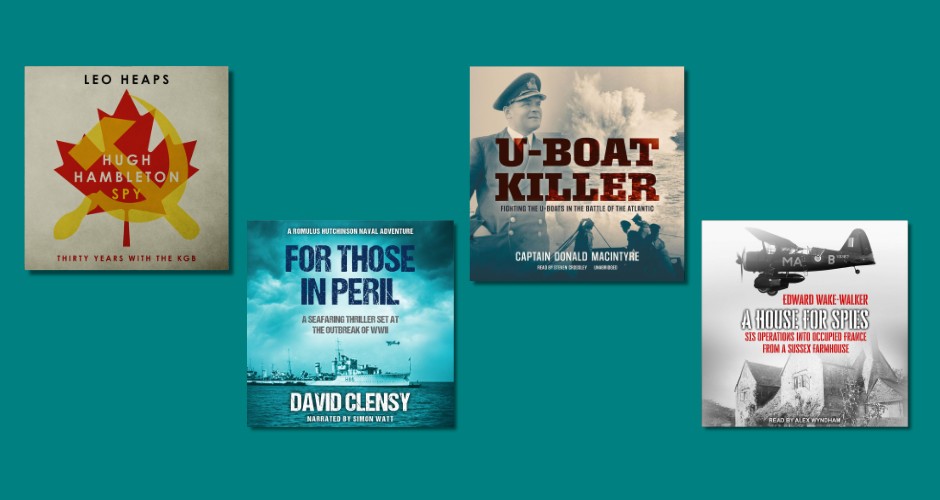
Lose yourself in a great audiobook this month!
Professor, friend, Soviet spy; who was the real Hugh Hambleton? Find out in Hugh Hambleton, Spy by Leo Heaps.
Two brothers are keen to start their naval careers. But could it all be over before they’ve barely begun? Find out in For Those in Peril by David Clensy.
Don’t miss this unique account of the Battle of the Atlantic from the perspective of a British destroyer captain in U-Boat Killer by Donald Macintyre.
Discover the unforgettable history of French intelligence agents and courageous British pilots who risked everything in the fight against Hitler in A House for Spies: SIS Operations into Occupied France from a Sussex Farmhouse by Edward Wake-Walker.
May’s Non-Fiction Releases
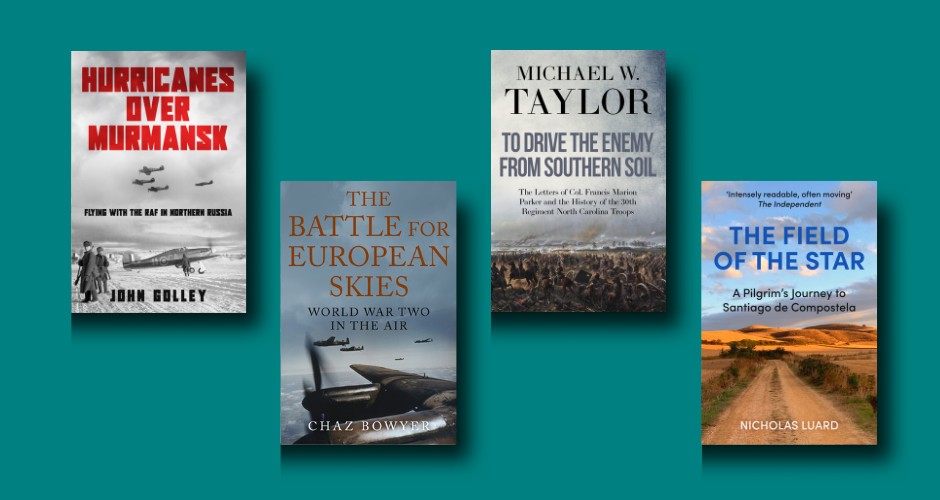
Hurricanes over Murmansk by John Golley tells the remarkable story of the RAF’s daring defence of the Soviet Union against the brutal Nazi onslaught of 1941. Drawing on first-hand accounts from RAF pilots as well as senior Soviet officials, Golley has crafted a thoroughly researched, vividly told account of bravery, sacrifice, and wartime ingenuity.
The Battle for European Skies by Chaz Bowyer is a comprehensive account of the savage aerial war fought over Europe during the Second World War. This book stands as a poignant tribute to the bravery and dedication of the men on both sides who took to the skies time and again, uncertain of their fate, in the service of their country.
To Drive the Enemy from Southern Soil by Michael W. Taylor draws upon the personal correspondence of Confederate Colonel Francis Marion Parker to recount the history of the brave men of the 30th Regiment North Carolina Troops, from its inception in September 1861 to its final surrender at Appomattox in 1865. The result is a deeply personal record of the daily life and cares of a Civil War soldier.
The Field of the Star is a searingly honest account of author Nicholas Luard’s pilgrimage along the Camino de Compostela, undertaken after the devastating illness and death of his eldest daughter.
Happy Reading! Team Sapere
Vibrant Voices. Sensational Stories. Beautiful Books.

Canadian paratrooper Leo Heaps (1923–1995) was seconded to the British Army during the Second World War and participated in the Battle of Arnhem. He was captured by the Germans and upon his escape, his work with the Dutch Resistance to help rescue hundreds of Allied soldiers behind enemy lines resulted in his being awarded the Royal Military Cross for “outstanding gallantry”. To commemorate the eightieth anniversary of the end of the Second World War, Leo’s son Adrian reflects on his father’s life in 1945.
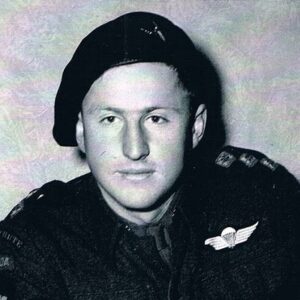
Leo Heaps
In 1945, Leo Heaps was just twenty-two, a young Canadian whose experiences in the Second World War shaped him into the complex figure I knew.
Born in Winnipeg in 1923, growing up as the son of Abraham Albert Heaps, a prominent Parliamentarian, wasn’t easy, but Leo forged his own path. Educated at Queen’s University, the University of California, and McGill, he was restless by 1944, bored with the Canadian Infantry Holding Unit. His commanders underestimated him, calling him “not of officer caliber, no initiative, not aggressive enough.” Sarcastic and defiant, he failed to qualify for the Infantry. His father urged him to work on his aunt’s farm, an exemption from service, but Leo sought action. He volunteered for the CANLOAN program, seconding Canadian officers to the British Army, a choice that plunged him into Operation Market Garden.
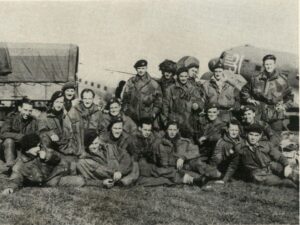
Leo (upper right) before his first jump into Arnhem
In September 1944, Leo joined the British 1st Airborne Division, commanding the 1st Parachute Battalion’s Transport — without ever having jumped before. He described his first drop on 17 September 1944 with vivid clarity: “I floated down gently from heaven at 1:30 p.m. on Sunday… The sun shone, the fields of Wolfheze were bathed in warm light and the green meadow bloomed with large bursts of yellow sunflowers.” That beauty was short-lived. The Battle of Arnhem, part of a failed plan to seize Rhine bridges, ended in defeat. Captured by the Germans, Leo didn’t stay a prisoner for long. With the help of the Dutch Resistance, he escaped, hiding in a chicken coop at Ennyshoeve. There, he met members of the Resistance risking their lives for Allied evaders.
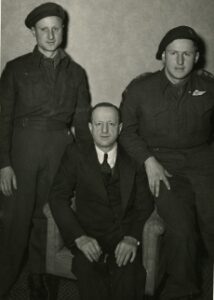
Leo with his father and brother David
His work with the Dutch Resistance earned him the Military Cross, a rare honour for a Canadian in British service. His brother, David, also received the Military Cross, making them the only Jewish brothers during the Second World War to win the decoration. Leo’s role in Operation Pegasus, the escape of over 100 Allied soldiers across the Rhine, was a triumph he chronicled in his book The Grey Goose of Arnhem. He called it “the most amazing mass escape of World War II.”
But some memories were harder to share. In April 1945, Leo was among the first to enter Bergen-Belsen concentration camp after the Germans fled, leaving behind a typhoid outbreak and unimaginable suffering. As a Jewish soldier, the sight of skeletal survivors, the stench of death, and the chaos of the camp struck him profoundly. In Escape from Arnhem (1945) he described the eerie silence broken by the groans of the starving, the piles of unburied bodies, and the desperate eyes of those clinging to life. The scale of the horror overwhelmed him. He rarely spoke of Belsen, but when he did, his voice was subdued. I can picture him there, a young man of twenty-two, confronting a darkness that no one could fully process.
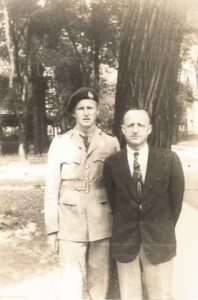
Leo with his father following his decoration
By May 1945, Leo was no longer the kid who frustrated his commanders, but a decorated veteran, a survivor of capture, combat, and collaborator with the Dutch underground. However, the war left its mark on Leo in what we now recognise as PTSD. The loss of friends killed by the Germans ushered a quiet guilt for those surviving when so many didn’t. Yet Leo channelled his unease into action, as if movement could keep the ghosts at bay. His writing, his adventures, his relentless drive — they were, in part, his way of coping with a war that never fully left him.
In 1994, my son and I accompanied Leo to Arnhem for the fiftieth anniversary, as one of forty Canadian veterans. I often wonder what he felt in those sunflower fields, thinking of his lost comrades and his own life’s pursuits. Some of these feelings can be found in his records and letters in the Ontario (Canada) Jewish Archives, which offer a glimpse of the man and the many moments beyond his stories.
Leo died in 1995, leaving a legacy I’m still unravelling. In 1945, he emerged from the war not just as a survivor but as a storyteller who gave voice to the unsung. His books are a testament to a war that left its scars, but also of the man who became my father.
By Leo Heaps:
Congratulations to the estate of Leo Heaps, whose remarkable World War Two memoir, Escape From Arnhem, is out now!
On September 17, 1944, over 8,000 men of the British 1st Airborne Division landed in German-occupied Netherlands as part of the largest airborne invasion ever undertaken. Twenty-two-year-old Canadian paratrooper Leo Heaps was one of them.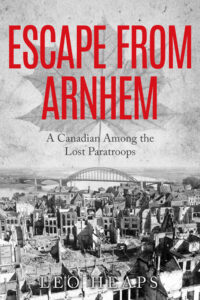
Told with authenticity and clarity, Heaps’ personal account of the nightmare battle fought after the paratroopers dropped at Oosterbeek paints a remarkably vivid picture of one of the most dramatic and little-known events of the Second World War.
Captain Leo Heaps volunteered to serve with the British Army early in 1944 and arrived in England in May of that year. Attached to the Dorset Infantry Regiment, he took part in the D-Day assault on Normandy in June. After twelve days, he was wounded and returned to England. In August, he applied to join a British Parachute Regiment and was accepted. A mere three weeks later, Heaps made his first and only jump as the Arnhem assault commenced.
Escape from Arnhem is one of the most visceral diaries of a young men caught up in the horrors of war. Barely out of his teens, Leo Heaps is charged with the responsibility of working with the Dutch underground, while evading capture from the Germans; all set against the backdrop of one WW2’s biggest battles.
From the battlefield to Belsen, Capt. Leo Heaps chronicles a story of capture and escape, unintended heroism and personal loss. It is a life-changing journey that goes beyond the medals and ceremony of war.
Written only a year after the war ended, the images of the Battle of Arnhem are as fresh and raw as the wounds of war themselves and offer a stark reminder of the triumph and tragedy during and after the battle.