

When I wrote my first story featuring Josef Slonský, Lying and Dying, I had plans for a further two up my sleeve. Now the eighth has just been published, and I still have ideas for further plots. Woven around those plots are stories of the characters’ lives, so for each one I have had to create a biography. Not everything that is in the biography immediately gets onto the page. For example, Lucie Jerneková’s difficult relationship with her father was always in my mind but is coming out in stages. Slonský’s own past is revealed as it becomes necessary, though most of it is provided by the man himself, who may be an unreliable narrator.
The comments I receive from readers suggest that they value this fleshing out of the characters. It makes them feel real — except, of course, that they are not. They are all imaginary — but I hope they are consistent.
Take the police headquarters as an example. The building I describe is in the same place as the real one, but it looks a little different. The police are reluctant to let visitors wander through the corridors, so I have created an internal architecture that probably bears no resemblance to reality. The only thing I will claim is that the building is the same size and has the same number of floors.
Similarly, it is unlikely that the detection of homicides in Prague is in the hands of just six officers. I had to simplify the police ranks system (do we really need three grades of lieutenant?) and give Sergeant Mucha a lot of shifts on the front desk. He is rarely not there.
But sometimes characters write their own story. Rajka was only supposed to appear for a few moments in one book, and found himself appointed Slonský’s new boss. I needed to explain how Mucha could leave the desk at short notice, and thus Officer Fintr came into being. Now that Navrátil and Peiperová are married, we see less of their mothers, though rest assured, they are still there.
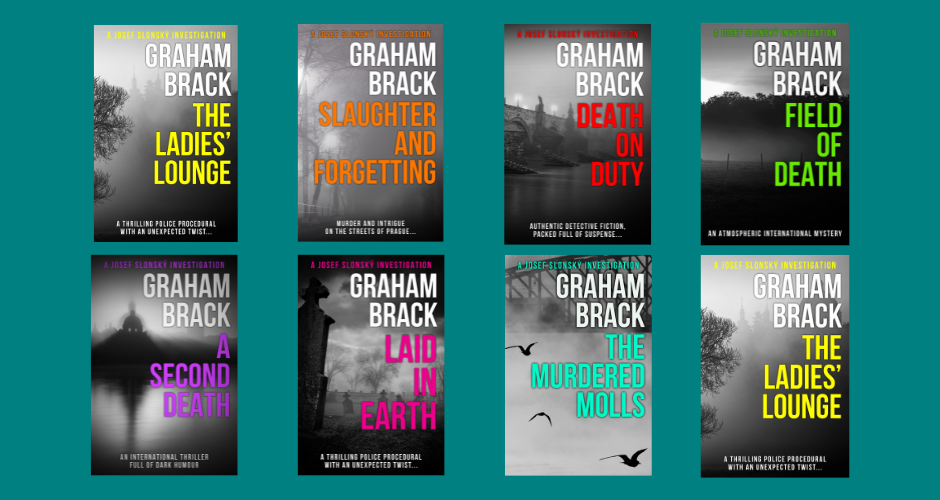
The latest book, The Ladies’ Lounge, came about when I saw a sign saying just that over a doorway. What kind of place was behind it? In no time, the idea of a communist-era club for successful women was born. The kinds of women who would join produced my cast of characters, and they needed backstories too. Again, only part of their history gets into the pages, but it all has to be written.
I hope you enjoy The Ladies’ Lounge. If it never existed; perhaps it should have. It is very real to me.
Congratulations to Graham Brack, whose absorbing crime thriller, The Murdered Molls, is published today!
The Murdered Molls is the seventh book in the Josef Slonský Investigations series, atmospheric police procedurals full of dark humour.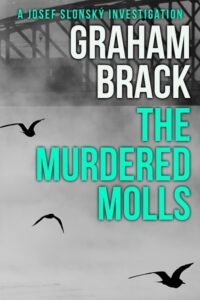
A woman is discovered brutally murdered in her apartment, with some of her body parts surgically removed.
The pathologist has dubbed the perpetrator the nastiest killer he’s ever come across in the Czech Republic.
But after a scuffle with a cat burglar, Captain Josef Slonský has found himself laid up in hospital with a series of torn ligaments in his knee, unable to rush to the scene of the crime.
With his medical review due in less than nine weeks, and the threat of enforced retirement hanging on the outcome, he is determined to get out of bed and back on active duty asap.
With the help of his friend Valentin, Slonský signs himself out of hospital and puts his mind to solving the killing.
Is a serial killer at large? Are more women in danger?
And can Slonský prove his worth and keep the job that means so much to him?
This Christmas, we’ve put together an anthology of festive crime fiction that is sure to give you the chills! Here’s a taste of what to expect from MIDWINTER MYSTERIES…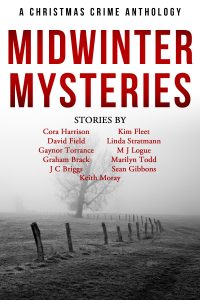
In Graham Brack’s AWAY IN A MANGER, a decidedly non-festive Lieutenant Josef Slonský investigates a string of thefts amid Prague’s bustling Christmas market.
At a Christmas Eve gathering, Charles Dickens weaves a gory, atmospheric ghost story that becomes a little too real in J C Briggs’ FOOTPRINTS IN THE SNOW.
Keith Moray’s LOST AND FOUND follows the residents of West Uist as they merrily prepare for their New Year’s Eve traditions – until one of them is found dead…
While trying to provide for his family, young Alfie finds himself investigating the disappearance of gold bars from a bullion store – which have vanished along with his beloved dog, Mutsy – in Cora Harrison’s THE SPIRIT OF CHRISTMAS.
In Seán Gibbons’ THE STOLEN SANTA SACK, unlucky driver Ben Miller is stuck with a dead Santa Claus and a sackful of cash in the back of his cab…
While hurrying to develop her clients’ portraits in time for Christmas, photographer Julia McAllister is landed with a drunken newlywed and a photograph of a ghost in Marilyn Todd’s WILL POWER.
Gaynor Torrance’s CHRISTMAS SPIRITS follows headstrong Detective Inspector Jemima Huxley as she finds herself caught up in an armed robbery while doing her Christmas shopping.
In David Field’s THE ESSEX NATIVITY, Detective Sergeant Jack Enright discovers a destitute couple expecting their first child in the shelter of a barn.
When one of her clients is stalked by a mysterious figure, Private Investigator Eden Grey attempts to uncover the unwelcome follower in Kim Fleet’s SECRET SANTA.
Major Thankful and Thomazine Russell investigate the theft of a scandalous manuscript written by the king in M J Logue’s STIR UP SUNDAY.
In Linda Stratmann’s THE CHRISTMAS GHOST, wilful sleuth Mina Scarletti attempts to bring peace to a woman haunted by the spirit of her dead son.
Click here to order MIDWINTER MYSTERIES!
Graham Brack is the author of the JOSEF SLONSKÝ INVESTIGATIONS series.
When I started writing the book that became Lying and Dying, I didn’t have a detective in mind. There would have to be one, of course, and because I wanted it to be realistic he would have to be part of a team, but the character of Slonský was not central to my thinking.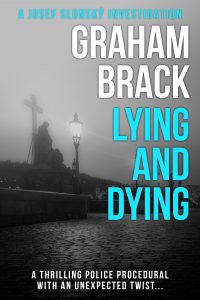
I can remember precisely when he appeared. My brother and I were at the National Theatre; during the interval I described the story, and together we arrived at the notion that a senior Czech detective must have worked under Communism and would therefore probably have some skeletons in his closet. Moreover, everyone he knew would have similar problems, so it would be understandable if he had little or no respect for anyone of his own vintage.
The world-weary detective is a lazy trope, so I made Slonský enthusiastic about his work. He loves his job. He believes it matters, and he has no patience with corrupt colleagues. And then it came to me that the biography I had proposed for him, in which he spent around half his career under Communism, and half after it, meant he must be coming up to retirement. That provided a rich vein of character analysis, because he dreads retirement; there is nothing else in his life, so he wants to go on as long as he can, and the fact that his bosses know that gives them the only hold they have over him.
Thus, Captain Lukas is able to get him to take a trainee officer, Jan Navrátil. Slonský has had partners before, but they quickly apply for transfers. Navrátil can’t do that. He is a fast-tracked police academy officer with a law degree, fierce intelligence, a strict moral code and an open and trusting nature. Slonský comes to realise that Navrátil is incorruptible and probably always will be, and that when he is gone Navrátil has the potential to reach the very top of the tree – provided he listens to Slonský’s sage advice. Shaping Navrátil’s police career will give Slonský the nearest thing he can have to a legacy. Later they are joined by a woman officer, Kristýna Peiperová, who doesn’t have a law degree but balances that by knowing much more about how the world works. Slonský enjoys training her too, and he honestly does not know which of them will get the top job first, but he doesn’t care. Male or female doesn’t matter; all he wants is someone who can bring about the clean, efficient police force he wanted to join.
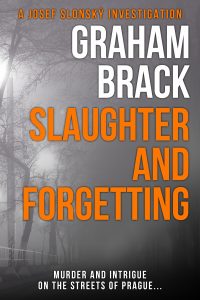 I sat down to write one Saturday morning, and after a page or so the police car pulled up and Slonský climbed out. Battered, inelegant, disinclined to waste any effort, cunning, cynical and sharp-tongued, he appeared in my mind’s eye and somehow took over. A story in which he was a necessary figure but not the star was seized and made into a section of his biography. Whenever he walked into a scene, it livened up, and I found if I just listened to him he told me so much about himself.
He doesn’t eat well, but he eats a lot. He is a typical Czech, he believes, devoted to beer and sausages. He lives in a dingy one-room flat, so he spends most evenings in bars. He was married, but his wife left him, and he took it for granted that they were divorced, which proved not to be the case. He believes that nobody can work on an empty stomach, that you should never miss a chance to eat or pee (because you don’t know when the next one will come) and that not everything about the old days was bad.
His name was derived from the Czech word slon, meaning elephant. It seemed appropriate, given his size and his memory, and it was gratifyingly similar to the Czech surname Slánský.
After Lying and Dying was published, a woman wrote to me to say that Slonský was appallingly non-PC in his language but his instincts were good; he was meticulously fair, and therefore free from prejudices such as sexism and racism; and, she said, while she wouldn’t invite him to dinner, if she were ever murdered she would want him to be investigating her death. I think he would allow himself a smile if he heard that.