

Linda Stratmann is the author of the Mina Scarletti Mysteries and the Early Casebook of Sherlock Holmes series.
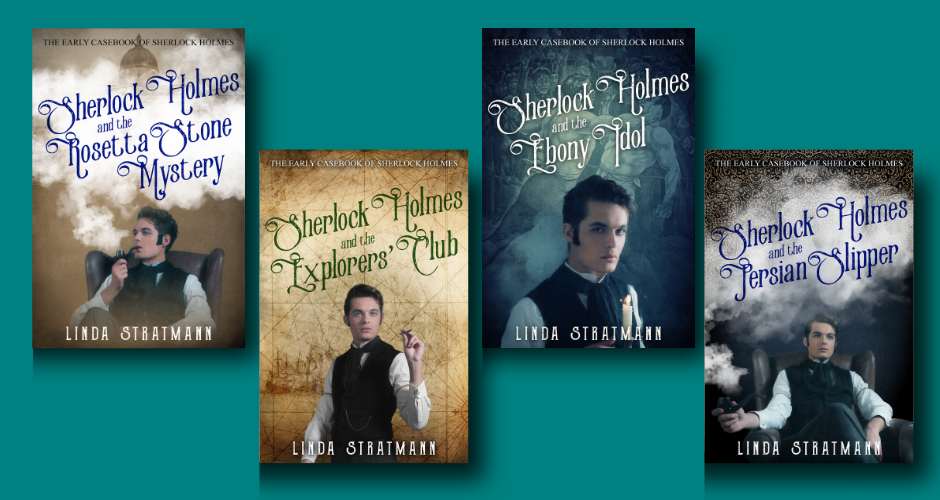
There are many different interpretations of Sherlock Holmes created by authors inspired by the works of Conan Doyle. They might sometimes appear to conflict, but it was my love of science fiction that made me realise that the different versions can all be valid at the same time if they exist in parallel universes. One such interpretation is that Holmes is not human but alien, or possibly even an android.
The Holmes in my books is a human, if an unusual one, but can a good case be made for him not being human? The basis of the case must, I believe, be derived from what I call ‘the canon’ — the original Holmes fiction of Conan Doyle.
So let us examine the canon and look for the clues.
Our first evidence is from Dr Watson himself. In an uncharacteristic feat of observation in The Sign of Four, he declares, ‘“You really are an automaton, — a calculating machine. […] There is something positively inhuman in you at times.”’ Holmes, he says in ‘A Scandal in Bohemia’, is ‘the most perfect reasoning and observing machine the world has seen.’
But what other clues do we have? There are many.
Clue one: An alien or android has no family tree, and Holmes is extremely cagey about his ancestors.
In ‘The Greek Interpreter’, Watson states that Holmes’s gifts for observation and deduction must come from his systematic training, and not his ancestry. Holmes agrees that this is true to some extent and reveals that his ancestors, who he does not name, were country squires who led the life ‘“natural to their class”’. However, he attributes his powers of observation to descent from a family of French artists. His grandmother was the sister of the French artist Vernet. There must, he believes, be some hereditary principle, as his brother Mycroft has the same talent.
If Holmes was an alien or android, a vague reference to unnamed county squires and an artist whose family connections could not have been easily researched would have satisfied Watson’s curiosity. Watson saw some similarities between Holmes and Mycroft, and if Holmes was an alien or android, it would suggest that Mycroft was as well.
Clue two: Holmes has strangely superhuman strength.
Holmes is not a burly man. In ‘The Red-Headed League’, ‘He curled himself up in his chair, with his thin knees drawn up to his hawk -like nose.’ Yet he obviously had a sinewy strength and was skilled in boxing, singlestick and swordsmanship.
To maintain bodily fitness over many years, regular exercise is usually necessary, but with Holmes this is not the case. ‘I have a curious constitution,’ he says in The Sign of Four. ‘I never remember feeling tired by work, though idleness exhausts me completely.’ He then heads off for a smoke.
In ‘The Adventure of the Speckled Band’we have this extraordinary incident. Holmes receives a visit from tall, broad and fierce Dr Grimesby Roylott. Roylott tries to intimidate Holmes by picking up a steel poker and bending it into a curve before flinging it down. After his departure, Holmes picks up the poker ‘and with a sudden effort, straightened it out again.’ Is that even humanly possible?
In ‘The Adventure of the Yellow Face’, Watson tells us that Holmes ‘seldom took exercise for exercise’s sake’ and that he regarded ‘aimless exertion’ as ‘a waste of energy’. Yet he also tells us that ‘Few men were capable of greater muscular effort’ and Holmes was ‘one of the finest boxers of his weight that I have ever seen.’ When there was a requirement for action, he was ‘untiring’. By the time this story was published in 1893, Conan Doyle might have sensed that he needed to explain to his readers the anomaly of a man who hardly ever exercised but excelled at physical activity. ‘That he should have kept himself in training under such circumstances is remarkable,’ says Watson, who goes on to say unconvincingly that ‘his diet was usually of the sparest and his habits were simple to the verge of austerity.’ Holmes, he adds, ‘save for the occasional use of cocaine […] had no vices.’
Clue three: Holmes uses drugs and smokes, apparently without adverse effects.
Conan Doyle introduces us to Holmes’s use of cocaine in The Sign of Four, which includes a brief single reference to the recreational use of morphine. (It is only ever used once again by Holmes, given medicinally in ‘The Adventure of the Illustrious Client’). In ‘The Adventure of the Yellow Face’,published three years after The Sign of Four,ConanDoyle obviously feels the need to dial back, perhaps after some disapproval expressed by his readers, and tells us that ‘he only turned to the drug as a protest against the monotony of existence, when cases were scanty and the papers uninteresting.’ Holmes’s heavy smoking of strong tobacco is never seen by Watson as a vice, or as something that might affect Holmes’s health.
There are numerous references in the stories to Holmes smoking heavily. In ‘The Man with the Twisted Lip’, Holmes smokes an ounce of shag tobacco while deliberating, leaving his room ‘full of a dense tobacco haze.’ In ‘The Adventure of the Engineer’s Thumb’,his before-breakfast pipe is ‘composed of all the plugs and dottles left from his smokes of the day before, all carefully dried and collected on the corner of the mantelpiece.’ If Holmes is an alien or a machine, that explains his apparent imperviousness to the harmful effects of drugs and tobacco. In later adventures, Conan Doyle does however make him more believable by showing Holmes exhausted by his burden of work as he ages. The last year in which a Holmes story is set is 1914 (His Last Bow, published in 1917), by which time he is sixty years of age, and to Watson’s eyes, has hardly changed.
Clue four: Holmes shows little emotion.
Science fiction readers and writers have compared Holmes to an android like Star Trek’s Data, lacking emotion of any kind. If he is an alien, he most closely resembles Star Trek’s coolly logical Vulcans. They have emotions but restrain them; however, they are obliged to let them all out once every seven years in a ritual called pon farr. Does this fit with Holmes’s behaviour? Does a restriction of emotions cause Holmes any stress? If he was a Vulcan, like Mr Spock, could this explain what was really happening in 1891 when Holmes rushed away to the Reichenbach Falls and did not return for three years? Did he feel the approach of pon farr and have to quit England before it took him over? If so, there would be other absences at similar intervals.
I counted back seven years and then I saw it. There are no adventures chronicled by Watson for the years 1884 and 1885. Was this because of a previous pon farr? Holmesian scholars have assumed that during these years Watson was away, perhaps in America, but there might be another explanation? Was Watson with Holmes during these absences, his account carefully crafted to conceal the truth about his friend? Looking ahead another seven years from 1892, there are no adventures dated from between January 1899 (‘The Adventure of Charles Augustus Milverton’) and June 1900 (‘The Adventure of the Six Napoleons’). There are no adventures dated 1906, or 1913. This is all supposition, of course, but the timeline is compelling.
Clue five: Holmes does not wish to marry.
Not only is Holmes averse to marriage, he appears to have no romantic or intimate connections with anyone. If he is not human, this is something he would avoid, or his masquerade as a human might be discovered. Conan Doyle is careful to avoid any suggestion of Holmes having hidden desires which would have alienated his readers. According to Watson, Holmes’s only such interest, is a woman, ‘the woman’, as he calls her, Irene Adler, whom he clearly admires but without allowing any emotions to disturb his finely balanced mind.
On what principles was the alien or android Holmes constructed or programmed?
If Holmes was sent to Earth programmed to solve crimes, he needed to be constructed from many parts. Superhuman strength and constitution. Numerous useful skills. Impervious to the ravages of smoke and drugs. A brilliant reasoning machine undistracted by emotions. The aliens who made or trained him would have studied other detectives of the era and used elements of the finest to create Holmes.
There are three main candidates:
Joseph Bell (1837–1911) was a Scottish surgeon and lecturer who advocated the importance of careful observation. Conan Doyle was a student of Bell from 1877 to 1878. Bell used his observational talents to deduce personal details about complete strangers, a skill which Holmes frequently employed.
Edgar Allan Poe’s C. Auguste Dupin is considered to be the first fictional detective, who used advanced reasoning to solve mysteries. Through observation, he is able to follow the train of thought of his companion, an ability with which Holmes astonishes Watson in ‘The Adventure of the Cardboard Box’.
Le Chevalier Lecoq, a fictional French policeman, inspired by a real criminal investigator, Eugène-François Vidocq (1775–1857). In the works of Émile Gaboriau, published in 1869, Lecoq’s methods when making a detailed examination of a crime scene, using a magnifying glass, are strongly reminiscent of Holmes’s scientific approach. In A Study in Scarlet, Holmes dismisses Dupin as ‘a very inferior fellow’ and Lecoq as ‘a miserable bungler’.
My case is complete. I have laid the facts before you. Make of them what you will.
NOTE:
There were several artists in the Vernet family but only one, Emile Jean Horace (1789-1863) fits the timeline as Holmes’s most probable great uncle. A number of Conan Doyle’s family members were artists, and a friend was a collector of Vernet.
Congratulations to Donna Gowland, whose page-turning historical mystery, The Lost Girls, is published today!
The Lost Girls is the second book in the Mary Shelley Investigations series: Gothic murder mysteries with a tenacious literary heroine working as a female sleuth.
1815, London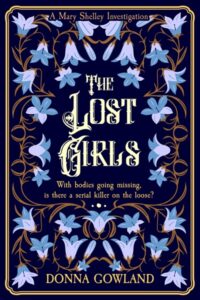
After triumphantly solving a murder case in Paris, Mary Wollstonecraft Godwin and Percy Shelly return to London penniless.
As Percy is still married to his estranged wife, he and Mary are shunned from polite society for living together out of wedlock.
Isolated and trapped in squalid lodgings, Mary finds herself alone while Percy escapes to the tavern. But one evening when she goes looking for him, she stumbles upon a body.
She leaves to fetch help and when she returns the dead girl is gone…
When she receives a note from an old friend and discovers another girl is missing, Mary wonders if the crimes are connected.
What happened to the body? Was it taken by the murderer?
Can Mary and Percy come together to solve another tricky case…?
Congratulations to R. M. Cullen, whose twisty murder mystery, Death’s Long Shadow, is out now!
Death’s Long Shadow is the second instalment in the Richard Brinsley Sheridan Mystery Series: eighteenth-century crime thrillers set in London at a time of Revolution.
1792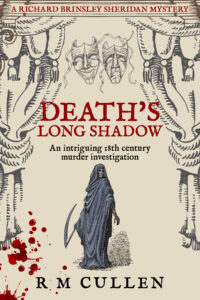
Playwright Richard Brinsley Sheridan’s retreat to the country is interrupted when he stumbles upon a body during a woodland stroll.
The man is identified as Edward Stretton, cousin to Earl Cannock who Sheridan is residing with.
Stretton had a reputation as a scoundrel and seducer and was heavily in debt at the time of his death.
He had been poisoned, and when the Earl’s servants are questioned, unusual evidence puts one man in custody.
But Sheridan is not convinced of his guilt. And one another man is murdered, he suspects there may be a connection.
Can Sheridan uncover the link? Could he save an innocent man from death?
Or will this case prove too complex for this amateur sleuth…?
Congratulations to Donna Gowland, whose absorbing murder mystery, The Missing Wife, is out now!
The Missing Wife is the first book in the Mary Shelley Investigation series.
1814, London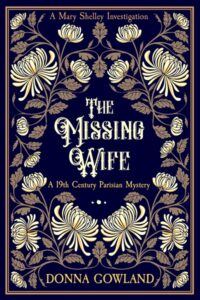
It isn’t easy being the daughter of the great Mary Wollstonecraft, harder still to navigate life without her. 16-year-old Mary Godwin is desperate for excitement and trapped in a family she feels stifled in, under the watchful, disapproving glare of her stepmother Mary, she is constantly battling for her father’s attention and approval.
So when the young Romantic poet, Percy Shelley, comes blazing into her life, she falls quickly and deeply in love with him. But Percy has plenty of demons. He is already married with a second child on the way, and he turns up to the Godwin family home with a bottle of laudanum, declaring he will end his life if he cannot be with Mary.
William Godwin forbids contact between them, but Mary’s heart aches for the man she believes to be her soulmate. And so she agrees to elope to Paris.
The excitement of the journey soon wears off and they arrive in the city weary, travel-sick and penniless, though luck finally seems to be on their side when they meet a man who offers them money to find his missing wife.
But with Mary becoming increasingly homesick and concerned for her future, will her love affair with Percy be all she had hoped for? Could the search for the missing wife set her on a new course of self-discovery?
Or will her first daring adventure prove to be her downfall…?
We are thrilled to announce that we have signed the ninth book in the Master Mercurius Mysteries series by Graham Brack.
Set in seventeenth-century Europe, the series follows the adventures of a gifted cleric-turned-sleuth.
In Graham’s words: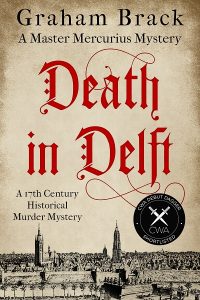
“After eight adventures, Mercurius is very keen that there should not be a ninth. He wants a peaceful life surrounded by his books, and perhaps now that the Stadhouder is King of England he can have it. So long as William III is in England, and Mercurius stays in Leiden, he should be quite safe.
“The long vacation is approaching, and Mercurius decides to make doubly sure by not being in Leiden either. He is planning a tour of great German cathedrals, something that he has long wanted to do. He has even been learning some German in preparation.
“But then comes an invitation he cannot refuse. An old friend would like some advice on buying books for a library. It will take the whole summer, but then those cathedrals will still be there next year, and he has always wanted to spend someone else’s money on books…
“And while he is there, a baffling crime is committed — or is it?
“The Mercurius stories are a delight to write and I am grateful to Sapere Books for showing such faith in them. If he were alive today, I am sure Master Mercurius would love to see his name on the covers. After all, his multi-volume Commentary on the Nicomachean Ethics is rarely read these days, but his memoirs continue to find readers, for which I am very grateful.”
Congratulations to David Field, whose twisty Victorian thriller, The Retirement Murder, is out now!
The Retirement Murder is the ninth instalment in the Esther and Jack Enright Mystery Series – a traditional British detective series set in Victorian London and packed full of suspense.
London, 1898
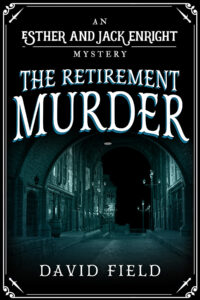
The time has finally come for Percy Enright to retire from Scotland Yard. His nephew, Jack, is sad to lose a partner in the force, but Jack’s wife Esther is glad Percy won’t be getting her husband into any further scrapes.
It seems Esther’s relief might be short lived, though, when a senior officer collapses at Percy’s farewell ceremony.
It soon becomes clear that the officer was poisoned, and Percy delays retirement to help Jack track down the culprit.
It’s a daunting task that involves trawling through all the murdered officer’s recent cases in the search for someone who may still bear him a grudge.
But when it becomes clear the dead man may not have been the intended target, the investigation suddenly turns in a new direction.
Why are the police being targeted? Can Percy make one final arrest before he retires?
Or will the murderer outwit the Enrights in their latest case…?
Congratulations to Laura Martin, whose absorbing Regency-era mystery, The Body on the Beach, is out now!
The Body on the Beach is the fourth book in the Jane Austen Investigation series: thrilling historical murder mysteries with a tenacious literary heroine working as a female sleuth.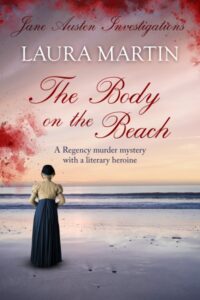
1798, Dorset, England
Jane Austen is on holiday with her parents and her sister, enjoying time at the seaside in Lyme Regis.
But one morning, while out on an early stroll, her peace is shattered.
There is someone lying at the bottom of the cliffs.
After rousing her father and sister, she hurries along the beach to find a young woman, dead.
It is clear to Jane that the young woman has been strangled. There is bruising about her neck and marks of discolouration on her face, yet the magistrate and doctor are quick to dismiss her concerns.
As Jane starts to investigate further, she discovers there have been two other young women found dead on the beach between Charmouth and Lyme Regis in the last five months.
Jane and Cassandra are certain the deaths are connected, but why is no one else looking for their killer?
Were the women known to each other? Are they connected in some way?
Can the Austen sisters unravel the mystery?
Congratulations to Keith Moray, whose absorbing Egyptian thriller, Fall Of A Scribe, is out now!
Fall Of A Scribe is the second book in the Ancient Egypt Mystery series: historical thrillers set in Alexandria and featuring Overseer of the Police, Hanufer.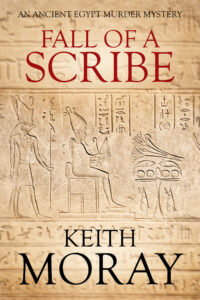
275 BC, Alexandria
Hanufer of Crocodilopolis, the captain of the Medjay police is being plagued by nightmares. Strange shadows haunting him in the night that are not banished by the gods he prays to.
He is worried it is a sign of evil to come.
And when two separate murder cases land at his door, he fears he is right.
Two prostitutes have been brutally slain in separate incidents, pointing towards a serial killer.
And a Necropolis guard has been stabbed through the eye by one of his colleagues – the murderer rambling about an evil spirit.
Things are complicated further when Hanufer is summoned to court by the High Priest to investigate rumours of a witch manipulating the Pharoah and his queen.
As his shadowy nightmares intensify, Hanufer struggles to unravel all the threads.
Are the crimes all related? Is some evil force infecting the city? Or are these foul deeds the work of man….?
Congratulations to Laura Martin, whose gripping historical murder mystery, Death of a Lady, is published today!
Death of a Lady is first book in the Jane Austen Investigation series: thrilling Regency-era murder mysteries with a tenacious literary heroine working as a female sleuth.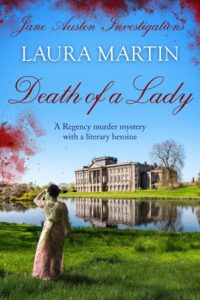
1795, Hampshire, England
Jane Austen and her family are delighted to be attending Lord Wentworth’s ball. The event has been at the centre of village gossip after it was announced Wentworth was holding a ball to celebrate the return of his brother, who went missing in India many years earlier and had been declared dead.
At the ball an old friend, Emma Roscoe, bumps into Jane and tells her she saw something she shouldn’t have. She asks Jane to meet her at ten o’clock in the library to discuss it.
Delayed by dancing with the charming Mr Tom Lefroy, Jane is late to meet to her friend.
But when she arrives, she finds the body of Emma Roscoe lying on the floor with a dagger sticking out of her chest.
Distraught and feeling horribly guilty, Jane is determined to help with the investigation into Emma’s murder.
Was it a coincidence that the murder happened on the night of Lord Wentworth’s brother being reintroduced to society? What did Emma see that was worth killing her over?
And could more people be in danger?
With the help of her sister Cassandra, Jane must use her wit and intelligence to get to the heart of the mystery.