

As we celebrate National Crime Reading Month, an annual initiative spearheaded and developed by the Crime Writers’ Association which runs throughout the month of June, we asked C. V. Chauhan, author of the Inspector Sharma Thrillers set in Leicester, to tell us what crime fiction means to him and how it has influenced his own writing.
“I was born and brought up in a small town in the Rift Valley in Kenya. Despite the breathtaking natural beauty of the location, my childhood was highly deprived. My local school had ninety-seven pupils, but no resources and no library. At home, my six siblings and I shared three books. I still remember them vividly, because they kickstarted my love affair with reading. Two featured European fairy tales: Hansel and Gretel, Cinderella and Rapunzel. The third book was about Greek myths and legends. They were probably given to my father, a cobbler, by an ex-pat British customer. I read and re-read those books by the light of a hurricane lamp in the evening, fascinated by the magical world of fairy tales and the adventures of Perseus and Medusa, Theseus and the Minotaur. This is where my fascination with heroes tussling with dark forces and sinister figures began.
“At the age of eleven I moved with my family to a Victorian terraced house in Leicester and joined a small secondary school without any playing fields. For all its faults, it did have a library, from which I borrowed copious books, and a good English teacher who introduced us to Shakespeare — I loved the themes of passion, greed, power and corruption in Macbeth, Hamlet and Julius Caesar. The battle between good and evil was a constant theme in many of the books I read.
“As an undergraduate at the University of York, my reading became turbocharged. I suddenly had access to thousands of books and met many like-minded people who were hungry for knowledge. In addition to reading the core textbooks for history and economics, I started reading more widely: Graham Greene, Agatha Christie, Aldous Huxley, James Baldwin, George Orwell. I was such a voracious reader that I often read three books simultaneously — a few chapters from one, a few from another, and so on until I went back to the first. My contemporaries thought I was mad, but I was happily lost in the many different worlds and characters created by these fabulous writers.
“Immersing myself properly in crime fiction came not long after. I trained to be a teacher and taught history in some challenging secondary schools in London and Birmingham. At one of these schools, I became good friends with an English teacher called Jim MacLachlan. He introduced me to a wonderful range of crime fiction authors, many of whom I wasn’t previously aware. I soon became embroiled in the lives of the characters in the 87th Precinct series of police procedural novels by Ed McBain, as well as the thrilling plots created by Elmore Leonard, Dorothy L. Sayers, Ngaio Marsh, Raymond Chandler, Lawrence Block, Donald E. Westlake, Patricia Cornwell and Joseph Hansen. Like Shakespeare, the genre delved into complex human behaviours, grappling with morality and justice whilst immersing the reader into danger from a safe distance. I was hooked.
“As a writer, I continue to read widely in all genres. Raymond Chandler, Dashiell Hammett and James M. Cain are perennial favourites, as are Lee Child, Stephen King, Jeffery Deaver and James Lee Burke. The Laidlaw books by the late William McIlvanney are fabulous. I also love historical fiction with a criminal element and, more recently, have discovered the many wonderful Japanese writers of crime fiction.
“I gave up full-time work a few years ago to focus on writing crime-fiction. My thrillers are set in Leicester and feature Inspector Rohan Sharma and his idiosyncratic African Grey parrot, Fernando. I have drawn upon my love of detective fiction and police procedurals to write about the city I live in, whilst exploring contemporary themes of diversity, organised crime and human trafficking.
“As we celebrate Crime Fiction Month this June, I often reflect on the fact that crime fiction is a wonderful vehicle through which to examine social and moral dilemmas. I try to bring that to the forefront in my writing and if a reader reflects on something they have read in one of my books, then I’m happy. It’s how I remember the books that have made an impression on me. Even today, I still remember the stories of Perseus and Medusa, Theseus and the Minotaur.”

Visit C. V. Chauhan’s website for all his latest news.
For more information on National Crime Reading Month, visit: https://crimereading.com/
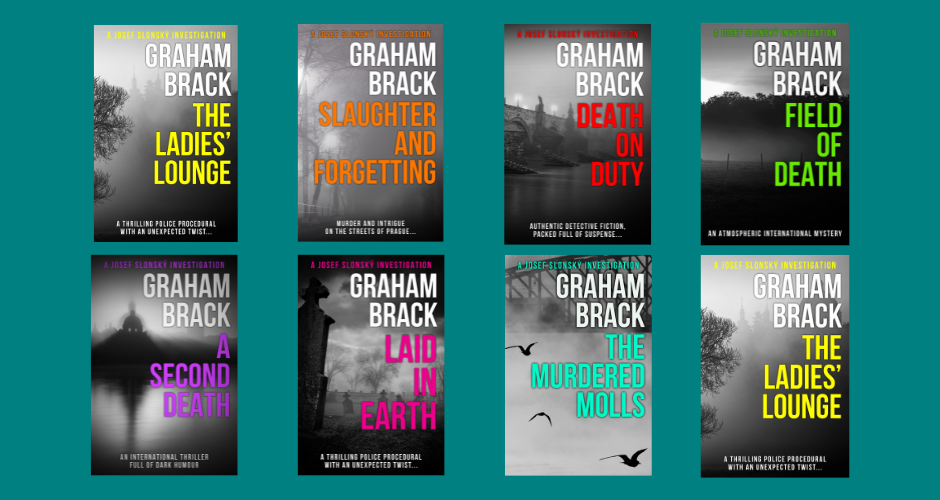
When I wrote my first story featuring Josef Slonský, Lying and Dying, I had plans for a further two up my sleeve. Now the eighth has just been published, and I still have ideas for further plots. Woven around those plots are stories of the characters’ lives, so for each one I have had to create a biography. Not everything that is in the biography immediately gets onto the page. For example, Lucie Jerneková’s difficult relationship with her father was always in my mind but is coming out in stages. Slonský’s own past is revealed as it becomes necessary, though most of it is provided by the man himself, who may be an unreliable narrator.
The comments I receive from readers suggest that they value this fleshing out of the characters. It makes them feel real — except, of course, that they are not. They are all imaginary — but I hope they are consistent.
Take the police headquarters as an example. The building I describe is in the same place as the real one, but it looks a little different. The police are reluctant to let visitors wander through the corridors, so I have created an internal architecture that probably bears no resemblance to reality. The only thing I will claim is that the building is the same size and has the same number of floors.
Similarly, it is unlikely that the detection of homicides in Prague is in the hands of just six officers. I had to simplify the police ranks system (do we really need three grades of lieutenant?) and give Sergeant Mucha a lot of shifts on the front desk. He is rarely not there.
But sometimes characters write their own story. Rajka was only supposed to appear for a few moments in one book, and found himself appointed Slonský’s new boss. I needed to explain how Mucha could leave the desk at short notice, and thus Officer Fintr came into being. Now that Navrátil and Peiperová are married, we see less of their mothers, though rest assured, they are still there.
The latest book, The Ladies’ Lounge, came about when I saw a sign saying just that over a doorway. What kind of place was behind it? In no time, the idea of a communist-era club for successful women was born. The kinds of women who would join produced my cast of characters, and they needed backstories too. Again, only part of their history gets into the pages, but it all has to be written.
I hope you enjoy The Ladies’ Lounge. If it never existed; perhaps it should have. It is very real to me.
We are delighted to announce that we have signed a new Leicester-based crime series by C V Chauhan.

C V Chauhan
The series follows Detective Rohan Sharma as he unravels a succession of dark and thrilling mysteries.
In C V Chauhan’s words:
“I’m absolutely delighted to have been signed by Amy and her team at Sapere for my new, three-book series which breaks new ground in the genre. I’ve been made most welcome by all members of the team and by my fellow authors. It’s a very friendly and supportive community, and I feel privileged to be part of it.
“If you like your crime fiction with added spice, then you’ve come to the right place. THE DANCE OF DEATH, my debut novel, introduces you to Rohan Sharma, an able, erudite detective who lives in the heart of the Asian community in Leicester and who has a talkative, African grey parrot for company. Recently divorced, he is the father of two children.
“In the first instalment in the series, Rohan Sharma and his team hunt for a psychopathic killer while dark forces undermine his work and put others in danger.
“THE DANCE OF DEATH will be published in the near future, and I’m currently working on the next Rohan Sharma novel. I’m not going to give away too much at the moment, but suffice to say it’ll have an international dimension. More on this later…”