

C. F. Dunn is the author of The Tarnished Crown Series: Wars of the Roses historical fiction set in Medieval Europe.
“Double, double toil and trouble” — Shakespeare’s famous refrain from Macbeth — remains one of the most recognisable lines in Western literature. When it was first performed in the early seventeenth century, Shakespeare was drawing on a long tradition of folklore and belief that his audience would have immediately understood. Even if some of the finer details escaped them, they knew the framework: witchcraft, prophecy, and the unsettling idea that unseen forces might determine human fate.
Fast forward to the twenty-first century, and many still imagine witches as medieval figures — women ducked, pricked, and burned amid cries of superstition. In truth, the great witch hunts of Europe belong not to the Middle Ages but to the Early Modern period, from the sixteenth century onwards. From a medieval perspective, witchcraft as we now think of it was relatively uncommon. The frenzied persecutions of later centuries would have seemed alien to most people of the fourteenth or fifteenth centuries.
In fifteenth-century English law there was no specific statute making witchcraft a capital offence. The Church regarded it largely as a form of heresy — a spiritual error, not a criminal conspiracy. It was not until the Witchcraft Act of 1542 that England paved the way to criminalise witchcraft as punishable by death. Before then, most cases resulted only in fines, penance, or public admonition.
The meaning of ‘witchcraft’ in the Middle Ages also differed from the later concept. The boundary between magic and medicine was fluid. Healing practices incorporated charms, incantations, astrological timing, and a range of -mancies — divination by fire (pyromancy), by names (onomancy), or by reflections in mirrors or water (scrying). Medieval healers drew on classical learning, Christian devotion, and folk wisdom alike. A prayer could be as powerful as a potion, an amulet as trusted as a relic.
This was not sorcery in the later, sinister sense, but an expression of a worldview in which the divine and natural worlds were deeply intertwined. The medieval cosmos was one in which the supernatural existed alongside the physical — a realm of possibilities where God, angels, and spirits could all play a part in human health and fate.
By the later Middle Ages, however, witchcraft and divination began to intersect with politics. When accusations touched those close to the throne, the implications became far more serious. The Church might have seen such practices as misguided or at worst, heresy; the state viewed them as potentially treasonous.
Terminology was crucial. ‘Witchcraft’ often implied healing or protection and was tolerated to a degree. But necromancy—a form of divinationthat involved summoning the dead to foretell the future — crossed a dangerous line. When divination involved predicting the monarch’s death, it fell under the crime of “compassing or imagining the death of the king”, one of the key clauses of Edward III’s Treason Act of 1352. Necromancy became not only a spiritual threat but a political weapon.
An infamous example is that of Eleanor de Cobham, Duchess of Gloucester. Accused in 1441 of “treasonable necromancy” for attempting to divine the death of Henry VI, she was sentenced to life imprisonment. Her alleged accomplice, Margery Jourdemayne, the Witch of Eye, was convicted of heresy and burned at the stake. Eleanor’s real offence, however, was more political than supernatural: she denied the allegations of necromancy and treason, but admitted to having sought potions to help her conceive a child with her husband, Humphrey, Duke of Gloucester, whose proximity to the line of succession made him many enemies.
Eleanor’s case was not unique. Similar accusations were levelled against Walter Langton, bishop of Coventry and Lichfield in the early fourteenth century, and later against Jacquetta of Luxembourg and her daughter Elizabeth Woodville, queen to Edward IV. Each was a figure of power and influence, close to the throne and a focus for political attack. When an enemy could not be defeated in open conflict, an accusation of sorcery could prove equally effective and more difficult to defend.
In 1477, the Oxford scholar John Stacy, a man with previous form and known as a magnus necromanticus (great sorcerer) and astrologer of repute, was accused of “imagining the king’s death by necromancy.” Under torture he implicated Thomas Burdet, a member of the household of George, Duke of Clarence, brother to King Edward IV. It was perhaps no coincidence Burdet was also a main suspect in the penning and deployment of seditious writings that questioned Edward IV’s legitimacy and his right to rule — as well as that of his heir.
The oft quoted, but unsubstantiated Prophecy of G has also been linked with subversive writings supposedly foretelling that Edward IV’s rule would be followed by someone with a name beginning with G. As Edward’s son and heir was another Edward, the prediction in itself was treasonable.
It might have been an unfortunate coincidence for the hapless duke that his name was George, or perhaps convenient for those who would malign him before — or after — his death. Whether the Prophecy of G was merely apocryphal, the reference to it in later writings nonetheless reflected a common perception that the power of divination could — and did — exist.
When Clarence publicly defended Burdet and questioned the justice of his trial, he drew attention to himself. His criticism of royal authority and his association with alleged necromancers were enough to throw his loyalty to the Crown into question. Nor did Clarence hold back from accusing Edward of using the black arts to “poison his Subgettes, suche as hym pleased”.
Were accusations of witchcraft and necromancy simply cynical tools to eliminate rivals? At times, perhaps, yet they also reflected genuine belief. When Henry VI heard predictions of his own death, he did not dismiss them as nonsense or political machinations; he ordered his astrologers to investigate. To medieval minds, the natural and supernatural were interwoven. The heavens, the body, and the soul were all thought to lie under divine influence — and, by extension, vulnerable to darker forces.
The fear of the dark arts in late medieval England was not born of ignorance but of imagination — the conviction that unseen powers could alter the course of events. To “imagine the king’s death” through necromancy was not simply treasonous speech; it was a symbolic act that might disturb the divinely ordered world. The real danger from divination in the later Middle Ages was not the village healer or the cunning woman, but the whisper of sorcery at the heart of the royal court.
Notes
The question of magic and politics in England during the later medieval period challenges my ability to encapsulate such a myriad and vast subject in so short a blog. For the curious, there are many useful works available, including the few listed below:
Courting Disaster: Astrology at the English Court and University in the Later Middle Ages by Hilary M. Carey, Palgrave Macmillan, 1992
‘Medieval necromancy, the art of controlling demons’ by Sebastià Giralt. View via Sciencia.cat: https://www.sciencia.cat/temes/medieval-necromancy-art-controlling-demons
Magic in the Middle Ages by Richard Kieckhefer, Cambridge University Press, 2021
‘Thomas Burdet of Arrow, MP for Warwickshire in 1455, and the execution of George, duke of Clarence’ by Simon Payling: https://historyofparliament.com/2022/08/02/thomas-burdet/
‘Witch Hunts in Medieval England: The Trial of Walter Langton’ by Kathryn Walton: https://www.medievalists.net/2021/03/witch-hunts-medieval-england/
Magic as a Political Crime in Medieval and Early Modern England by Francis Young, Bloomsbury, 2020
We are thrilled to announce that we have signed the next three books in The Tarnished Crown series by C. F. Dunn.
Set during the Wars of the Roses, the series follows Isobel Fenton — a brave and determined heiress — and the intrigues that surround her.
In Dunn’s words: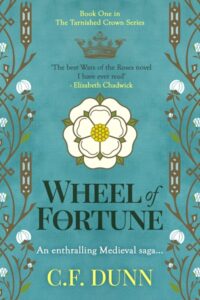
“I am delighted to continue working with the team at Sapere Books to bring the Wars of the Roses and this tempestuous period in English medieval history to life.
“I take the view that everything that happened in the past resonates down the centuries. The great names in history didn’t exist in isolation, but were part of a rich web that made up as complex a society as any that exists today. It is relationships at every level that enabled society to work, and when these broke down, conflict ensued. And like people throughout time, actions were driven by love and loyalty, fear, feuds and ambition.
“The next three books in The Tarnished Crown series see Isobel and her beloved Robert confront unforeseen twists of fortune, testing their allegiance to the Crown and to each other as England faces challenges from abroad and treachery at home. And when those closest to the throne call upon Robert and Isobel’s support, bonds of friendship and fealty are stretched to breaking point.”
Congratulations to C. F. Dunn, whose powerful medieval saga, Sun Ascendant, is out now!
Sun Ascendant is the second book in The Tarnished Crown series: historical novels set during the Wars of the Roses.
1470, England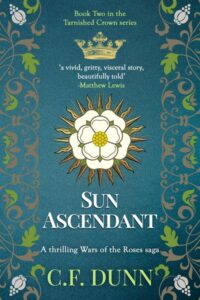
England is in turmoil as the battle between supporters of the Yorkist king, Edward IV and the old Lancastrian king, Henry VI escalates.
And for Isobel Fenton the war is personal. Her father’s sudden death made her an heiress to Beaumoncote Manor, a desirable estate in the midlands. But as conflict threatens England’s unstable peace, Isobel and her lands become the focus of bitter tensions and a long-held feud.
Taken from her manor, Isobel becomes the unwilling mistress of an indomitable Earl. Unable to protect her own lands or herself, she sees her only chance of happiness in the Earl’s brother, Robert Langton, newly sworn to serve Richard, Duke of Gloucester.
Isobel’s life in the castle becomes increasingly difficult as the Countess plots against her rival, and Isobel finds herself trapped and alone in her gilded prison.
She is determined to take her fate into her own hands, but how can she gain her freedom and find her way back to Beaumoncote…?
Congratulations to C. F. Dunn, whose thrilling War of the Roses saga, Wheel of Fortune, is out now!
Wheel of Fortune is the first book in the Tarnished Crown series: historical novels set in medieval Europe.
1469, England
For almost ten years, attractive and charismatic Edward IV has ruled with the Earl of Warwick’s support, but now rebellion threatens England’s fragile peace.
With the Midlands in uproar, King Edward wants peace in the shires and the last thing he needs is potential trouble in the form of an unwed heiress.
But, strong-willed and single-minded, Isobel Fenton is determined that nothing will separate her from her beloved manor of Beaumancote, even if she does have to marry to stay there.
Isobel is unaware of the importance she and her land represent, nor of the agenda of the formidable Earl in whose care she finds herself.
And as unrest boils into war, she is drawn into the very heart of the conflict.
Can Isobel escape from the web in which she is trapped? Will she find a way to decide her own fate?
Or will the Wheel of Fortune fail to turn in her favour…?
Bringing together more than four hundred writers — both onsite and online — the 2024 Historical Novel Society Conference took place at Dartington Hall, a medieval estate in Devon.
This year, the focus was historical fiction on film, TV and stage, but the conference also provided delegates with an excellent opportunity to connect with fellow writers and seek out advice for projects in progress.

Dartington Hall deer park
Among those in attendance were five Sapere Books authors and our Publishing Director, Amy Durant.
Valerie Holmes, author of the Yorkshire Saga Series, reflects on the origins of the society and the conference. “Over two decades ago, I met Richard Lee at a Romantic Novelists’ Association conference. He told me about an idea he had, which led to the forming of a society to champion the historical novel. I happily signed up,” she says. “With dedication and effort, both the Historical Novel Society and the conference have gone on to achieve international success.
“This year, networking and catching up with lovers of historical fiction in the beautiful surroundings of Dartington Hall was truly amazing. I have seen Bernard Cornwell, an early supporter, give entertaining and inspiring talks over the years, and this year was no exception. With an impressive international supporting cast of speakers, attendees and volunteers, the 2024 conference was a triumph.”
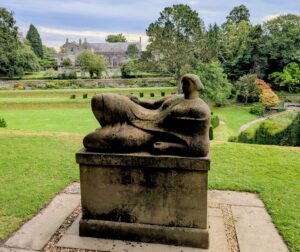
Dartington Hall grounds
C. F. Dunn, who writes medieval and Gothic fiction, enjoyed the accessibility and friendly atmosphere of the event. “The conference provided the perfect opportunity to get to know my editor, Amy, and to meet other Sapere authors in a relaxed and convivial environment,” she says. “It was also wonderful to connect with old friends and make new ones, and to talk with other historical writers from all around the world.”
Kate Robertson, who is working on a Tudor suspense series, valued the opportunity to meet like-minded history enthusiasts. “This was my third Historical Novel Society conference, but my first in the UK,” she says. “One of the things I love about every HNS conference is the time I get to spend with other historical novelists, catching each other up on our progress, roadblocks and research. It’s just such an easy entry — rather than going through the usual layers of questions you get when you’re a writer, I love meeting someone new and just starting with, ‘What time period do you write?’ and the conversation deepens from there. There are very few places where you can guarantee that others will ‘get you’ and understand your nerdiest tendencies!”
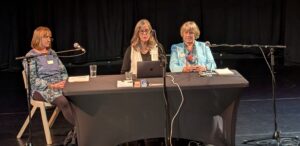
Jules Larimore (centre)
Jules Larimore, who is writing a series about the Capetian dynasty, was a panellist for the conference’s session on French historical dramas. “I delivered this session with two colleagues from France’s Splendid Centuries authors’ collaborative,” she says. “We were honoured to be among the presenters at this conference alongside keynote speakers, including Bernard Cornwell, Diana Gabaldon, Kate Quinn, and many others.
“The conference setting was quintessentially English, but our panel focused on stories set in France. While assembling all the aspects of the presentation was time-consuming, my interactions with other authors re-invigorated my enthusiasm for the craft of writing historical fiction.”

Dartington Hall grounds
Amy Durant, Sapere Books’ Publishing Director was invited to attend to lead one-to-one pitch sessions with writers who were attending the conference and she is always impressed with the high calibre of submissions that are presented by members of the HNS. “I always come away from the HNS Conferences excited by the pitches I’ve heard and hopeful that I will be able sign at least one author to Sapere’s list. This time was no exception and hopefully we will have some exciting rights announcements to share soon.”
Christopher M. Cevasco, who is working on a series of Arthurian novels, is the programme chair for next year’s conference in Las Vegas. “I’m very excited about the theme of the 2025 conference, which will celebrate the many subgenres of historical fiction — from historical mysteries and romance to alternate history, military fiction, historical fantasy, and beyond,” he says. “As always, we’re planning a comprehensive, multi-track program with panels, talks, and networking opportunities that should appeal to new and established writers as well as to readers. There will also be a few new surprises in terms of session formats, all designed to explore the ways authors, agents, and editors craft, publish, and market historical fiction in its varied forms.”
All photos by Amy Durant.