

Richard Kurti is the author of the Basilica Diaries Medieval Mysteries: historical thrillers set in fifteenth-century Rome and featuring a brother and sister investigative duo. The fifth book in the series, Tyranny of Indulgence, is now available to pre-order.
I can write pretty much anywhere. As long as I have headphones and Spotify on my mobile, the words will flow. Particular favourites are writing on trains and in coffee shops, as the continual bustle of people always fires my imagination.
But it’s important to have a base, especially when writing historical fiction, as I need a place where I’m surrounded by all my notes and reference books.
When we moved to Ely in Cambridgeshire three years ago, I snapped up one of the front rooms, as it has sunlight all day and a big window to watch the world go by. The only downside is that it’s the closest room to the front door, so whenever the Amazon driver rings the bell, it’s always me who has to get up and answer it.
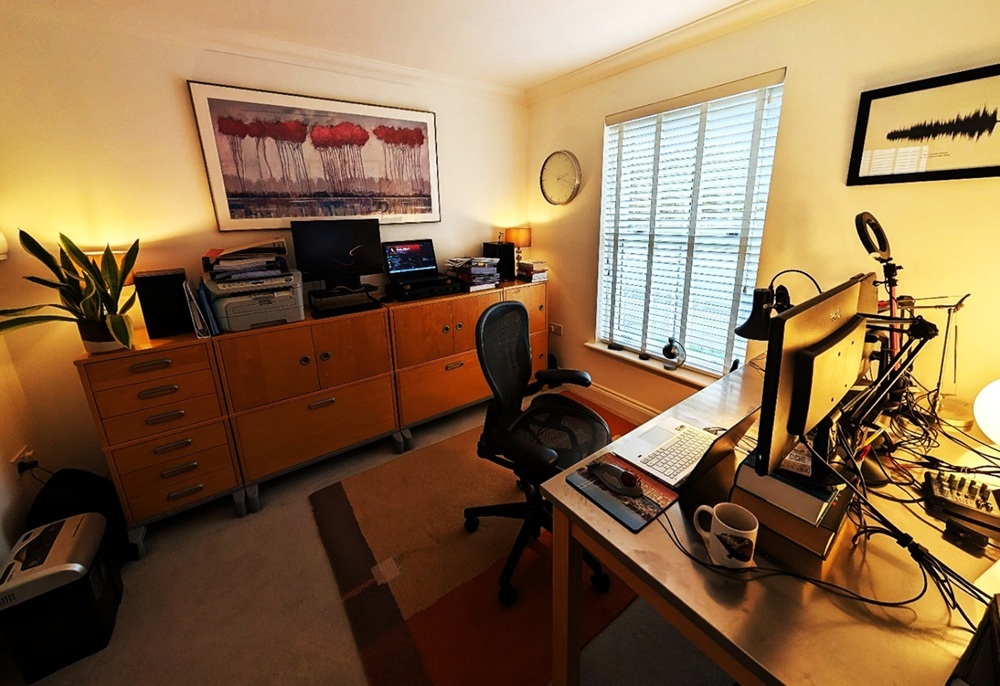
The room to the left of this one is lined with shelves groaning under the weight of reference books, but this room is dedicated to putting words on the page. As you can see, a pair of loudspeakers is in prime position, so that I can listen to music all day.
Incidentally, the folders on top of the printer are where I indulge my only writing superstition. When I finish a chapter, I always print it out and put it in a large file. This is because my secret fear is that one day there will be a massive solar flare that will knock out the Google Drive and OneDrive servers and wipe the discs of all my computers … so I like to have a paper copy as well, just in case!
A few weeks ago, I was standing outside St Peter’s Basilica in Rome, gazing at the ancient Egyptian obelisk that sits in the middle of the square. (It’s also on the front cover of Omens of Death — the first book in The Basilica Diaries series.)
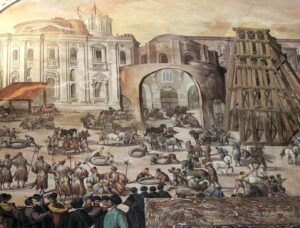
A fresco in the Vatican depicting preparations for the erection of the obelisk in front of St Peter’s Basilica. Photograph taken by Richard Kurti.
The guide who was showing me round said, “There’s an interesting story about this obelisk. When Moses was a young man, he was educated in Heliopolis (modern Cairo), where this obelisk originally stood. As he hurried back and forth to school, Moses would have seen this very stone every day. Even then it was a thousand years old. He would have walked past it, used it as a meeting point for friends, maybe even sat in its shade.
“Now, cut forward across time. The Romans have stolen the obelisk and brought it to Italy, where the Emperor Caligula ordered it to be set up at the Circus of Nero just outside the city walls. And that is the same place where St Peter was executed. Which means the very last thing St Peter saw before he died would have been this obelisk. And now you are gazing at the exact same stone.”
I could feel my brain jolt. Moses, Caligula, St Peter and myself, all connected across 4,500 years by a single object. These were no longer remote characters from the pages of the Bible — if I reached out my hand, I could touch them through this granite obelisk.
 What the guide did was a brilliant demonstration of the power of narrative. He could have bombarded me with facts and figures about the height and weight of the obelisk, about where the stone was quarried and when it was carved, and how it was moved from the Circus of Nero to its current site and erected in a single day.
But he didn’t, because he knew that those facts would have gone in and out of my mind in seconds. Instead, he told a story that organised the truth in such a way that it connected me to the distant past.
That’s what I’ve been attempting to do on every page of The Basilica Diaries historical thrillers. I have spent countless hours researching the novels, but rather than bombard the reader with details, I have tried to organise the truth into narratives that will resonate with the modern world whilst also transporting us back across the centuries.
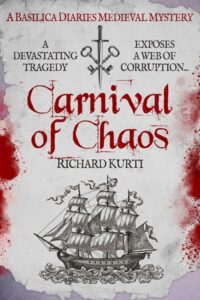
I hope you enjoy the latest adventure in the series, Carnival of Chaos, which will be published in April.
Congratulations to Richard Kurti, whose absorbing historical mystery, Omens of Death, is published today! Omens of Death is the first book in the Basilica Diaries Medieval Mysteries series, set in fifteenth-century Rome.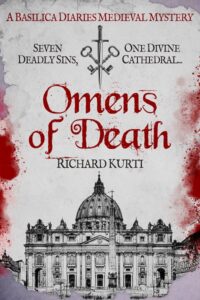
1497, Rome
Wealthy merchant’s daughter Cristina Falchoni has a vision: to create a magnificent cathedral in the heart of Rome. Europe is in desperate need of a powerful unifying symbol, and a great basilica, built over the tomb of St Peter, will be a rallying point for Western civilisation.
With the help of her brother Domenico, as Head of Security at the Vatican, Cristina manages to persuade Pope Alexander VI to cleanse his conscience by reviving a decades old plan to construct a new basilica as a celebration of God’s greatness. Whatever bribery, corruption, lechery, or assassination lay in the Borgia Pope’s past, all would be forgiven; he could atone through stone.
But when a prominent aristocrat is found brutally murdered in a grotesque parody of the martyrdom of St Peter, Pope Alexander fears it is a divine warning, a message from God not to tamper with the revered shrine.
Realising that their dream of a glorious new cathedral is in jeopardy, Cristina and Domenico urgently start to investigate the grisly murder.
But as more ominous events torment Rome, they soon realise that whoever is behind these strange portents will stop at nothing to get their own way — even if it means killing the Pope himself.
With the Pope’s life in danger, can Cristina and Domenico uncover the truth before it’s too late? Or are they about to become the killer’s next targets?