

To mark the publication of Indomitable, the second book in the Newt Beresford Naval Adventures, author Jonathan Eyers takes a closer look at the Battle of the Chesapeake — one of the most crucial naval engagements in United States history.
In the 250 years since the United States declared its independence from Great Britain, the American struggle for freedom has become a key part of the country’s glorious story. Most of the story is true, of course, but it is also fair to say that the level of accuracy depends on who is telling it.
Ask your average American what the turning point for the war was and most will say the Battle of Yorktown in October 1781. And they wouldn’t necessarily be wrong. This was the last major land battle of the War of Independence; the British didn’t just lose, but were forced into the humiliation of surrendering an entire army. It led to the resignation of the British Prime Minister and a subsequent vote in Parliament to begin negotiations to end the war — in effect, recognising American independence.
But ask historians, especially maritime historians, what the turning point for the war was and most will that say the Battle of Yorktown was only lost by the British because a month before they had also lost the Battle of the Chesapeake. Once you look at who fought in this battle, also known as the Battle of the Capes, you start to understand why it is so little known, despite being so important.
After all, it’s arguably the most decisive battle of the American War of Independence — but not a single American fought in it.
At this point it’s crucial to understand the broader context of the entire war from a European perspective. For the British, what started as a bit of unrest in Massachusetts, which they expected to be able to put down with the same ease they put down unrest elsewhere in the Empire, had turned into a prolonged, deeply unpopular war. For the Crown and the government, the need to keep fighting it was a matter of pride. For a lot of the British, however, the American colonies were an offshoot of the motherland, full of their own relatives (however distant), unlike most other British colonies.
For the French, meanwhile, the War of Independence was a splendid opportunity. It was entirely in the interests of the French that the British, their main rival for power not just in Europe but across the entire world, get bogged down, distracted and exhausted by a fight an ocean away. Cities and schools across the US are named after the Marquis de Lafayette, but the French contribution to the American cause was far more extensive than its most famous volunteer.
Indeed, France poured so many resources into what for them effectively became a proxy war with the British that it almost bankrupted itself. It continued to support it, however, in the expectation that after finally winning independence due to French assistance, the newly free United States would be so grateful to France that it would become almost a vassal state, with American trade dominated by France. Instead, the likes of Thomas Jefferson and Alexander Hamilton pushed to begin trading with Great Britain again almost immediately there was peace. France had no way to recoup its huge financial losses, and the resulting financial crisis was a key factor in France’s own Revolution. But that’s another story.
Even before George Washington’s men arrived at Yorktown, on the southern bank of the York River in eastern Virginia, Lafayette was there making trouble for the British. The British had been led to believe the American and French forces were preparing for a major attack on New York, and here General Cornwallis was mustering his forces. He soon found his army surrounded and besieged by the Americans and the French, at which point he became dependent on the Royal Navy either bringing reinforcements or evacuating British forces via Chesapeake Bay.
So the French blockaded it. Cornwallis’ position was soon rather dire. If the Royal Navy didn’t break that blockade, he stood little chance against the combined forces of the Continental Army and their French allies. Under Rear Admiral Sir Thomas Graves, a British fleet of nineteen ships of the line sailed from New York. The French fleet of twenty-four warships, under Lieutenant Général des Armées Navales François Joseph Paul de Grasse, left Chesapeake Bay to meet them.
The British initially had the weather gauge, so believed they had the advantage, even if they were outnumbered. Ships of the line were so named precisely because they were intended to sail in single file, parallel to the enemy’s line, firing broadsides at the other side until one side lost sufficient ships to realise they couldn’t win, so disengaged and withdrew.
In the Battle of the Chesapeake, however, the British and French fleets converged at an angle, rather than forming parallel lines. This meant the vanguard saw brutal close-quarters fighting, whereas ships bringing up the rear on both sides barely participated in the battle at all. Much has been written about why the Royal Navy fleet failed, beyond being somewhat unexpectedly outnumbered, but that loss sealed the fate of General Cornwallis and his army. Without relief or escape by water, the British forces at Yorktown were brought to surrender in under six weeks.
You can see why the story of the Battle of the Chesapeake doesn’t get told quite so often as that of the Battle of Yorktown, or the Battle of Saratoga in 1777, which convinced France to ally with the American revolutionaries in the first place. No Americans fought in it, so it’s not as glorious a part of the narrative as Yorktown. The British lost it, and with it the war, and defeats never get quite the same attention as victories. And as for the French, it was the last major naval victory of L’Ancien Regime, which lost its heads a few years later precisely because it impoverished the French to bolster the Americans.
But it’s a fascinating and exciting battle to explore in fiction, which is why I have put it at the heart of Indomitable, the second book in the Newt Beresford series. To the men of Royal Navy ships like the fictional third-rate ship of the line HMS Indomitable, caught up in the noise and terror of a sea battle, they would have been unaware that history was being written all around them. For Newt and his fellow midshipman Banks, the Chesapeake is a battleground of another sort, as their rivalry mirrors that of the British and the French. Only one of them can come out of it with all the glory, too.
Tenacious and Indomitable are available from Amazon now.
On July 4, 2026, the United States marks the 250th anniversary of the Declaration of Independence, a milestone known as America250. Across the United States, commemorative events, exhibitions and educational programmes are exploring the people, ideas and conflicts that shaped the birth of the nation.
David Armitage says in The Declaration of Independence in Global Perspective that:
‘No American document has had a greater global impact than the Declaration of Independence. It has been fundamental to American history longer than any other text because it was the first to use the name “the United States of America”: in this sense, the Declaration was the birth certificate of the American nation.’
The Declaration of Independence can be found and read online via The National Archives’ collection of America’s Founding Documents. As the first successful declaration of independence in history, the Declaration of Independence continues to influence nations around the world. Over 192 countries represented at the United Nations now have a similar declaration, many of which were inspired by or directly influenced by the American example.
While the Declaration of Independence was signed on 4 July 1776, it was the culmination of years of political debate, military conflict and revolutionary activism. For readers looking to learn more about the American Revolution, the Founding Fathers and the struggle for American independence, non-fiction history books offer an ideal starting point.
To commemorate America250 and Independence Day, here are five fascinating books that explore the creation of the United States.
Why These Books?
This reading list explores the military leaders, political thinkers, international allies, opposing forces, and eyewitnesses who experienced the birth of the United States firsthand. The figures featured in the novels below, George Washington, Samuel Adams, and Lafayette, helped shape the ideas and events that transformed thirteen British colonies into the United States of America. Together, these books provide a broader understanding of the American Revolution and the remaining legacy of the Declaration of Independence 250 years later.
Essential Books for the 250th Anniversary of Independence
1. George Washington: First in War, First in Peace by James A. Crutchfield
 For five years George Washington led the fledging thirteen colonies against the overwhelming might of Great Britain, he helped shaped the foundations of the country at the Constitutional Convention in Philadelphia and served as the first president of the United States for two terms.
George Washington: First in War, First in Peace reveals a leader whose outward simplicity concealed a quick, analytic mind, capable of learning from mistakes, and who made decisions with the forethought of how they would impact the young nation he was helping to build.
While Washington became the public face of the Revolution, Samuel Adams helped create the political movement that made independence possible.
2. The Grand Incendiary by Noel B. Gerson
 John Adams, the second President of the United States and a second cousin of Samuel Adams, claimed, “The Revolution was Sam’s personal creation.” Yet, how did this man, who had failed at business and mishandled his inheritance, emerge in middle age as one of the most important of America’s Founding Fathers?
While other figures like George Washington or Thomas Jefferson may be more well-known today, during the years of the American Revolution and for many years afterward, Samuel Adams was regarded as the first citizen and a leading statesman of the new nation. Such was his influence that on the eve of the Revolution, General Thomas Gage put a price on Adams’ head and declared him “the most dangerous man in the New World.”
No account of American independence is complete without the Marquis de Lafayette, the French officer whose military support proved crucial to the Revolutionary cause.
3. Statue in Search of a Pedestal by Noel B. Gerson
 “Liberty for all is worth any sacrifice.” So said Gilbert Motier de Lafayette, the French visionary who championed freedom and equality, but whose devotion to the cause of democratic government came at a great personal sacrifice.
Born into one of the oldest aristocratic families in France, as a teenager the idealistic Lafayette volunteered to fight under George Washington for America’s independence in the Battle of Yorktown in 1781, a decisive victory which brought him lasting military renown and made him one of the true heroes of the American Revolution.
Elected to the Chamber of Deputies in 1818 following two decades in political exile, Lafayette continued to fight for freedom of speech, press, assemblage, and worship, arguing that these were rights that belonged to all people and could not rightly be taken from them by any government.
Drawing on contemporary material, including private letters and Lafayette’s own memoirs, Noel B. Gerson paints a vivid picture of a man of physical and moral courage, whose fight for the cause of liberty earned him the title the “Hero of Two Worlds”.
To fully understand the American War of Independence, it is important to examine the wider international conflict that surrounded it. Admiral Rodney offers a British perspective on the struggle that reshaped the Atlantic world.
4. Admiral Rodney: The Man Who Broke the Line by Donald Macintyre
 George Brydges Rodney, better known as Admiral Rodney, was one of the Royal Navy’s greatest commanders during the Age of Sail. Remembered most for his decisive victory over the French at the Battle of the Saintes in 1782 during the American War of Independence, he was also involved in numerous raids against the French during the Seven Years’ War and saw his first action in the War of the Austrian Succession. Rodney is credited with reimposing discipline in a mismanaged, neglected Navy and initiating important tactical reforms in battle.
Captain Donald Macintyre presents a thoroughly researched and absorbing account of the life, career, and character of one of the most compelling figures in the history of the British Navy. Drawing on a wide range of historical sources — including contemporary accounts and personal letters — Macintyre balances official records with vivid testimony from those who served alongside Rodney. The result is a fascinating insight into a system of rank and command in which factions ruled and disloyalty and back-biting were rife.
To fully comprehend the context into which the Declaration of Independence was signed, the years after, and its impact to this day, a wider look at American History is a must.
5. Eyewitness to American History by James A. Crutchfield
 Eyewitness to American History brings the past to life through the voices of those who were there.
Ranging from the 1750s to the 1850s, these thirty-five accounts are set in a wide variety of locales throughout the United States and include incredible first-hand tales of adventure and bravery, hardship and danger. Read about Roanoke Island’s lost colony, the fur trade era, the joys of early steamboat travel, Chief Blackbird of the Omahas, the Oregon Trail, and the tribulations of the early frontier military troops. Along the way are some surprising and humorous episodes from American history, such as the court-martial of a Revolutionary War veteran for refusing to cut his hair, as well as more dramatic events, including the massacre at Frenchtown and the first presidential assassination attempt.
James A. Crutchfield has drawn together a range of narratives from people from all walks of life — explorers, trappers, diplomats, soldiers, and politicians, among others — whose eyewitness accounts of everyday American life shed a valuable light on a legendary era.
America250 Reading List: Why Revolutionary-Era History Still Matters
Two hundred and fifty years after the signing of the Declaration of Independence, the lives of figures such as George Washington and Samuel Adams continue to shape discussions about democracy, liberty and national identity. Debates that shaped the American Revolution remain surprisingly relevant. Questions about liberty, representative government, national identity and civic responsibility continue to influence public life in the United States and beyond.
By exploring biographies of those involved readers can gain a deeper understanding of the challenges faced by the Revolutionary generation and the decisions that helped create a new nation.
Whether you are celebrating the Fourth of July, participating in America250 events or simply looking to expand your knowledge of American history, these books provide valuable insight into one of the most important turning points in world history.
Celebrate the Fourth of July with These Must-Read Revolutionary War Histories
As America250 commemorates the anniversary of the Declaration of Independence, these books offer an opportunity to look beyond the famous date of 4 July 1776 and explore the people, battles, ideas and international alliances that made American independence possible. Whether you are a lifelong student of history or simply looking for a meaningful Fourth of July read, these titles provide an excellent introduction to the revolutionary generation.
Discover these titles and more in our History & Biography books.
Congratulations to David Field, whose thrilling maritime adventure, Beyond The Setting Sun, is published today!
Beyond The Setting Sun is the second Tudor novel in The New World Nautical Saga Series – historical adventures set during the reign of Elizabeth I and beyond.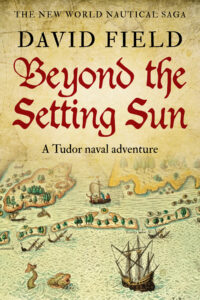
England, 1580
Walter Raleigh dreams of the unknown lands that lie over the distant western horizon. He had grown up believing that if you journey too far you risk falling off the side of the earth. But now, intrepid mariners are telling stories of new lands, blessed with limitless riches that await those bold enough to claim them.
Raleigh’s patron, Queen Elizabeth is easily seduced by the prospect of amassing a great fortune for her war chest and agrees to finance his quest.
But the seas are unpredictable, and when his first attempt fails, he fears his adventuring days may be over.
Weaving tales of the legendary land of El Dorado, city of gold, Raleigh successfully persuades Elizabeth to grant him a charter to explore a passage through the Americas to the South Seas.
And this time, he successfully sets up a colony in the New World.
Virginia is born, in honour of the great monarch who sanctioned its creation.
But what dangers are waiting the intrepid settlers? Will they find themselves in a new heaven – or a fresh Hell?