

Jacquie Rogers is the author of the Quintus Valerius Roman Mysteries.
In about AD 224, 9,262 silver denarius coins were neatly wrapped, stacked in leather bags, and carefully stored under the floor of a courtyard villa at Shapwick in the low Polden Hills of Somerset. It was the largest and most valuable silver hoard so far uncovered across the Roman Empire (equivalent to over £250,000 today). The villa was demolished almost immediately, though more modest dwellings on the same site were built and inhabited for many more decades. Archaeologists believe the deposition of the hoard and the demolition were closely related events (Aston and Gerrard, 2013).
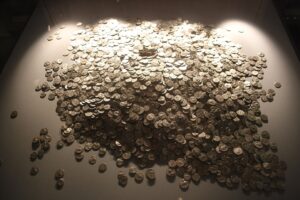
Coins from the Shapwick Hoard on display at the Museum of Somerset
Nearly 1,800 years later I moved to the Somerset Levels, living between the Mendips to the north and the Poldens to the south. Being a lifelong Romanophile, I had already seen Roman lead ingots from the silver/lead mines of the Mendips, in the British Museum. At least one such ingot has been found by modern assays to be fraudulently stamped, declaring the native silver in the lead removed. The failure to remove silver and send it to the imperial coffers, as obligated by Roman law, was treason. It wasn’t a far step to ponder the links between fraud at the nearby Cheddar mines, a massive hidden hoard of silver coins (some of which were counterfeit, by the way), and the simultaneous demolition of Shapwick villa, leaving the hoard unrecovered.
Like any keen reader of historical fiction, I wondered if this story was already out in the world. Apart from Lindsey Davis’s excellent Falco novel, The Silver Pigs (set long before the hoard was deposited), it was an untold story. So I decided to write it myself.
At that time, I was between jobs as a university lecturer. Not that I taught any particularly relevant subject at university. Apart from A Level Ancient History, I am self-taught with regard to Roman history. But I was partway through an Open University diploma in creative writing, and used the Shapwick story to develop my end-of-course short story assignment. My tutor (author Jane Elmor) suggested that my short story would do better as a novel. But then I resumed work at the University of the West of England in Bristol, and the novel idea went on the back burner. Even when I had more free time to write, I resisted the concept of a novel. It was too scary. The length envisaged (around 90,000 words) was even longer than my doctoral thesis, and I’d sweated enough over that! Besides, I’d already begun a science fiction novella. That was completed, and is now rightly languishing in the fabled bottom drawer all writers have.
But the story wouldn’t go away. It turned into an account of theft, arson, murder and rebellion. Eventually I developed an outline and some opening chapters, which I took to an independent editor friend for developmental advice. ‘It’s got promise,’ she told me. ‘But not as the coming-of-age YA book you’ve outlined.’
I was taken aback. ‘What do you mean?’ I asked, thinking wistfully of the many hours that had gone into the book already.
‘You’ve got a mystery here, a full-blooded one,’ she said. ‘And these characters here —’ she said dismissively of my two main characters — ‘they’re not the ones you’re keen on. It’s this scarred army officer, and that thirty-something woman, Julia, who really interest you, isn’t it?’
Of course, she was right. Quintus Valerius, detached from the Praetorian Guard in Rome and sent back to Britannia to investigate the emperor’s missing silver, and his lost Romano-British love, Julia Aureliana, were very close to my heart. Once I’d understood that, the book flowed out. The Governor’s Man is the result, and will be followed by three more Quintus Valerius mysteries, set variously across Britannia, Rome, Gaul, York, Caledonia and Aquae Sulis (Bath). A high-stakes mission to Tara of the High Kings in Ireland will follow and along the way, Quintus will join forces with a Londinium-born-and-bred subaltern, Tiro, who mostly enjoys the wealth of adventure offered to a Roman military investigator, but remains convinced that Londinium is the greatest city in the world.
Reference
Aston, M. and Gerrard, G. (2013) Interpreting the English village: Landscape and Community at Shapwick, Somerset. Windgather Press, Oxford.
The Governor’s Man is available to pre-order from Amazon now.
Jacquie’s Substack newsletter, YouTube channel, magazine articles and social media can all be accessed via Linktree.
Image credit: The image of the Shapwick Hoard is from Wikimedia Commons (public domain).