

J. C. Briggs is the author of the Charles Dickens Investigations.
I’m really looking forward to the BBC’s annual Victorian ghost story. This time it will be an adaptation of The Ghost of the Bride Chamber (1858) which forms part of Dickens’s collaboration with Wilkie Collins in The Lazy Tour of Two Idle Apprentices. The story is set in the King’s Arms, an ancient inn in Lancaster where Dickens and Collins stayed in 1857 which had a ‘very mysterious character after night fall’. And it is at night — at one o’clock — when a curious old man appears at the door of a room where the two apprentices are sitting over their wine, an old man who has a terrible story to tell. Dickens, in the character of Francis Goodchild, one of the apprentices, asks the old man about the hangings at Lancaster Castle. The visitor knows a great deal about them and describes ‘the rush of fire and earthquake and the castle springs into the air, and you tumble down a precipice.’
Francis Goodchild notices how ‘his cravat appeared to trouble him. He put his hand to his throat.’ Can it be that this old man knows what it is to be hanged? It may be so, for his story is that of the murder of a bride by her husband. It is a terrible marriage, and it is a dreadful murder with dreadful consequences. Francis Goodchild cannot escape this haunting. His companion apprentice falls asleep, and the old man’s fiery eyes hold those of Francis in an inescapable gaze. There are some very spooky moments in this very dark story — read it if you dare.
Dickens began a series of ghostly Christmas stories in 1843 with A Christmas Carol, followed by The Chimes (1844), The Cricket on the Hearth (1845), The Battle of Life (1846), and The Haunted Man (1848). In A Christmas Carol, Dickens, ‘the man who invented Christmas’, creates a vivid impression of Christmas in the descriptions of London at Christmastime in ‘the great fire’ lit in a brazier in the street where holly sprigs and berries ‘crackled in the lamp heat’, and shop windows were full of ‘pot-bellied baskets of chestnuts’, ‘blooming pyramids’ of apples and pears, ‘juicy’ oranges and lemons, sugared and candies fruits, spices, and bells ringing everywhere, but there is also the dark shadow of the miser, Scrooge, on his way home to his solitary old house in a solitary yard where the black gateway is wreathed in fog. And this is where Scrooge sees his doorknocker turn into Marley’s face, and where, in his solitary chamber he hears the clanking of chains coming from the cellar. Marley brings a warning, followed by the three spirits who show Scrooge the error of his ways so that he can be redeemed. And he is.
A Christmas Carol is still the most popular of Dickens’s works. A Wordsworth edition presently has a ‘number one best-seller’ orange flag on Amazon. Wordsworth also has an edition of Complete Ghost Stories of Charles Dickens, twenty in all, including ‘The Lawyer and the Ghost’, in which the apparition is told by the imperturbable young lawyer to be sensible and go to haunt a more comfortable set of rooms than the damp, rotten chambers that he is forced by poverty to inhabit.
After 1848, Dickens produced a variety of stories by himself and other writers in his periodicals Household Words and All The Year Round, including one of my favourites, entitled, To Be Read at Dusk (1851), in which a woman’s dream of a man in black stays with her so that she is terrified of seeing him again, and of course, he appears, but not in a dream. The Signalman, (1868) is the brilliant story of a signalman who is haunted by visions of terrible accidents which eventually come to pass. It was published after Dickens was involved in a railway accident in 1867. Dickens was on the train from Folkestone to London. Some of the rails had been removed by workmen and Dickens’s train, travelling on the bridge, jumped the rails, leaving his carriage hanging precariously over the side. Ten people were killed and many seriously injured. Dickens worked for two hours, rescuing the injured from the carriages and offering water and brandy. In this case, Dickens becomes ‘The Haunted Man’. He told a friend that he could not travel by train without feeling ‘a nervous dread’, and this may account for the really chilling ‘nameless horror’ and nightmarish sense of foreboding which pervades the story.
Elizabeth Gaskell was one of the contributors to Household Words and Dickens particularly admired her ghost story, The Old Nurse’s Story, though he did try to persuade her to alter the ending. She didn’t, and it is a perfectly good, chilling ghost tale as she wrote it. Definitely worth a read. He described a story by Mrs Dinah Craik, published in Household Words (1855) as ‘the best ghost story’ he had ever read. A young couple is seated in a box at the theatre when they feel a strangely cold draught between them, and they notice people staring at them. A friend, Colonel Hart, comes up to ask who was sitting between them — no one, is their reply, but in the next interval Colonel Hart comes again with a witness, Captain Elmore, who has also seen the third person — a man who died a year ago to the very day. I’m not sure that it is the best ghost story I’ve ever read, but it would have appealed to Dickens who knew many of the London theatres and their ghostly legends, which are still told today.
There was — still is — the ghost of John Buckstone who supposedly haunts the Theatre Royal, Haymarket. Buckstone was a famous actor whom Dickens knew and who appears in my novel The Chinese Puzzle. The ghost of the late nineteenth-century actor, William Terris, is seen at the Adelphi Theatre. Terris was famous for playing Shakespeare; he belonged to Henry Irving’s company at the Lyceum Theatre. One of his colleagues, Richard Archer Prince, a young actor who was jealous of Terris, stabbed him to death outside the Adelphi. Legend has it that Terris’s dying words were “I will be back”. And he was — and still is — apparently haunting Covent Garden tube station as well as the Adelphi. The clown, Joseph Grimaldi, is said to haunt Sadler’s Wells Theatre and Drury Lane. As a child, Dickens saw Grimaldi perform and edited his memoirs in 1838.
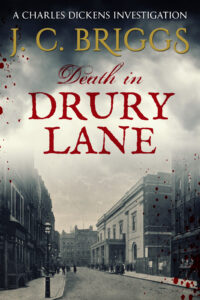 And finally, Dickens is a haunted man again at the Dury Lane Theatre, the setting of my new book, Death in Drury Lane. Dickens would have been familiar with the well-known legend of ‘The Man in Grey’ in his eighteenth-century costume who is still seen disappearing through a wall at Drury Lane. He is possibly the ghost of a murdered man whose skeleton was found in the wall, but no one knows. He is regarded as a benign spirit, but I’ve turned him into something more sinister. After all, this is a murder mystery — I couldn’t have a nice ghost in pleasant conversation with Dickens as in ‘The Lawyer and the Ghost’, so my ghost is in the cellars of the theatre which are full of strange noises, cold, eerie winds, and so many odd little rooms where shadows gather and the ghosts of actors hover. And there is the chandelier room with its dizzying perspective on the stalls a hundred feet below. Suppose someone fell, or was pushed by an unseen hand?
Death in Drury Lane is available to pre-order from Amazon now.
Visit J. C. Briggs’ website for all her latest news.