

How we found the Mary Rose
‘Henry VIII was an enthusiastic shipbuilder, whose pride in his “Army by Sea” would see his fleet grow from five at the start of his reign to 53 by the time of his death in 1547. While he may have had many ships, it is the Mary Rose that is remembered as his favourite.’
Built in 1510/1511, the Mary Rose was one of King Henry VIII’s favourite ships for 34 years until it sunk in 1545. It stood out amongst the fleet, known for its speed, the length of time it spent in service, and its cutting edge approach to weaponry.
The Mary Rose sank on the 19th of July 1545, almost 500 years ago. Its location remained a mystery for centuries, causing much fascination to historians. If you want to discover more about this infamous ship, its sinking, and its recovery, read on…
What was the Mary Rose?
The Mary Rose was a famous Tudor warship built in Portsmouth alongside sister ship, the Peter Pomegranate. It was 600 tons and carried a small amount of heavy guns for use against enemy ships and smaller guns intended for use on personnel. After only one year as a navy vessel, it was used as flagship in The Battle of St Mathieu on the 10th August 1512. It was a favourite of King Henry VIII’s and a point of pride for the Tudor navy. The Mary Rose was a prominent piece in battles against the French in its 34 years of service up to, and including, its sinking.
Why did the Mary Rose sink?
As infamous as the Mary Rose was, its sinking has become the largest part of its legacy. The exact reasoning behind why it sank is unclear, but there are strong theories.
What happened on 19 July 1545?
The Mary Rose sank during the Battle of the Solent, a confrontation between French and English troops on the Isle of Wight, as well as a face-off between their respective fleets in the Solent between the Isle of Wight and Portsmouth.
Eyewitness accounts claim that the Mary Rose had fired its starboard side guns and was manoeuvring through a turn when suddenly the ship took aboard water via its open gunports. Exactly why the ship was at such an angle to be able to do this is unclear.
Whilst we may never know for sure, common theories as to why the ship sank include:
- Human error – it was Sir George Carew’s first command of a naval vessel and it is theorised that he simply could have given an order that was beyond the ship’s capabilities, or was misunderstood by his men.
- Weather conditions – it was theorised that a sudden gust of wind could have caught the sails as the ship manoeuvred, pushing it onto its side.
- Weight – whilst this theory is not an academic favourite, there is a possibility that the ship was overloaded with guns and men to the point it was past the ship’s capacity to safely sail. However, the ship managed to reach battle without issue, causing this theory to be frequently dismissed.
- French gunfire – French eyewitnesses claim that the Mary Rose was struck, perhaps causing the ship to take the quick turn that lead to its sinking.
Whatever the cause, the Mary Rose sank within minutes, taking the majority of her crew down with her. Of the estimated 500 men aboard, only approximately 35 survived the sinking.
Alastair Miles, Collections Manager at The Mary Rose Trust, said:
‘The hull and her crew remained largely undisturbed on the seabed for over four centuries until the rediscovery of the site in the early 1970s. The subsequent excavations culminated in the recovery of the Mary Rose on 11th October 1982. In addition to the 19,000 artefacts brought ashore from the site, the remains of up to 300 of the crew were also recovered. These have remained under the careful stewardship of the Mary Rose Trust ever since.
The Mary Rose Museum is dedicated to preserving the memory of those lost, but there is also a dedication within Portsmouth Cathedral. On 19th July 1984, one of the ship’s company was reburied in a symbolic act of remembrance. Nothing is known about the individual that was chosen for the reburial, but it is through his anonymity that he stands as a poignant representative for the entire crew – and all those who have lost their lives at sea.’
The search for the Mary Rose wreck
Although contemporaries knew roughly where she had sunk, shifting sands and changing tides gradually concealed the wreck beneath the seabed. Numerous attempts were made to locate her over the following centuries, but none succeeded. The Mary Rose remained undisturbed from 1545 to the 1970s, over 400 years.
Everything changed in the late 1960s. Historian, novelist, journalist, diver and amateur archaeologist Alexander McKee became determined to solve one of Britain’s greatest historical mysteries. Drawing together divers, historians, and volunteers, McKee established a search that combined painstaking archival research with innovative underwater surveying.
After years of collaborative investigation, the team finally located the wreck in 1971, beginning one of the most ambitious maritime archaeological projects ever undertaken.
The discovery captured international attention and ultimately led to the remarkable salvage operation that culminated in the raising of the Mary Rose in 1982. The ship was then carefully preserved and can now be visited in person in Portsmouth at The Mary Rose Museum.
Alongside uncovering the remains of the Mary Rose itself, discovery of the wreckage also came with the discovery of over 19,000 artefacts. These included weaponry, military and navy gear, provisions, and personal effects, alongside the oldest known fiddle in Europe. It provided a unique and fascinating portal to the Tudor era, providing unique insight and perspective on daily life in the Tudor Navy.
You can discover more about the exact timeline of the Mary Rose’s recovery on the Mary Rose Trust website.
How We Found the Mary Rose tells the extraordinary story
Many books have been written about the Mary Rose, but few can match the authority of Alexander McKee’s How We Found the Mary Rose.
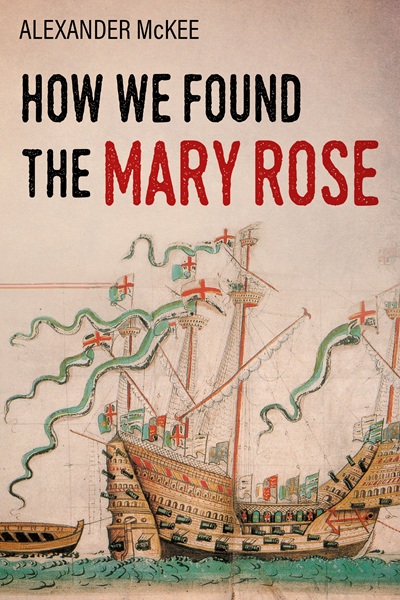
Unlike later historians looking back on events, McKee writes as the man who led the search from its earliest stages. His account takes readers behind the headlines, sharing the determination, setbacks and breakthroughs that eventually led to the discovery of the wreck.
The search was never a matter of luck. McKee describes the meticulous historical research, underwater exploration and collaboration that gradually narrowed the search area until the long-lost flagship was finally found. His book reveals the detective work behind one of Britain’s greatest archaeological achievements.
More than half a century after the wreck’s discovery, the Mary Rose continues to capture the imagination. It is a story of Tudor history, maritime innovation, archaeological perseverance, and human curiosity. McKee’s insider perspective allows readers to experience the excitement of the discovery as it unfolded, making How We Found the Mary Rose an essential read for anyone interested in Britain’s Tudor and naval past.
Celebrate 55 years since the discovery of the Mary Rose
Fifty-five years after the discovery of the wreck, the story of the Mary Rose continues to captivate historians, archaeologists and readers alike. For anyone fascinated by Tudor history, maritime archaeology or one of Britain’s greatest historical discoveries, How We Found the Mary Rose by Alexander McKee offers the definitive first-hand account of the search that brought Henry VIII’s flagship back into the light.
Discover the remarkable true story behind one of Britain’s greatest archaeological discoveries. Order your copy of How We Found the Mary Rose by Alexander McKee from Sapere Books today.