

Ahead of the publication of The Restless Wave, the fourth book in the Romulus Hutchinson Naval Adventure Series, author David Clensy takes a closer look at why Operation Pedestal was such a critical moment in the Second World War.
By the summer of 1942, Malta was perilously close to defeat. Isolated in the centre of the Mediterranean, the island had endured almost two years of relentless siege. Axis aircraft and submarines had reduced its ports, airfields and towns to rubble, while starvation and fuel shortages threatened to bring military operations to a standstill. Yet Malta remained strategically indispensable. From its harbours and airstrips, British forces could strike at Axis supply lines to North Africa, choking Rommel’s Afrika Korps just as it prepared for a decisive push towards Egypt.
Operation Pedestal was the Allies’ last throw of the dice to save the island. Conceived as a massive convoy operation and executed at extraordinary risk, it stands as one of the Royal Navy’s most hard-fought and costly triumphs of the Second World War.
It is at the heart of The Restless Wave, the fourth book in the Romulus Hutchinson Naval Adventure series: action-packed, authentic historical adventures following twin brothers fighting with the Royal Navy and the Merchant Navy during the Second World War.
Rom is now a first lieutenant, rapidly getting the chance to show his mettle on the bridge, seeing action in the Mediterranean for the Allied landings at Sicily and Salerno, as well as helping to lift the siege of Malta as part of Operation Pedestal.
In this blog, I wanted to take a closer look at why the operation was so significant.
Malta under siege
By mid-1942, Malta’s position was desperate. Previous attempts to resupply the island had suffered severe losses, with convoys harried from the air by the Luftwaffe and Regia Aeronautica, and attacked at sea by submarines and fast torpedo boats. Fuel for aircraft and ships was critically low, forcing the RAF to limit operations at the very moment when air defence was most urgently needed. Food stocks were so reduced that rationing had reached near-starvation levels for both civilians and servicemen alike.
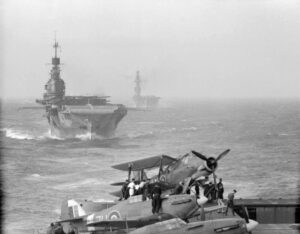
HMS Victorious’ flight deck showing HMS Indomitable and HMS Eagle
Despite this, the island continued to disrupt Axis operations. Intelligence from signals interception and reconnaissance imposed a heavy toll on shipping bound for North Africa. The Axis understood that neutralising Malta was essential. The Royal Navy knew that losing it could turn the Mediterranean decisively against the Allies.
Launched in August 1942, Operation Pedestal was the largest and most heavily escorted convoy yet to attempt to supply the island. Fourteen merchant ships were assembled, carrying food, ammunition and fuel. Their cargo included aviation fuel in bulk and, most critically, the oil tanker SS Ohio, the survival of which would prove vital to keeping the island in Allied hands.
The escort was formidable. Under the command of Admiral Sir Neville Syfret, the Royal Navy committed two battleships, four aircraft carriers, seven cruisers and more than thirty destroyers. It was an extraordinary concentration of naval power, reflecting the strategic stakes involved. Even so, planners knew losses would be heavy. The convoy had to pass through the narrow Sicilian Channel, within range of Axis airfields, submarines and surface craft.
Running the gauntlet
The convoy sailed from Gibraltar on 10 August 1942. Almost immediately, it came under attack. Axis aircraft struck repeatedly, launching coordinated bombing and torpedo attacks designed to overwhelm the escorts. U-boats and Italian submarines waited ahead, while fast torpedo boats prepared night assaults.
The Royal Navy’s carriers played a crucial early role, providing fighter cover that blunted the worst of the air attacks in the opening days. However, as the convoy pressed eastwards, the carriers were forced to turn back in accordance with operational limits, leaving the merchant ships increasingly exposed.
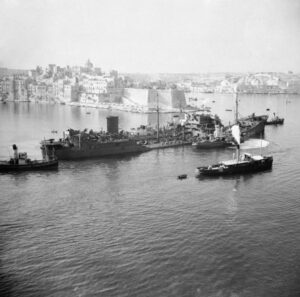
SS Ohio arrives at Malta
Losses mounted. The aircraft carrier HMS Eagle was sunk by submarine attack. Several cruisers and destroyers were badly damaged or sunk while defending the convoy. Merchant ships were picked off one by one, yet the escorts continued to fight tenaciously, laying smokescreens, counterattacking submarines and engaging enemy surface forces at close range.
At the centre of the drama was SS Ohio. Heavily damaged by bombing and torpedo strikes, the tanker was left barely afloat. Her engine failed, her deck was shattered, and she was down by the bows. Yet abandoning her was not an option. Without her fuel, Malta’s air defences and naval forces would grind to a halt.
In one of the most remarkable episodes of the naval war, Royal Navy destroyers and minesweepers refused to give up. Ohio was lashed between escorting ships and painstakingly shepherded towards Malta, under constant threat of further attack. When she finally entered Grand Harbour on 15 August, broken-backed but still afloat, she was greeted by cheering crowds. It was also the Feast of the Assumption, later commemorated on the island as the day Malta was saved.
A landmark moment
Of the fourteen merchant ships that set out, only five reached Malta. The Royal Navy suffered grievous losses: a carrier, two cruisers, a destroyer and numerous aircraft. By any conventional measure, it was a costly operation.
Yet strategically, Operation Pedestal was a success. The supplies that arrived, especially the fuel carried by Ohio, enabled Malta to survive the siege. Within weeks, the island’s air and naval forces were back in action, once again savaging Axis supply lines to North Africa. This pressure played a significant role in undermining Rommel’s offensive and set the conditions for the Allied victory at El Alamein later that year.
For Malta, the convoy became a defining moment, later recognised through the award of the George Cross to the island as a whole. For the Royal Navy, Pedestal remains one of its most hard-fought convoy battles, a stark reminder that maritime logistics, often overlooked, can determine the outcome of entire campaigns.
The Restless Wave is available to pre-order now.
Stay up to date with David’s news and latest releases here.
Image credits: Operation Pedestal Carriers and SS Ohio are from Wikimedia Commons (public domain).